Advertising reports and market data
Documents

Curated Panel: Buying on Rewarded Platforms: The Benefits & Challenges.
Rewarded platforms have evolved into a critical component of modern user acquisition strategies, experiencing significant growth in revenue share across the global gaming industry over the past year.
- Rewarded platforms have become a critical component of user acquisition, showing significant growth in revenue share across the global gaming industry over the past year.
- Profitability in rewarded channels requires aligning external reward structures with the internal player lifecycle to ensure lifetime value consistently exceeds the cost per install.
- Success depends on rigorous data maturity and the precise tracking of in-game events to manage the higher post-event churn rates typical of incentive-driven users.
Session: Mastering Game Marketing in the era of Data Privacy - Jesse Lempiäinen, Geeklab.
The game marketing industry faces a significant paradigm shift due to the erosion of user-level tracking, specifically following the removal of Apple’s Identifier for Advertisers (IDFA) and the impending implementation of Google’s Privacy Sandbox.
- The erosion of user-level tracking, driven by the removal of Apple’s IDFA and the introduction of Google’s Privacy Sandbox, has rendered traditional device-based attribution models obsolete.
- Marketing strategies must pivot from tracking individual user journeys to analyzing creative-level performance to maintain visibility in a privacy-focused landscape.
- Implementing creative-level tracking links allows developers to bridge the gap between ad networks and applications, enabling real-time campaign optimization without relying on invasive user data.
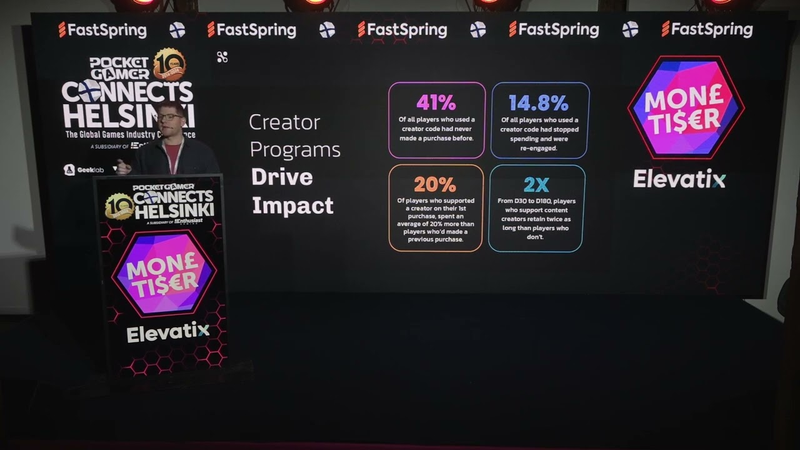
Session: Support-a-Creator programs: How They Impact Games Success - Justin Sacks, Nexus.gg
Creator programs represent a strategic evolution in game marketing, shifting from traditional, budget-heavy influencer campaigns to performance-based, evergreen models.
- Support-a-Creator programs shift marketing from upfront influencer fees to performance-based models that use unique identifiers to track and reward creators based on actual in-game revenue generated.
- Data shows these programs effectively convert non-paying users, with 41% of players using a creator code being first-time spenders.
- Creator programs aid in player retention and reactivation, as 15% of users who utilize creator codes are lapsed players returning to the game.
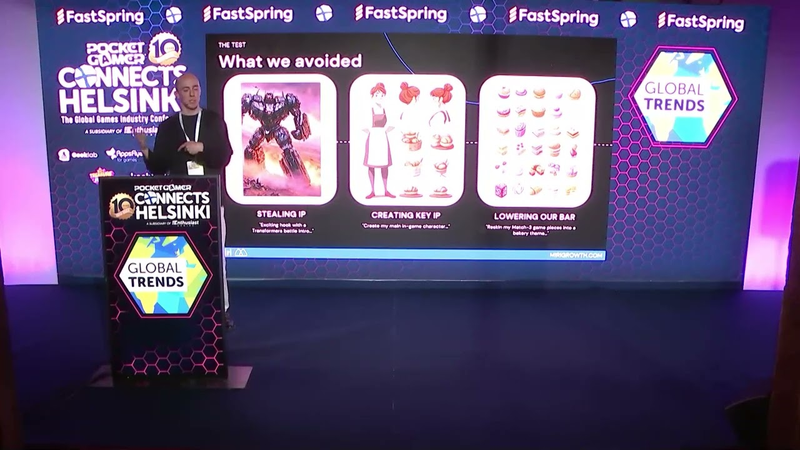
Session: Can AI Keep Winning Ads Alive Longer? Zach Van Driel, Miri Growth.
The primary objective of this analysis is to determine how generative AI can extend the lifespan of high-performing mobile game advertisements, thereby maximizing return on ad spend and scaling user acquisition.
- Winning mobile game ad creatives typically experience performance fatigue, characterized by declining IPM (installs per mille) and ROAS, within 4 to 8 weeks of launch.
- Generative AI can extend the lifespan of hero creatives by enabling rapid, low-cost iterations on specific variables like voiceovers, scripts, sound effects, and visual backgrounds to combat auction and audience fatigue.
- Iterating on sound effects for a core ad concept resulted in a 17% improvement in click-through rates (CTR), though conversion rates required further optimization to maintain overall IPM.
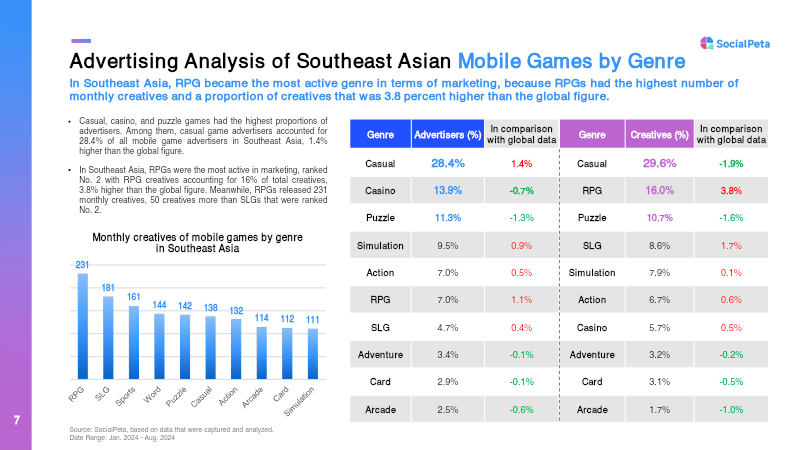
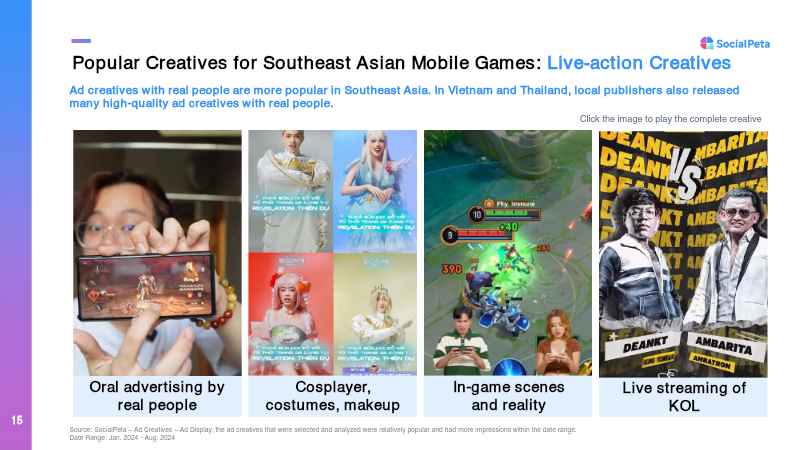

Insights into Marketing Trends in Southeast Asian Mobile Games in 2024
The Southeast Asian mobile gaming market in 2024 is characterized by high advertiser activity and a strategic shift toward video-centric marketing.
- Video-centric marketing is the dominant strategy in Southeast Asia, accounting for nearly 70% of all ad creatives across all mobile game genres.
- Indonesia is the region's largest market by advertiser volume with 12.3K monthly advertisers, while Thailand leads in content intensity with over 100 creatives per advertiser.
- The Southeast Asian mobile gaming market saw a 9.5% year-over-year increase in active advertisers, averaging over 20,000 per month between January and August 2024.

The Marketing Money Talk: How to Budget Your Indie Game's Promotion Campaign
Successful indie game promotion relies on a flexible, prioritized budget that treats marketing as a multiplier for a game’s inherent quality rather than a fixed percentage of development costs.
- First-party store support (e.g., Steam, Xbox, Nintendo) provides the highest reach and should be prioritized, as no other marketing channel matches the impact of features like the 'Popular Upcoming' list or store pop-up banners.
- Marketing should be viewed as a multiplier rather than a primary driver of success; it accelerates growth for games that already resonate with players but produces diminishing returns for games that fail to find an audience.
- When budgeting for trailers, expect to spend between $5,000 and $10,000 for a professional-grade trailer, while high-end agency productions involving actors or mixed reality can range from $10,000 to over $50,000.
Diversifying your Mobile Game UA with Influencer Marketing (real data included)
Mobile game user acquisition strategies are increasingly shifting toward influencer marketing as a necessary diversification from traditional channels like Facebook and Google.
- Influencer marketing should be treated as a performance-driven pillar rather than a branding exercise, specifically for games with a minimum US lifetime value of $3 to $4.
- Initial test budgets for influencer campaigns should range between $10,000 and $20,000 to establish data-backed performance benchmarks.
- YouTube and podcasts are the most reliable platforms for user acquisition due to superior attribution, long-term searchability, and the ability to repurpose content for broader advertising.
Creative trends in mobile games - August 2024
The mobile gaming industry is currently defined by a strategic reliance on high-impact, often misleading advertising hooks designed to minimize customer acquisition costs.
- Celebrity endorsements in mobile game advertising are increasingly cost-effective, with talent from major franchises available for as little as $475 per video, allowing for scalable user acquisition campaigns.
- The practice of 'creative stealing' remains a dominant industry trend, with top-performing games like Hero Wars and Top Heroes directly copying and pasting successful ad concepts from competitors without significant interference from ad networks.
- Hybrid-casual games are heavily utilizing 'fake ad' mechanics—such as sorting puzzles or non-existent mini-games—to drive engagement, even when these features are not present in the actual gameplay.
Impulse Brain Training games: A hyper scaling app masquerading as a brain training
Impulse Brain Training operates as a high-scale mobile product that utilizes the guise of cognitive improvement to deploy hyper-casual gaming mechanics.
- Impulse Brain Training generates $5 million to $6 million in monthly revenue with approximately 90,000 daily downloads by positioning hyper-casual gaming as a wellness and cognitive improvement tool.
- The app targets women aged 35 and older through Facebook advertisements that utilize emotional health assessments, such as ADHD or anxiety screenings, to drive user acquisition.
- Monetization relies on a friction-heavy model that increases ad frequency over time, incentivizing users to purchase subscriptions to remove advertisements.
Top 10 Ad Networks For Mobile Games 2024… and the Latest Ad Creative trends!
The mobile gaming advertising landscape in 2024 is defined by a paradox of increasing competition and strategic refinement.
- Mobile gaming advertisers are shifting from high-volume creative output to fewer, higher-quality assets, even as the total number of active advertisers in the market continues to grow.
- Developers are increasingly diversifying their user acquisition strategies by targeting Tier 2 markets like Brazil, India, and Mexico to offset rising costs in saturated Tier 1 regions.
- Generative AI is lowering production barriers and enabling rapid creative iteration, leading to a resurgence in image-based advertising alongside high-paced, narrative-driven video templates.
Mobile advertisers are going in blind on Apple | Fernando Pernica from Nefta
The mobile advertising industry is currently navigating a significant shift in data accessibility, primarily driven by heightened privacy regulations on the iOS platform.
- Apple's privacy-driven data restrictions have created a paradox where overall app revenue is rising despite declining user retention and in-app purchase metrics.
- Advertisers are currently using broad, inefficient user acquisition strategies to compensate for a lack of granular targeting data, driving iOS costs per install (CPI) above five dollars.
- The industry is shifting away from cross-web tracking toward first-party publisher data, which analyzes in-game player behavior to improve ad auction relevance.
Creative trends in mobile games - July 2024 (Sound fixed)
Mobile gaming marketing in July 2024 is defined by a strategic shift toward high-tension, emotionally charged creative content designed to maximize user acquisition.
- Top-performing mobile game creatives currently leverage high-tension mechanics, such as near-death experiences, fear-inducing scenarios, and the 'pushing objects' mechanic to drive user engagement.
- TikTok requires a high-frequency creative testing cadence, with successful strategies involving the introduction of new creatives into ad groups every two days.
- Visual elements like rivers, fences, and tracks are recurring, high-converting motifs in current mobile game advertisements.