Updated Jun 1, 2026 by Sensor Tower
Report
Published by Sensor Tower
Consumer banking applications have emerged as the preeminent mobile financial platform worldwide, with global downloads exceeding two billion by June 2025 and quarterly figures surpassing half a billion. The growth trajectory is strongest in emerging markets, where apps such as Nubank, Kotak Bank: 811, and BRImo enable account opening, transfers, and bill payments without physical branches, thereby accelerating financial inclusion. Regional leaders remain incumbents: Capital One Mobile dominates the United States, Agricultural Bank of China leads in China, and Yucho Passbook App maintains a strong position in Japan, while digital‑first entrants steadily gain traction. Demographic analysis reveals pronounced differences across markets. In India, 82 % of top banking‑app users are male and the 25–34 age group is predominant, whereas Southeast Asian markets like Vietnam and Indonesia exhibit a higher concentration of 18–24 users. These patterns highlight opportunities for inclusive financial access and targeted product development. Advertising spend is heavily concentrated on video‑centric platforms; YouTube accounts for 63 % of impressions in Japan, while Facebook is the primary channel in South Korea and India. These allocations reflect localized, persona‑driven strategies that align with each market’s user behavior. Financial over‑the‑top (OTT) platforms and YouTube are increasingly expanding banking access to underserved populations by aligning content with real user behaviors and cultural preferences. Sensor Tower’s mobile intelligence suite demonstrates rising platform penetration across APAC, underscoring that tailored content and targeted advertising are key drivers of broader adoption. The findings collectively illustrate a dynamic landscape where consumer banking apps, demographic nuances, and media channel preferences converge to shape the future of mobile financial services.
Sensor Tower Introduction/Overview Sensor Tower is the leading source of mobile app, digital advertising, retail media, and audience insights for the largest brands and app publishers across the globe. With a mission to measure the world’s digital economy, Sensor Tower’s - 2 winning platform delivers unmatched visibility into the mobile app and digital ecosystem, empowering organizations to stay ahead of changing market dynamics and make informed, strategic decisions. Founded in 2013, Sensor Tower’s mobile app insights have helped marketers, app, and game developers demystify the mobile app landscape with visibility into usage, engagement, and paid acquisition strategies. Today, Sensor Tower’s digital market insights platform has expanded to include Audience, Retail Media, and Pathmatics Digital Advertising Insights, helping brands and advertisers understand their competitor’s advertising strategies and audiences across web, social, and mobile. Press Inquiries: [email protected] Business Inquiries: [email protected]
Sensor Tower |Our Customers Top publishers trust Sensor Tower insights to grow their business. Top publishers trust Sensor Tower insights to grow their business. L'ORÉAL O Google u epaon Disnep petco HERSHEY amazon 2ROVIO PDOORDASH depop Walmart * Microsoft SEGA dyson SONY zfetch Piu ∞ Meta OUTFiT7 Gett. Il ByteDance REWARDS Alibaba POPeYeS Tencent Hifl VBWARNER BROS. P&G SNBA cvs B gohmsonaJohmson Welch's Revolut Health. Domino's Note: Top publishers by app store revenue | Source: Sensor Tower Note: Top publishers by app store revenue Source: Sensor Tower
Sensor Tower Solutions Sensor Tower Sensor Tower Sensor Tower Sensor Tower App Performance App Advertising Audience Pathmatics Digital Insights Insights Insights Advertising Insights For those who need visibility For those who need visibility For those who need visibility For those who need visibility into the mobile app ecosystem. into paid user acquisition into your existing, competitor, into the digital ad ecosystem. Enjoy insight into: app rankings, strategies. and potential new audiences. Gain insight into: ads served, spend downloads, and revenue; active Enjoy insight into: global and Enjoy insight into: which apps and impression estimates, SOV, and users, demographics, retention, regional share of voice (SOV) consumers are actually more across key channels, like: sessions, and time spent; app across apps and the biggest interacting with (app Facebook, Instagram, X (formerly ratings and reviews, keywords, mobile app ad networks, top engagement) AND which ads Twitter), OTT, YouTube, display, search ads, and more. advertisers, publishers, creatives, they’re seeing (ad exposure). video, and others. and more.
Sensor Tower Solutions Sensor Tower Sensor Tower Gaming Advanced Usage Insights Insights For those who need the deepest For those who need the deepest look into the mobile gaming look into app user engagement. ecosystem. Sensor Tower Pathmatics Retail Media Insights For those who need industry-first insight into on- and off-site retail media network investments Enjoy insight into: downloads, Enjoy insight into: sessions per revenue, RPD, and ARPDAU user; time spent; time of day; days Enjoy insight into: ad spend, media beyond the top-level category used per time period; new, mix, share of wallet, impressions, (Lifestyle & Puzzle) and can drill retained, resurrected, and churned and SOV for brands and products deeper into genres (Puzzle, user trends; and cohort usage across retailers – gaining a coveted Arcade, etc.) and sub-genres overlap. view into the co-branded digital ad (Swap, Word, etc.). ecosystem and retail media networks.
Sensor Tower Executive Summary The report provides an in-depth analysis of global Consumer Banking Sponsored wow the Chicken Big Mac is just like the Big Mac fr apps and brands in 2025. This includes trends in Consumer Banking app downloads in recent years, changes in banking app downloads 15:06 .l 5G across iOS and Google Play and the performance of leading apps in Today 24 September some of the world’s most dynamic consumer banking markets. The report also leverages Sensor Tower’s Advertising Insights to explore trends in digital advertising by consumer banking brands across The Big Mac now comes in Order Now prime different markets, as well as major advertising channels and popular ad video creatives. Clarification on Revenue and Downloads Data NEW ON APPLE ARCADE Sensor Tower's revenue figures are derived from estimated in-app purchase Race into Temple (IAP) revenue on the App Store and Google Play, excluding ad revenue, Run: Legends revenue from third-party Android app- store sales, and direct payment Apple Arcade revenue from developers’ websites and other channels. Unless explicitly Temple Run: Legends Get All New Temple Run Advent. stated as net revenue, the revenue figures shown represent gross revenue (before platform deduction). Sensor Tower's downloads figures are derived from estimated downloads on the App Store and Google Play, excluding - installs, duplicate downloads, and downloads from third-party Android - store.
t. stated as net revenue, the revenue figures shown represent gross revenue (before platform deduction). Sensor Tower's downloads figures are derived from estimated downloads on the App Store and Google Play, excluding - installs, duplicate downloads, and downloads from third-party Android - store. Google Play is not available in Mainland China.
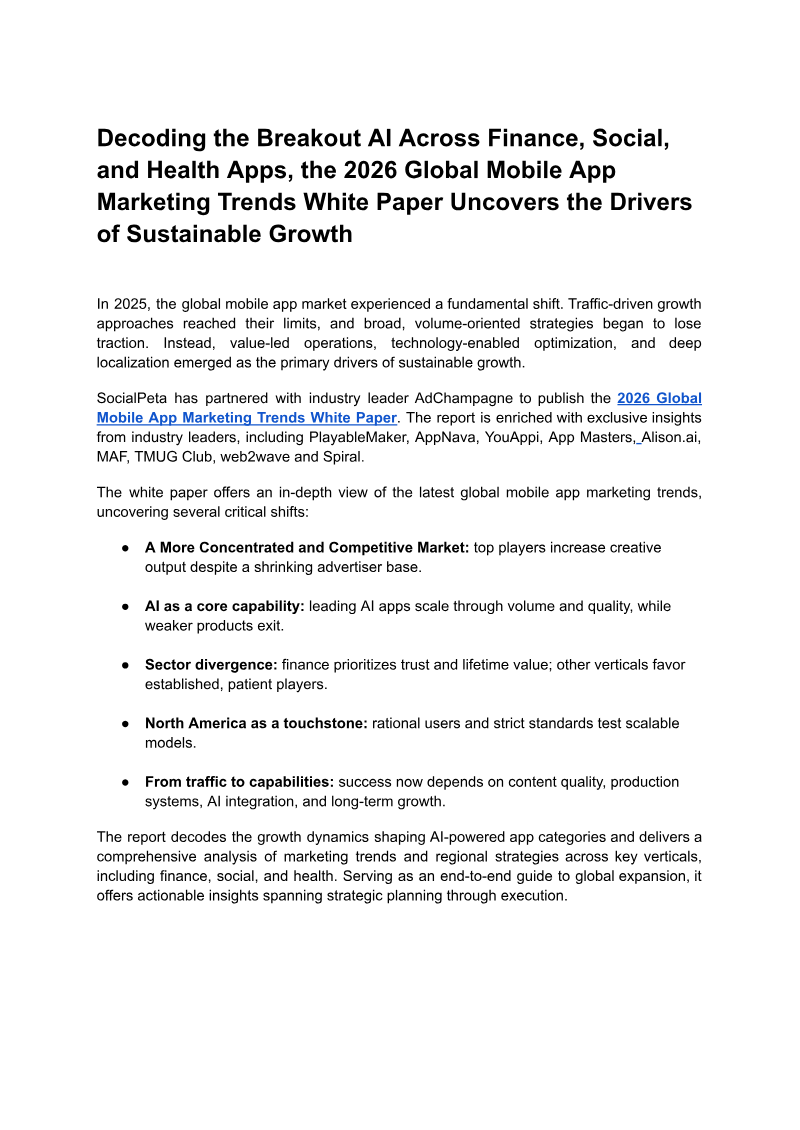
The white paper argues that the 2025 mobile app market has shifted from volume‑driven traffic growth to value‑centric, technology‑enabled optimization. It identifies a “scissor gap” where the number of active advertisers fell 16.7 % YoY while creatives per advertiser rose 73.3 %, indicating higher competitive thresholds and a focus on creative quality. Market share remains strongest in business & productivity, utilities, entertainment, and finance, but creative volume is dominated by short‑drama, reading, and AI apps. iOS and Android advertising ratios stabilized at 4:6, with iOS advertisers producing more creatives due to higher monetization expectations. User acquisition spend reached $78 billion, a 13 % YoY increase driven almost entirely by iOS, with e‑commerce, fintech, and betting leading non‑gaming verticals. Video remains the dominant ad format (≈70 % of social inventory), while static and playable ads serve testing, Android traffic, and engagement signals. AI has moved from a marketing tool to a core capability; leading AI apps scale through volume and quality, while many smaller entrants exit due to weak monetization. Finance apps maintain steady growth focused on user quality, lifetime value, and compliance, contrasting with AI’s rapid scaling. North America remains the most selective market, demanding high content quality and long‑term trust; success here signals scalability elsewhere. The paper concludes that sustainable growth now hinges on creative capability, system efficiency, AI integration, and long‑term value creation rather than sheer traffic volume.
SocialPeta’s analytics platform aggregates data from more than 90,000 micro‑drama advertisers and 80 million ad creatives across over 55 countries, positioning itself as a key resource for launching and scaling micro‑drama apps worldwide. The platform projects the global micro‑drama market to reach $6 billion by 2026, emphasizing its capacity to deliver actionable insights into advertising strategies, creative formulas, and regional audience preferences. In 2025 the ecosystem expanded sharply: active advertisers rose by 63.6 % to over 700, while each advertiser produced a 144.9 % increase in creatives, largely thanks to AI‑powered production tools. Southeast Asia dominated genre preferences for “reversal of fortune” and “rebirth” dramas, whereas North America’s high‑paying users gravitated toward premium romance content. Europe remained the largest source of creative volume, underscoring a sustained upward trend in both advertiser participation and output across the globe. A case study of “Evil Bride vs. The CEO’s Secret Mom” illustrates high‑impact marketing: 44 K creatives generated an estimated 2.7 B impressions in key markets such as the USA, UK, Canada, Australia, and Germany. AI‑driven tools—DSV restructuring and automated cover/clip generation—reduced production time, enabling rapid localization. Short, cliffhanger‑style ads with intense conflict and strong visual hooks outperformed longer formats, driving downloads and engagement in North America, Southeast Asia, Latin America, and the Middle East. By late 2024 vertical micro‑dramas had matured into a stable ecosystem, with regional preferences—“reversal of fortune” in Southeast Asia and conflict‑driven stories in Latin America—fueling audience engagement. Production scaled to 55 vertical dramas in 2025 through standardized pipelines and AI‑enhanced marketing, allowing faster creative validation, lower volatility, and continuous data‑driven optimization. The analysis stresses that audience‑first IP development—testing concepts in short form before scaling—and multi‑platform, AI‑supported workflows are essential for reducing creative risk and converting IP into long‑term company capital.
The 2026 mobile marketing landscape is defined by a fundamental transition from media-centric targeting to creative-driven acquisition, necessitated by tightening privacy constraints and the saturation of traditional advertising channels. Competitive advantage now hinges on the speed of creative iteration and the ability to unify product development, monetization, and distribution. By leveraging early behavioral signals to predict long-term value, industry leaders are successfully aligning short-term performance metrics with sustainable user lifecycle growth. This evolution is supported by a strategic shift toward AI-powered personalization and behavior-driven gamification, as non-gaming applications increasingly adopt the engagement tactics traditionally reserved for the mobile gaming sector. Data from 2025 reveals a period of significant market consolidation, marked by a 16.7% decline in active advertisers alongside a 73.3% surge in creative output per advertiser. Playable ads have emerged as the premier format, consistently yielding the highest attention duration, scroll-stop rates, and conversion metrics. While the AI app sector experienced a sharp 48% contraction in the number of advertisers, top-tier players have responded by aggressively scaling localized marketing efforts. Simultaneously, the finance and health sectors have maintained greater stability, focusing on service-centric, medical-grade solutions and persuasive, value-based messaging to capture mature markets in North America and Europe. Global strategies for 2026 prioritize a balanced media mix, typically favoring video content, while emphasizing hyper-local operations in emerging regions like Southeast Asia and the Middle East. Success in these diverse markets requires intensive user education and culturally nuanced, scenario-based ad updates. As the industry moves toward subscription-based models and on-device AI integration, the focus has shifted from mere technological development to the large-scale monetization of AI-enhanced user experiences. Ultimately, the market is moving toward a future of highly segmented, interactive, and performance-driven advertising that prioritizes technical precision and regulatory compliance to foster long-term user trust.
The analysis demonstrates that while the global pool of active AI‑advertisers has contracted by 35–45 % in H1 2025, the remaining players are compensating with a markedly higher creative output—an 84 % increase to an average of 416 monthly creatives per advertiser. Video advertising dominates the landscape, with 84 % of all ads and more than half of inventory in 15‑30 second formats. Geographic patterns reveal that Europe and North America maintain the largest advertiser volumes, yet exhibit lower creative density than Japan and South Korea, which show the fastest growth rates. Market saturation appears to be driving these firms toward intensified brand exposure through increased creative frequency, even as overall advertiser participation declines. Meitu’s financial results corroborate the commercial potency of AI‑driven features. Revenue rose 12.3 % to RMB 1.8 billion, largely propelled by a 45.2 % jump in AI‑powered imaging and design subscriptions to RMB 1.35 billion, while advertising income grew modestly by 5 %. The company’s flagship AI applications—“AI Wardrobe,” “WHEE,” and “Wink”—secured top positions in App Store charts across more than twelve countries, underscoring the role of AI enhancements in global user acquisition and subscription monetization. The broader ecosystem of AI‑powered mobile apps, including chatbots, development tools, and educational platforms, continues to enjoy strong monthly active user figures and high stickiness. However, product overlap creates fierce competition, making clear positioning and precise subscription pricing essential for successful global expansion. Rapid overseas success is achievable when apps tailor local marketing strategies to regional preferences. These conclusions are drawn from SocialPeta’s extensive dataset of 1.6 billion advertising data points, sampled across 80+ channels and regions from January 2024 to June 2025.