Updated Jun 1, 2026 by Gamesforum
Article
Published by Gamesforum
10-11 February | InterContinental Hotel Insights from Industr y Leaders By Mariam Ahmad, Head of Content, Gamesforum By Mariam Ahmad, Head of Content,Gamesforum T H E F U T U R E O F A D M O N E T I Z A T I O N The Future of Ad Tatiana Kondratyeva Monetization PlayPack Ahead of their Gamesforum Barcelona 2026 panel “The Future of Ad Monetization,” three experts: Tatiana ...
GAMESF ORU M B A RC E LONA 10-11 February | InterContinental Hotel Spotlight Series: The Future of Ad Monetization Insights from Industr y Leaders By Mariam Ahmad, Head of Content, Gamesforum By Mariam Ahmad, Head of Content,Gamesforum
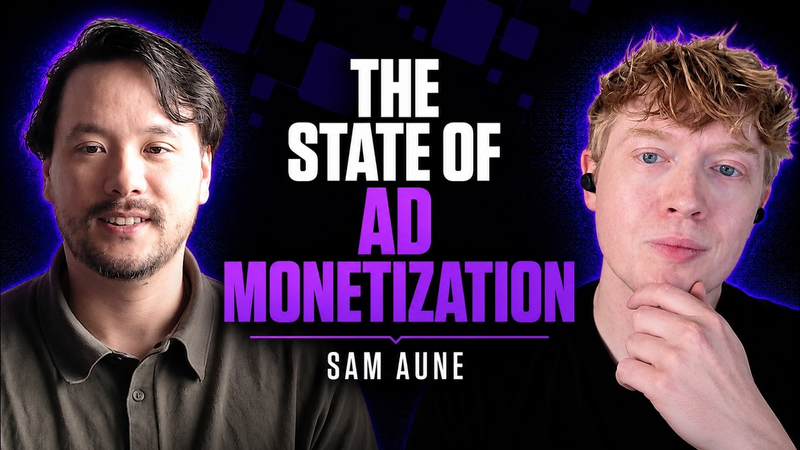
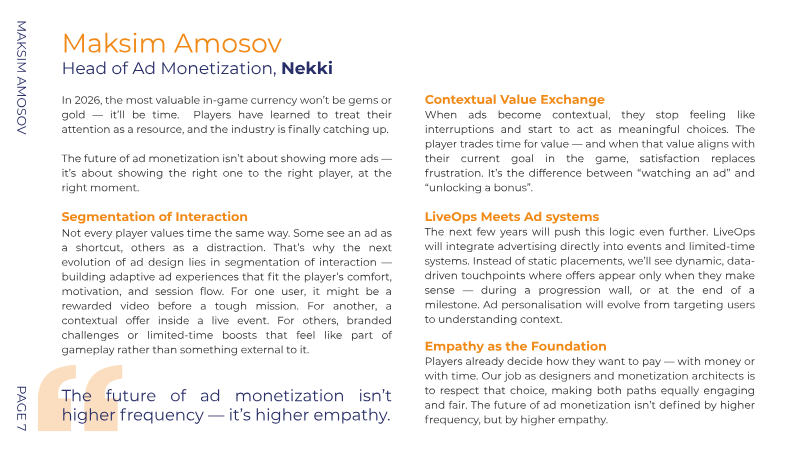
THEFUTUREOFADMONETIZATION The Future of Ad Tatiana Kondratyeva CEO and Co-Founder Monetization PlayPack Panel Preview Ahead of their Gamesforum Barcelona 2026 panel “The Future of Ad Monetization,” three experts: Tatiana Damjan Kačar Kondratyeva, CEO and Co-Founder of PlayPack, Damjan Ad Monetization Specialist Kačar , Ad Monetization Specialist at GameBiz Consulting, GameBiz Consulting and Maksim Amosov, Head of Ad Monetization at Nekki, share their perspectives on the trends, challenges, and creative opportunities shaping the next generation of ad monetization. Maksim Amosov Head of Ad Monetization Nekki PAGE 2
TATIANAKONDRATYEVA Tatiana Kondratyeva CEO & Co-Founder, PlayPack Ad Monetization as a System By 2025, ad monetization has shifted to be one of the hardest systems in mobile gaming to get right. Even outside of hyper and hybrid-casual sections, it’s very clear that ads are not ‘bonus revenue’, but rather a big part of your game economy and loops designed around it. A well-placed ad can double the duration of a session or kill the playtime. M onetization is now a creative discipline. Hybrid Models in Action At PlayPack, we’ve seen this evolution up close. Our Merge-2 title, Merge Away, runs on a hybrid monetization model that combines ads and in-app purchases. Throughout its lifetime, we have seen how the interaction between those two factors has the power to make or break profitability. As a small studio PAGE 3 we need to find the angle to be competitive with bigger players, and it’s literally a million dollar question how to do it. The Data Merge Revolution The biggest change for us in 2025 was the final merging of monetization based on behaviour analytics and user acquisition goals. The same data you use for acquisition is now used in a good ad-mon setup. Quick-reward casual games should appear in your ad stack if your UA campaign attracts a particular kind of user. Richer, progression-based offers and possibly no ads at all should be visible to IAP-driven spenders that your UA attracts. ROAS is destroyed when the wrong cohort is shown the wrong content. And we've all witnessed the abrupt drops in revenue of 30% caused by misaligned sources. Adaptivity as the New Frontier That’s why I believe the real frontier now isn't just new formats; it's adaptivity.
ders that your UA attracts. ROAS is destroyed when the wrong cohort is shown the wrong content. And we've all witnessed the abrupt drops in revenue of 30% caused by misaligned sources. Adaptivity as the New Frontier That’s why I believe the real frontier now isn't just new formats; it's adaptivity. Monetization tools must understand where the user came from and how users are interacting with your game. What is their behavior: ad-driven, hybrid, or spender. Ad kill switches, rewarded placements, and even frequency configs should adapt automatically to that data. While the newer SDKs from partners are moving in that direction, with machine-learning-based personalisation, most studios still treat monetization as static.
TATIANAKONDRATYEVA Visibility and Accountability Another pain point is that too often when ad revenue drops, no one can explain why. It's a black box. For small studios like ours, that's unacceptable. Every percentage point of yield matters. You need full visibility into which sources are performing, which campaigns got paused, and which partners actually deliver clean traffic. We've built internal dashboards that cross-reference ROAS and retention by UA channel just to get that clarity. Without it, you're flying blind. User Experience Matters The user experience side matters just as much. Players are fatigued by heavy ad loads. They expect ads to feel optional, quick, and rewarding — not like punishment for playing. In our games, we integrate ad moments as “side quests,” never blockers. It’s about keeping momentum, not stopping play to monetize it. Final Takeaway Looking forward, the winners in ad monetization will be studios that design with ads in mind, not around them. Monetization is now a creative discipline as much a design decision as the core loop itself. Respect the player, understand PAGE 4 your data, and treat your ad stack as a living system that evolves with your audience.
DAMJANKA Č A R Dam Ad Mo jan Kačar netization Specialist, GameBiz Consul ting The Hype vs. The Reality Every few months you hear news about the success of new ad What we need is more cont rol — formats, such as App Open, Audio ads, Immersive/In-Game not another interstitial in disguise. Ads and similar. Despite the hype, these formats have not achieved the widespread adoption of staples like rewarded Poor User Experience video, interstitial and banner ads. So what’s holding them back? Formats like App Open or Audio Ads can be frustrating to Shared Struggles Across Formats users. Nobody likes being hit with an ad before they’ve even seen the main menu, or having a voice start talking over their It’s a bit unfair to group all these formats together since they gameplay. Immersive ads are much better in terms of UX, but serve different purposes. Still, after seeing them tested across only if they fit your gameplay, which limits them to a few different portfolios, they tend to suffer from similar problems: genres. If you’re going to use a disruptive format, closely track technical friction, poor user experience, and lackluster retention and user feedback to make sure that the revenue performance. uplift is worth it.
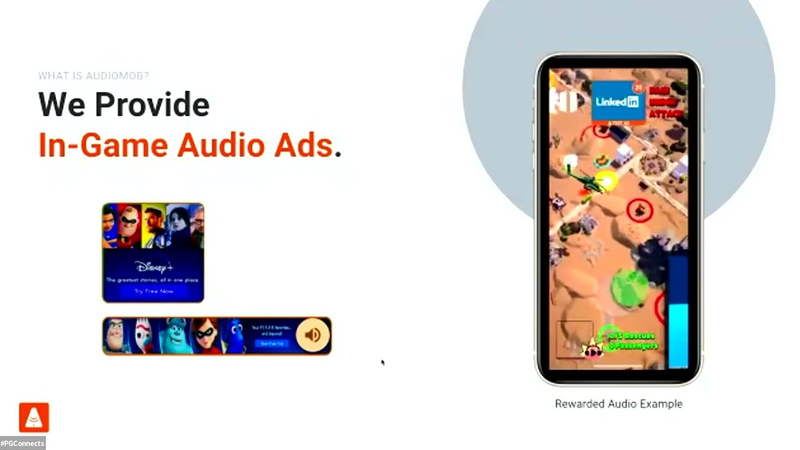
This analysis examines the efficacy of in-game audio advertising as a non-intrusive alternative to traditional video and banner formats within the mobile gaming industry. The primary thesis posits that audio ads maintain player engagement and retention by allowing gameplay to continue uninterrupted, thereby fostering a more positive brand association compared to conventional, disruptive advertising models. Research findings are derived from a combination of market surveys and behavioral testing. A YouGov survey of 2,200 respondents highlights that 86% of UK adults dislike video ads, while 28% identify audio ads as their preferred monetization model. Behavioral testing conducted by Go Live Test confirms that 100% of participants continued playing during audio ad delivery and achieved 100% brand recall when ads were paired with a companion banner. Furthermore, the data indicates a significant engagement advantage, with audio ads achieving a click-through rate (CTR) of approximately one click per 1.4 listens, vastly outperforming the 0.08% average CTR typical of static banners. The effectiveness of this format is further validated by a Warner Music Group case study targeting 18-to-30-year-olds in the United States. The campaign achieved a 1.78% CTR—representing a 1,000% increase over traditional banner standards—and an ad completion rate exceeding 75%, significantly higher than the 4% to 8% industry standard for skippable video ads. Additionally, the campaign recorded a 1.8% bounce rate on the destination page, suggesting high intent among users who engaged with the audio format. These findings suggest that audio advertising offers a viable solution for developers and brands seeking to monetize a global audience of 2.8 billion mobile gamers without compromising the user experience. By integrating seamlessly into the background of gameplay, audio ads mitigate the frustration associated with screen-blocking video ads, ultimately driving higher engagement and more favorable brand outcomes.
What we set out Keep reading to learn... to learn AD Keep reading to learn… The true impact of in-game advertising on The true impact of in-game advertising on With 8o% of under-18s' actively gaming and Gen Z younger audiences.
Modern Times Group delivered a record‑setting performance for the fourth quarter of 2025, underscoring the company’s momentum in the digital entertainment sector. Organic revenue expanded by 8 percent, which translates to a 108 percent increase when measured in constant‑currency terms, and net sales reached SEK 3.1 billion. These figures reflect the strength of the group’s core portfolio and its ability to generate growth despite a volatile macro‑economic environment. A pivotal element of the results was the integration of Plarium, which was completed on 12 February 2025 and consolidated from 31 January. The acquisition contributed SEK 5,384 million in sales for the quarter and produced SEK 495 million of income before tax, after accounting for SEK 786 million of purchase‑price amortisation. When the acquisition is modelled as if it had been in place from the start of the year, total sales for 2025 would have risen to SEK 12,137 million, with pre‑tax income of SEK 398 million, albeit offset by SEK 1,269 million of amortisation. The combined impact of robust organic growth and the strategic addition of Plarium positions Modern Times Group as a leading player in the global gaming market. The financial outcomes demonstrate that the company’s acquisition strategy is delivering immediate scale and profitability, while its underlying business continues to expand at a pace that exceeds prior expectations. This performance suggests a durable growth trajectory for the remainder of the fiscal year and beyond.
Intrinsic in-game advertising functions as a resilient, year-round engagement channel that maintains steady session volumes even during seasonal lulls in traditional media. While PC and console platforms offer superior immersion and average session lengths of 107 minutes, mobile gaming provides twenty-five times the impression scale and greater gender diversity. Market data reveals a significant strategic opportunity in the first quarter, particularly in North America, where advertising costs drop by over 25% despite high player activity. This period offers a cost-effective window for wellness and travel brands to reach an attentive audience at a lower entry point than the highly competitive fourth quarter. The effectiveness of this medium is driven by high viewability rates reaching nearly 100% and attention metrics that consistently outperform traditional digital formats. Although the sports genre commands the highest playtime and premium pricing, racing and simulation categories represent efficient alternatives where high engagement intersects with lower costs. Regional performance varies significantly, with European markets offering peak value in the first and third quarters, while the Asia-Pacific region follows a distinct cycle driven by second-quarter demand and localized cultural events. Beyond visibility, these advertisements generate substantial brand lift, including a 20-point increase in recall and a 6% conversion rate for physical foot traffic. While male players currently report higher brand favorability, female audiences demonstrate stronger purchase intent, suggesting a need for more nuanced targeting strategies. Overall campaign performance remains highly efficient, with conversion costs averaging 21% below established goals. To maximize these returns, advertisers must integrate gaming into their permanent media mix, while developers should align in-game events with high-demand periods and real-world sporting calendars to optimize revenue.