Action-Adventure reports and market data
Documents
Physical Animation in Star Wars Jedi: Fallen Order
Star Wars Jedi: Fallen Order integrates physical animation to bridge the gap between authored character poses and dynamic physics simulations.
- Star Wars Jedi: Fallen Order utilizes a hybrid animation system that blends authored poses with dynamic physics simulations to eliminate geometry clipping and improve movement fluidity.
- The system employs motors, velocity-based drives, and custom constraints to ensure characters maintain natural, physically grounded presence during complex actions.
- Combat interactions for NPCs, such as force-pulls and death sequences, use intelligent transitions to freefall ragdoll states when obstacles are detected.

Developing Raji: An Ancient Epic & Crossing the Finish Line | Game Dev Unchained Episode 233
The development of Raji: An Ancient Epic serves as a case study for the burgeoning Indian game industry, highlighting the successful effort to integrate rich cultural narratives into the global gaming market.
- The development of Raji: An Ancient Epic demonstrates the viability of integrating underrepresented cultural narratives, such as Hindu and Balinese mythology, into the global gaming market.
- The project serves as a case study for the maturation of the Indian game industry, driven by increased accessibility to development tools and the rise of local studios.
- The COVID-19 pandemic forced a transition to remote workflows, proving that distributed teams can maintain development momentum without traditional in-office collaboration.

Destructible Environments in Control: Lessons in Procedural Destruction
The development of destructible environments in the game Control focused on creating a reactive, cinematic experience within the game’s primary setting, the Oldest House.
- Remedy implemented a procedural destruction system in Control using a three-layer approach: rigid body simulations (RBDs) for large chunks, mesh particles for smaller debris, and material-based decals for surface-level damage.
- The destruction pipeline relied on metadata tagging for all environmental assets, allowing the engine to apply specific physics rules based on material properties like concrete, wood, or metal.
- To manage performance, the team utilized collision delays, high sleeping thresholds for physics objects to prevent unnecessary movement, and Signed Distance Fields (SDFs) for efficient particle-to-environment collisions.
NPC Voice Design in The Division 2
The development of The Division 2 prioritized the creation of systemic, AI-driven voice barks to enhance player immersion and provide essential gameplay feedback.
- The Division 2 utilized a stimulus-based architecture for NPC voice barks, replacing rigid, timer-based dialogue with dynamic, context-aware reactions to combat and player behavior.
- The project managed a massive scale of over 93,000 lines of dialogue per language, distributed across 364 unique characters.
- Development efficiency and localization quality were improved by replacing hard-coded logic with a centralized, data-driven tag system using modular starter and response matrices.

Last of Us Part 2 Delayed Indefinitely | Games ReCAP
The indefinite delay of The Last of Us Part 2, originally scheduled for a May 2020 release on PlayStation 4, serves as a primary case study for the logistical challenges facing the video game industry during the COVID-19 pandemic.
- Sony Interactive Entertainment indefinitely delayed the May 2020 release of The Last of Us Part 2 due to the logistical inability to guarantee a synchronized global launch.
- The decision to delay was primarily driven by disruptions in physical distribution chains and concerns that global internet infrastructure could not support a purely digital-only rollout.
- Naughty Dog confirmed the game was in its final stages of development, focusing on bug fixes, when the pandemic-related constraints forced the postponement.
4K Checkerboard in Battlefield 1 and Mass Effect Andromeda
Achieving 4K-like visual fidelity on hardware with limited bandwidth requires sophisticated rendering techniques that balance performance budgets with image quality.
- The Frostbite engine utilizes packed checkerboard rendering to achieve 4K-like visual fidelity by shading a subset of pixels and reconstructing high-resolution frames from lower-resolution buffers.
- Implementing checkerboard rendering in Battlefield 1 reduced GPU frame costs by approximately 5.08 milliseconds, enabling stable 60Hz performance.
- To maintain visual integrity, the pipeline employs geometry-aware resolves, velocity-based reprojection, and object/primitive ID buffers to prevent color bleeding and z-fighting.

GDC Plays GDCA Nominee Control with Mikael Kasurinen and Brooke Maggs
The development of the action-adventure title Control represents a deliberate shift toward the New Weird genre, prioritizing environmental mystery and world-building over traditional, linear exposition.
- The development of Control utilized a sandbox model where leadership established strict thematic pillars and lore rules, enabling cross-departmental teams to contribute ideas while maintaining narrative consistency.
- Narrative designers functioned as essential bridges between art, level design, and writing to ensure environmental storytelling and collectibles remained coherent regardless of player exploration order.
- The design team prioritized the 'New Weird' genre by centering the game on the Oldest House, a Brutalist, shifting architectural space that fosters discovery through environmental mystery.
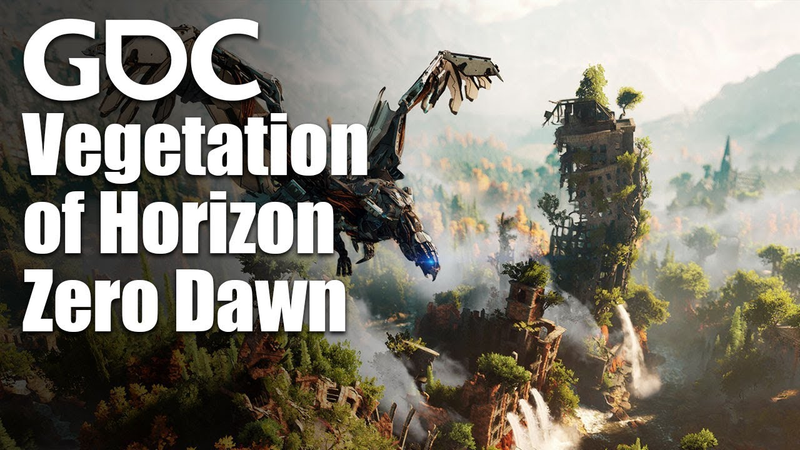
Between Tech and Art: The Vegetation of Horizon Zero Dawn
The development of Horizon Zero Dawn represents a sophisticated intersection of artistic intent and technical optimization, specifically regarding the creation of expansive, high-fidelity vegetation.
- The development team prioritized performance by inverting the asset pipeline, establishing the lowest level of detail first to ensure the game maintained a consistent 30 frames per second.
- Foliage movement was achieved through a global wind force field system that utilizes 3D textures and vertex-based animation.
- To manage rendering loads, the team implemented a two-pass system using depth-only passes for alpha testing and custom offline mip-chain generation for visual consistency.

Assassin's Creed Origins: Monitoring and Validation of World Design Data
The development of Assassin’s Creed Origins necessitated a sophisticated approach to quality assurance to manage the complexities of a 120-square-kilometer open world.
- To manage the 120-square-kilometer open world of Assassin’s Creed Origins, the team replaced manual quality assurance with an automated validation framework to address navigation mesh failures and AI pathing errors.
- The development team implemented a daily automated testing suite using C#-based scripts to query over 200,000 individual game objects for objective pass/fail evaluations.
- The integration of a visual interface called Atlas allowed developers to pinpoint specific coordinates of data conflicts, enabling the resolution of issues before they cascaded into systemic failures.
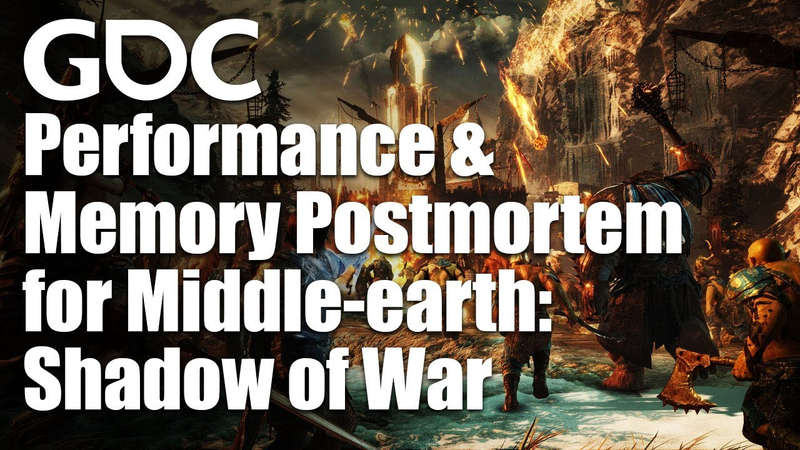
Performance and Memory Postmortem for Middle-earth: Shadow of War
Middle-earth: Shadow of War required extensive technical optimization to support a complex open-world environment featuring up to 200 unique AI actors.
- To manage 200 unique AI entities in Middle-earth: Shadow of War, the team moved away from individual system threading in favor of a 'monolithic' approach, where entire systems like effects were scheduled to run on a single core to minimize context switching and cache misses.
- The engine team replaced expensive kernel semaphores with lightweight multiple-reader/single-writer primitives, such as Microsoft’s Slim Reader/Writer (SRW) lock, to reduce CPU overhead during high-contention scenarios.
- To optimize GPU constant buffer uploads, the team implemented named constant buffers and heuristic-based data packing, which prioritized frequently used constants and zero-valued data to minimize memory footprint and avoid cache line flushing issues.
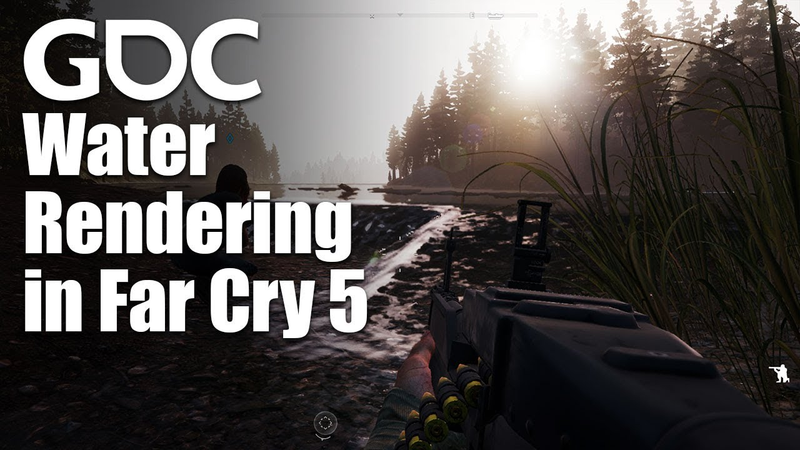
Water Rendering in Far Cry 5
The modernization of water rendering in Far Cry 5 centers on transitioning from manual, sector-based placement to a procedural, spline-based architecture.
- Far Cry 5 utilizes a unified water system that replaces previous fragmented methods with a single engine function, handling water quadtrees, streaming height maps, and dynamic water levels for rivers, lakes, and waterfalls.
- The rendering pipeline employs screen-space tessellation using a 16x16 tile grid, where constant density is achieved by mapping instance IDs to draw calls via an indirect arguments buffer.
- To optimize performance, the team implemented a distance-based Level of Detail (LOD) approach for surface shape calculations, reducing texture fetches from nine per pixel for nearby water to three per pixel for distant water.
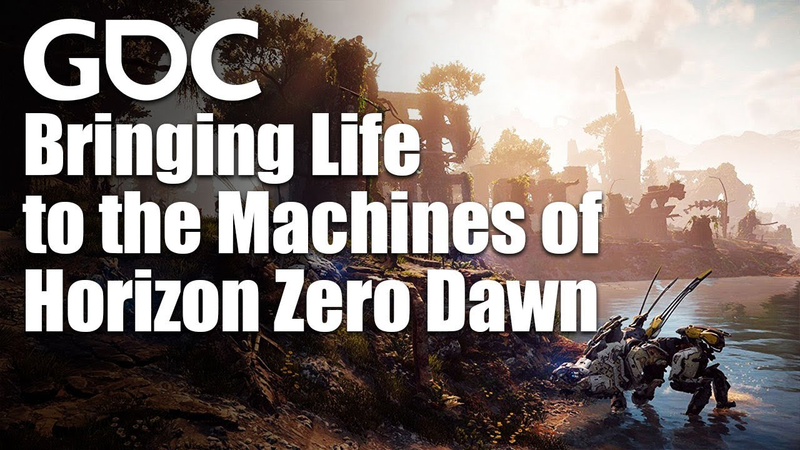
Animation Bootcamp: Bringing Life to the Machines of Horizon Zero Dawn
The development of mechanical creatures for Horizon Zero Dawn centered on the challenge of blending realistic animalistic movement with industrial, machine-based aesthetics.
- Guerrilla Games utilized a 'mood board' and personality video process, dedicating three weeks to defining character behavior before starting final animation to ensure consistent machine identity.
- The team used a custom AI mover system that dynamically adjusts forward and sideways velocity based on directional changes, allowing for animation-driven movement that minimizes foot sliding.
- To handle complex terrain without the time to create individual slope animations for 25 machines, the team implemented uneven terrain nodes in Morpheme to procedurally adjust character posture.