Action-Adventure reports and market data
Documents
AMA: Sucker Punch Productions Co-founder Brian Fleming talks Ghost of Tsushima
The development of Ghost of Tsushima represents a masterclass in iterative design and disciplined scope management within the AAA gaming landscape.
- Sucker Punch’s development of Ghost of Tsushima was a six-year project that required a significant shift in technical infrastructure, including increasing the game's map tiles from 100 to 1,200 and quadrupling their size, which caused major instability for 18 to 24 months.
- To maintain cultural authenticity, the development team partnered with Japanese experts to ensure every kanji character used in the game existed in the 13th century.
- The studio’s primary lesson on game design is that excessive complexity in individual systems can overwhelm the player; developers should prioritize simplicity in each component to ensure the overall experience remains cohesive.
Rocket Man: Creating Flight for Anthem
The development of flight mechanics in Anthem centers on the pursuit of a high-fidelity superhero fantasy, prioritizing intuitive, fluid movement over strict adherence to realistic physics.
- To solve the problem of players bypassing level design by flying over the map, BioWare implemented a heat-management system that forces players to navigate through cooling environments like waterfalls or water surfaces, turning traversal into a skill-based mechanic.
- The team abandoned realistic physics in favor of 'game feel,' utilizing a binary boost state that triggers immediate visual feedback—such as camera shake, field of view adjustments, and post-processing effects—to simulate speed while the character's actual velocity ramps up over time.
- To maintain consistent physics, the game capsule never rotates on the X or Z axes; instead, all banking, pitching, and rolling visuals are handled entirely through animation, requiring 27 unique base poses per suit to cover slow, medium, and fast flight speeds.
Animating the Main Villain in Marvel's Spider-Man (or "What, I'm Rigging HOW Many Legs?!")
The development of the primary antagonist, Doctor Octopus, for the 2018 title Marvel’s Spider-Man presented significant technical challenges, primarily centered on the character’s four mechanical tentacles.
- The Doctor Octopus rig for Marvel’s Spider-Man (2018) utilized a massive 790-joint structure, with 552 joints dedicated exclusively to the four mechanical tentacles.
- To prioritize animator accessibility and debugging speed over file size, the team utilized an all-in-one asset approach rather than a modular system for the character's 800,000+ vertices.
- The team implemented proxy tiers to allow animators to work with simplified geometry during the blocking phase, effectively managing the high computational cost of the complex rig.
Middle-earth: Shadow of War: Creating Multi-Character Combat Animations
The development of Middle-earth: Shadow of War centered on the implementation of complex, multi-character combat animations to establish a visceral and brutal aesthetic.
- Monolith Productions managed a high-volume animation pipeline for Middle-earth: Shadow of War by producing 1,200 unique sync-action animations between the player and orcs within a three-year development window.
- To maintain production efficiency, the team utilized a motion capture-first workflow where in-house animators performed the stunts, allowing for rapid iteration and immediate feedback from designers on-site.
- The studio employed a 'destructive' animation workflow that prioritized baking keys and layering poses over traditional non-destructive rigging, enabling animators to quickly adjust timing and weight without getting precious about curve handles.

Virtual Insanity: Meta AI on Assassin's Creed: Origins
The development of Assassin’s Creed: Origins introduced a sophisticated Meta AI architecture designed to sustain a persistent, living ecosystem within a massive open-world environment.
- Ubisoft implemented a 'Meta AI' system for Assassin's Creed: Origins that manages NPCs and objects globally, allowing them to function autonomously, navigate, and maintain persistent states even when they are far from the player or outside the loaded nav mesh.
- The game utilizes an AI network graph to handle long-range navigation for entities, enabling NPCs to travel across the map and perform scheduled tasks like eating or socializing without requiring the player's presence.
- To optimize performance, the engine uses a component-level Level of Detail (LOD) system with six states based on distance and visibility, allowing the game to disable or reduce the update frequency of specific components like head-tracking or AI logic.

Behind the Audio of the Heroes of Star Wars Battlefront II
The audio design for Star Wars Battlefront II centers on the objective of creating an immersive, authentic soundscape that bridges multiple eras of the franchise.
- The audio team managed a roster more than twice the size of the previous game by implementing a modular sound patch configuration system.
- To prevent listener fatigue and maintain variety, designers created between five and twenty-five unique variations for individual sound effects.
- The development team utilized a data-driven approach that shared environmental assets, such as debris and reflections, to streamline production and optimize performance.
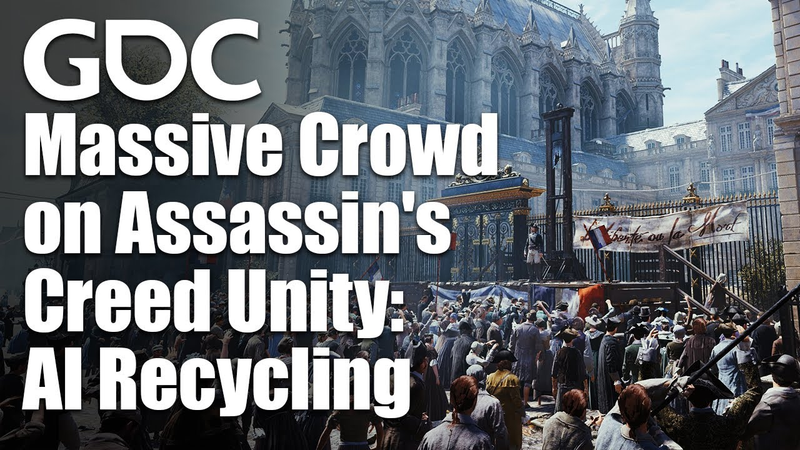
Massive Crowd on Assassin's Creed Unity: AI Recycling
Achieving unprecedented crowd density in Assassin's Creed Unity required the development of a sophisticated AI Level of Detail framework known as the Bulk system.
- The 'Bulk' system manages up to 10,000 NPCs by categorizing them into three proximity-based states: high-fidelity autonomous NPCs, mid-range Puppet NPCs, and long-range Low-Res meshes.
- Engine performance is optimized by reducing polygon counts for distant entities from 20,000 to 2,000, allowing the crowd system to consume only 5% of the total RAM budget.
- The architecture utilizes a deterministic 'Shepherd' container that employs pre-calculated paths and pooled assets to maintain consistent CPU and memory efficiency.

Cinematic Environment Production for Uncharted 4
The production of cinematic environments for Uncharted 4 centers on the integration of visual composition and narrative storytelling to deepen character development.
- Transitioning from pre-rendered cinematics to a real-time pipeline eliminated technical bottlenecks, enabling seamless transitions between gameplay and cutscenes.
- Cinematic spaces are scaled up by 25% compared to standard gameplay environments to accommodate specific camera angles and collision requirements.
- The production workflow utilizes an iterative process starting with rough block meshes to establish scale and composition before committing to detailed asset creation.
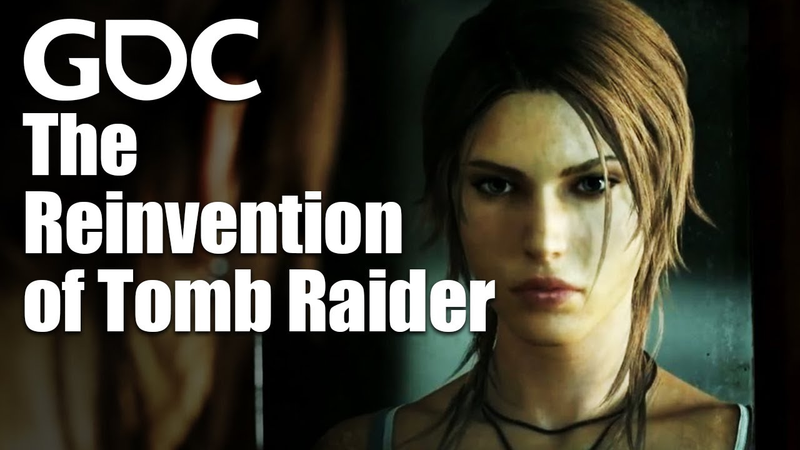
The Reinvention Of Tomb Raider
The reinvention of the Tomb Raider franchise centers on the strategic transformation of Lara Croft from an established icon into a vulnerable, humanized protagonist through a gritty survival-focused origin story.
- The franchise reboot achieved significant production efficiency by reducing the time required to create three hours of content from seven months to approximately two and a half months.
- Development was structured around a 'vertical slice'—a high-quality, two-hour playable segment—that served as the foundational blueprint for all subsequent core gameplay pillars.
- The studio utilized an episodic production model, organizing multi-disciplinary teams around specific gameplay mechanics to facilitate global scalability and faster output.
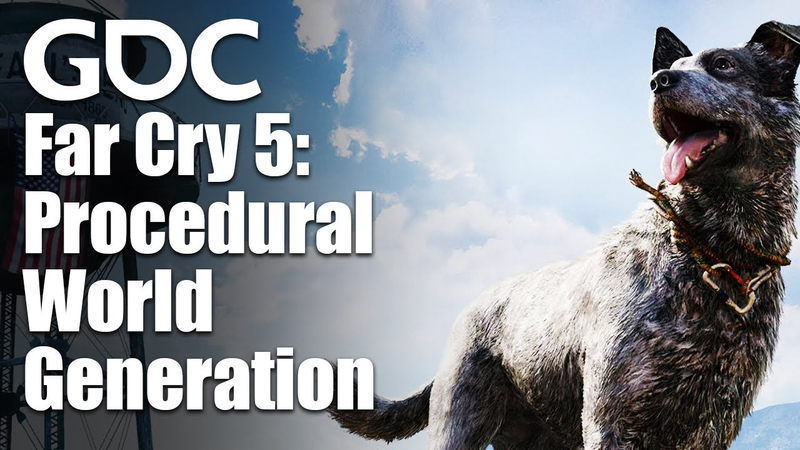
Procedural World Generation of Far Cry 5
The development of Far Cry 5 relied on a sophisticated procedural pipeline designed to manage the immense scale of the game world while maintaining artistic control and environmental consistency.
- Ubisoft developed a procedural pipeline for Far Cry 5 that automated complex world-building tasks, including freshwater network generation, biome distribution, cliff geometry creation, and fog density mapping.
- The procedural system operates on a sector-based granularity of 64 by 64 meters, allowing developers to bake data locally under the camera, across specific map sections, or within the camera's frustum to optimize performance.
- Cliff generation is driven by terrain slope thresholds, which are then remeshed to remove stretched quads and processed with flow simulations to create realistic geological stratification and erosion effects.

Character Control with Neural Networks and Machine Learning
Modern AAA game development faces significant challenges as traditional hierarchical state machines become increasingly unmanageable due to the sheer volume of states and animations required for complex character movement.
- Modern game development, exemplified by the growth from Assassin's Creed Syndicate (2015) to Origins (2017), requires managing massive animation libraries, with Origins utilizing approximately 15,000 individual animation clips.
- Traditional animation systems rely on complex, hierarchical state machines and blend trees that become increasingly difficult to scale and maintain as project scope grows.
- Motion matching replaces rigid state machines by treating animation as a database retrieval problem, using nearest-neighbor regression to find the best-fitting animation clip based on current gameplay variables.
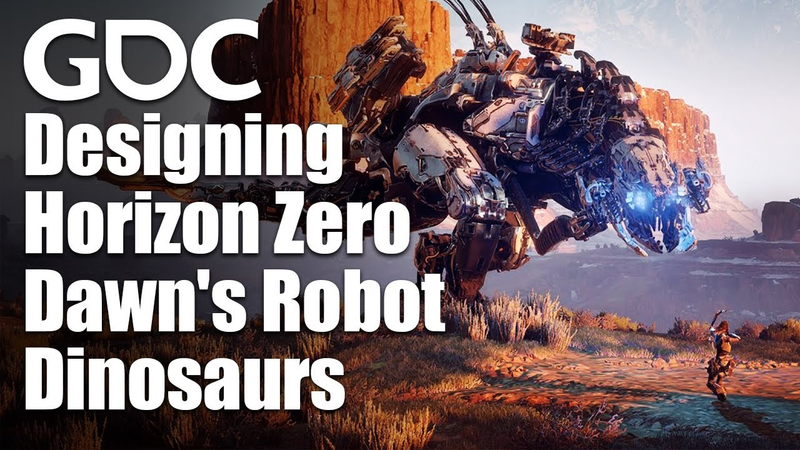
A No-Nonsense Approach to Designing Horizon Zero Dawn's Robot Dinosaurs
Guerrilla Games developed Horizon Zero Dawn to revitalize its creative output following a decade of work on the Killzone franchise.
- Guerrilla Games developed Horizon Zero Dawn to pivot away from the Killzone franchise and establish a distinct, vibrant post-apocalyptic intellectual property.
- The design team utilized intrinsic ideation, a methodology that grounds all visual elements, architecture, and societal structures in logical environmental and resource-based constraints.
- To ensure intuitive combat, the studio transitioned from military-inspired aesthetics to biomimetic designs modeled after real-world animal and dinosaur behaviors.