Showing 30 of 2,250 results · 4.18s
May 2026
State of the LATAM Games Industry 2026
GamesBeat, Xsolla
fostering trust and prioritizing accessibility, the Latin American gaming sector is effectively countering the stagnation currently impacting global mobile markets, establishing itself as a vital, influential player
Report33 pages
Apr 2023
Training Data: Arresting Development for the Sake of Going Slow
SuperJoost
data point is the $4.9 billion acquisition of mobile publisher Scopely by the Saudi Arabian government’s Savvy Games Group. This move is part of a broader
Article
May 2024
The Helldivers 2 Community Goes to War
Video Games Industry Memo
organized pressure groups against major publishers. While the game’s unique, collaborative ethos provided the foundation for this mobilization, the outcome was ultimately driven by the combination
Article1 pages
Mar 2011
Financial Results for the First Half of the Fiscal Year Ending March 2011
Koei Tecmo
market, accounting for 86.7% of sales. While the Game Software segment remains the largest revenue driver, the Online & Mobile segment showed robust growth, with sales increasing from
Financial34 pages
Dec 2023
Gaming Industry Report: Global & MENAP Outlook Q4 2023
Shorooq Partners
convergence of emerging technologies—virtual reality, artificial intelligence, mobile platforms, quantum computing, GPU‑as‑a‑Service, and cloud gaming—which together are accelerating content creation, distribution, and consumption
Report30 pages
Apr 2026
Top 10 Most-Watched Arena of Valor Tournaments Ever
Esports Charts
major international showcases remains the primary indicator of the game's long-term viability and growth within the mobile esports sector
Article1 pages
Apr 2020
Interview: Tuning Promotion to Make Academia a Success
GameDiscoverCo
sales, as regional differences in Steam penetration and local gaming cultures—such as the prevalence of piracy or mobile-first habits—can drastically impact conversion rates. Data from
Article1 pages
Sep 2023
Gaming Deals Report: 2023 Q3
InvestGame
methodology relies on tracked closed transactions across PC, console, mobile, and multiplatform segments, excluding pure gambling and non-gaming blockchain ventures. While the current landscape is defined
Report16 pages
Jan 2025
Mobile Advertising Market: Size, Share & Growth
Udonis
dominant position, representing more than 80 percent of mobile ad spend in the United States. Simultaneously, in-game advertising is experiencing consistent revenue gains as brands increasingly leverage
Article1 pages
Jan 2025
Push to Talk #9: The Secret Parallel Universe of Women-Led Games
Push to Talk
scope of this report covers the global indie game sector during early 2024, specifically focusing on PC and mobile platforms. It contrasts the success of these grassroots movements
Article
Jun 2003
NetEase 20‑F: FY2002 Annual Report
NetEase
wireless value‑added services, particularly SMS and mobile products, contributed significantly to the revenue mix, with online gaming emerging as a notable new segment. Operating performance improved markedly
Financial1 pages
May 2019
Consolidated Financial Results for the First Quarter of the Fiscal Year Ending December 31, 2019
KLab
Japanese market with global reach through its mobile titles, KLab’s operations are divided between its core Game Business and Other Businesses, which now includes a venture capital
Financial8 pages
Mar 2025
From Expansion to Efficiency: How Major Publishers Are Shifting Strategy
Sparkers
revenue rose to $92 billion, with domestic gaming up 23% and international growth of 15%, largely from mobile and live‑service titles; GameStop’s adoption of Bitcoin
Article1 pages
Nov 2020
Resolution No. 1 of the Extraordinary General Meeting of PlayWay S.A. (27 November 2020)
PlayWay
approved the transfer of assets related to the mobile version of Car Mechanic Simulator 18 to Digital Melody Games. This transfer includes source code, intellectual property rights
Legal8 pages
Mar 2026
Google Play's Rate Cuts: Who Actually Won
Deconstructor of Fun
creating a rising-tide effect for ad-monetized games, even as the platforms retain significant control over the mobile ecosystem
Article1 pages
Jan 2021
2021-2025 Mobile Market Forecast
Sensor Tower
structural shift is underway as non-game applications increasingly drive revenue, with projections indicating that non-gaming spend will surpass gaming revenue on the App Store
Report53 pages
Mar 2024
Brazilian Gaming Industry Report 2023
Abragames
shift toward multi-platform strategies, with computers and mobile devices serving as the primary targets for the 1,009 games produced in 2022. While 93% of studios develop
Report171 pages
Jan 2025
Gaming 2025 (Epyllion)
Epyllion
third-party storefronts. By 2030, nearly one billion mobile devices will be capable of running high-fidelity console-spec games, positioning emerging regional markets as the primary engine
Report224 pages
May 2026
Destiny Rising Revenue Crashes 97% as Downloads Fall 96.5% From Launch Peak
The Game Post
revenue and downloads for Destiny Rising, a mobile spin‑off of Bungie’s Destiny franchise developed by NetEase Games. Using SensorTower data accessed through GachaRevenue, the analysis tracks
Article1 pages
Jun 2026
Outlast the Tools: A Game Producer's Field Guide to AI
Game Production Alchemist
veteran with thirty years of experience across AAA, mobile free-to-play, and live service sectors, argues that game producers already possess the fundamental skills required to integrate
Article1 pages
Tencent 2026 First Quarter Results Presentation
Tencent
year increase in domestic game revenue and a 13% rise in international game revenue, driven by titles such as Peacekeeper Elite and VALORANT Mobile. Marketing services saw significant
Financial25 pages
Nov 2020
Does Apple's 15% Platform Cut Change the Game?
GameDiscoverCo
competitive landscape of PC gaming, where platforms like Steam and the Epic Games Store utilize varying revenue-split models to attract developers, mobile ecosystems remain highly centralized
Article1 pages
Jan 2021
Newzoo's Generations Report: How Different Generations Engage with Games 2021
Newzoo
including Gen X and Baby Boomers, primarily utilize games for casual relaxation, often preferring single-player experiences on mobile devices. The research also identifies a growing trend toward
Report21 pages
Jun 2026
Games and Numbers (June 17 - June 30, 2026)
GameDev Reports, PWN Games
weekly “Games and Numbers” update tracks milestone achievements for PC, console, and mobile titles released between June 17 and June 30, 2026. It aggregates sales figures, download counts
Article1 pages
Mar 2020
Transition Writ Large: How the Coming Console Generation Will Differ From the Last
SuperJoost
move toward digital services, subscription-based "buffet-style" gaming, and lower-entry price points. This evolution mirrors the mobile industry, where platform holders must offer multiple device tiers
Article
Mar 2021
Popremierowy Raport Sprzedażowy Dotyczący Gry Mr.Prepper - Korekta
PlayWay
Looking forward, the strategic plan involves expanding the game’s reach through ports to Xbox, PlayStation, Nintendo Switch, and mobile platforms, managed by various entities within the PlayWay
Legal2 pages
Jan 2022
Multiplayer Report 2022
Unity
South Korea—representing a significant portion of global gaming revenue. The analysis segments the industry into various categories, including mobile, PC, and console platforms, while distinguishing between casual
Report26 pages
Feb 2026
Phil Spencer Retiring from Xbox, Microsoft AI Exec Asha Sharma Taking Over Gaming Division
Game File
expansion of the Xbox brand across PC, mobile, and cloud platforms, as well as the development of the Game Pass subscription service. In outlining her vision
Article1 pages
Mar 2026
Savvy Owns Big Stakes in Gaming's Giants, but Says It Isn't Pushing to Change Them
Game File
Savvy Games, a Riyadh-based gaming conglomerate funded by the Saudi government, has clarified its strategic intent regarding its significant equity holdings in major global game publishers. Following
Article1 pages
Jan 2025
Power of Play: Informe Global de Videojuegos 2025
AEVI
regions, a majority of players report gaming primarily for fun (56 %), stress relief (55 %) and mental stimulation (46 %). Mobile devices dominate usage (55 % of respondents), followed by PCs/laptops
Report64 pages
State of the LATAM Games Industry 2026
May 202633 pages9k words
Summary
Latin America has solidified its position as a formidable force in the global gaming landscape, transitioning from a peripheral source of cost-effective labor to a sophisticated hub of creative innovation and live service expertise. Driven by massive, mobile-first player populations in Brazil and Mexico, the region is increasingly defined by high levels of community engagement and a thriving esports culture. While economic challenges such as currency volatility and limited infrastructure persist, the industry is successfully pivoting toward sustainable, long-term business models that prioritize authentic, socially integrated experiences over traditional, short-term monetization strategies.
The regional ecosystem is characterized by a strategic shift toward self-publishing and advanced Live Ops, supported by a deep pool of engineering talent that is increasingly utilizing artificial intelligence to enhance production efficiency. Although major hubs like Brazil and Mexico anchor the market, smaller nations such as Argentina and Ecuador are gaining international visibility through indie innovation and strategic global partnerships. This evolution reflects a broader maturation of the industry, where developers are moving beyond simple localization to address the specific technological and cultural nuances of individual domestic markets.
Success within this territory requires a departure from standardized global frameworks in favor of localized strategies that account for unique payment preferences and regional economic constraints. Despite systemic hurdles regarding access to specialized venture capital and user acquisition, the region offers significant growth potential for developers who commit to long-term engagement. By fostering trust and prioritizing accessibility, the Latin American gaming sector is effectively countering the stagnation currently impacting global mobile markets, establishing itself as a vital, influential player in the international creative economy.
Pages



Insights
- Brazil and Mexico serve as the region's primary anchors, with Brazil driving engagement across all platforms and Mexico acting as a commercial gateway for global publishers.
- Mexico's gaming industry generated $1.27 billion in revenue in 2024, with mobile and tablet devices accounting for 72% of all gaming activity.
- Brazil hosts a robust ecosystem of over 1,000 developers, while indie game creation in Mexico grew by 30% year-over-year in 2023.
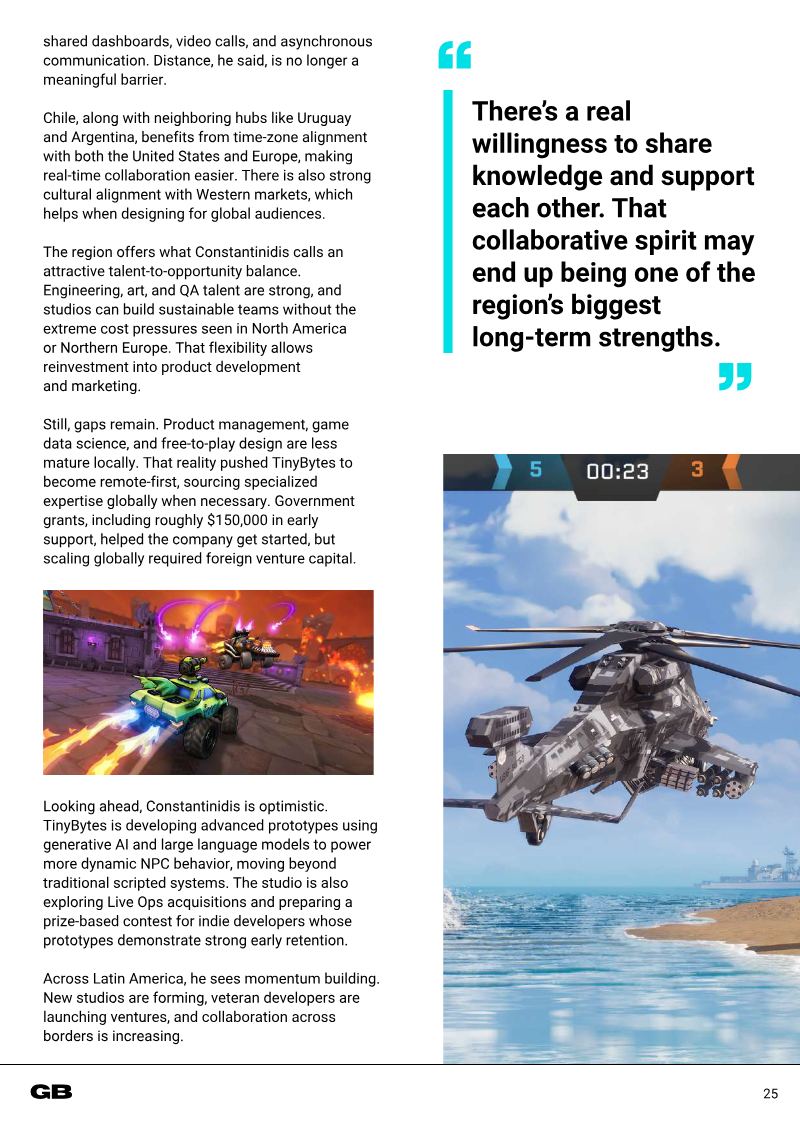
- Successful regional studios like Chile-based TinyBytes have achieved significant scale, with over 100 million downloads and $40 million in lifetime gross revenue from titles like Massive Warfare.
- Growth in the LATAM market is frequently driven by localized payment methods, such as PIX in Brazil and OXXO in Mexico, which are essential for reducing friction in price-sensitive, mobile-first economies.