GamesBeat
Media3 documents
Documents
Article
Global Gaming Workforce Growth Analysis: North America Trends
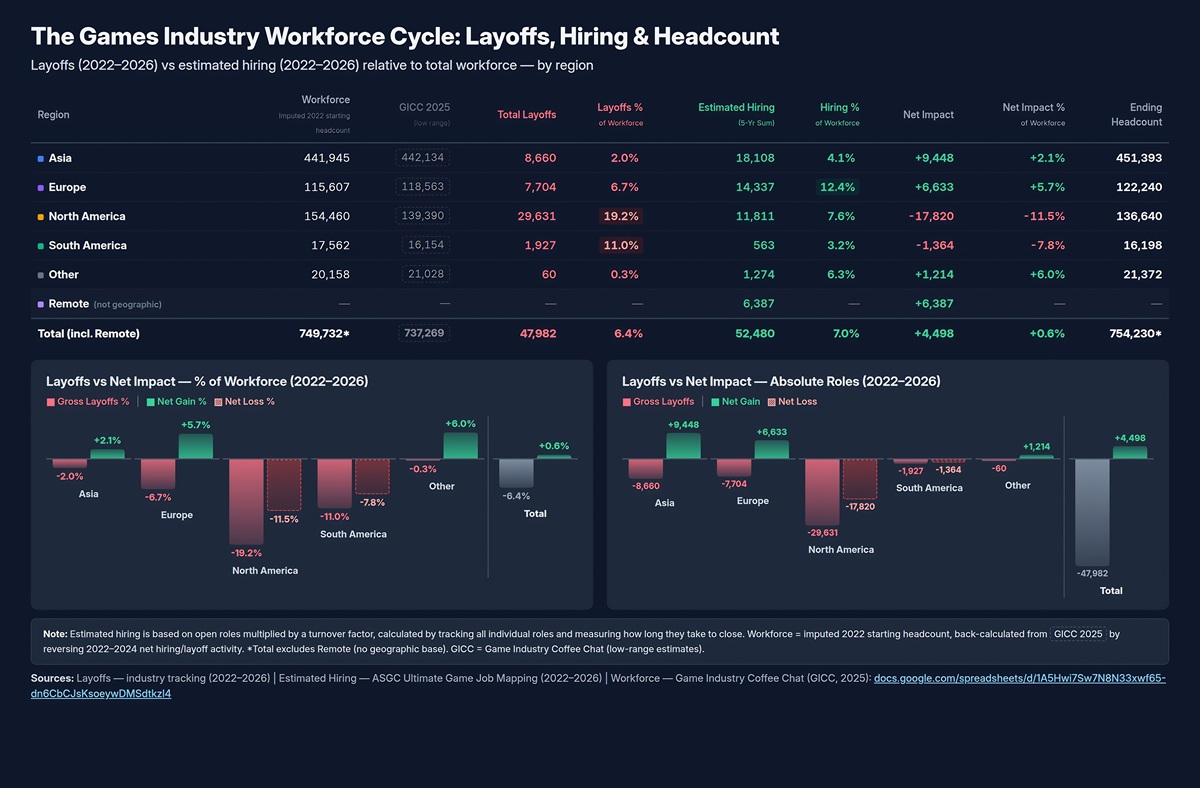
The global gaming industry experienced a period of stagnation between 2022 and 2026, with the total workforce growing by only 0.6%, or approximately 4,000 net new roles. This represents a significant shift from the rapid expansion observed between 2017 and 2022, when the industry functioned as a high-capacity "sponge" for new talent. While the global headcount remained relatively flat, the regional distribution of labor shifted, with North America experiencing an 11.5% contraction in its gaming workforce, losing 19.2% of its regional staff during this four-year window.
The analysis, which utilizes proprietary data from the Always Supporting the Gaming Community (ASGC) and industry-wide layoff tracking, highlights a severe imbalance between labor supply and demand. An estimated 288,000 individuals—including graduates, career switchers, and laid-off workers—competed for limited opportunities, resulting in a global ratio of five job seekers for every one hire. In North America, the situation is more acute, with an 11-to-1 ratio of seekers to hires. While the industry is not shrinking in total size, it has effectively ceased its previous pace of absorption, creating a challenging environment for new entrants.
Methodologically, the findings are derived from a triangulation of regional industry data, public and non-public layoff records, and an analysis of open role turnover. The data indicates that while North America has seen a decline, jobs have redistributed toward Europe and Asia. Within the United States, there is a notable migration of open roles from the West, South, and Southwest toward the Northeast, specifically New York and Boston. Despite these shifts, the industry remains characterized by high concentration, with a small number of large-scale events accounting for the majority of layoffs.
- From 2022 to 2026, the global gaming workforce experienced a modest growth of 0.6%, increasing from approximately 750,000 to 754,000 employees, despite 48,000 roles being eliminated globally.
- North America's gaming workforce significantly shrank by 11.5% between 2022 and 2026, losing 19.2% of its regional workforce, while other regions like Asia (2% loss) and Europe (6.7% loss) experienced smaller declines.
- The gaming industry saw approximately 48,000 roles eliminated globally from 2022 through 2026, but also experienced roughly 52,500 new hires in the same period, indicating a redistribution rather than a collapse of the industry.
- The number of job seekers in the gaming industry has surged, with roughly five seekers for every one global hire, and an even more competitive 11 to 1 ratio in North America, where the market was actively shrinking.
- The 2026 projected layoffs in the gaming industry have risen to 11,580, an 8.4% increase from the March 24, 2026 forecast, bringing the cumulative total of layoffs from 2022-2026 to an estimated 55,408.
GamesBeat

Report36 pages
Asia Pacific Market Report 2025: Creating Opportunities for Video Games in Asia
Asia’s gaming landscape in 2025 is dominated by a triad of regional strengths that together shape the global market. Japan remains the cultural nucleus, with iconic franchises such as Pokémon, Final Fantasy and Monster Hunter generating $215 billion in worldwide influence and $178.8 million in IP revenue, while mobile titles like Fate/Grand Order expand overseas earnings. The country’s mature domestic market and brand prestige are offset by regulatory limits on gacha mechanics, sparse esports sponsorships, and a need to align with global live‑service standards. Success will depend on leveraging storytelling prowess and anime‑gaming synergies rather than chasing fleeting trends.
South Korea contributes a high‑speed, 5G‑driven esports ecosystem and hybrid free‑to‑play models that set industry benchmarks for competitive play and monetization. Southeast Asia, meanwhile, is the fastest‑growing mobile‑centric market, with a $14.8 billion industry powered by 680 million under‑30 residents and high mobile engagement. Monetization is shifting from ad‑heavy hypercasuals to midcore RPGs and MOBAs, supported by local payment systems such as GCash and GoPay. Esports in the region is projected to generate $350–380 million, underscoring its economic significance.
Developers face significant entry barriers across the APAC region, including localization challenges, fragmented regulations, and diverse payment ecosystems. End‑to‑end solutions that integrate local payments, provide compliance support, and enable flexible distribution are essential. Embedding community‑driven monetization—through affiliate revenue shares, in‑game branded content, and live‑stream partnerships—offers a sustainable path to growth. The overarching thesis is that deep cultural insight, sharp localization, and adaptability to mobile‑first dynamics are the keys to unlocking opportunities in Asia’s rapidly evolving gaming market.
- Southeast Asia is the region's fastest-growing mobile-centric market, currently valued at $14.8 billion and driven by a demographic of 680 million residents under the age of 30.
- Japan remains a global cultural powerhouse, with iconic franchises generating $215 billion in worldwide influence and $178.8 million in IP-specific revenue.
- Esports in Southeast Asia is a significant economic driver, with projected revenue between $350 million and $380 million.
- Market entry in the APAC region requires integrated solutions for fragmented regulations, diverse payment ecosystems like GCash and GoPay, and complex localization challenges.
- Monetization strategies in Southeast Asia are shifting away from hypercasual ad-heavy models toward midcore RPGs and MOBAs.
GamesBeat
Report33 pages
State of the LATAM Games Industry 2026
Latin America has solidified its position as a formidable force in the global gaming landscape, transitioning from a peripheral source of cost-effective labor to a sophisticated hub of creative innovation and live service expertise. Driven by massive, mobile-first player populations in Brazil and Mexico, the region is increasingly defined by high levels of community engagement and a thriving esports culture. While economic challenges such as currency volatility and limited infrastructure persist, the industry is successfully pivoting toward sustainable, long-term business models that prioritize authentic, socially integrated experiences over traditional, short-term monetization strategies.
The regional ecosystem is characterized by a strategic shift toward self-publishing and advanced Live Ops, supported by a deep pool of engineering talent that is increasingly utilizing artificial intelligence to enhance production efficiency. Although major hubs like Brazil and Mexico anchor the market, smaller nations such as Argentina and Ecuador are gaining international visibility through indie innovation and strategic global partnerships. This evolution reflects a broader maturation of the industry, where developers are moving beyond simple localization to address the specific technological and cultural nuances of individual domestic markets.
Success within this territory requires a departure from standardized global frameworks in favor of localized strategies that account for unique payment preferences and regional economic constraints. Despite systemic hurdles regarding access to specialized venture capital and user acquisition, the region offers significant growth potential for developers who commit to long-term engagement. By fostering trust and prioritizing accessibility, the Latin American gaming sector is effectively countering the stagnation currently impacting global mobile markets, establishing itself as a vital, influential player in the international creative economy.
- Brazil and Mexico serve as the region's primary anchors, with Brazil driving engagement across all platforms and Mexico acting as a commercial gateway for global publishers.
- Mexico's gaming industry generated $1.27 billion in revenue in 2024, with mobile and tablet devices accounting for 72% of all gaming activity.
- Brazil hosts a robust ecosystem of over 1,000 developers, while indie game creation in Mexico grew by 30% year-over-year in 2023.
- Successful regional studios like Chile-based TinyBytes have achieved significant scale, with over 100 million downloads and $40 million in lifetime gross revenue from titles like Massive Warfare.
- Growth in the LATAM market is frequently driven by localized payment methods, such as PIX in Brazil and OXXO in Mexico, which are essential for reducing friction in price-sensitive, mobile-first economies.
GamesBeatMay 2026