Showing 30 of 2,310 results · 1.51s
Q2 2026 Market Index: Mobile, Web, and Ad Trends
Sensor Tower
advertising sectors. The analysis highlights a divergence in performance between non-gaming and gaming mobile sectors: while non-gaming mobile revenue reached a record $2.4 billion, mobile gaming
Article1 pages
Jan 2021
Intellectual Property in the Mobile Games Market 2021: An Analysis of IPs in U.S. Mobile Gaming
Sensor Tower
films, books, television, toys, celebrities, sports, board games, video games, comics, and manga. The findings suggest that as the mobile marketing landscape evolves, particularly following changes to identifier
Report25 pages
Aug 2021
Mobile Game Genre Report: Puzzle Games
Newzoo, Pangle
mobile emerged as the primary gaming platform globally, with puzzle games representing a significant 8% of total mobile game revenues, totaling $6.9 billion in 2020. The United States
Report26 pages
Pocket Beans: Hamburger Kultsender Machs Mobilformat
Gamecity Hamburg, Hamburg Kreativ Gesellschaft
station actively encourages local developers to submit mobile titles for potential coverage, signaling an ongoing commitment to integrating mobile gaming into the mainstream discourse of core gaming audiences
Article1 pages
Jan 2021
Next-Gen Mobile Games: The Arrival of Cross-Platform and Evolution of High-Fidelity Mobile Games
Newzoo
gaming has emerged as the dominant force in the global games industry, projected to generate $90.7 billion in 2021 and represent over half of all global gaming revenue
Report47 pages
Jan 2021
The Modern Mobile Gamer: 2021 Gen Z Edition
Tapjoy
indicate that Gen Z is heavily invested in the mobile ecosystem, with 86% using mobile as a gaming platform—significantly higher than the 42% who use consoles
Report19 pages
Jan 2021
The State of Mobile Gaming: An Analysis of Mobile Gaming Market Trends and Top Titles in the U.S., Europe, and Asia
Sensor Tower
dominant market, with PUBG Mobile and Honor of Kings topping download charts. Despite a 44 % YoY decline in Chinese installs, mobile‑game spend there continued to rise, contributing
Report78 pages
Jan 2022
The State of Mobile Game and App Markets: H1 2022
AdQuantum, SocialPeta
costs and the restrictive post-ATT environment, marketers reduced the total volume of mobile game creatives by nearly 30% year-over-year. This contraction reflects a broader industry
Report42 pages
Jan 2021
The State of Mobile Game Advertising: An Analysis of U.S. Mobile Game Advertising Trends in 2021
Sensor Tower
Mobile game advertising in the United States remained resilient through the first half of 2021, showing no immediate negative impact from privacy changes such as the deprecation
Report30 pages
Feb 2026
Vietnam's Mobile Dev Opportunity
Naavik
rise of mobile gaming. The country now hosts over 35 000 game programmers—comparable to China’s workforce—and more than 300 active mobile publishers headquartered in Vietnam
Report7 pages
Mar 2019
Gaming Spotlight 2018 Review
data.ai, International Data Corporation
gaming landscape, focusing on the shifting dynamics between mobile, PC, and console platforms. The report establishes that mobile gaming has solidified its dominance, with consumer spending
Report16 pages
May 2026
Podcast: The Modern Mobile Gaming Economy
Mobile Dev Memo
Mobile gaming revenue in the United States is increasingly concentrated within puzzle and 4X titles, which together command roughly forty‑three percent of iOS earnings. This concentration reflects
Article1 pages
Jul 2026
Mobile Game Ad Monetization in 2026
Sensor Tower, PWN Games
mobile gaming industry is increasingly shifting toward hybrid monetization models as developers seek to maximize revenue in a stagnating in-app purchase (IAP) environment
Article1 pages
Jan 2021
The State of Mobile Game Advertising: U.S. 2021
Sensor Tower
mobile game advertising landscape in the United States remained resilient throughout the first half of 2021, showing no immediate negative impact from industry-wide privacy changes such
Report30 pages
Jan 2023
State of Mobile Games: Cognitive and Psychological Benefits
Skillprint
competitive games enhanced focus and grit. Non‑game controls such as a dripping faucet video yielded negative mood shifts, underscoring the relative benefit of game interventions. The findings
Report14 pages
Benin’s Malaika Games to Launch Idle RPG “Clash of Myths” on iOS and Android
Games Industry Africa
Malaika Games, a mobile game development studio based in Cotonou, Benin, officially launched its debut title, Clash of Myths, on August 7, 2026. The game is available
Article1 pages
May 2026
Why Players Play: The Psychology Behind Mobile Games
Sensor Tower
Mobile game development relies on the strategic alignment of product features with fundamental human psychological drivers to maximize player retention and monetization. By integrating core motivations such
Report63 pages
Dec 2019
200+ Mobile Gaming Market Statistics
Udonis
global mobile gaming industry has successfully navigated a post-pandemic market correction, establishing a stable foundation for long-term growth. With 2024 revenues reaching $92 billion and projections
Article1 pages
Jan 2018
A Global Analysis of Mobile Gaming Benchmarks: 2018 Edition
GameAnalytics
mobile gaming landscape between July 2017 and June 2018 was characterized by a widening performance gap between elite titles and the market median. Analysis of over
Report31 pages
Jan 2022Google
Data for Mobile Gaming 2022-2024
Mobile gaming maintains its position as the primary driver of industry expansion, fueled by widespread smartphone adoption and consistent engagement across both emerging and established markets. Between
Report56 pages
Jan 2023
App Store Growth Slows for Apple in 2022: IDFA and ATT
Lu Weiming
mobile gaming industry experienced a notable stagnation in 2022, characterized by flat revenue growth for Apple’s App Store and a decline in Google Play revenue. While Apple
Article1 pages
Jan 2022
Games Can Be Good for the Mind: State of Mobile Games – Cognitive and Psychological Benefits
Skillprint
gaming, challenging the narrative that gaming is primarily detrimental to mental health. Based on a large-scale study of nearly 500 U.S. participants and 28 individual game impact
Report14 pages
Apr 2026
2026 Global Mobile Gaming Marketing Trends White Paper
SocialPeta, Singular Aarki
white paper establishes that the mobile‑gaming advertising ecosystem expanded rapidly in 2025, with more than 90 000 active advertisers and an influx of roughly
Report90 pages
Dec 2016
Raport Bieżący Nr 31/2016
PlayWay
complete the production of several pending mobile games under ECC Games’ pipeline. The capital increase restructured ownership of ECC Games, allocating 25.03 % of the enlarged equity to Playway
Legal2 pages
Jan 2025
The Israeli Mobile Game Market Report (2022)
SocialPeta
Israeli mobile game market reached approximately $9 billion in 2021, driven by more than 200 companies and 14,000 employees. Casual, puzzle, and hyper‑casual titles now represent
Report40 pages
May 2025
Mobile Gaming's $4.1 Billion Reboot
SuperJoost
mobile gaming industry is undergoing a significant structural transformation driven by legal and regulatory challenges to the traditional 30% platform commission model. Following the U.S. Supreme Court
Article1 pages
Jan 2021
PaaS for Mobile Cloud Gaming
Niko Partners
global expansion of this model beyond Asia, reshaping monetization and discovery in the mobile gaming ecosystem
Report23 pages
Jan 2025
Mobile Gaming M&A Playbook: How to Identify and Target High‑Growth Gaming Companies
Sensor Tower
playbook outlines a systematic approach for mobile gaming publishers and investors to identify, evaluate, and acquire high‑growth developers. It argues that the mobile gaming market—projected
Report5 pages
Jan 2022
The State of Mobile Game and App Markets: Global Report on App Marketing for H1 2022
AdQuantum
Document Title: The State of Mobile Game and App Markets: H1 2022 Executive Overview Market Contraction, but Not Uniform: Overall mobile‑app and game ecosystem shrank
Report42 pages
Mobile Game Dissections
Udonis
provided content serves as a repository of analytical case studies focused on the mobile gaming industry. The primary objective is to provide developers, marketers, and industry stakeholders with
Article1 pages
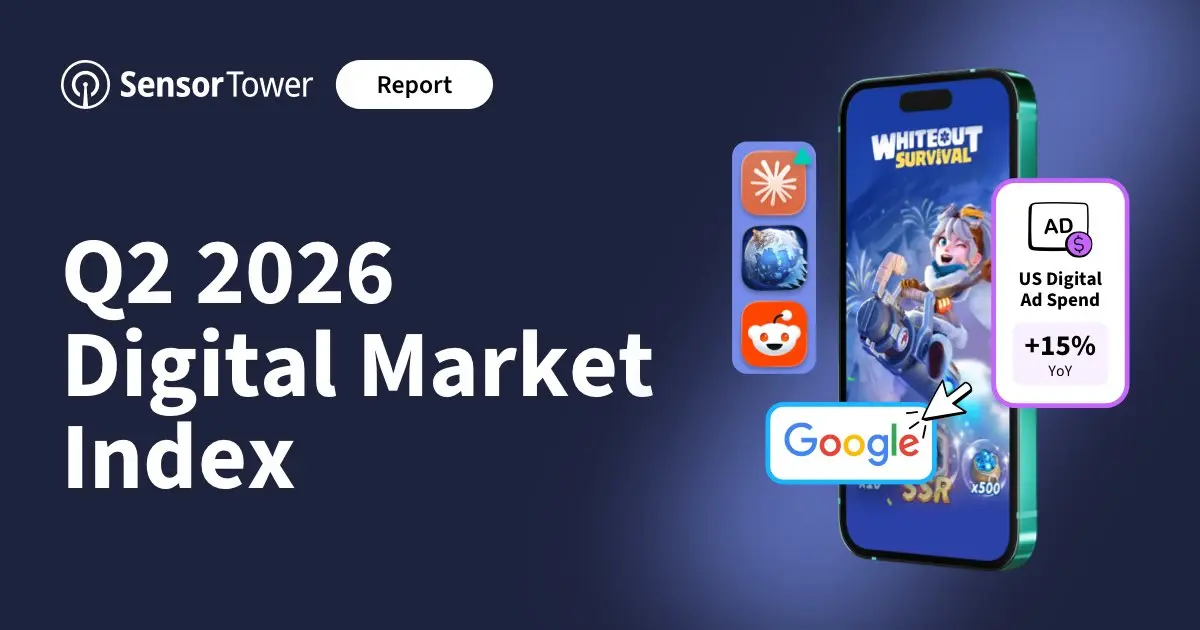
Q2 2026 Market Index: Mobile, Web, and Ad Trends
1 pages1k words
Summary
The Q2 2026 Digital Market Index provides a comprehensive performance review of the global digital economy, focusing on shifts in mobile, web, and advertising sectors. The analysis highlights a divergence in performance between non-gaming and gaming mobile sectors: while non-gaming mobile revenue reached a record $2.4 billion, mobile gaming experienced a 5.9% quarter-over-quarter decline, falling below $20 billion for the first time in over two years.
The broader digital landscape shows signs of resilience and structural change. Digital advertising reached $49 billion, with social channels capturing 54% of total U.S. spend as linear TV investment dropped by 6%. Within the advertising sector, shopping remains the leading category, bolstered by significant growth from major retailers. Conversely, the retail media segment faced headwinds, with total U.S. impressions declining 19% year-over-year, largely driven by a 27% drop from Amazon.
Technological adoption continues to reshape monetization strategies, particularly within generative AI. While ChatGPT retains a 60% revenue share, competitors including Claude, Grok, and Gemini have demonstrated rapid growth, each increasing revenue by at least 7x year-over-year. Additionally, global web engagement remains stable, with 2.04 trillion visits recorded in Q2. Growth in this area is increasingly driven by emerging economies, specifically India, Argentina, and Saudi Arabia.
The findings are derived from a 50-page analysis incorporating over 45 interactive charts covering global digital trends. By contrasting the contraction in mobile gaming and retail media impressions against the expansion of social advertising and AI monetization, the data illustrates a digital economy currently defined by shifting consumer priorities and evolving platform dominance.
Insights
- Mobile gaming revenue declined 5.9% quarter-over-quarter, falling below $20 billion for the first time in nine quarters.
- Non-gaming mobile revenue reached a record $2.4 billion, providing a buffer against the gaming sector's downturn.
- Digital advertising spend reached $49 billion, with social channels capturing 54% of total US expenditure as linear TV spend dropped 6%.
- While ChatGPT maintains a 60% revenue share in the Gen AI market, competitors Claude, Grok, and Gemini each achieved at least 7x year-over-year revenue growth.
- Retail media in the US saw a 19% year-over-year decline in total impressions, driven largely by a 27% drop from market leader Amazon.
Showing 1 – 30 of 2,310