Showing 28 of 89 results · 0.18s
Jan 2024
Perforce 2024 State of Game Technology Report
Perforce, JetBrains
Cloud development is also prevalent: 49 % run cloud servers, led by AWS (30 %) and Azure (18 %), while hybrid or on‑premises setups are rare. Hiring priorities across gaming
Report33 pages
Jan 2024
2024 State of Game Technology Report
Perforce
global game technology landscape has reached a critical inflection point in 2024, characterized by the widespread expansion of game engines into non-gaming sectors such as automotive, healthcare
Report33 pages
Jan 2024
Gaming Report 2024: Meet the Moment
Bain & Company
rise of cloud-based distribution and the demand for seamless, multi-channel experiences. As market saturation intensifies, the high failure rates observed in mobile gaming underscore the need
Report32 pages
Jan 2025
Gaming 2025 (Epyllion)
Epyllion
enabling new cloud-native experiences and third-party storefronts. By 2030, nearly one billion mobile devices will be capable of running high-fidelity console-spec games, positioning emerging
Report224 pages
Jan 2025
Japan’s World of Gaming & Influencer Marketing 2025
Nintendo
RPGs and adventure titles. The ecosystem is increasingly defined by the convergence of gaming, live streaming, and broader entertainment. Esports revenue is expected to reach ¥21.8 billion
Report74 pages
May 2010
Informe de Resultados: Cómo se proyecta el videojuego del futuro
AEVI
projected surge in immersive content. The forecast anticipates that roughly 68 % of all game sales will be conducted through virtual stores or server‑based platforms, eliminating the need
Report69 pages
Jan 2021
Next-Gen Mobile Games: The Arrival of Cross-Platform and Evolution of High-Fidelity Mobile Games
Newzoo
gaming has emerged as the dominant force in the global games industry, projected to generate $90.7 billion in 2021 and represent over half of all global gaming revenue
Report47 pages
The Future of Gaming Infrastructure: 2026-2028
InvestGame
gaming industry is currently undergoing a critical architectural transition as live-service titles face a trilemma of escalating operational demands: the need for sub-10ms AI-driven decision
Report17 pages
Jan 2025
Global Games Market Report 2025
Newzoo
profitability across a game’s back catalogue. Methodologically, the report employs a top‑down, data‑driven model that blends proprietary engagement metrics (Game Performance Monitor, Steam data), public
Report67 pages
Game Data: Building vs Buying
InvestGame
building an in‑house data pipeline and purchasing a third‑party solution for game analytics, using GameAnalytics’ PipelineIQ Pro as the primary example. It argues that while custom
Report11 pages
Jan 2020
Games Industry 2019/20
game – Verband der deutschen Games-Branche e. V.
curricula in game design, computer science, art and virtual reality, concentrating talent pipelines in Berlin and Hamburg. Mid‑size studios such as Deep Silver, Kolibri Games and Mimimi
Report43 pages
Jan 2024
The Xsolla Report: State of Play – Summer Edition 2024
Xsolla
Summer Edition of the Xsolla Report demonstrates that indie game development has entered a phase of rapid democratization and commercial viability. Accessible engines such as Unity, Unreal
Report53 pages
Jan 2021
Newzoo Metaverse Report 2021
Newzoo
beyond sharded instances to thousands of users in a single persistent world—requires cloud-native infrastructure and radical improvements in network protocols. Additionally, the industry must navigate regional
Report71 pages
Jun 2024
How to Master Europe’s Digital Infrastructure Needs?
Video Games Europe
Video Games Europe argues that Europe’s digital infrastructure policy should reinforce, rather than reshape, the existing market dynamics that underpin the continent’s thriving video‑game ecosystem
Report6 pages
Jan 2010
¿Cómo Se Proyecta el Videojuego del Futuro?: España
AEVI
barriers to online play, and the aspirations of different user segments for future gaming experiences. Research combined three perspectives—regular gamers, industry experts and parents—through focus groups
Report17 pages
A Shortcut to Your Own Game Insights Platform
InvestGame
titles using Raw Export—illustrating tangible ROI gains. The scope covers global game studios, with examples from iOS, Android, Steam, and VR platforms. Timeframes referenced include daily updates
Report20 pages
Feb 2026
Mobile Market Landscape 2026
AppMagic
approximately 80% as developers move toward puzzle and simulation subgenres. Meanwhile, midcore gaming revenue has plateaued at $33–34 billion, prompting a reliance on intensified LiveOps and direct
Report94 pages
Dec 2025
Leveling Up for the New Reality: The Gaming Report
InvestGame
report examines the global gaming market’s evolution from 2017 to 2028, highlighting a post‑pandemic correction that has shifted growth expectations from double‑digit rates to modest
Report18 pages
Jan 2024
Xsolla Report: State of Play – Winter 2024 Edition
Xsolla
global gaming industry is currently navigating a period of stabilization following a massive 26% growth surge between 2019 and 2021. While the rapid pandemic-era expansion has moderated
Report55 pages
Interview with Game Expert at Line Studio: Japan Market Insights
Korea Creative Content Agency
shift 1. Time‑scarcity: Japanese commuters and office workers increasingly favor games that can be enjoyed in 5‑10‑minute bursts. 2. Platform diversification: With smartphones
Report21 pages
1Q FY2023 Presentation Material
CyberAgent
FY2023, emphasizing a dual‑stream business model that blends advertising revenue with game development while expanding into media and digital content. Core financial highlights show a modest increase
Report30 pages
Jan 2025
Interview with Yi Yuan, at Hiverlab: Southeast Asia
Korea Creative Content Agency
time and interaction density to assess engagement. Effective experiences consistently incorporate gamified micro‑games and selfie‑style interactions that encourage user participation and social sharing. These design elements
Report15 pages
Beyond the Game: How Gamification is Becoming Mainstream
InvestGame, GDev
analysis examines how gamification—applying game‑like mechanics such as streaks, leaderboards, and reward loops—to non‑gaming consumer apps has shifted the mobile app economy over
Report9 pages
Jan 2024
The PC & Console Market Gaming Report 2024
Newzoo
approximately 30 publishers who control 80% of all monthly active users. In 2023, games six years or older accounted for over 60% of total playtime. Although new releases
Report46 pages
Jan 2021
Intro to the Metaverse 2021
Newzoo
The metaverse represents a fundamental evolution of the gaming industry, transitioning from Games-as-a
Report71 pages
May 2025
The State of Video Gaming in 2026
Epyllion
The global video game industry is currently navigating a period of significant contraction and structural
Report231 pages
Jan 2024
Mobile Growth and Monetization Report 2024
Unity
The 2024 mobile gaming landscape is defined by a strategic transition from volume-based user
Report48 pages
Jan 2023
Game Development Report 2023
Rendered VC, Griffin Gaming Partners
The global game development landscape is currently undergoing a fundamental transition driven by escalating project
Report47 pages
Perforce 2024 State of Game Technology Report
Jan 202433 pages9k words
Summary
The report demonstrates that real‑time 3D engines and advanced asset pipelines are now integral to more than half of organizations beyond traditional game development, spanning media, automotive, education and healthcare. The primary drivers are the demand for high‑quality visual tools that can be reused across projects and the need to streamline workflows amid increasingly complex, remote‑enabled teams. Funding constraints, collaboration bottlenecks—particularly large‑file transfer—and limited staffing emerge as the top challenges.
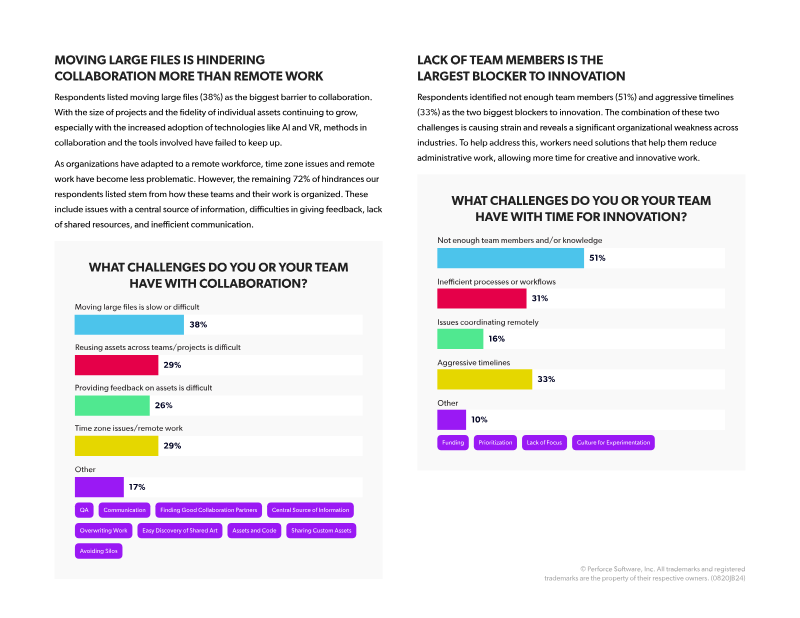
Collaboration pain points persist, with 31 % of studios citing slow large‑file transfer and 38 % reporting remote coordination issues. Unreal Engine dominates usage at 63 %, while Unity follows at 47 %. Perforce Helix Core leads version‑control adoption (51 %) across industries, with GitHub and GitLab trailing. These figures underscore the necessity of robust pipelines that support rapid asset sharing, remote teamwork and efficient version control.
Asset management practices vary by studio size: AAA studios largely build custom tools (≈ 19 %) to handle extensive IP libraries, diverting resources from core development; indie and mid‑size studios rely more on market solutions, with 32 % using Perforce Helix Core and only 17 % developing in‑house tools. Generative AI is widely adopted, with over 65 % of respondents using an AI tool—ChatGPT being the most common (47 %). Indie studios adopt AI more aggressively than AAA studios, and usage patterns differ by industry. Cloud development is also prevalent: 49 % run cloud servers, led by AWS (30 %) and Azure (18 %), while hybrid or on‑premises setups are rare.
Hiring priorities across gaming, media, education, engineering and automotive sectors emphasize specialized experience (91–100 %) and strong portfolios (75–94 %). General cross‑functional skills such as rapid learning and presentation abilities are valued but to a lesser extent (54–82 %). The data indicate that firms prioritize deep technical expertise and demonstrable work, reflecting a continued focus on specialized knowledge across all sectors.
Pages

Insights
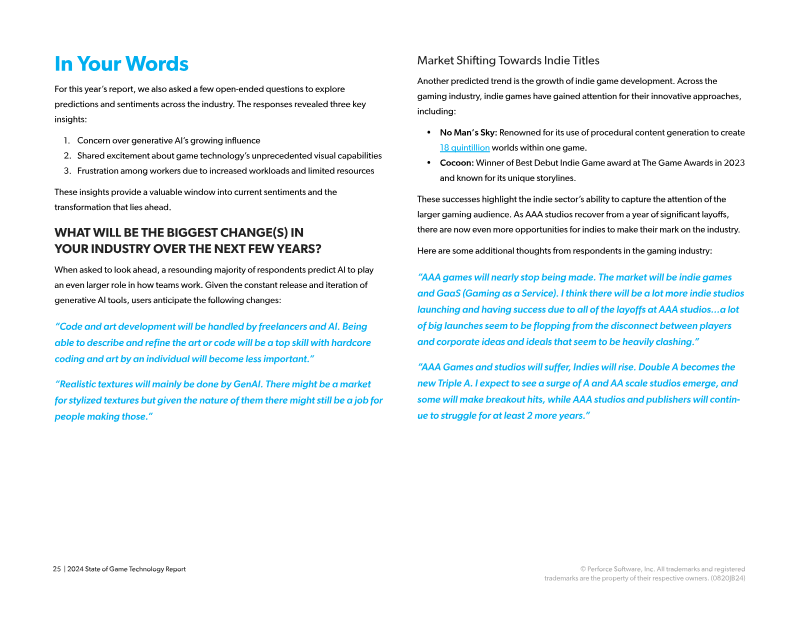
- Real-time 3D engines have expanded beyond gaming, with over 50% of organizations in media, automotive, education, and healthcare now integrating these technologies into their workflows.
- Unreal Engine leads the market with 63% usage, followed by Unity at 47%, while Perforce Helix Core remains the primary version-control solution for 51% of firms.
- Generative AI adoption is widespread, with over 65% of respondents utilizing AI tools, led by ChatGPT at 47%, with indie studios showing higher adoption rates than AAA counterparts.
- Collaboration remains a significant bottleneck, as 31% of studios struggle with slow large-file transfers and 38% report ongoing issues with remote team coordination.
- Cloud infrastructure is the industry standard for development, with 49% of organizations utilizing cloud servers, primarily through AWS (30%) and Azure (18%).
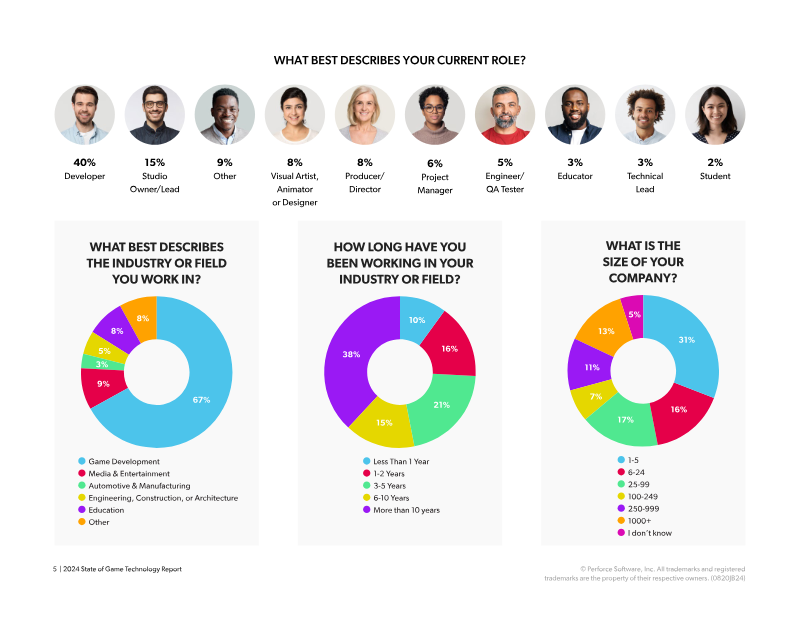
HOW LONG HAVE YOU BEEN WORKING IN YOUR INDUSTRY OR FIELD?
Showing 61 – 89 of 89