Updated Jun 1, 2026 by InvestGame
Report · December 14, 2025
Published by InvestGame
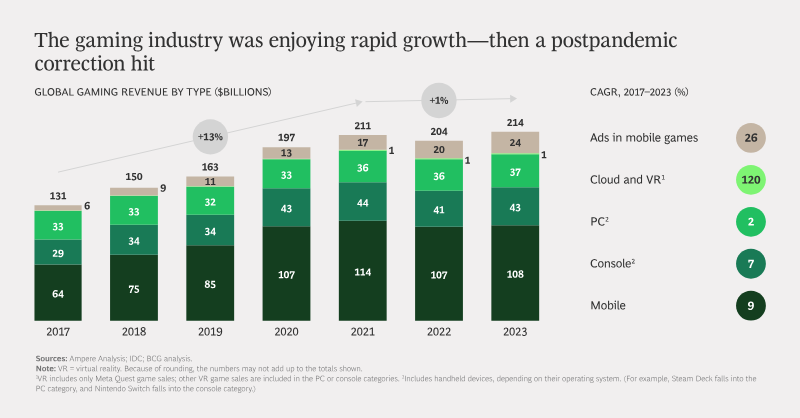
The gaming industry was enjoying rapid growth—then a postpandemic GLOBAL GAMING REVENUE BY TYPE ($BILLIONS) +1% CAGR, 2017–2023 (%) +13% 197 211 204 214 Ads in mobile games 26 163 13 17 1 20 1 24 1 131 150 9 11 33 36 36 ...
The gaming industry was enjoying rapid growth—then a postpandemic correction hit GLOBAL GAMING REVENUE BY TYPE ($BILLIONS) +1% CAGR, 2017–2023 (%) +13% 197 211 204 214 Ads in mobile games 26 163 13 17 1 20 1 24 1 131 150 9 11 33 36 36 37 Cloud and VR¹ 120 33 6 33 32 43 44 41 43 PC² 2 29 34 34 107 114 107 108 Console² 7 64 75 85 Mobile 9 2017 2018 2019 2020 2021 2022 2023 Sources: Ampere Analysis; IDC; BCG analysis. Note: VR = virtual reality. Because of rounding, the numbers may not add up to the totals shown. 1VR includes only Meta Quest game sales; other VR game sales are included in the PC or console categories. 2Includes handheld devices, depending on their operating system. (For example, Steam Deck falls into the PC category, and Nintendo Switch falls into the console category.)
Future growth will be more modest, as double-digit rates are unlikely to return GLOBAL GAMING REVENUE BY TYPE ($BILLIONS) CAGR, 2023-2028E (%) +5% 243 254 2 266 2 Ads in nonmobile games 56 214 221 0 232 0 31 1 32 3 34 3 Ads in mobile games 7 24 1 26 2 28 2 39 2 40 41 Cloud and VR¹ 16 37 37 39 47 48 50 43 43 45 PC² 2 108 113 118 124 130 137 Console² 3 Mobile 4 2023 2024E 2025E 2026E 2027E 2028E Sources: Ampere Analysis; IDC; BCG analysis. Note: VR = virtual reality. Because of rounding, the numbers may not add up to the totals shown. 1VR includes only Meta Quest game sales; other VR game sales are included in the PC or console categories. 2Includes handheld devices, depending on their operating system. (For example, Steam Deck falls into the PC category, and Nintendo Switch falls into the console category.)
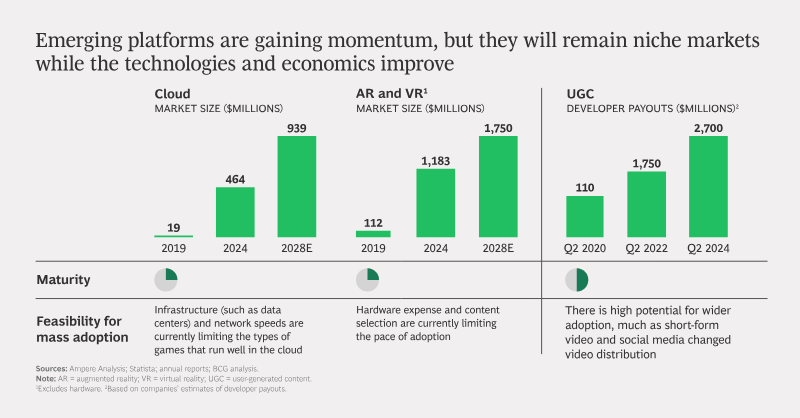
Emerging platforms are gaining momentum, but they will remain niche markets while the technologies and economics improve Cloud AR and VR¹ UGC MARKET SIZE (MILLIONS) MARKET SIZE (MILLIONS) DEVELOPER PAYOUTS ($MILLIONS)² 939 1,750 2,700 1,183 1,750 464 110 19 112 2019 2024 2028E 2019 2024 2028E Q2 2020 Q2 2022 Q2 2024 Maturity Feasibility for Infrastructure (such as data Hardware expense and content There is high potential for wider mass adoption centers) and network speeds are selection are currently limiting adoption, much as short-form currently limiting the types of the pace of adoption video and social media changed games that run well in the cloud video distribution Sources: Ampere Analysis; Statista; annual reports; BCG analysis. Note: AR = augmented reality; VR = virtual reality; UGC = user-generated content. 1Excludes hardware. 2Based on companies’ estimates of developer payouts.
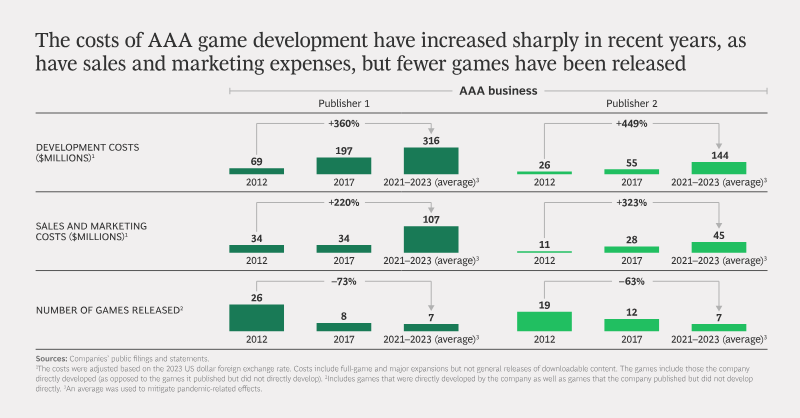
> **[Chart page]** This page contains visual data — view in PDF for the best experience. The costs of AAA game development have increased sharply in recent years, as have sales and marketing expenses, but fewer games have been released Publisher 1 AAA business Publisher 2 +360% +449% DEVELOPMENT COSTS 197 316 144 ($MILLIONS)¹ 69 26 55 2012 2017 2021–2023 (average)³ 2012 2017 2021–2023 (average)³ +220% +323% SALES AND MARKETING 107 45 COSTS ($MILLIONS)¹ 34 34 11 28 2012 2017 2021–2023 (average)³ 2012 2017 2021–2023 (average)³ –73% –63% NUMBER OF GAMES RELEASED² 26 8 7 19 12 7 2012 2017 2021–2023 (average)³ 2012 2017 2021–2023 (average)³ Sources: Companies’ public filings and statements. 1The costs were adjusted based on the 2023 US dollar foreign exchange rate. Costs include full-game and major expansions but not general releases of downloadable content. The games include those the company directly developed (as opposed to the games it published but did not directly develop). ²Includes games that were directly developed by the company as well as games that the company published but did not develop directly. ³An average was used to mitigate pandemic-related effects.
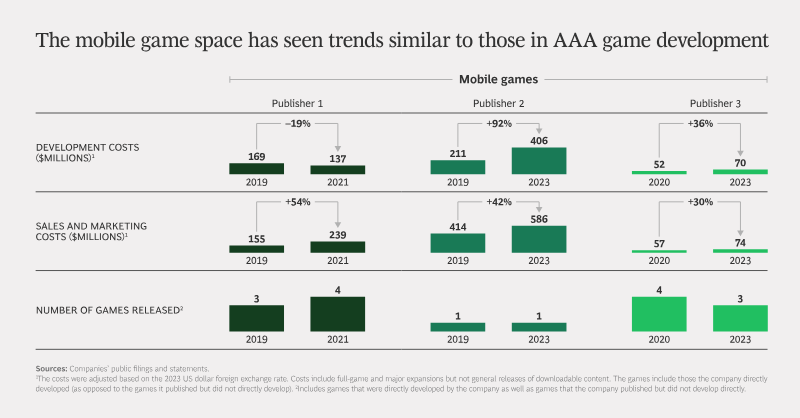
> **[Chart page]** This page contains visual data — view in PDF for the best experience. The mobile game space has seen trends similar to those in AAA game development Mobile games Publisher 1 Publisher 2 Publisher 3 ~~–19%~~ ~~+92%~~ ~~+36%~~ DEVELOPMENT COSTS 169 211 406 ($MILLIONS)¹ 137 52 70 2019 2021 2019 2023 2020 2023 ~~+54%~~ ~~+42%~~ ~~+30%~~ SALES AND MARKETING 239 414 586 COSTS ($MILLIONS)¹ 155 57 74 2019 2021 2019 2023 2020 2023 NUMBER OF GAMES RELEASED² 3 4 1 1 4 3 2019 2021 2019 2023 2020 2023 Sources: Companies’ public filings and statements. 1The costs were adjusted based on the 2023 US dollar foreign exchange rate. Costs include full-game and major expansions but not general releases of downloadable content. The games include those the company directly developed (as opposed to the games it published but did not directly develop). ²Includes games that were directly developed by the company as well as games that the company published but did not develop directly.
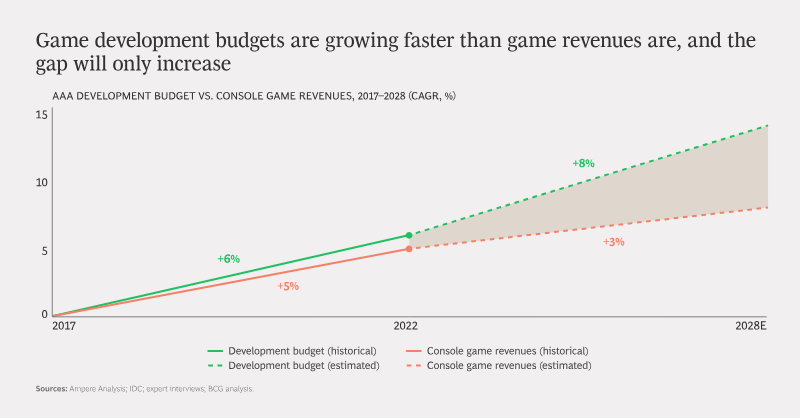
Game development budgets are growing faster than game revenues are, and the gap will only increase AAA DEVELOPMENT BUDGET VS. CONSOLE GAME REVENUES, 2017–2028 (CAGR, %) +8% 5 +6% +3% +5% 0 2017 2022 2028E Development budget (historical) Console game revenues (historical) Development budget (estimated) Console game revenues (estimated) Sources: Ampere Analysis; IDC; expert interviews; BCG analysis.
The interim filing presents the fourth‑quarter 2025 financial results for a midcore‑casual gaming group, emphasizing a record‑setting revenue run and the successful execution of a transformation agenda that includes the integration of the Plarium acquisition and the rollout of a new district structure in early 2026. Revenue reached SEK 3,123 million, reflecting 108 % organic growth year‑on‑year and a 25 % increase on a constant‑currency basis, while adjusted EBITDA rose to SEK 717 million, delivering a 23 % margin that matches the full‑year figure. Unlevered free cash flow amounted to SEK 878 million, with a cash‑conversion rate of 66 % and a leverage ratio of five times EBITDA, underscoring robust liquidity and disciplined capital management. User‑acquisition spending accelerated, representing 38 % of quarterly revenue—up from 37 % in the prior quarter—and grew 76 % on a reported basis, driven by heightened investment in original studios, new casual titles, and the racing franchise. The direct‑to‑consumer channel expanded by 600 basis points to 32 % of total revenue, reflecting a strategic shift toward higher‑margin in‑app purchases. Across the fiscal year, the company posted a 9 % organic revenue increase, with word‑games, racing, and RAID franchises delivering the strongest quarter‑end performance. Operating cash flow for the quarter stood at SEK 840 million, while adjusted net income was SEK 1,390 million, translating to an adjusted EPS of SEK 11.33. The financial outcomes exceed guidance and position the firm to meet its medium‑term outlook, with a pre‑IPO study for PlaySimple concluded and the midcore transformation progressing as planned.
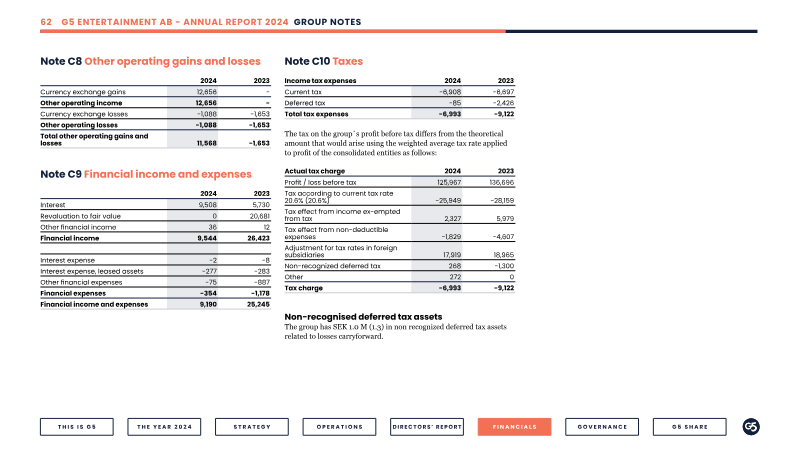
G5 Entertainment’s 2024 performance reflects a strategic pivot toward operational efficiency and margin expansion within the global mobile gaming sector. Despite a 14% year-over-year revenue decline to SEK 1,135 million, the company achieved a 5% increase in operating profit, reaching SEK 116.8 million. This improvement is attributed to a disciplined focus on its core demographic—women aged 35 and older—and the expansion of its proprietary direct-to-consumer G5 Store, which now accounts for 16.1% of total revenue. By leveraging AI-driven development and a rigorous funnel of five to six soft launches annually, the company aims to sustain its position in the evergreen Hidden Object, Match-3, and Mahjong genres. The company maintains a robust financial foundation, characterized by SEK 276 million in available cash and an equity/asset ratio of 83%. Financial stability is further supported by a conservative approach to capital, with no external debt and a portfolio where the top ten titles generate 98% of intangible asset value. While the business remains sensitive to market volatility, currency fluctuations, and reliance on major third-party distribution platforms, auditors have provided an unqualified opinion on the financial statements, confirming that the valuation of capitalized development costs remains within reasonable parameters. Beyond financial metrics, the organization emphasizes a structured approach to corporate governance and human capital. With a gender-balanced workforce and a commitment to ethical business conduct, G5 integrates comprehensive labor policies and 360-degree performance assessments to drive organizational health. While the company has implemented energy-efficient practices, it currently lacks formal climate mitigation plans and EU taxonomy-aligned sustainability metrics. Moving forward, the board remains focused on balancing organic growth with shareholder returns, as evidenced by the proposed dividend of SEK 8.0 per share and a continued emphasis on performance-based executive remuneration.
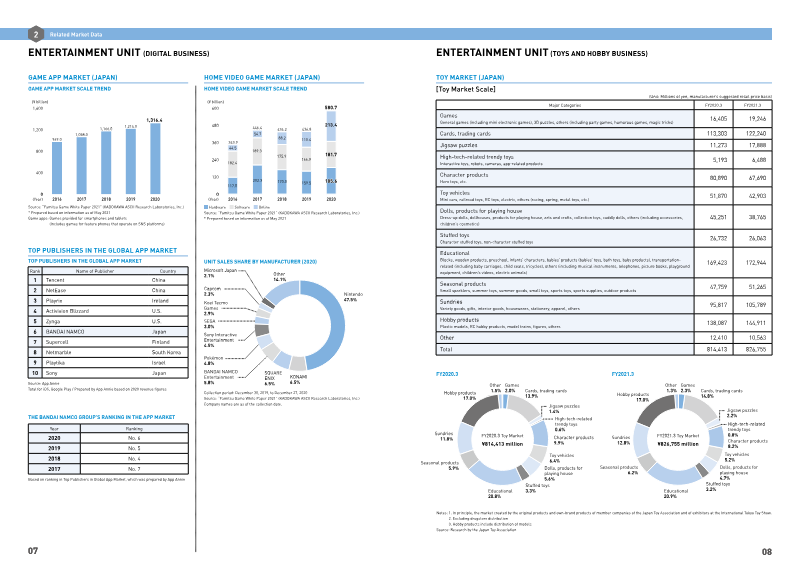
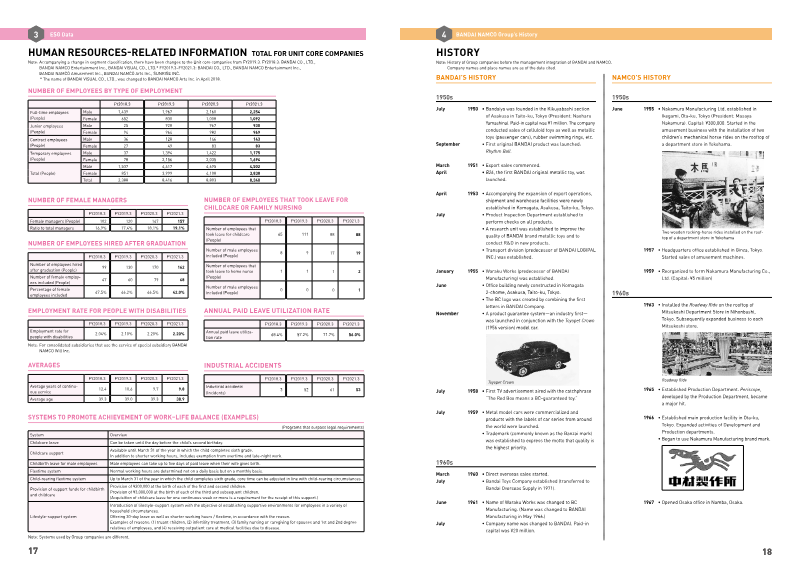
The 2021 Fact Book presents a comprehensive overview of Bandai Namco Holdings’ strategic direction, emphasizing its transformation into a globally integrated entertainment conglomerate and its commitment to corporate social responsibility. Central to the narrative is the thesis that sustained growth across toys, video games, animation and amusement can be achieved through diversified product portfolios, expansive international operations, and proactive sustainability initiatives. The company’s evolution is traced from a collection of independent toy, arcade‑machine and media firms to a unified group after the 2005‑2007 merger of Bandai and Namco. Key milestones include the launch of flagship lines such as Gundam models (over 500 million units shipped), Tamagotchi (exceeding 20 million units), and Zatchbell Battle (300 million units), as well as the development of major video‑game franchises—TEKKEN, DARK SOULS III and Tales—collectively surpassing 50 million sales. International expansion is evident through subsidiaries and regional headquarters in North America, Europe and Asia, reinforced by repeated listings on the Tokyo Stock Exchange and industry recognitions such as Cannes Best Actor and TSE awards. Environmental and social performance data for fiscal year 2021 highlight a suite of CSR actions, including CO₂ reduction targets, supply‑chain safety measures and work‑life‑balance programmes, all framed within the “NEXT STAGE” mid‑term plan aimed at deepening engagement with a mature fan base and broadening cross‑media offerings. The Fact Book thus underscores Bandai Namco’s dual focus on market leadership and sustainable corporate practices across a worldwide footprint and multiple entertainment segments.
The Q1 2021 market snapshot delivers a data‑driven overview of the global mobile‑gaming landscape, focusing on iOS performance in the United States, Japan and China and comparing it with the preceding quarter. By applying GameRefinery’s three‑layered genre taxonomy to the top‑grossing 200 titles, the analysis quantifies shifts in genre share, publisher dominance and emerging feature trends, while also profiling player archetypes and their motivations. Across the three regions the overall market shape remained stable, yet distinct regional dynamics emerged. In the United States simulation games continued to grow and Roblox solidified its position as the leading grossing title, surpassing Playrix and King. Japan saw a measurable decline in RPG share accompanied by a sharp rise in sports, highlighted by Cygames’ Uma Musume Pretty Derby capturing a sizable slice of the charts. China experienced a double‑digit drop in RPG and strategy share, while shooters gained traction. Revenue‑share changes are illustrated by puzzle maintaining a 22.9 % share in the US (+0.1 pp), RPG falling to 45.4 % in China (‑2.7 pp) and sports expanding to 12.3 % in Japan (+27 pp). Monetisation patterns diverged by market: collectibles albums appear in over 70 % of the US top‑100 grossing games, battle‑pass systems are present in more than a quarter of Japan’s top‑100, and special‑gacha mechanics doubled YoY to exceed 30 % of Chinese leaders. Feature analysis shows guild mechanics, co‑op modes and PvP as critical for puzzle, RPG and strategy titles, while social‑collectible systems drive retention in casual segments. Player‑archetype profiling reveals that fast‑paced, competitive “King of the Hill” and “Thrill‑Seeker” types continue to dominate the US top‑200, with a rising “Skill‑Master” segment indicating growing demand for reflex‑based competition. Demographically, puzzle games attract primarily female players aged 25‑44, whereas strategy and RPG titles skew male in the same age bracket. Soft‑launch monitoring flags titles such as Clash Quest, Tom and Jerry: Chase and Pokémon Unite as promising entrants that could