Report49 pages
Mobile App Trends 2025: Japan Edition
Japan remains the world’s third-largest mobile app market, characterized by a resilient consumer spend of $16.5 billion in 2024 and a 7% year-over-year increase in total installs. While the gaming sector remains a foundational pillar, the market is undergoing a significant diversification into finance, entertainment, and digital comics. User trust is also on an upward trajectory, evidenced by App Tracking Transparency opt-in rates rising to 21.4%, with the gaming vertical leading at 31%. This shift suggests a maturing ecosystem where users are increasingly comfortable with data sharing in exchange for personalized experiences.
The gaming sector demonstrated notable stability in the first half of 2025, with a 3% increase in installs that outperformed global trends. Card games experienced a 127% surge in sessions, while role-playing games maintained the highest engagement levels with average session lengths of 40 minutes. Simultaneously, the finance sector emerged as a high-growth vertical, with installs rising 50% driven by payment and banking apps. Although average revenue per monthly active user has seen declines in some sectors, engagement metrics remain strong, particularly in entertainment where short-form drama apps have achieved a high revenue-per-download of $4.13.
A defining trend across the Japanese landscape is the strategic shift toward paid user acquisition. This is most visible in the comic app market, which reached a record paid-to-organic ratio of 1.03. Despite a decline in new installs for comics, the vertical remains a global revenue powerhouse due to deep user loyalty and session lengths averaging over 17 minutes. Across finance, entertainment, and comics, the market is transitioning from a phase of rapid expansion to one focused on maximizing the lifetime value of a culturally invested and highly engaged user base.
- Japan’s mobile market generated $16.5 billion in consumer spend in 2024, supported by a 7% year-over-year increase in total installs.
- The finance sector is a primary growth driver, with a 50% surge in installs fueled by the adoption of payment and banking applications.
- Gaming remains a stable pillar, with card games seeing a 127% increase in sessions and role-playing games maintaining 40-minute average session lengths.
- User trust is maturing, as evidenced by App Tracking Transparency opt-in rates rising to 21.4% overall, with the gaming vertical reaching 31%.
- The comic app market has shifted to a paid-to-organic acquisition ratio of 1.03, prioritizing high lifetime value and user loyalty over raw install volume.
+1
AdjustJan 2025

Report74 pages
Japan’s World of Gaming & Influencer Marketing 2025
Japan represents the world’s third-largest gaming market, valued at $26.3 billion in 2024 with projections to exceed $60 billion by 2033. This growth is underpinned by a mature player base of 55.5 million, characterized by the highest average revenue per user globally at approximately $580. While mobile gaming currently commands 75% of consumer spending, the market is undergoing a structural transition. Digital distribution and subscription models are increasingly replacing physical media, while the PC sector exhibits a robust 8.8% annual growth rate. Domestic giants Sony and Nintendo maintain market leadership by leveraging iconic intellectual properties and a cultural preference for narrative-heavy genres such as RPGs and adventure titles.
The ecosystem is increasingly defined by the convergence of gaming, live streaming, and broader entertainment. Esports revenue is expected to reach ¥21.8 billion by 2025, supported by a shift in viewership toward platforms like YouTube and Twitch. A unique cultural phenomenon in this space is the dominance of VTubers and virtual influencers, who drive significant engagement among Gen Z and Millennial demographics. Marketing strategies have pivoted toward these creators and nano-influencers to achieve authenticity, particularly as major publishers aim to quadruple the international market for Japanese content by integrating anime aesthetics into global entertainment ecosystems.
Technological advancements in 5G, cloud streaming, and augmented reality are further diversifying the landscape, though traditional social dynamics remain influential. While YouTube and X serve as the primary digital hubs for the gaming community, professional networking continues to favor established platforms like Facebook over LinkedIn due to local cultural barriers. As the mobile sector prepares for a projected rebound to $21 billion by 2025, the industry focus remains on cross-platform accessibility and the expansion of "evergreen" franchises within an increasingly digital and interconnected global market.
- Japan’s gaming market is valued at $26.3 billion in 2024 and is projected to exceed $60 billion by 2033, supported by 55.5 million players and the world's highest average revenue per user at approximately $580.
- Mobile gaming currently accounts for 75% of consumer spending, with a projected rebound to $21 billion by 2025, while the PC sector maintains a robust 8.8% annual growth rate.
- Domestic leaders Sony and Nintendo maintain market dominance by leveraging iconic intellectual properties and a strong cultural preference for narrative-heavy RPGs and adventure titles.
- Esports revenue in Japan is expected to reach ¥21.8 billion by 2025, driven by a shift in viewership toward YouTube and Twitch.
- VTubers and virtual influencers are the primary drivers of engagement for Gen Z and Millennial demographics, leading publishers to prioritize these creators for authentic marketing.
+1
NintendoJan 2025
Report37 pages
Japan Market Report 2025
The Japanese games market represents a unique and highly lucrative landscape, accounting for 9.1% of global games revenue despite containing only 2.2% of the global player base. Average revenue per user is significantly higher in Japan than in Western markets, with Japanese players spending approximately $223 compared to $145 in the United Kingdom. While the market is characterized by a strong preference for domestic franchises and Nintendo’s 70% dominance of console hardware, a substantial $2.5 to $3.0 billion opportunity exists for international stakeholders when excluding mobile and Nintendo platforms.
Demographic and behavioral data indicates that Japan’s PC and console player base is generally older than its Western counterparts. Player motivations also diverge sharply from global trends; Japanese gamers prioritize narrative depth, character design, and solo play, whereas Western players favor open worlds, high-end graphics, and competitive multiplayer. Genre preferences further illustrate this divide, with Japanese console players gravitating toward single-player RPGs and fantasy themes, while PC players increasingly embrace shooters and lower-priced co-op experiences.
The market has seen rapid PC revenue growth over the last seven years, though this trajectory is expected to stabilize through 2027. Conversely, the console segment has faced recent declines attributed to the Nintendo Switch lifecycle and a weaker slate of premium releases. International publishers face specific macroeconomic challenges, notably the weakening Japanese Yen against the U.S. Dollar. Despite these headwinds, titles such as Apex Legends and Genshin Impact have maintained massive free-to-play success, signaling continued potential for well-positioned global titles. This analysis utilizes data from the Newzoo Global Gamer Study, incorporating surveys from over 73,000 gamers across 37 markets to provide a comprehensive view of the 2025 landscape.
- Japan generates 9.1% of global games revenue from only 2.2% of the global player base, with an average revenue per user of $223 compared to $145 in the UK.
- International stakeholders have a $2.5 to $3.0 billion market opportunity when excluding mobile and Nintendo platforms, which currently command 70% of console hardware dominance.
- Japanese gamers prioritize narrative depth, character design, and solo play, contrasting with Western preferences for open worlds, high-end graphics, and competitive multiplayer.
- While PC revenue has experienced rapid growth over the last seven years, this trajectory is projected to stabilize through 2027.
- The console segment is currently facing declines due to the Nintendo Switch lifecycle and a weaker slate of premium releases.
+1
UKIE – UK Interactive EntertainmentJan 2025
Report4 pages
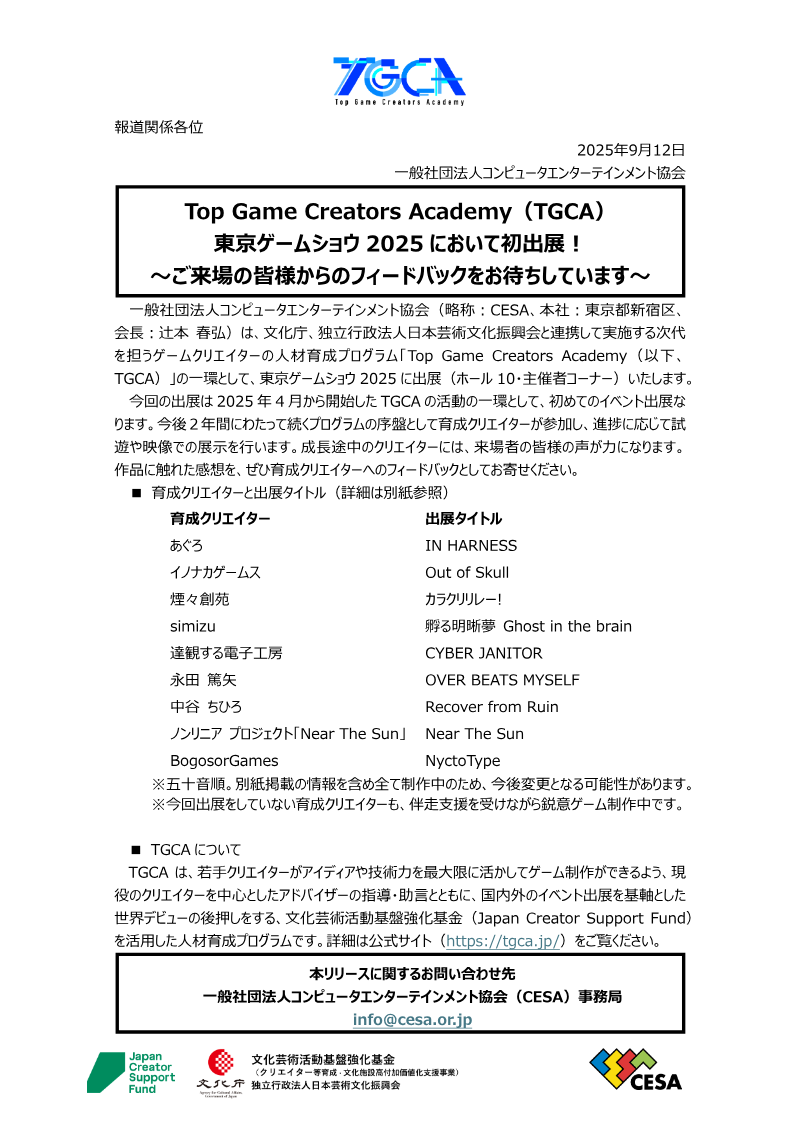
Top Game Creators Academy: Tokyo Game Show 2025 Exhibition
Top Game Creators Academy (TGCA) is being introduced to the public for the first time at the Tokyo Game Show 2025, where it will occupy Hall 10’s organizer’s corner. The initiative, run by the Computer Entertainment Association in partnership with the Agency for Cultural Affairs and the Japan Arts & Culture Promotion Agency, aims to accelerate the development of next‑generation game creators by pairing them with active industry advisors and providing exposure through domestic and international events. The exhibition showcases ten emerging developers, each presenting a work‑in‑progress title ranging from an online cooperative 3D jump‑action (IN HARNESS) to a 2D puzzle platformer (Out of Skull), a collaborative “game‑making relay” (カラクリリレー!), a first‑person horror action (Ghost in the brain), a formula‑driven shooter (CYBER JANITOR), a rhythm‑action experience (OVER BEATS MYSELF), an exploratory RPG (Recover from Ruin), a 2D stealth‑action novel (Near The Sun), and a competitive typing‑board hybrid (NyctoType). All projects remain under development and may evolve before final release.
The program, launched in April 2025, is structured as a two‑year pipeline in which creators receive ongoing mentorship and are encouraged to gather visitor impressions as direct feedback for iterative improvement. Although no quantitative metrics are provided, the breadth of genres and innovative mechanics underscores TGCA’s commitment to diversifying Japan’s game development talent pool and facilitating global market entry. The announcement concludes with a call for attendees to submit their reactions, positioning audience interaction as a core component of the creators’ growth trajectory.
- The Computer Entertainment Association, in partnership with the Agency for Cultural Affairs and the Japan Arts & Culture Promotion Agency, launched the Top Game Creators Academy (TGCA) in April 2025 to accelerate the development of next-generation talent.
- The TGCA program utilizes a two-year pipeline structure that pairs emerging developers with active industry advisors to facilitate professional growth and global market entry.
- Ten emerging developers are debuting work-in-progress titles at the Tokyo Game Show 2025 in Hall 10, representing diverse genres including 3D action, 2D puzzle platformers, horror, and rhythm-action.
- Audience interaction is a core component of the program, with creators actively soliciting visitor feedback at the Tokyo Game Show to drive iterative improvements for their projects.
- The initiative aims to diversify Japan’s game development talent pool by providing creators with exposure through both domestic and international industry events.
+3
CESA – Computer Entertainment Supplier's AssociationJan 2025
Report45 pages
Game Developer Employment: Career Formation of Student Game Creators 2019 Survey 2025
The 2025 Japanese survey of students’ career aspirations investigates how the role of “game creator” is perceived across gender, age, and educational level, aiming to gauge the pipeline of future talent for the domestic game development sector. It encompasses elementary, middle, high‑school, technical‑college and university respondents nationwide, providing a comprehensive snapshot of attitudes toward a profession that remains peripheral in the broader labor market.
Findings reveal a stark gender divide. Among male pupils in elementary and middle school, the game‑creator career ranks first overall and consistently appears within the top two choices for grades three through nine, indicating strong early enthusiasm. In contrast, female students place the same role far lower, with the position falling to nineteenth overall for females and remaining near the bottom of their preference lists at every age level. When respondents reach higher‑education stages, roughly eighty percent of those who still consider the occupation view it primarily as a professional pathway rather than a hobby or ancillary activity.
The data suggest that while the game‑creator profession enjoys robust appeal among young males, it fails to attract comparable interest from females, potentially limiting diversity in the future workforce. The pronounced early‑stage gender gap underscores the need for targeted outreach, curriculum development, and mentorship programs that can broaden awareness and appeal among female students, thereby strengthening the talent base for Japan’s evolving game industry.
- A significant gender divide exists in career aspirations, with game creator ranking as the top choice for male elementary and middle school students while placing nineteenth for females.
- The appeal of a game development career for males remains consistently high, appearing in the top two career choices for students from grade three through nine.
- Approximately 80% of higher-education students interested in game creation view the role as a professional career path rather than a hobby or secondary activity.
- The persistent lack of interest among female students across all age levels suggests a potential long-term bottleneck for diversity in the Japanese game industry workforce.
- The 2025 survey data indicates that the game creator profession remains a peripheral career choice within the broader Japanese labor market despite strong early enthusiasm from young males.
+1
CESA – Computer Entertainment Supplier's AssociationJan 2025
Report1 pages
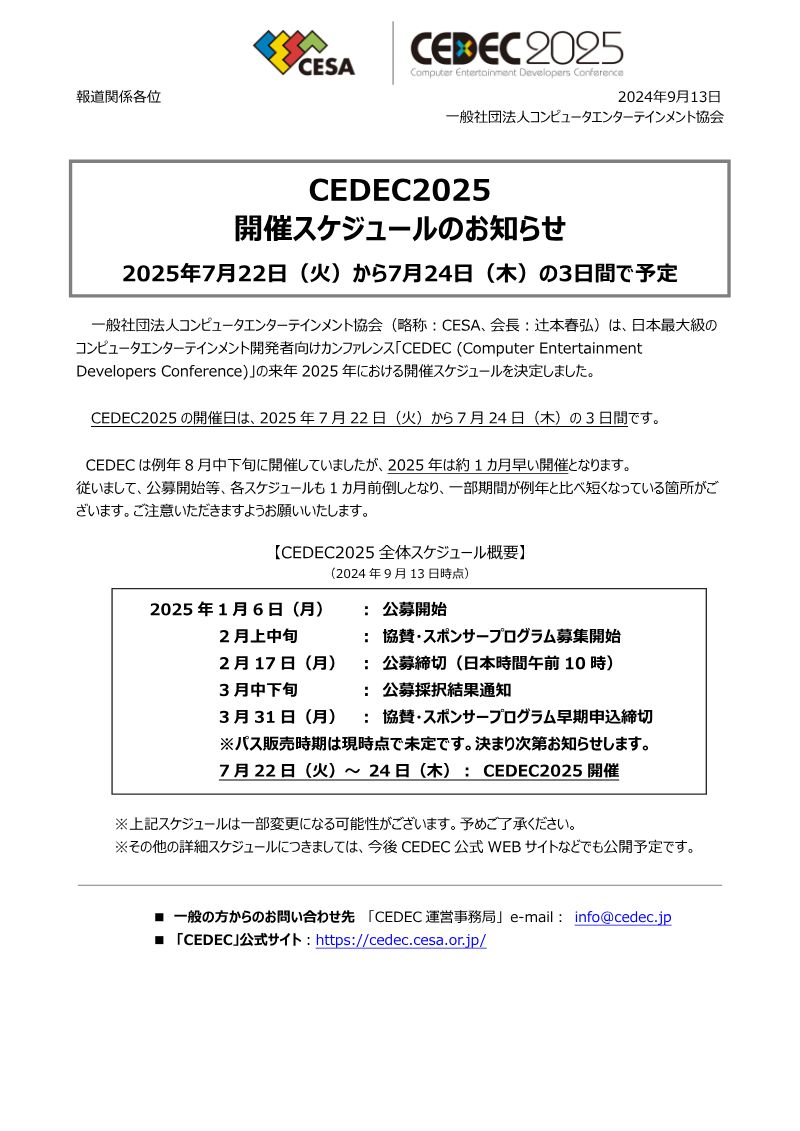
CEDEC 2025 Schedule Announcement
The announcement establishes the official timetable for CEDEC 2025, Japan’s premier three‑day conference for computer‑entertainment developers organized by the Computer Entertainment Developers Association (CESA). By moving the event to July 22‑24, 2025—approximately one month earlier than the traditional late‑August slot—the schedule compresses several preparatory phases, prompting participants to adjust their planning accordingly.
Key milestones are detailed: the public call for proposals opens on January 6, 2025, followed by the launch of sponsor and partnership programs in early‑to‑mid February. The final deadline for submissions is set for February 17 at 10 a.m. JST, with selection results communicated in late March. An early‑application deadline for sponsorships occurs on March 31, while ticket‑sale dates remain pending and will be announced later. The conference itself occupies three consecutive days, Tuesday through Thursday, in late July.
The scope is national, targeting Japanese developers, studios, and related stakeholders within the computer‑entertainment sector, and it outlines a timeline that spans from early January through late July 2025. Although the schedule is provisional and subject to minor adjustments, contact information for the CEDEC operations office and the official website are provided for inquiries and future updates.
- CEDEC 2025 will take place from July 22–24, 2025, shifting the conference approximately one month earlier than its traditional late-August schedule.
- The call for session proposals opens on January 6, 2025, with a strict submission deadline of February 17, 2025, at 10 a.m. JST.
- Selection results for proposed sessions will be communicated to applicants in late March 2025.
- Sponsorship and partnership programs launch in early-to-mid February 2025, with an early-application deadline for sponsors set for March 31, 2025.
- The conference is organized by the Computer Entertainment Developers Association (CESA) and targets Japanese developers, studios, and computer-entertainment stakeholders.
+1
Computer Entertainment Developers AssociationSept 2024

Report53 pages
Mobile App Trends 2024: Japan Edition
The Japanese mobile app market maintains its status as a global powerhouse, generating $17.9 billion in consumer spending and 2.5 billion downloads in 2023. Despite a marginal decline in annual installs, the market demonstrated a strong recovery in the first quarter of 2024, characterized by a 3.5% rise in spending and a 3% increase in downloads. This growth is underpinned by high user engagement and a notable 30% ATT opt-in rate within the gaming sector, signaling a resilient ecosystem for data-driven marketing and monetization.
Mobile gaming remains the primary revenue driver, with RPGs accounting for nearly half of all consumer spend and achieving a high average revenue per monthly active user of $5.09. However, the landscape is evolving toward deeper immersion, as evidenced by simulation games reaching average session lengths of over 40 minutes. Simultaneously, the finance and e-commerce sectors are experiencing rapid expansion. Finance apps saw a 53.5% spending surge in early 2024, while e-commerce lifetime value in Japan reached $9.67 by the end of the first month, nearly doubling global medians.
Strategic shifts in user acquisition are evident across all segments, with a marked transition toward paid channels. The paid-to-organic install ratio for gaming reached 2.31 in early 2024, while finance and e-commerce also saw significant increases in paid acquisition efforts. This trend is complemented by the emergence of Connected TV as a critical performance channel. With ad spend projected to reach 170 billion yen by 2025, advertisers are increasingly reallocating budgets from social media to CTV to leverage its high viewership and its proven ability to assist in driving mobile app installs through sophisticated measurement and AI-driven creative optimization.
- The Japanese mobile market generated $17.9 billion in consumer spending in 2023, with Q1 2024 showing a 3.5% increase in spending and a 3% rise in downloads.
- Mobile gaming remains the primary revenue driver, with RPGs capturing nearly 50% of consumer spend and simulation games achieving session lengths exceeding 40 minutes.
- Finance apps experienced a 53.5% surge in spending in early 2024, while e-commerce apps reached a first-month lifetime value of $9.67, nearly double the global median.
- Connected TV is emerging as a critical performance channel, with ad spend projected to reach 170 billion yen by 2025 as advertisers shift budgets away from social media.
- User acquisition strategies have shifted heavily toward paid channels, evidenced by a 2.31 paid-to-organic install ratio in the gaming sector during early 2024.
+1
Sensor TowerMar 2024
Report4 pages
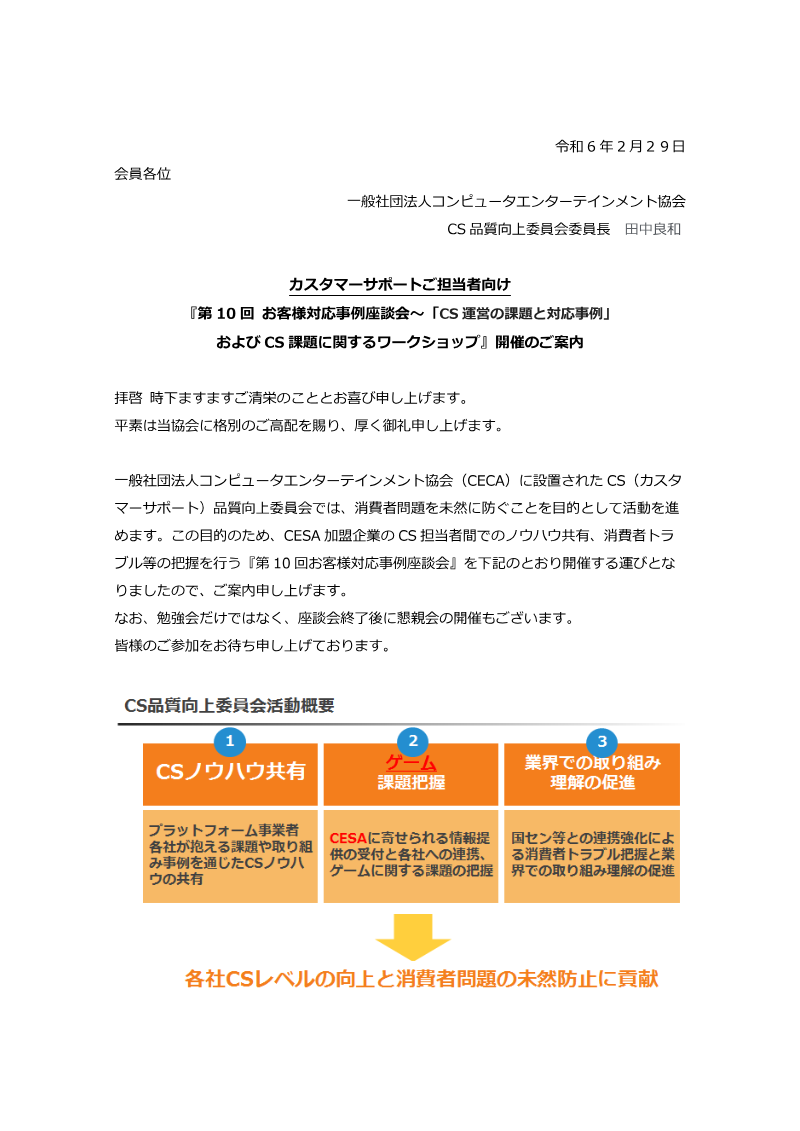
第10回 お客様対応事例座談会〜「CS運営の課題と対応事例」および CS課題に関するワークショップ
The announcement seeks to convene customer‑support managers from member firms of the Computer Entertainment Association (CECA) to exchange practical solutions for ongoing CS operational challenges. Its central aim is to foster preventive measures against consumer‑related issues by facilitating knowledge sharing on two focal topics: the integration of AI tools into support workflows and the management of customer harassment incidents.
The event is scheduled for March 19, 2024, running from 16:00 to 18:00, with a reception beginning at 15:30. It will be held simultaneously at the Shinjuku Sumitomo Sky Room in Tokyo and via Zoom, allowing both in‑person and online participation. Attendance is limited to CECA members, with pre‑registration required by March 8; excess demand may be redirected to the virtual format. The agenda includes opening remarks, case‑study presentations on AI adoption and harassment handling, and a workshop where groups of six to seven participants will discuss these issues in breakout rooms, followed by a plenary debrief. A networking reception follows, with an estimated fee of ¥5,000 per participant.
The scope is confined to the Japanese computer‑entertainment sector, targeting CS professionals active in 2024. While no empirical data are presented, the format emphasizes interactive discussion and peer‑learning rather than formal survey analysis, positioning the gathering as a practical forum for collective problem‑solving and the dissemination of best practices within the industry.
- The Computer Entertainment Association (CECA) is hosting a customer support forum on March 19, 2024, focused on AI integration and managing customer harassment.
- The event is restricted to CECA member firms, with a pre-registration deadline of March 8, 2024.
- The program features case-study presentations and small-group workshops of six to seven participants to facilitate peer-to-peer knowledge sharing.
- The session will be held in a hybrid format at the Shinjuku Sumitomo Sky Room in Tokyo and via Zoom, with a ¥5,000 fee for the networking reception.
- The forum aims to establish industry-wide preventive measures and best practices for CS operational challenges in the Japanese computer-entertainment sector.
CESA – Computer Entertainment Supplier's AssociationFeb 2024

Report6 pages
GungHo Online Entertainment Business Report Vol. 42
GungHo Online Entertainment’s business report outlines a strategic transition from a Japan-centric mobile focus toward a diversified global entertainment model. The primary thesis centers on leveraging established intellectual properties, specifically Puzzle & Dragons and the Ragnarok series, to anchor international expansion while developing new console and PC titles for a worldwide audience.
Financial data indicates a significant shift in revenue composition, with the overseas sales ratio rising steadily to reach 64.1% by late 2024. While consolidated net sales saw a decline from 125.3 billion yen in 2023 to 103.6 billion yen in 2024, the group maintained a strong capital-to-asset ratio of 75.9%. Performance in the first half of 2025 shows net sales of 50.5 billion yen and an operating profit of 5.0 billion yen. To enhance shareholder value, the company revised its return policy in February 2025, committing to a consolidated dividend payout ratio of 30% or more and executing substantial share cancellations.
The report highlights the longevity of core titles, noting that Puzzle & Dragons celebrated its 13th anniversary with over 63 million downloads in Japan. To sustain this momentum, the group released Puzzle & Dragons 0 in May 2025 across 150 countries in 11 languages. Simultaneously, the Ragnarok IP, managed by subsidiary Gravity Co., Ltd., has grown from 5 billion yen in annual sales in 2008 to approximately 50 billion yen, driven by mobile expansions in Asia and new initiatives in Latin America.
Future growth is targeted through multi-platform development and the revitalization of existing series. Key projects include the redevelopment of the survival action title Deathverse: Let It Die and the release of the Lunar Remastered Collection. By focusing on original IPs for consoles and PC—areas where the group can demonstrate technical expertise—GungHo aims to establish brand recognition in Western markets where it was previously less known.
- GungHo has successfully pivoted to a global business model, with overseas sales now accounting for 64.1% of total revenue as of late 2024.
- Consolidated net sales declined from 125.3 billion yen in 2023 to 103.6 billion yen in 2024, though the company maintains a strong capital-to-asset ratio of 75.9%.
- The Ragnarok IP, managed by subsidiary Gravity Co., Ltd., has scaled significantly, growing from 5 billion yen in annual sales in 2008 to approximately 50 billion yen today.
- To sustain the 13-year-old Puzzle & Dragons franchise, the company launched Puzzle & Dragons 0 in May 2025 across 150 countries in 11 languages.
- The company is shifting focus toward console and PC development to build Western brand recognition, with key projects including the Lunar Remastered Collection and the redevelopment of Deathverse: Let It Die.
GungHo Online EntertainmentJan 2024
Report17 pages
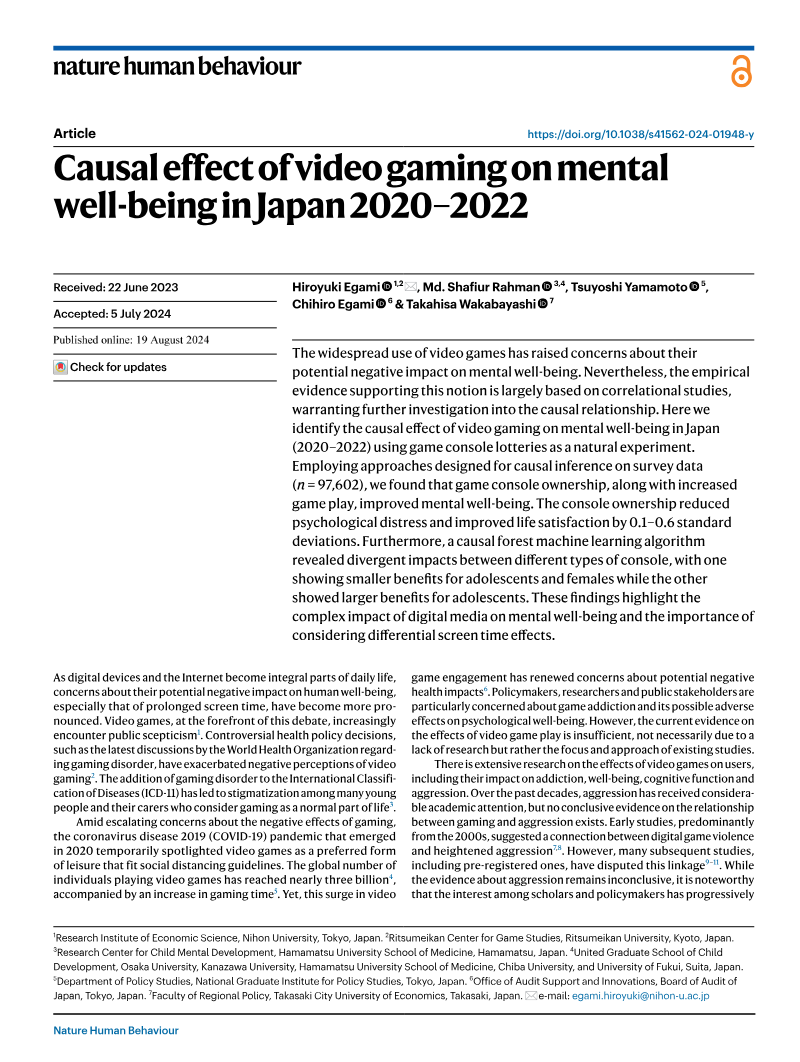
Causal Effect of Video Gaming on Mental Well-Being in Japan 2020–2022
Evidence from a natural experiment conducted in Japan between 2020 and 2022 demonstrates that video game ownership and increased play time exert a positive causal influence on mental well-being and life satisfaction. By leveraging the unique lottery-based distribution of gaming consoles during pandemic-related supply shortages, researchers analyzed data from over 97,000 respondents to isolate the effects of gaming from self-selection bias. The findings indicate that winning a console lottery reduced psychological distress by 0.1 to 0.6 standard deviations, directly challenging traditional correlational studies that often associate gaming with negative mental health outcomes.
The magnitude of these psychological benefits varies significantly across different demographic groups and hardware platforms. Machine learning analysis reveals that the Nintendo Switch offers more pronounced well-being improvements for adolescents and female users, whereas the PlayStation 5 provides stronger positive effects for adult males and dedicated gamers. While the overall impact of gaming remains positive, the data suggests a threshold of diminishing returns, as the benefits to mental health and life satisfaction begin to decline after three hours of daily play.
The scope of this research is specifically focused on the Japanese market during the COVID-19 pandemic, a period characterized by heightened social isolation and restricted physical activity. These environmental factors may have amplified the observed positive effects, as gaming served as a primary tool for digital engagement and stress mitigation. Despite these contextual considerations, the use of instrumental variable causal forests and propensity score matching provides a rigorous statistical foundation for the conclusion that moderate video game consumption serves as an effective intervention for improving psychological health.
- Winning a gaming console lottery during the 2020–2022 Japanese supply shortages reduced psychological distress by 0.1 to 0.6 standard deviations, establishing a positive causal link between gaming and mental well-being.
- The positive impact of video games on mental health and life satisfaction follows a threshold effect, with benefits beginning to decline after three hours of daily play.
- Nintendo Switch ownership provides the most pronounced well-being improvements for adolescents and female users, while the PlayStation 5 yields stronger benefits for adult males and dedicated gamers.
- The study utilized data from over 97,000 respondents to isolate the effects of gaming from self-selection bias, effectively challenging prior correlational research that linked gaming to negative mental health outcomes.
- The observed psychological benefits were likely amplified by the COVID-19 pandemic environment in Japan, where gaming functioned as a critical tool for digital engagement and stress mitigation during periods of social isolation.
Springer Science and Business Media LLCJan 2024
Report9 pages
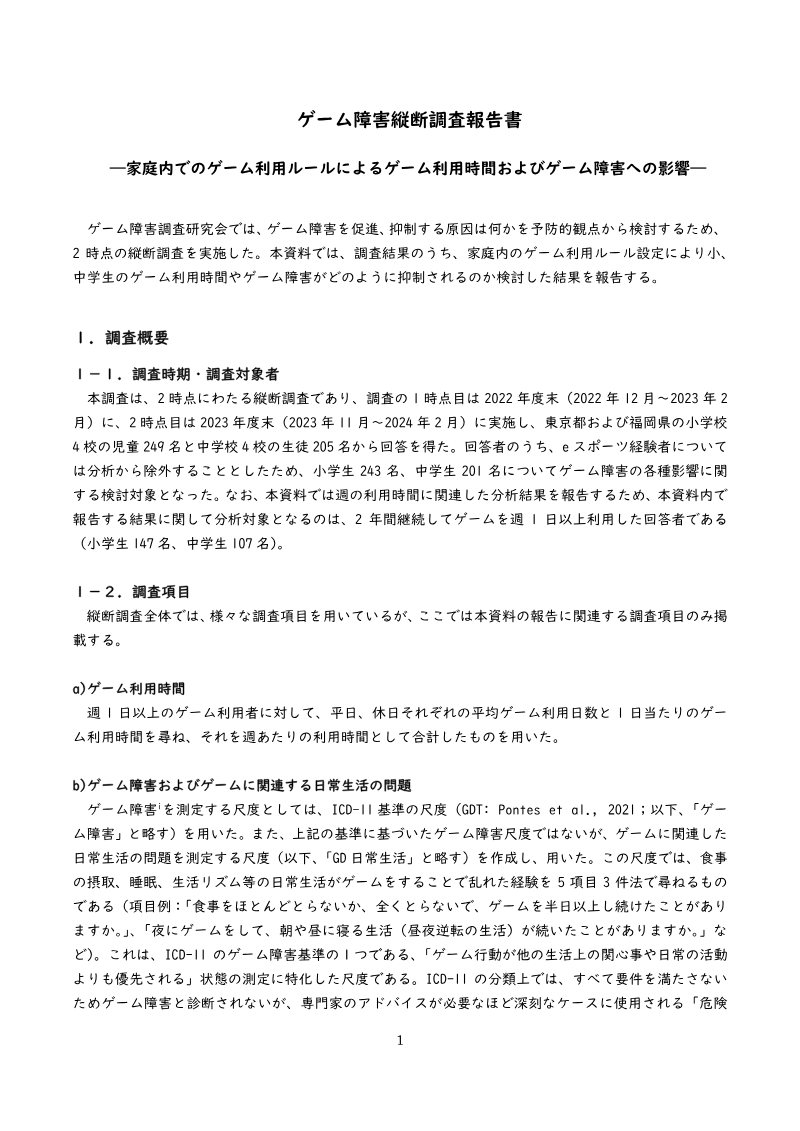
Longitudinal Survey Report on Gaming Disorder: Japan
The study investigates how household rules governing video‑game use influence weekly play time and the emergence of gaming disorder among Japanese elementary and middle‑school students. By tracking participants over two survey waves—late 2022 to early 2023 and late 2023 to early 2024—the research tests whether specifying permissible gaming periods or prohibiting certain times can curb excessive play and related daily‑life problems.
A longitudinal sample was drawn from four elementary schools and four middle schools in Tokyo and Fukuoka, yielding 243 elementary and 201 middle‑school respondents after excluding esports players. Analyses focused on the 147 elementary and 107 middle‑school students who reported gaming at least once per week across both waves. Weekly gaming hours were calculated from weekday and weekend use, while gaming disorder was measured with the ICD‑11‑based Gaming Disorder Test and a custom scale assessing disruptions to sleep, meals, and routine. The presence of two rule types—“allowed‑time” (e.g., one hour per day) and “prohibited‑time” (e.g., no gaming after midnight)—was recorded at each wave and examined using cross‑lagged models and mixed‑design ANOVAs.
Results show that higher weekly gaming hours predict later increases in gaming‑disorder scores for both age groups (standardized coefficients .12 for elementary and .11 for middle‑school students), while disorder does not feed back into later play time. Gaming hours and daily‑life problems mutually reinforce each other, forming a negative feedback
- Increased weekly gaming hours serve as a significant predictor for higher gaming disorder scores, with standardized coefficients of .12 for elementary students and .11 for middle-school students.
- Gaming hours and daily-life problems, such as disruptions to sleep and meals, create a negative feedback loop where each factor mutually reinforces the other.
- Gaming disorder symptoms do not appear to influence or increase future weekly play time, suggesting that excessive play is the primary driver of disorder rather than a consequence of it.
- The study tracked 254 total students—147 elementary and 107 middle-schoolers—who played games at least once per week across two survey waves between late 2022 and early 2024.
- Research methodology utilized the ICD-11-based Gaming Disorder Test and a custom scale to measure the impact of household rules, specifically 'allowed-time' limits and 'prohibited-time' restrictions.
+1
CESA – Computer Entertainment Supplier's AssociationJan 2024
Report42 pages
ゲーム開発者の就業とキャリア形成 2024
The 2024 Game Developer Survey for Japan provides a comprehensive snapshot of compensation trends among the nation’s game development workforce, focusing on individuals with formal vocational‑school or university education. By capturing responses from a broad cross‑section of developers, the study aims to assess whether recent industry growth translates into tangible financial benefits for skilled professionals.
Findings reveal that more than 80 % of educated respondents reported a salary increase over the preceding year, a pattern that holds consistently for full‑time employees, with roughly the same proportion experiencing any rise in earnings. This upward trajectory suggests that Japanese studios are increasingly rewarding qualified talent, reflecting both heightened competition for skilled labor and the sector’s expanding revenue streams. The data also underscore the importance of formal education as a predictor of wage growth, indicating that employers value academic credentials when allocating compensation adjustments.
Overall, the survey indicates a robust and positive compensation environment for Japan’s game development sector in 2024, highlighting sustained investment in human capital. The prevalence of salary gains among highly educated, full‑time developers points to a healthy labor market that may enhance talent retention and support continued industry innovation.
- Over 80% of game developers with formal vocational or university education in Japan received a salary increase in 2024.
- The trend of rising earnings is consistent among full-time employees, with approximately 80% reporting wage growth over the past year.
- Formal academic credentials serve as a significant predictor of wage growth, as employers prioritize these qualifications when determining compensation adjustments.
- The widespread salary growth reflects heightened competition for skilled labor and the overall expansion of revenue streams within the Japanese gaming sector.
- The 2024 data indicates a robust labor market characterized by sustained investment in human capital and improved talent retention strategies.
+1
CESA – Computer Entertainment Supplier's AssociationJan 2024

Report30 pages
Insight into 2024 Marketing Trends for Japanese Mobile Games
The Japanese mobile gaming market is characterized by a conservative but highly specialized marketing landscape, where local companies maintain a dominant revenue position. Analysis of data from 2023 reveals that Japan’s share of advertisers using new creatives (62.23%) and the overall volume of new creatives (29.77%) sit significantly below global averages. Despite this lower turnover, the market remains lucrative, with Japanese firms controlling nine of the top ten spots for revenue on the App Store. Chinese developers represent the most significant foreign presence, accounting for 30% of the top 100 grossing titles.
Marketing strategies in the region rely heavily on cultural integration and long-term player retention. Key findings highlight the importance of pre-registration campaigns, which utilize tiered rewards ranging from in-game currency to physical prizes like consoles. Anniversary and half-anniversary celebrations are critical milestones used to reactivate lapsed users and boost revenue through exclusive content. Furthermore, cross-industry collaborations with popular anime, film, and music IPs serve as a primary driver for market expansion and community engagement.
Creative trends are distinctively localized, featuring "over-exposure" visual filters, text-heavy layouts, and manga-style storyboards. Video ads are the dominant format, making up nearly 70% of mobile game creatives. Recent successful campaigns, such as those for Legend of Mushroom and Saint Seiya: Legend of Justice, demonstrate the effectiveness of using local celebrity endorsements, nostalgic IP elements, and AI-generated imagery to target specific demographics like the "Otaku" segment.
The data, compiled by SocialPeta, draws from a global database of 1.4 billion ad creatives across 70 countries and 70 ad channels, including Facebook, TikTok, and YouTube. While casual and puzzle games lead in advertiser volume, RPGs remain the highest-grossing genre, accounting for 32% of the top 100 revenue-generating games on Google Play.
- Japanese firms dominate the domestic market, holding nine of the top ten revenue spots on the App Store, while Chinese developers account for 30% of the top 100 grossing titles.
- RPG titles are the most lucrative genre in Japan, representing 32% of the top 100 revenue-generating games on Google Play.
- Marketing in Japan is characterized by low creative turnover, with only 62.23% of advertisers using new creatives and a total new creative volume of 29.77%, both significantly below global averages.
- Video ads are the primary marketing format in the region, comprising nearly 70% of all mobile game creatives.
- Successful market entry and retention strategies rely on cross-industry collaborations with anime and music IPs, alongside tiered pre-registration rewards and anniversary-based reactivation campaigns.
+2
SocialPetaJan 2024
Report30 pages
State of Mobile Games in Japan
The analysis provides a comprehensive overview of Japan’s mobile‑gaming ecosystem in 2024, measuring the market’s size, growth dynamics, and competitive landscape. Total in‑app purchase (IAP) revenue reached roughly ¥2.5 trillion, marking a modest increase over 2023, while the combined share of the Apple App Store and Google Play stabilized at about 55 % and 45 % respectively. Advertising‑derived income expanded by 35 % year‑on‑year, now accounting for roughly 8 % of overall mobile‑gaming revenue, driven largely by user acquisition through YouTube, TikTok and Instagram.
Top‑grossing publishers dominate the market, with Mixi, Bandai Namco, CyberAgent, miHoYo, Square Enix and GungHo each securing multiple titles in the upper echelon of revenue. Flagship games such as Fate/Grand Order, eFootball, Pokémon GO, and the One Piece franchise collectively generated more than ¥1 trillion, underscoring the continued strength of established IPs. Genre analysis shows 3D titles now represent roughly half of the top‑performing apps, reflecting a shift toward richer visual experiences, while 2D and casual games retain a sizable user base.
The study covers the period January through July
- Japan’s mobile gaming market generated approximately ¥2.5 trillion in total in-app purchase (IAP) revenue during the first seven months of 2024.
- Established intellectual properties remain the primary revenue drivers, with titles like Fate/Grand Order, eFootball, Pokémon GO, and the One Piece franchise collectively accounting for over ¥1 trillion in earnings.
- Advertising-derived income grew by 35% year-on-year, now representing 8% of total mobile gaming revenue, fueled by user acquisition campaigns on YouTube, TikTok, and Instagram.
- The market is highly concentrated among top-tier publishers, including Mixi, Bandai Namco, CyberAgent, miHoYo, Square Enix, and GungHo.
- 3D titles have become the dominant visual format, now accounting for roughly 50% of the top-performing mobile applications.
Sensor TowerJan 2024

Report95 pages
Integrated Report: Value Creation Story 2023
DeNA is undergoing a fundamental strategic evolution, transitioning from a primary focus on entertainment and gaming toward a diversified "Serve" approach that addresses complex social issues. This shift leverages the company’s core competencies in internet technology and artificial intelligence to drive growth across healthcare, medical digital transformation, and urban development. While the capital market historically viewed the organization as a hit-driven game company, the current strategy emphasizes a multi-segment portfolio designed for sustainable, long-term value creation. This transformation is centered in Japan, particularly through its "Home Base" in Yokohama, but maintains a global reach through international medical platforms and strategic intellectual property partnerships.
Financial performance in FY2022 reflects this transition, with consolidated revenue reaching ¥134.9 billion. While the game segment faced revenue declines, prompting a shift toward a global pipeline of major IP and partnerships with Nintendo and Shueisha, other sectors showed robust growth. The Live Streaming segment, bolstered by the Vtuber app IRIAM, and the Healthcare & Medical segment, driven by the expansion of the "Join" communication platform and a health database covering 18 million people, have become significant growth engines. The company aims for ¥20 billion in healthcare revenue by FY2024, utilizing M&A and medical IoT to capture a domestic market potential valued in the hundreds of billions of yen.
The organizational structure supports this diversification through a sophisticated human capital strategy and a rigorous governance framework. DeNA emphasizes autonomous career development and internal mobility to optimize its workforce across sports, AI, and healthcare initiatives. Governance is maintained through a board with 43% independent representation and a performance-linked compensation structure that aligns management incentives with shareholder interests. Furthermore, the company has integrated sustainability and risk management into its core operations, monitoring climate-related emissions and maintaining robust cybersecurity protocols to protect its expanding digital and medical data ecosystems.
- DeNA is pivoting from a hit-driven gaming model to a diversified 'Serve' strategy, focusing on healthcare, digital transformation, and urban development to ensure long-term sustainable growth.
- The Healthcare & Medical segment is a primary growth engine, targeting ¥20 billion in revenue by FY2024 by leveraging a health database of 18 million people and medical IoT expansion.
- Consolidated revenue for FY2022 reached ¥134.9 billion, with the gaming segment experiencing declines that are now being addressed through a global pipeline of major IP partnerships with Nintendo and Shueisha.
- The Live Streaming segment has emerged as a key revenue driver, specifically bolstered by the performance of the Vtuber application IRIAM.
- DeNA’s corporate governance structure includes a board with 43% independent representation and a performance-linked compensation system designed to align management with shareholder interests.
+1
DeNA Co., LtdSept 2023
Report3 pages
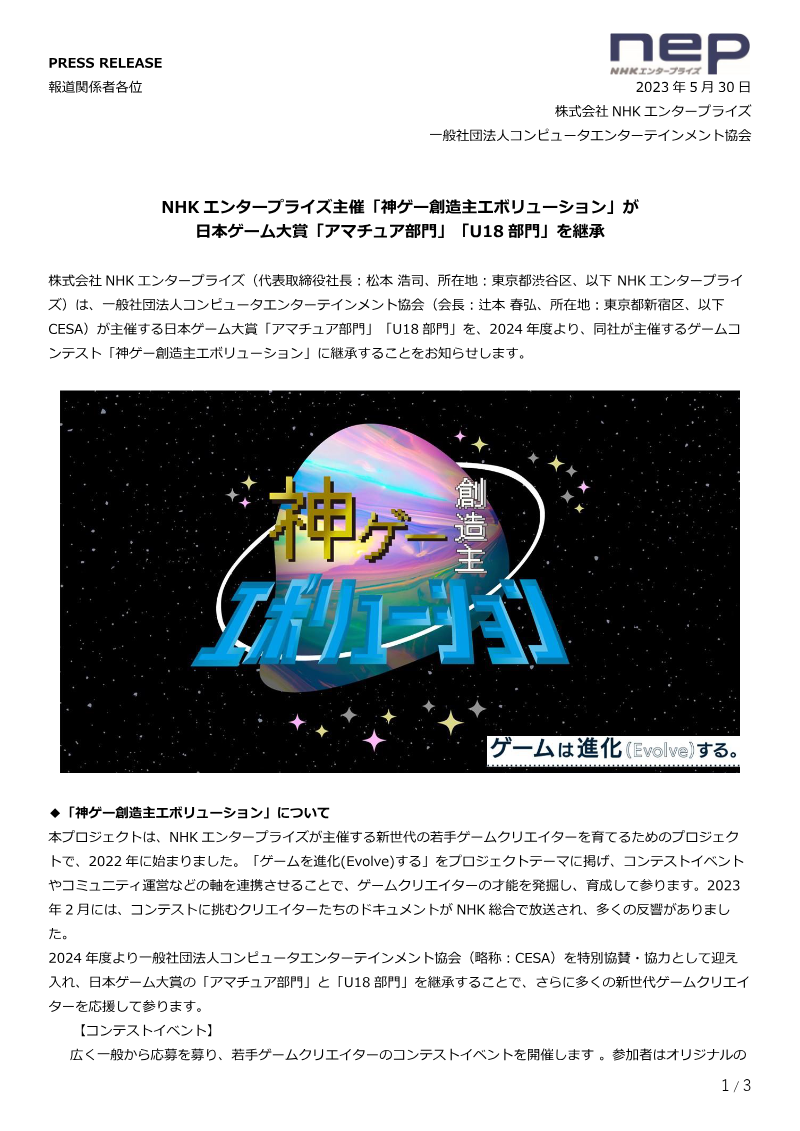
NHK Enterprise's 'Kami-Ge Creator Evolution' Succeeds Japan Game Awards 'Amateur' and 'U18' Divisions
NHK Enterprise is launching the “Kami‑Ge Creator Evolution” contest as a dedicated platform for nurturing the next generation of Japanese game developers, and from 2024 it will incorporate the Japan Game Awards’ Amateur and U18 divisions. The initiative, begun in 2022 under the theme “Evolve the Game,” seeks to discover and develop talent through a series of contest events, community support, and media exposure, including a documentary broadcast on NHK General in February 2023 that generated strong public interest.
The competition invites creators from across Japan to submit original games, which are evaluated for innovative expansion of the medium’s boundaries by a diverse panel of established game designers, media artists, and other industry figures. In addition to expert judging, a public popularity vote is conducted, and the contest awards a Grand Prize, Excellence Awards, and Honorable Mentions in the Amateur category, while the U18 category focuses on participants aged 18 or younger, reflecting the Japan Game Awards’ long‑standing commitment to youth development since 2018. The 2024 schedule begins with an entry period from 1 February to the end of April, followed by nomination, second‑round video submissions in July, third‑round game submissions in October, finalist announcements at the end of October, and a final event slated for December.
A closed Discord community supports participants with exclusive benefits, knowledge sharing, and mentorship, reinforcing the project’s role as a learning environment. Special cooperation from the Computer Entertainment Supplier’s Association (CESA) provides additional industry credibility and resources. The contest is open to individuals, teams, corporations, and organizations regardless of age, gender, nationality, or the number of entries, emphasizing inclusivity and broad outreach.
By integrating the Amateur and U18 awards, the “Kami‑Ge Creator Evolution” aims to broaden the creative framework of Japanese games, foster innovative design, and strengthen the pipeline of skilled developers. The organizers are actively seeking sponsors to sustain the project’s growth and align with NHK Enterprise’s broader commitment to sustainable development and cultural enrichment.
- NHK Enterprise has integrated the Japan Game Awards’ Amateur and U18 divisions into its 'Kami-Ge Creator Evolution' contest, effective from 2024.
- The 2024 competition timeline spans from February 1 to a final event in December, featuring a multi-stage evaluation process including video submissions in July and game submissions in October.
- The contest is open to all applicants regardless of age, nationality, or organizational status, with specific categories for general amateur creators and those aged 18 or younger.
- Participants gain access to a closed Discord community providing mentorship, knowledge sharing, and exclusive resources to support developer growth.
- The initiative is supported by the Computer Entertainment Supplier’s Association (CESA) to provide industry credibility and resources for the project.
+2
CESA – Computer Entertainment Supplier's AssociationMay 2023
Report4 pages
スペイン、カナリア諸島の州政府機関から「ビデオゲーム業界視察ミッション」のご案内
The invitation seeks to generate business opportunities for Japanese video‑game, animation and related audiovisual firms by showcasing the Canary Islands as a strategic production hub. It positions the archipelago as an emerging, tax‑friendly environment, highlighting preferential rates for game development, film and animation, as well as a reduced corporate tax rate, alongside high‑quality infrastructure, skilled talent pools, and strong public support. The core thesis is that direct exposure to local studios, financing mechanisms and regulatory incentives will encourage Japanese companies to establish subsidiaries, pursue co‑production agreements, or outsource projects to Canary Island partners.
The mission is scheduled for 9 – 15 October, with participants traveling from Japan to Tenerife on 9 October and returning after the final day on 15 October. The itinerary includes briefings on the regional industry and tax regime, visits to multiple development studios such as Drakhar, Foxter, The Game Kitchen, Promineo and No Brake Games, a tour of a super‑computer facility, and attendance at the Canarias Game Show on Gran Canaria, featuring B2B matchmaking, conference sessions and networking dinners. All travel costs—including economy‑class round‑trip airfare, hotel accommodation, meals and intra‑island transport—are covered by the organizers, with additional support offered for group participation.
Target participants are Japanese firms contemplating legal entity formation in the Canary Islands, joint‑development projects, or outsourcing production to local studios. The program is coordinated by the Spanish Embassy’s Economic and Commercial Section in Tokyo and the Canary Islands government agency Proexca, which also serves on the regional game office. While the embassy assists with logistics, detailed tax‑incentive information is to be obtained from the Canary Islands authorities and specialist advisors. The initiative aims to deepen Japan‑Spain investment ties within the audiovisual sector by converting the exploratory visit into concrete commercial collaborations.
- The Canary Islands government is hosting a business mission for Japanese video game and animation firms from October 9–15 to promote the region as a strategic production hub.
- The mission covers all travel expenses, including economy-class airfare, accommodation, meals, and local transport, for qualified Japanese companies interested in expansion or outsourcing.
- The Canary Islands offer a competitive business environment featuring reduced corporate tax rates and specific financial incentives for game development, animation, and film production.
- The itinerary includes site visits to local studios such as Drakhar, Foxter, The Game Kitchen, Promineo, and No Brake Games, alongside a tour of a regional super-computer facility.
- Participants will attend the Canarias Game Show on Gran Canaria, which provides dedicated B2B matchmaking, industry conferences, and networking opportunities.
+2
CESA – Computer Entertainment Supplier's AssociationMay 2023
Report15 pages
Japanese Esports on the Rise: Five Teams to Watch
Japan is rapidly evolving from a video game superpower into a significant esports market, overcoming historical regulatory and cultural hurdles. While the country previously lagged behind China and South Korea due to strict anti-gambling laws that capped prize pools and a lack of domestic titles in popular esports genres like MOBAs, recent policy shifts have transformed the landscape. Following the 2019 removal of most legal restrictions and the formation of the Japan Esports Union (JeSU), the market grew by 11% to reach $77 million in 2022.
The ecosystem is characterized by a unique "watching but not playing" culture, where livestreaming and content creation drive engagement among both gamers and non-gamers. This has led to the rise of prominent organizations such as Crazy Raccoon, DetonatioN FocusMe, FENNEL, SCARZ, and ZETA DIVISION. These teams increasingly operate as lifestyle brands, generating revenue through traditional sponsorships, merchandise, and specialized content partnerships. Notably, non-endemic brands like Nissin Foods have entered the space, with sponsorship fees reportedly increasing tenfold over the last five years.
Despite this momentum, the industry faces challenges, including a "Galapagos syndrome" where domestic game preferences differ from global trends, and a power imbalance where publishers maintain strict control over tournament formats. However, the outlook remains optimistic. Industry leaders anticipate further consolidation and professionalization, mirroring the evolution seen in Western markets a decade ago. As teams seek international expansion and venture capital, Japan is positioned to become a major hub for esports talent and tourism in Asia.
- Japan's esports market reached $77 million in 2022, marking an 11% growth following the 2019 removal of restrictive anti-gambling laws and the establishment of the Japan Esports Union (JeSU).
- Non-endemic brand involvement is surging, evidenced by companies like Nissin Foods entering the space and sponsorship fees increasing tenfold over the last five years.
- Leading organizations including Crazy Raccoon, DetonatioN FocusMe, FENNEL, SCARZ, and ZETA DIVISION are operating as lifestyle brands to monetize through merchandise, content partnerships, and sponsorships.
- The Japanese market is driven by a unique 'watching but not playing' culture, where high engagement in livestreaming and content creation attracts both gamers and non-gamers.
- The industry faces structural challenges including 'Galapagos syndrome,' where domestic game preferences diverge from global trends, and strict tournament control by game publishers.
+1
Niko PartnersFeb 2023
Report1 pages
New Generation Game Creator Contest: Kami‑Game Creator Evolution Broadcast Notice (Japan)
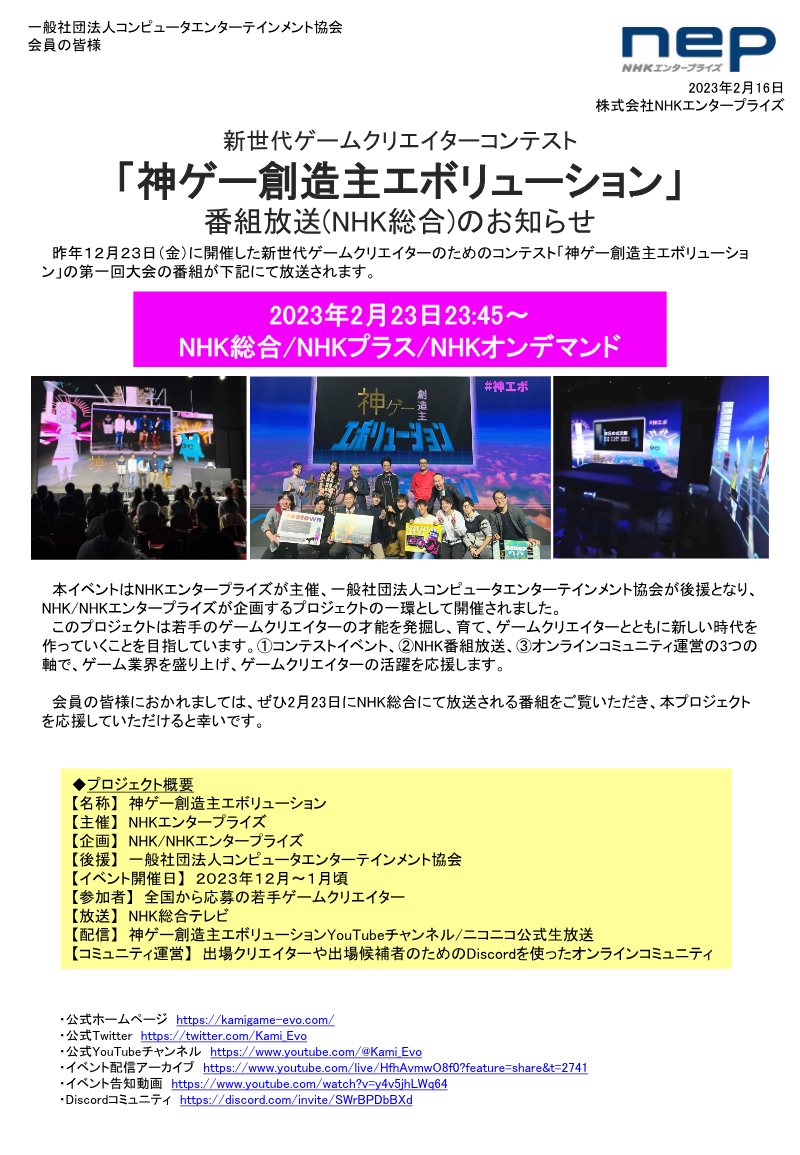
The announcement serves to inform viewers of the upcoming televised presentation of the inaugural “Kami‑Game Creator Evolution” contest, a competition designed to discover and nurture emerging game developers across Japan. The broadcast is scheduled for February 23, 2023 at 23:45 on NHK General, with simultaneous streaming on NHK Plus, NHK On‑Demand, and the contest’s official YouTube and Niconico channels, ensuring broad accessibility for a national audience.
Organized by NHK Enterprise and endorsed by the Computer Entertainment Association, the project integrates three pillars: a nationwide contest held between December 2022 and January 2023, a televised program that showcases the finalists, and an online community hosted on Discord for participants and candidates. The contest solicited entries from young creators throughout the country, aiming to spotlight innovative concepts and support their development through exposure, mentorship, and peer interaction.
The initiative’s strategic goal is to invigorate the Japanese gaming sector by fostering fresh talent and encouraging collaboration between creators and broadcasters. By leveraging both traditional television and digital platforms, the program seeks to reach diverse demographics, from casual viewers to industry professionals, thereby amplifying the impact of the selected works.
Supporting resources include a dedicated website, official Twitter feed, YouTube channel, and archived event streams, which together provide continuous updates, promotional material, and a repository of contest content for ongoing community engagement.
- NHK Enterprise is launching the inaugural 'Kami-Game Creator Evolution' contest to identify and nurture emerging game development talent across Japan.
- The contest's televised finale will broadcast on NHK General on February 23, 2023, at 23:45, with simultaneous streaming on NHK Plus, NHK On-Demand, YouTube, and Niconico.
- The project, endorsed by the Computer Entertainment Association, ran its nationwide entry phase between December 2022 and January 2023.
- The initiative utilizes a three-pillar structure consisting of a nationwide competition, a televised showcase for finalists, and a dedicated Discord community for peer interaction and mentorship.
- The program aims to revitalize the Japanese gaming sector by bridging the gap between independent creators and traditional broadcasting platforms to reach a broader demographic.
NHK EnterpriseFeb 2023
Report36 pages
Mobile Games: State of the Market & Playtime Q3 2023
Mobile games: state of the market & playtime Joint report of Apptica & Gamelight The purpose of this study is to analyse the state of gaming category in Q3 2023. All data presented in this report has been collected from Apptica and Gamelight platforms. "Games" category is defined by a store's tag. The basis of this analysis is made up of data from the Apptica's Store, Ad and Market Intelligence sections and Gamelight's playtime and app usage data.
- iOS remains the dominant platform for mobile gaming revenue, accounting for 56.01% of the total global share compared to 43.99% for Android.
- The United States and Japan are the leading revenue generators among major markets, contributing $2.92 billion and $2.03 billion respectively, with the six analyzed countries accounting for 59% of global gaming revenue.
- South Korea experienced the highest growth in game installs at 32% compared to Q3 2022, while the United States and France saw declines of 5% and 0.7%, respectively.
- Card games are the most engaging genre globally with an average playtime of 41.68 minutes, consistently ranking as the top genre for user engagement across analyzed regions.
- Average daily playtime is higher on iOS (38.69 minutes) than on Android (32.17 minutes) across the studied markets.
+6
AppticaJan 2023