
Report64 pages
Videojuegos en el Aula: Guía para un Aprendizaje Adecuado
The guide argues that video games, when deliberately selected and scaffolded, can become powerful learning tools across primary, secondary and vocational settings. By positioning games along a continuum from free play to structured, teacher‑guided activities, educators can align specific game mechanics—joy, meaning, immersion, challenge and agency—with curricular objectives, thereby fostering both cognitive and affective outcomes.
Empirical evidence shows that the $180 billion global games market, with more than three billion active players (over half of Europeans aged 6‑64 and 70 % of those 6‑24), can support cooperative, discovery‑based and project‑based learning. Systematic reviews and studies such as Parker & Thomsen 2019 link core game characteristics to measurable gains in attention, memory, problem‑solving, literacy and even clinical assessment for ADHD. Narrative‑driven titles (e.g., Florence, Mutazione) are already classified as literary texts in Scotland and Poland, while language‑learning apps and exergames extend benefits to vocabulary, pronunciation and physical health. Multiplayer and emotionally charged games are shown to develop empathy, self‑regulation and ethical reasoning, with data from a Flemish suicide‑prevention project confirming social‑emotional growth.
Practical integration strategies emphasize alignment with national curricula, use of in‑game metrics for assessment, and gamification elements such as digital badges and leaderboards. Open‑world and historically themed games (Minecraft, Assassin’s Creed Discovery Tour, Age of Empires) serve as contextual nodes for interdisciplinary projects, while creation platforms—from Scratch Jr to RPG Maker—enable progressive skill development in coding, storytelling and design. The guide also highlights industry disparities (71 % male developers, low representation of women and Black creators) and urges inclusive curricula to broaden participation.
Health considerations note the WHO’s classification of gaming disorder in ICD‑11, but research indicates problematic use remains a minority, often driven by micro‑transaction models. Recommendations include reliance on PEGI age ratings and parental
- Video games are effective pedagogical tools that improve cognitive functions like memory and problem-solving, with studies such as Parker & Thomsen (2019) linking game mechanics to measurable gains in literacy and clinical ADHD assessment.
- The global games market now encompasses over three billion active players, including 70% of Europeans aged 6–24, providing a massive, accessible platform for cooperative and project-based learning.
- Educational integration is most successful when educators use a continuum from free play to structured activities, utilizing titles like Minecraft and Assassin’s Creed Discovery Tour to support interdisciplinary curricula.
- Games are increasingly recognized as legitimate academic texts and social-emotional tools, with narrative titles like Florence and Mutazione used as literature in Scotland and Poland, and multiplayer games shown to foster empathy and ethical reasoning.
- Creation platforms such as Scratch Jr and RPG Maker allow students to develop technical skills in coding and design, while gamification elements like digital badges provide new methods for tracking student progress.
+1
European SchoolnetAug 2023

Report40 pages
Store Intelligence Data Digest: Q2 2023
Global mobile app performance in the second quarter of 2023 reflects a stabilizing market, with total downloads reaching 34.3 billion despite a marginal 1.5% year-over-year decline. While TikTok maintained its long-standing position as the most downloaded app globally, the quarter was defined by the rapid expansion of the shopping platform Temu, which achieved 74 million downloads and secured a top-ten global ranking. In the gaming sector, established titles like Subway Surfers and Ludo King continued to lead worldwide, though new entries such as MONOPOLY GO! and Honkai: Star Rail demonstrated significant momentum by dominating Western markets and leveraging existing brand equity.
Geographic trends highlight a shift in growth centers, as traditional markets like the United States, China, and the United Kingdom experienced download contractions. In contrast, India solidified its status as the world’s largest mobile market, accounting for 24% of global Google Play downloads. Emerging markets also showed resilience, with the App Store seeing double-digit growth in Brazil and Indonesia. While Meta and Google remain the preeminent global publishers, Meta faced regional headwinds in Asia due to regulatory shifts in India that impacted Instagram and Facebook adoption.
Sector-specific analysis reveals a transition toward gamification and retention-focused strategies. Education apps, led by Duolingo, successfully utilized streak features to drive high user engagement, whereas the food delivery and streaming sectors faced saturation. Food delivery downloads fell below pre-pandemic levels, and streaming services pivoted toward aggressive monetization and advertising strategies to combat slowing acquisition. Although Netflix maintains a superior 79% retention rate, its low new-user acquisition rate of 3% underscores the broader challenge of maintaining growth in a mature digital landscape.
- Global mobile app downloads reached 34.3 billion in Q2 2023, reflecting a stabilizing market despite a 1.5% year-over-year decline.
- India has become the world’s largest mobile market, accounting for 24% of all global Google Play downloads, while traditional markets like the U.S., China, and the U.K. experienced contractions.
- Temu emerged as a major disruptor with 74 million downloads, while new gaming titles MONOPOLY GO! and Honkai: Star Rail gained significant momentum in Western markets.
- Netflix faces a mature market challenge with a high 79% retention rate but a low 3% new-user acquisition rate, forcing the streaming sector to pivot toward aggressive monetization.
- Food delivery downloads have fallen below pre-pandemic levels, signaling market saturation in the sector.
+1
Sensor TowerJul 2023
Report14 pages
Console Title Activity Trends: June 2023
Console title activity in June 2023 reveals a market dominated by established live-service franchises, though major new releases successfully disrupted engagement patterns. Data collected from PlayStation and Xbox platforms across 22 markets indicates that Fortnite remains the preeminent title by a significant margin, recording 36.1 million monthly active users (MAUs) and 612 million hours of total playtime. Other perennial leaders such as Grand Theft Auto V, FIFA 23, and Call of Duty: Modern Warfare II continue to hold the top positions, illustrating the entrenched nature of live-service games and the difficulty new titles face when competing for player time.
The launch of Diablo IV served as the primary market disruptor for the month, achieving 6.1 million MAUs and leading in engagement depth with an average of 55 hours played per user. It outperformed the launch-month playtime of Hogwarts Legacy despite lower initial console sales. Other notable June releases included Final Fantasy XVI, which reached 4.3 million MAUs on PlayStation 5, and Street Fighter 6, which showed stronger initial momentum than its predecessor. While premium titles performed well, the analysis highlights that subscription services are increasingly vital for user acquisition, often providing an initial surge in active users followed by an expected decline.
Engagement metrics suggest a significant opportunity for the expansion of the MMO genre on consoles. Currently, titles like Final Fantasy XIV Online and The Elder Scrolls Online show high player retention, but the category remains under-represented compared to other genres. Looking forward, the console sector is expected to maintain a balanced ecosystem of free-to-play and premium content, supported by the dual role of subscription services as both content providers and discovery platforms. This hybrid monetization model remains robust as publishers leverage high-engagement live services alongside major premium launches.
- Fortnite remains the dominant console title, leading the market with 36.1 million monthly active users and 612 million hours of total playtime in June 2023.
- Diablo IV emerged as the primary market disruptor, achieving 6.1 million monthly active users and leading in engagement depth with an average of 55 hours played per user.
- Established live-service franchises including Grand Theft Auto V, FIFA 23, and Call of Duty: Modern Warfare II continue to hold top market positions, demonstrating the difficulty new titles face in capturing player time.
- Final Fantasy XVI reached 4.3 million monthly active users on PlayStation 5, while Street Fighter 6 demonstrated stronger initial momentum than its predecessor.
- Subscription services are increasingly vital for user acquisition, acting as both content providers and discovery platforms that drive initial surges in active users.
Ampere AnalysisJul 2023

Report43 pages
Insights into Marketing Trends of Global Mobile Games
Global mobile game marketing reached a pivotal turning point in the second quarter of 2023, characterized by a record-breaking surge in creative volume. Over 9.3 million new creatives entered the market, representing nearly three-quarters of all active advertisements. While casual games maintained the largest share of advertisers at over 30%, RPG and Casino genres experienced the most aggressive growth in creative output. Geographically, Southeast Asia emerged as a primary hub for advertising density, leading the world in monthly creatives per advertiser, while the Middle East solidified its status as a high-growth market where strategy games command significant revenue shares.
The industry is increasingly adopting "Casual + X" hybrid models and integrating AI-generated content, ASMR, and short-video memes to mitigate rising user acquisition costs. Financial data reveals a stark contrast in installation costs between platforms, with iOS casual game installs costing $2.23 compared to $0.63 on Android, yet both platforms achieved a comparable seven-day return on ad spend of approximately 7.7%. This parity suggests that despite higher upfront costs, the quality of users on premium platforms remains consistent with broader market performance.
Market leaders like Honkai: Star Rail and MONOPOLY GO! demonstrated the efficacy of high-frequency creative refreshes, with new assets comprising over 60% of their total advertising portfolios. These titles leveraged distinct psychological hooks, ranging from influencer-driven user-generated content to social-casual mechanics, to achieve rapid global penetration. Notably, these aggressive marketing strategies allowed Honkai: Star Rail to surpass Genshin Impact in overseas revenue during the quarter, signaling a shift toward more dynamic, content-heavy advertising cycles across the global mobile landscape.
- In Q2 2023, the mobile gaming industry saw a record surge of 9.3 million new creatives, which accounted for nearly 75% of all active advertisements.
- Market leaders like Honkai: Star Rail and MONOPOLY GO! achieved rapid global growth by maintaining high-frequency creative refreshes, with new assets making up over 60% of their advertising portfolios.
- While iOS casual game installs cost $2.23 compared to $0.63 on Android, both platforms yielded a comparable seven-day return on ad spend of approximately 7.7%.
- Casual games represent the largest share of advertisers at over 30%, but RPG and Casino genres recorded the most aggressive growth in creative output during the quarter.
- Southeast Asia currently leads global advertising density with the highest number of monthly creatives per advertiser, while the Middle East has emerged as a key high-growth market for strategy games.
+2
SocialPetaJun 2023
Report9 pages
Microsoft’s Activision Acquisition: Implications for the Cloud Gaming Market and Industry
This analysis examines the implications of Microsoft’s $68.7 billion acquisition of Activision Blizzard, specifically focusing on the cloud gaming remedies proposed to global competition authorities. The assessment centers on the ten-year commitment to provide free licenses for streaming Activision PC games to third-party cloud service providers. While the cloud gaming market remains a nascent segment—valued at $446 million in 2022 and representing less than 0.3% of global consumer spending—the acquisition is scrutinized due to Microsoft’s end-to-end control over cloud infrastructure and content.
The findings suggest that the proposed remedies would significantly alter the market by increasing consumer access points and service provider choices. Under a "bring-your-own-game" (BYOG) model, consumers who purchase Activision titles or access them via subscriptions like Xbox Game Pass could stream those games on various competing platforms. This shift is expected to benefit BYOG service providers by enhancing their value propositions, though it may force them into routine adoption of these titles to remain competitive. Conversely, multi-game subscription services face greater complexity, as they would need to manage disparate licensing regimes for Activision content compared to their standard catalogs.
Ultimately, the analysis concludes that while the remedies address certain competition concerns, they simultaneously extend Microsoft’s industry influence. By decoupling game licensing from specific streaming hardware, Microsoft can expand the reach of the Xbox Game Pass ecosystem and the Microsoft Store without further investment in cloud infrastructure. This strategy allows Microsoft to leverage third-party server capacity to grow its subscriber base, positioning Xbox Game Pass as the most cost-effective entry point for Activision content across a global, multi-platform footprint.
- Microsoft’s $68.7 billion acquisition of Activision Blizzard includes a ten-year commitment to provide free streaming licenses for Activision PC games to third-party cloud providers.
- The cloud gaming market is currently a nascent sector, valued at $446 million in 2022 and accounting for less than 0.3% of total global consumer spending on games.
- The mandated 'bring-your-own-game' (BYOG) licensing model allows consumers to stream Activision titles on competing platforms, potentially forcing third-party providers to adopt these games to remain competitive.
- By decoupling game licensing from specific hardware, Microsoft can expand the reach of the Xbox Game Pass ecosystem and the Microsoft Store without needing additional investment in its own cloud infrastructure.
- The strategy enables Microsoft to leverage third-party server capacity to grow its subscriber base, positioning Xbox Game Pass as the primary cost-effective entry point for Activision content globally.
+1
Ampere AnalysisJun 2023

Report18 pages
H1'23 Gaming Deals Report
The first half of 2023 marked a period of significant contraction for the global video game industry’s financial landscape, characterized by a sharp decline in deal value across private investments, mergers and acquisitions, and public offerings. Total private investment fell to $1.5 billion across 239 deals, an 81% drop in value compared to the same period in 2022. This downturn was driven by a cooling late-stage venture capital market and a closed IPO window, which reduced the attractiveness of high-valuation exits. While early-stage activity remained the primary driver of deal volume, even this segment saw a threefold contraction in total value as investors shifted focus toward supporting existing portfolios rather than funding newcomers.
The mergers and acquisitions sector experienced the most dramatic decline, with deal value plummeting 97% to $0.9 billion. Strategic investors pivoted toward internal restructuring, cost optimization, and mass layoffs—exemplified by companies like Embracer—rather than aggressive expansion. Public offerings remained similarly muted due to a disparity between reported financial results and previous estimates, leading to significant valuation corrections. Despite the overall stagnation, financial sponsors like Savvy Games Group remained active, and the industry anticipates a value jump in the second half of 2023 as major pending deals, such as the Microsoft-Activision Blizzard acquisition, move toward completion.
Geographically, North America led early-stage investment volume, followed by Western Europe and MENA. Methodologically, the findings are based on tracked closed transactions in the video game industry, excluding gambling and non-gaming blockchain entities. While the broader market struggled, artificial intelligence emerged as a resilient niche, seeing a modest increase to $214.1 million in investment. Startups have largely abandoned "growth at all costs" strategies in favor of profitability and extended runways, while venture capital firms maintain significant unallocated capital that may signal a recovery in late 2023.
- The global video game industry saw a massive financial contraction in H1 2023, with private investment falling 81% to $1.5 billion and M&A deal value plummeting 97% to $0.9 billion.
- Strategic investors shifted focus from aggressive expansion to internal restructuring and cost optimization, resulting in widespread layoffs at companies like Embracer.
- Early-stage investment remained the primary driver of deal volume, though its total value contracted threefold as investors prioritized supporting existing portfolios over new ventures.
- Artificial intelligence emerged as a resilient investment niche, attracting $214.1 million in funding despite the broader market downturn.
- Public offerings remained muted throughout the first half of the year due to valuation corrections caused by a disparity between reported financial results and previous estimates.
+1
InvestGameJun 2023
Report159 pages
Impacto de la aplicación de sistemas de incentivos fiscales en la industria de videojuegos: España
The analysis evaluates how a targeted fiscal‑incentive regime would reshape Spain’s video‑game industry, arguing that a 20 % corporate‑tax credit for developers could expand sector turnover from €1.435 billion in 2022 to roughly €5.5 billion by 2028—a compound annual growth rate of about 27 %—and raise full‑time employment from just under 10 000 jobs to more than 23 000 by 2030, an 80 % increase. Despite the lower tax rate, overall fiscal receipts would grow, with a direct contribution of €1.9 billion and an additional €1.0 billion generated through reinvestment and consumer spending, indicating a net positive return for the Treasury.
Spain’s ecosystem comprises roughly 760 active studios, of which 445 are incorporated, and 71 publishers, with the top ten accounting for almost 95 % of revenue. Development costs vary markedly by platform—averaging €419 k for consoles, €338 k for PC and €94 k for mobile—while break‑even periods range from 8.6 to 15.5 months, underscoring the financing pressure on predominantly
- Implementing a 20% corporate tax credit for developers is projected to grow Spain’s video game sector turnover from €1.435 billion in 2022 to €5.5 billion by 2028, representing a 27% compound annual growth rate.
- The proposed fiscal incentives are expected to increase full-time employment in the industry from under 10,000 jobs to more than 23,000 by 2030.
- The tax regime is forecast to be net-positive for the Treasury, generating €1.9 billion in direct contributions plus an additional €1.0 billion through reinvestment and consumer spending.
- The Spanish market is highly concentrated, with the top ten companies accounting for approximately 95% of total industry revenue.
- Development costs vary significantly by platform, averaging €419k for consoles, €338k for PC, and €94k for mobile.
+2
AEVIJun 2023
Report3 pages
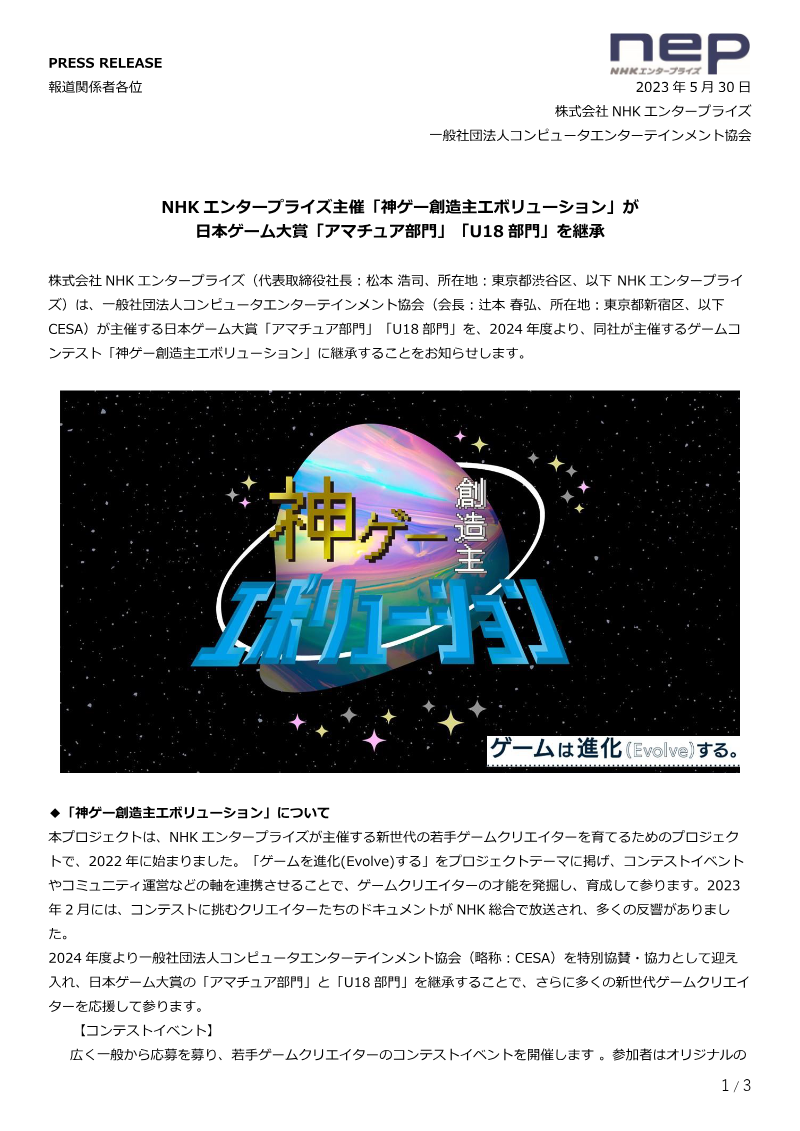
NHK Enterprise's 'Kami-Ge Creator Evolution' Succeeds Japan Game Awards 'Amateur' and 'U18' Divisions
NHK Enterprise is launching the “Kami‑Ge Creator Evolution” contest as a dedicated platform for nurturing the next generation of Japanese game developers, and from 2024 it will incorporate the Japan Game Awards’ Amateur and U18 divisions. The initiative, begun in 2022 under the theme “Evolve the Game,” seeks to discover and develop talent through a series of contest events, community support, and media exposure, including a documentary broadcast on NHK General in February 2023 that generated strong public interest.
The competition invites creators from across Japan to submit original games, which are evaluated for innovative expansion of the medium’s boundaries by a diverse panel of established game designers, media artists, and other industry figures. In addition to expert judging, a public popularity vote is conducted, and the contest awards a Grand Prize, Excellence Awards, and Honorable Mentions in the Amateur category, while the U18 category focuses on participants aged 18 or younger, reflecting the Japan Game Awards’ long‑standing commitment to youth development since 2018. The 2024 schedule begins with an entry period from 1 February to the end of April, followed by nomination, second‑round video submissions in July, third‑round game submissions in October, finalist announcements at the end of October, and a final event slated for December.
A closed Discord community supports participants with exclusive benefits, knowledge sharing, and mentorship, reinforcing the project’s role as a learning environment. Special cooperation from the Computer Entertainment Supplier’s Association (CESA) provides additional industry credibility and resources. The contest is open to individuals, teams, corporations, and organizations regardless of age, gender, nationality, or the number of entries, emphasizing inclusivity and broad outreach.
By integrating the Amateur and U18 awards, the “Kami‑Ge Creator Evolution” aims to broaden the creative framework of Japanese games, foster innovative design, and strengthen the pipeline of skilled developers. The organizers are actively seeking sponsors to sustain the project’s growth and align with NHK Enterprise’s broader commitment to sustainable development and cultural enrichment.
- NHK Enterprise has integrated the Japan Game Awards’ Amateur and U18 divisions into its 'Kami-Ge Creator Evolution' contest, effective from 2024.
- The 2024 competition timeline spans from February 1 to a final event in December, featuring a multi-stage evaluation process including video submissions in July and game submissions in October.
- The contest is open to all applicants regardless of age, nationality, or organizational status, with specific categories for general amateur creators and those aged 18 or younger.
- Participants gain access to a closed Discord community providing mentorship, knowledge sharing, and exclusive resources to support developer growth.
- The initiative is supported by the Computer Entertainment Supplier’s Association (CESA) to provide industry credibility and resources for the project.
+2
CESA – Computer Entertainment Supplier's AssociationMay 2023
Report4 pages
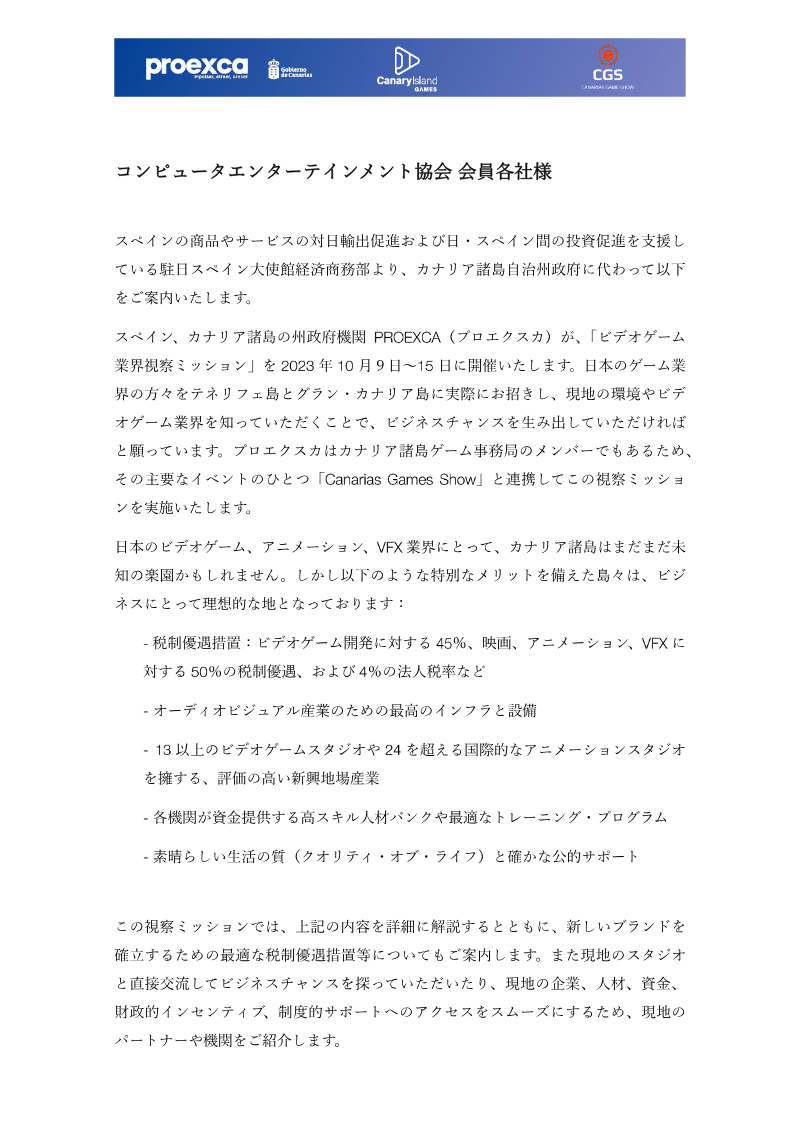
スペイン、カナリア諸島の州政府機関から「ビデオゲーム業界視察ミッション」のご案内
The invitation seeks to generate business opportunities for Japanese video‑game, animation and related audiovisual firms by showcasing the Canary Islands as a strategic production hub. It positions the archipelago as an emerging, tax‑friendly environment, highlighting preferential rates for game development, film and animation, as well as a reduced corporate tax rate, alongside high‑quality infrastructure, skilled talent pools, and strong public support. The core thesis is that direct exposure to local studios, financing mechanisms and regulatory incentives will encourage Japanese companies to establish subsidiaries, pursue co‑production agreements, or outsource projects to Canary Island partners.
The mission is scheduled for 9 – 15 October, with participants traveling from Japan to Tenerife on 9 October and returning after the final day on 15 October. The itinerary includes briefings on the regional industry and tax regime, visits to multiple development studios such as Drakhar, Foxter, The Game Kitchen, Promineo and No Brake Games, a tour of a super‑computer facility, and attendance at the Canarias Game Show on Gran Canaria, featuring B2B matchmaking, conference sessions and networking dinners. All travel costs—including economy‑class round‑trip airfare, hotel accommodation, meals and intra‑island transport—are covered by the organizers, with additional support offered for group participation.
Target participants are Japanese firms contemplating legal entity formation in the Canary Islands, joint‑development projects, or outsourcing production to local studios. The program is coordinated by the Spanish Embassy’s Economic and Commercial Section in Tokyo and the Canary Islands government agency Proexca, which also serves on the regional game office. While the embassy assists with logistics, detailed tax‑incentive information is to be obtained from the Canary Islands authorities and specialist advisors. The initiative aims to deepen Japan‑Spain investment ties within the audiovisual sector by converting the exploratory visit into concrete commercial collaborations.
- The Canary Islands government is hosting a business mission for Japanese video game and animation firms from October 9–15 to promote the region as a strategic production hub.
- The mission covers all travel expenses, including economy-class airfare, accommodation, meals, and local transport, for qualified Japanese companies interested in expansion or outsourcing.
- The Canary Islands offer a competitive business environment featuring reduced corporate tax rates and specific financial incentives for game development, animation, and film production.
- The itinerary includes site visits to local studios such as Drakhar, Foxter, The Game Kitchen, Promineo, and No Brake Games, alongside a tour of a regional super-computer facility.
- Participants will attend the Canarias Game Show on Gran Canaria, which provides dedicated B2B matchmaking, industry conferences, and networking opportunities.
+2
CESA – Computer Entertainment Supplier's AssociationMay 2023

Presentation20 pages
People Can Fly: Q1 2023 Financial Results
PCF Group, the parent entity of the People Can Fly studio, reports a period of continued organizational expansion and strategic financial positioning as of the first quarter of 2023. The group has significantly grown its workforce to 642 employees by March 31, 2023, up from 612 at the end of 2022. This growth is concentrated primarily in its European hubs, including Warsaw, Rzeszów, and Newcastle, while maintaining a substantial presence in North America through its Montreal and New York studios. The team composition remains heavily weighted toward development, supported by specialized units like Incuvo and GameOn.
Financial data indicates a stable balance sheet with total assets and liabilities reaching 351.9 million PLN. A notable shift is observed in the group’s cash position, which decreased from 137.1 million PLN at the end of 2021 to 60.9 million PLN by the end of Q1 2023. Simultaneously, investment in development work in progress has surged to 139.7 million PLN, reflecting an intensive production cycle. Equity remains strong at 271.6 million PLN, providing a solid foundation for the group’s long-term objectives.
The strategic focus is transitioning from a work-for-hire model toward self-publishing. While the group continues to leverage partnerships with global publishers to ensure financial stability and experimental freedom, the ultimate goal is to release three AAA projects under a self-publishing framework. This shift is projected to drive a 4.9x revenue increase between 2023 and 2027. Funding for this strategy is secured through a combination of operational cash flow, debt financing, and a strategic investment agreement with Krafton, which contributed 144.5 million PLN via a share subscription. This diversified capital structure is intended to support the full realization of the group’s ambitious development pipeline.
- People Can Fly is transitioning from a work-for-hire model to self-publishing, with a strategic goal to release three AAA projects by 2027.
- The group projects a 4.9x revenue increase between 2023 and 2027, supported by a capital structure that includes a 144.5 million PLN share subscription from Krafton.
- Development intensity has surged, with investment in work-in-progress projects reaching 139.7 million PLN as of Q1 2023.
- The company's cash position decreased from 137.1 million PLN at the end of 2021 to 60.9 million PLN by the end of Q1 2023, reflecting heavy reinvestment into production.
- The workforce grew to 642 employees by March 31, 2023, up from 612 at the end of 2022, with expansion focused on European hubs and North American studios.
+1
PCF GroupMay 2023
Report13 pages
Newzoo DLC Content Report 2023
This analysis examines the impact of downloadable content (DLC) on player engagement and revenue across the PC and console markets. Covering the period from April 2020 to April 2023, the study evaluates over 1,600 DLC releases across 37 major global markets. The findings demonstrate that DLC serves as a critical tool for extending game longevity and driving monetization, particularly within the live-service model. In 2022, DLC sales accounted for 13% of total PC revenue and 7% of console revenue in the United States, highlighting a stronger reliance on add-on content among PC audiences.
The research indicates that DLC launches provide a significant boost to player activity, with an average increase of 11% in Monthly Active Users (MAU) during the launch month. Medium-sized games, defined as those with 250,000 to 2 million MAU, saw the most substantial benefit, averaging a 22% growth rate. From a genre perspective, strategy games experienced the highest engagement spikes at 30.5%, followed by role-playing games at 21.1%. However, the data also reveals a trend of declining engagement in the months following a release, suggesting that players often churn or move to other titles once they have consumed the new content.
Case studies of The Sims 4 and Dead Cells illustrate diverse strategic approaches to content delivery. Electronic Arts successfully utilized a "free-to-play" funnel by releasing a free update immediately before a paid expansion, resulting in the most successful launch week in the franchise's recent history. Conversely, Dead Cells demonstrated the power of crossovers, with its Return to Castlevania DLC driving a 225% increase in MAU. Despite these spikes, the analysis notes that retention remains a challenge, as a significant majority of players do not return for subsequent updates, emphasizing the constant need for fresh content to maintain a stable player base.
- DLC launches drive an average 11% increase in Monthly Active Users (MAU), with medium-sized games (250,000 to 2 million MAU) experiencing the highest growth at 22%.
- Strategy games see the largest engagement spikes from DLC at 30.5%, followed by role-playing games at 21.1%.
- In 2022, DLC sales accounted for 13% of total PC revenue and 7% of console revenue in the United States, indicating a higher reliance on add-on content on PC.
- Retention remains a persistent challenge, as most players do not return for subsequent updates and engagement typically declines in the months following a release.
- Strategic content delivery, such as Electronic Arts' free-to-play funnel for The Sims 4 or the 225% MAU spike driven by the Dead Cells 'Return to Castlevania' crossover, can significantly boost performance.
+1
NewzooMay 2023
Report13 pages
How DLC boosts engagement for PC and console games
Downloadable content (DLC) serves as a critical driver for player engagement and long-term monetization in the PC and console gaming sectors. Analyzing over 1,600 content releases between April 2020 and April 2023 across 37 major markets, data indicates that DLC launches provide an average monthly active user (MAU) boost of 11%. This impact is most pronounced for medium-sized games with 250,000 to 2 million MAU, which experienced a 22% growth during launch months. While these releases successfully spike interest, engagement typically declines in the months following the initial release, highlighting the necessity of a consistent content pipeline to maintain player interest.
Monetization trends in the United States further underscore the importance of post-launch content. In 2022, DLC accounted for 13% of PC revenue and 7% of console revenue, contributing to a landscape where in-game spending represents nearly half of total industry earnings. Strategy games emerged as the top-performing genre for DLC-driven growth, seeing a 30.5% average increase in MAU, followed by role-playing and adventure titles. These findings suggest that genres requiring deep mechanical updates or narrative expansions benefit most from the DLC model.
Case studies of The Sims 4 and Dead Cells illustrate diverse strategic approaches to content delivery. Electronic Arts successfully utilized a "free-to-play" transition combined with a free base-game update to prime the audience for the "Growing Together" expansion, resulting in its most successful launch week since 2015. Conversely, Dead Cells demonstrated the power of high-profile collaborations, such as the Castlevania DLC, which drove a 225% MAU increase. However, the data also reveals a retention challenge, as a significant majority of players who engage with new DLC do not remain active in subsequent non-update months. This emphasizes that while DLC is a potent tool for re-acquisition and revenue, sustaining a permanent player base remains a complex hurdle for live-service titles.
- DLC releases drive an average 11% increase in monthly active users (MAU), with medium-sized games (250,000 to 2 million MAU) seeing the highest impact at 22% growth.
- Strategy games benefit most from the DLC model, recording a 30.5% average increase in MAU, followed by role-playing and adventure titles.
- DLC is a significant revenue driver, accounting for 13% of PC revenue and 7% of console revenue in the U.S. during 2022.
- High-profile collaborations can trigger massive short-term spikes, evidenced by the Dead Cells 'Castlevania' DLC which drove a 225% increase in MAU.
- Strategic content delivery, such as Electronic Arts' combination of a free-to-play transition and base-game updates for The Sims 4, can achieve record-breaking expansion launches.
+1
NewzooMay 2023
Report10 pages
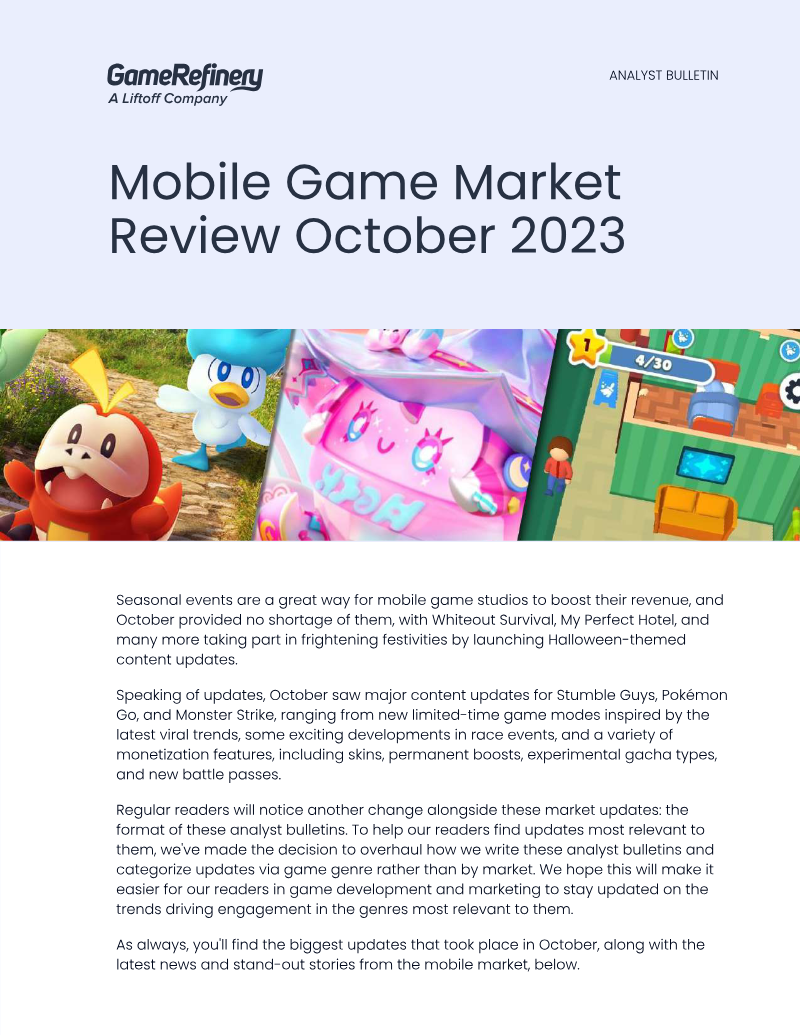
Mobile Game Market Review October 2023
The mobile gaming market in October 2023 was characterized by a heavy reliance on seasonal Halloween content and innovative social features to drive monetization and engagement. Analysis of the period reveals that major titles across the casual and midcore segments utilized limited-time events, crossover collaborations, and experimental gacha mechanics to bolster revenue. Geographically, the review focuses on major global markets, specifically the United States, Japan, and China, highlighting how regional preferences dictate event structures, such as the prevalence of social multi-gachas and location-based business discounts in the Japanese market.
In the casual segment, developers increasingly integrated social and competitive mechanics to maintain player interest. Notable examples include Pokémon Go’s introduction of a four-player party system and Eggy Party’s "Pedestrian Street" mode, which emphasizes social hangouts over core gameplay. Data indicates that titles like My Perfect Hotel successfully improved revenue trends by balancing download fluctuations with permanent boost systems and specialized battle passes. Furthermore, the market saw the rise of "challenging" platforming content in the party royale genre, drawing inspiration from viral PC trends to test player perseverance.
The midcore sector demonstrated the power of long-term live operations and high-profile collaborations. Monster Strike’s 10th-anniversary celebrations in Japan utilized celebrity partnerships and anime crossovers to maintain its top-tier status. Simultaneously, new entries such as Dungeon Hunter 6 and Reverse: 1999 achieved significant chart positions shortly after launch, with the latter reaching the top 100 in both the US and Japan. The findings suggest a market shift toward hybrid gameplay—such as combining merge mechanics with match-3 puzzles—and the successful localization of high-performing Chinese extraction shooters for Western audiences. Overall, the data underscores that consistent content overhauls and the strategic timing of feature updates remain the primary drivers for scaling performance in a competitive mobile landscape.
- Live operations and seasonal content, particularly Halloween-themed events and crossover collaborations, were the primary drivers for revenue and engagement across casual and midcore mobile titles in October 2023.
- Casual games are increasingly integrating social and competitive features to sustain retention, exemplified by Pokémon Go’s four-player party system and Eggy Party’s social-focused 'Pedestrian Street' mode.
- The midcore sector continues to rely on long-term live service strategies, evidenced by Monster Strike maintaining top-tier status in Japan through its 10th-anniversary celebrity and anime collaborations.
- New market entrants like Reverse: 1999 demonstrated strong global appeal by reaching the top 100 charts in both the US and Japan shortly after its launch.
- Monetization strategies in the casual segment are shifting toward permanent boost systems and specialized battle passes, as seen in the revenue stabilization of My Perfect Hotel.
+1
GameRefineryApr 2023
Report230 pages
Turkey Game Market 2022 Report
The Turkish gaming market in 2022 serves as a critical case study of a high-growth production hub navigating significant domestic economic volatility. While the player base expanded to over 44 million users—with 81% of adults engaging in mobile gaming—total market revenue saw a sharp correction, falling from $1.2 billion in 2021 to approximately $625 million. This decline was primarily driven by the depreciation of the Turkish Lira and weakened consumer purchasing power, which has accelerated a shift toward free-to-play titles, subscription services, and a demand for high-quality localization to reach a population with generally low English proficiency.
Despite these fiscal challenges, Türkiye has solidified its position as a global leader in gaming investment and development. Istanbul ranks second in Europe and fifth globally for gaming transactions, securing over $424 million in investments across dozens of deals. The domestic ecosystem is maturing beyond its historical focus on hyper-casual mobile titles, with over 2,943 publishers on Google Play and a strategic pivot toward indie, PC, console, and hybrid-casual development. This evolution is supported by a robust infrastructure of 25 entrepreneurship centers and 19 university programs, though a deficit in qualified instructional talent remains a hurdle for long-term sustainability.
The region has also emerged as a premier esports destination, evidenced by hosting the VALORANT Champions Tour and the formal legal recognition of the Turkish Esports Federation, which oversees more than 15,000 licensed players. While traditional segments like internet cafes have declined due to rising operational costs, the integration of gamification into e-commerce and corporate sectors is expanding. Moving forward, the industry is expected to maintain a compound annual growth rate of 24.1% through 2026, driven by blockchain integration, AI technologies, and a transition toward more complex, mid-core gaming experiences.
- The Turkish gaming market experienced a significant revenue contraction in 2022, falling to $625 million from $1.2 billion in 2021 due to currency depreciation and reduced consumer purchasing power.
- Despite the revenue decline, Istanbul remains a global investment hub, ranking second in Europe and fifth globally with over $424 million secured across gaming transactions in 2022.
- The industry is projected to maintain a 24.1% compound annual growth rate through 2026, driven by a strategic shift toward mid-core, PC, and console development alongside AI and blockchain integration.
- The domestic player base reached 44 million users in 2022, with 81% of adults participating in mobile gaming and a strong market preference for free-to-play models and localized content.
- The Turkish gaming ecosystem is maturing beyond hyper-casual titles, supported by 2,943 Google Play publishers and a specialized infrastructure of 25 entrepreneurship centers and 19 university programs.
+1
Gaming in TurkeyApr 2023
Report30 pages
Gaming Industry Report: Q1 2023
The gaming industry experienced a resilient start to 2023, with a projected global market size of $201 billion, representing a 9% year-over-year increase. Public markets showed strength, with gaming-focused exchange-traded funds (ETFs) recording gains between 10% and 23% year-to-date. While private market venture funding saw a total of $761 million across 109 deals in the first quarter, activity remains concentrated in early-stage investments, as late-stage funding has slowed significantly compared to the peak levels of 2021.
Geographically, Asia led global venture funding in the first quarter, followed by North America and Europe. Emerging markets such as Africa and South America saw sporadic but notable deal activity, highlighting a broader global interest in gaming infrastructure and content. Major industry players currently hold approximately $48 billion in cash and equivalents, suggesting a stable environment for potential future mergers and acquisitions despite ongoing regulatory scrutiny regarding large-scale consolidation.
Key industry trends in early 2023 include the integration of artificial intelligence for asset generation and conversational tools, alongside a strategic shift by major tech firms toward cloud-based gaming infrastructure. Competitive dynamics are evolving as Epic Games introduces self-publishing tools to challenge Steam’s market dominance and integrates user-generated content into its Fortnite ecosystem. Furthermore, platforms like Roblox are successfully expanding their reach by aging up their user demographic. These developments, supported by a robust schedule of global industry conferences, indicate a focus on platform scalability, content diversification, and the optimization of developer tools to sustain long-term growth.
- The global gaming market is projected to reach $201 billion in 2023, reflecting a 9% year-over-year growth rate.
- Major industry players possess $48 billion in cash reserves, signaling a stable environment for future M&A activity despite regulatory headwinds.
- Venture capital funding totaled $761 million across 109 deals in Q1 2023, with investment heavily concentrated in early-stage ventures rather than late-stage rounds.
- Gaming-focused ETFs demonstrated strong performance in early 2023, recording year-to-date gains ranging from 10% to 23%.
- Asia currently leads global venture funding, followed by North America and Europe, with emerging activity appearing in African and South American markets.
+3
KonvoyApr 2023
Presentation13 pages
Financial Results 2022
The financial results for PCF Group S.A. in 2022 reflect a transitional period for the company, characterized by a strategic shift toward self-publishing and a significant expansion of its global workforce. The primary objective of the data is to provide a comprehensive overview of the Group’s financial health and operational growth during the fiscal year ending December 31, 2022. The scope of the reporting covers the Group’s international presence, including studios in Warsaw, Rzeszów, Newcastle, Montreal, and New York, encompassing segments such as game development, quality assurance, and specialized subsidiaries like GameOn and Incuvo.
Financial performance in 2022 saw a decline compared to the previous year, with total revenues reaching 171.5 million PLN, down from 180.3 million PLN in 2021. This decrease is primarily attributed to the termination of a major development agreement with Take-Two Interactive Software. Adjusted EBITDA fell from 70.5 million PLN in 2021 to 49.7 million PLN in 2022, while net profit dropped significantly from 61.3 million PLN to 22.0 million PLN. Despite these lower earnings, the balance sheet shows a substantial increase in development work in progress, rising from 68.0 million PLN to 137.1 million PLN. This shift indicates a higher allocation of developer salaries toward internal assets as the company pivots toward independent production.
Operational growth remains a key highlight, with the total workforce expanding from 495 employees at the end of 2021 to 612 by the end of 2022. The majority of this team consists of developers, supported by QA and back-office staff. Geographically, the Group maintains a strong European base with 418 employees, while its North American operations grew to 194 staff members. The data suggests that while short-term profitability was impacted by the loss of a major partner, the Group is aggressively investing in its internal pipeline and human capital to support future self-published titles.
- PCF Group S.A. experienced a decline in financial performance in 2022, with net profit falling to 22.0 million PLN from 61.3 million PLN in 2021.
- Total revenue decreased to 171.5 million PLN in 2022, down from 180.3 million PLN the previous year, primarily due to the termination of a development agreement with Take-Two Interactive Software.
- The company is aggressively shifting toward self-publishing, evidenced by development work in progress doubling from 68.0 million PLN in 2021 to 137.1 million PLN in 2022.
- Adjusted EBITDA dropped to 49.7 million PLN in 2022, compared to 70.5 million PLN in 2021, reflecting the costs associated with the company's strategic transition.
- The Group expanded its total workforce by approximately 24%, growing from 495 employees at the end of 2021 to 612 by the end of 2022.
PCF GroupApr 2023

Report68 pages
The 50-Plus Gamer of Today and Tomorrow
The population of gamers aged 50 and older has expanded to 52.4 million individuals, with average weekly engagement rising over 40% since 2019 to reach 12 hours per week. While mobile remains the dominant platform due to the popularity of puzzle, card, and word games, there is a notable increase in console and PC usage among high-engagement segments. This demographic is segmented into five distinct cohorts, where the most passionate 26% of players—classified as Enthusiasts and Immersives—account for nearly half of all total spending. Although current biannual spending averages $49 per person, the market is poised for significant growth as the 40-49 age bracket, which boasts a 62% participation rate, transitions into this older demographic.
Primary motivations for play center on mental acuity and passing time, with 70% of these gamers viewing play as an essential component of healthy aging and cognitive stimulation. Despite this high level of engagement, a significant gap exists between consumer behavior and industry representation. Approximately 70% of older gamers feel the industry treats them as an afterthought, citing a lack of age-inclusive design and a dearth of marketing that reflects their demographic. Furthermore, these players express strong dissatisfaction with aggressive monetization strategies, such as progress-gating ads and microtransactions, which serve as primary barriers to enjoyment.
The industry currently faces a critical disconnect where older adults struggle to find titles specifically designed for their needs. While gaming peaks for this group during evening hours, their preferences remain concentrated in logic and tile genres, though higher-engagement segments increasingly seek narrative-driven and social experiences. To capture the full potential of this expanding market, developers must address sensitivities regarding cost and representation while leveraging the deep-seated belief among older players that gaming is a vital tool for maintaining mental health and social connection.
- The 50-plus gaming population has reached 52.4 million individuals, with average weekly engagement increasing by over 40% since 2019 to 12 hours per week.
- A high-engagement segment comprising 26% of the demographic—classified as Enthusiasts and Immersives—accounts for nearly 50% of total spending.
- 70% of gamers aged 50 and older believe gaming is essential for cognitive stimulation and healthy aging, yet 70% feel the industry treats them as an afterthought in design and marketing.
- Current biannual spending averages $49 per person, but the market is positioned for growth as the 62% participation rate of the 40-49 age bracket transitions into this demographic.
- Aggressive monetization strategies, specifically progress-gating ads and microtransactions, are identified as the primary barriers to enjoyment and retention for this age group.
+1
AARPApr 2023
Report18 pages
Esports Live-Streaming Trends Report: Q1 2023
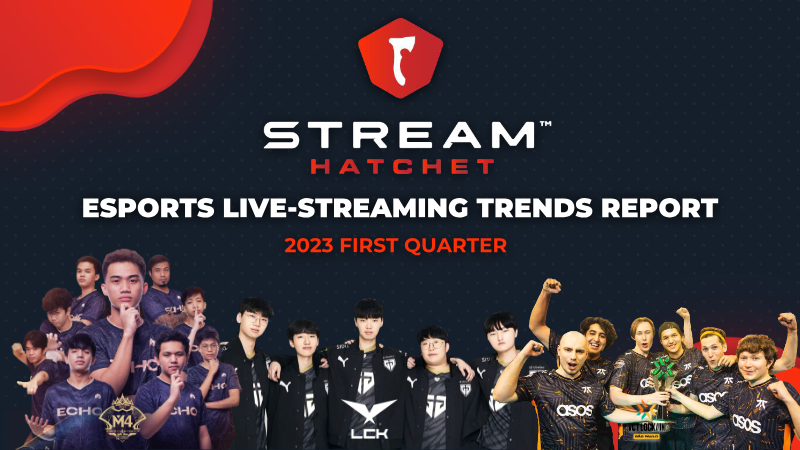
The esports live-streaming market demonstrated significant resilience in the first quarter of 2023, with viewership growing 15% year-over-year to reach 651 million hours watched. This growth occurred despite a general decline in broader live-streaming viewership during the same period. The data, aggregated from major platforms including Twitch, YouTube, Facebook Gaming, and AfreecaTV, indicates that the top 30 tournaments alone account for 68% of total esports viewership, highlighting a heavy concentration of audience interest in premier events.
Twitch maintains its market leadership with a 62% share of esports hours watched, followed by YouTube at 30%. While Twitch dominates smaller events with an 81% market share, YouTube has successfully increased its presence in the large-scale event segment, capturing 34% of viewership for tournaments with an average minute audience exceeding 80,000. Multiplayer Online Battle Arena (MOBA) and First-Person Shooter (FPS) remain the most popular genres, though Action-Adventure saw the highest growth due to specialized events like Minecraft Extremo.
A critical trend identified is the rise of co-streaming, where independent creators broadcast official tournament footage to their own audiences. In the case of the Call of Duty League, co-streaming helped triple the league's hours watched compared to the previous year, with nearly 60% of the peak audience watching via creator channels rather than official streams. Top creators like Tarik and Ibai have become central to this ecosystem, often generating higher chat engagement rates than official broadcasts. Mobile esports also showed strength, particularly Mobile Legends: Bang Bang, which saw a 273% increase in esports viewership despite a general downturn in the mobile gaming sector.
- Esports live-streaming viewership grew 15% year-over-year in Q1 2023 to 651 million hours, bucking the broader industry trend of declining live-streaming viewership.
- Audience interest is highly concentrated, with the top 30 tournaments accounting for 68% of total esports hours watched.
- Twitch holds 62% of the total esports market share, while YouTube maintains 30% and has successfully captured 34% of viewership for large-scale events with an average minute audience over 80,000.
- Co-streaming has become a primary growth driver, exemplified by the Call of Duty League tripling its hours watched as 60% of its peak audience tuned in via creator channels rather than official streams.
- Mobile esports demonstrated significant momentum, with Mobile Legends: Bang Bang recording a 273% increase in viewership despite a general downturn in the mobile gaming sector.
+1
Stream HatchetMar 2023
Report21 pages
Video Game Streaming Trends Report: Q1 2023
The live-streaming market experienced a cooling period in the first quarter of 2023, with combined viewership across major platforms decreasing by 16% compared to the previous year. Despite this decline, the industry remains significantly larger than pre-pandemic levels, with total hours watched still 46% higher than in Q1 2020 and double the volume of Q1 2019. This analysis, based on data from Twitch, YouTube Live Gaming, Facebook Live, and emerging platforms like AfreecaTV, highlights a shifting competitive landscape where Twitch and YouTube have increased their market share to 74% and 15% respectively, while Facebook Live’s influence plummeted by nearly 69%.
A primary trend identified is the growing synergy between streaming and other media formats. The release of The Last of Us television series on HBO triggered a 107% increase in viewership for the franchise's games and generated over one million related chat messages on Twitch within two weeks. Similarly, non-gaming content continues to expand, with sports—specifically football—accounting for four of the top five non-gaming broadcasts. In the gaming sector, League of Legends reclaimed the top spot by hours watched, while Hogwarts Legacy set a record for single-player games with 1.28 million peak viewers during its early access period.
The creator landscape saw significant shifts as KaiCenat became the top streamer, surpassing xQc following a record-breaking 30-day "subathon" that generated 53.4 million hours watched. The report also notes the rising dominance of VTubers, particularly in the female creator category, where they occupy half of the top ten spots. Geographically, the influence of Spanish and Portuguese-speaking creators remains strong, representing the majority of the top ten global streamers. While the market is stabilizing after years of rapid growth, these findings suggest that high-production crossovers and diverse content categories are becoming the primary drivers of audience engagement.
- Total live-streaming viewership declined 16% year-over-year in Q1 2023, though total hours watched remain 46% higher than Q1 2020 levels.
- Twitch and YouTube Live Gaming consolidated their market dominance to a combined 89% share, while Facebook Live viewership plummeted by 69%.
- Cross-media synergy is a primary growth driver, evidenced by the HBO 'The Last of Us' series triggering a 107% increase in viewership for the franchise's games.
- Hogwarts Legacy set a record for single-player games with 1.28 million peak concurrent viewers during its early access period.
- Creator KaiCenat became the top streamer in Q1 2023, generating 53.4 million hours watched during a 30-day 'subathon'.
+1
Stream HatchetMar 2023
Report19 pages
Global Gaming Report Q1 2023
The global gaming industry entered 2023 showing signs of a robust public market recovery, evidenced by a 12% rise in the Drake Star Gaming Index and a notable expansion in valuation multiples. While the volume of mergers and acquisitions experienced a temporary dip to 43 deals, private financing remained resilient. Over 200 deals raised approximately $1.3 billion during the first quarter, driven primarily by early-stage investments. A strategic shift in investor interest became apparent as capital moved away from blockchain-centric projects toward gaming tools and artificial intelligence platforms.
Investment activity was characterized by significant capital injections from major players, most notably Savvy Gaming Group’s $265 million investment in VSPO and Believer’s $55 million raise for open-world development. Venture capital firms such as BITKRAFT and Andreessen Horowitz maintained high deal volumes across PC, console, and platform segments. Despite the broader slowdown in consolidation, Embracer Group remained highly active, completing 18 deals totaling over $1.1 billion. Public market valuations revealed distinct regional and sectoral trends, with Japan and Korea-based developers commanding higher median EV/EBITDA multiples of 9.2x compared to the 5.7x seen in Western PC and console firms.
The financial landscape remains complex and volatile, marked by modest median revenue growth of 1% for hardware and platforms and negative average profit margins across several segments. Regional disparities are particularly sharp in the Chinese market, where Shenzhen-listed firms maintain significantly higher valuation multiples than their counterparts. In the hardware sector, NVIDIA continues to dominate with a market capitalization exceeding $680 billion, despite facing substantial declines in EBITDA. Looking forward, the industry is positioned for a significant M&A rebound in the latter half of the year, supported by massive capital earmarks from sovereign wealth funds and high-profile acquisitions in the mobile and social gaming space.
- The Drake Star Gaming Index rose 12% in Q1 2023, signaling a robust public market recovery despite a temporary dip in M&A volume to 43 deals.
- Private financing remained resilient with over 200 deals raising $1.3 billion, driven primarily by early-stage investments and a strategic pivot away from blockchain toward AI and gaming tools.
- Embracer Group remained the most active consolidator, completing 18 deals totaling over $1.1 billion during the quarter.
- Valuation disparities are significant, with Japan and Korea-based developers commanding median EV/EBITDA multiples of 9.2x, compared to 5.7x for Western PC and console firms.
- Major capital injections included Savvy Gaming Group’s $265 million investment in VSPO and Believer’s $55 million raise for open-world development.
+1
Drake Star PartnersMar 2023