
Report26 pages
Manifiesto de Video Games Europe 2024-2029
The European video‑game sector seeks recognition as a distinct blend of technology and creative culture and urges policymakers to embed this identity in the EU’s 2024‑2029 strategic framework. By positioning games as a driver of digital innovation, cultural expression, and economic growth, the manifesto argues that tailored legislation, financing, and data‑collection mechanisms are essential to sustain the industry’s momentum and competitiveness.
Between 2019 and 2024 the sector expanded by 16 %, reaching €24 billion in revenue and employing roughly 110 000 highly‑skilled workers across the Union. More than half of Europeans (53 %) now play games, with women accounting for 46.7 % of the audience and the average gamer aged 32. Research indicates that girls who game are three times more likely to pursue STEM studies, underscoring the medium’s educational impact. The self‑regulatory PEGI system, which has labelled over 40 000 titles in 40 countries, has cut non‑compliant sales by up to 50 %, demonstrating effective consumer protection without heavy legislative burden.
Current EU financing tools—tax credits and grants—are deemed insufficient to match the incentives offered by hubs such as Canada, the United Kingdom and France. The manifesto calls for a dedicated funding framework that channels public resources toward innovative, creative projects, alongside flexible talent‑attraction visas and Horizon‑funded labour‑market mapping to close digital‑skills gaps. It also highlights the strain of 850 new obligations introduced between 2017 and 2022, amounting to more than 5 000 pages of regulation, which increase compliance costs for developers and publishers.
To solidify the sector’s contribution, a unified intellectual‑property regime and a revision of NACE classification codes are proposed, enabling accurate economic measurement. Mandatory PEGI‑based age controls, parental‑lock tools and proactive chat moderation address the 53 % of Europeans prioritising child‑friendly environments. Finally, the industry’s low‑carbon digital products and initiatives such as “Playing for the Planet” and “Green Game Jam” are presented as foundations for a climate‑responsible future, aligning gaming with
- The European video game sector generated €24 billion in revenue between 2019 and 2024, representing a 16% growth rate and supporting 110,000 highly-skilled jobs.
- The industry faces a significant regulatory burden, having been subjected to 850 new obligations and over 5,000 pages of legislation between 2017 and 2022.
- Current EU financing tools are insufficient to compete with global hubs like Canada and the UK, prompting calls for a dedicated funding framework and improved tax incentives.
- The PEGI self-regulatory system has successfully labeled over 40,000 titles across 40 countries, reducing non-compliant sales by up to 50%.
- Video games have reached 53% of the European population, with a demographic split of 46.7% women and an average player age of 32.
+1
AEVIJan 2024
Report13 pages
Video Games Europe Manifesto 2024-2029
Europe’s video‑game sector has expanded by 16 % between 2019 and 2024, now delivering €24 billion in revenue and employing roughly 110 000 highly‑skilled workers. More than half of the continent’s gamers are under 20 years old, and nearly half of parents rely on the PEGI age‑rating system to ensure safe play. The industry’s dual nature—combining advanced technology with creative content—underpins a call for EU‑level measures that preserve an open, tax‑free single market, extend the Creative Europe programme, apply the General Exemption Regulation to games, and reinforce intellectual‑property protection while investing in digital‑skill education, particularly STEM pathways for girls.
The PEGI framework, supported by co‑regulation, has already classified around 40 000 titles across 40 European countries, halving non‑compliance penalties and cutting energy‑consumption violations by roughly 20 %. Nevertheless, the sector faces a regulatory load of 850 new EU obligations (over 5 000 pages of rules) introduced between 2017 and 2022. A shift toward transparent self‑regulation is advocated, emphasizing clearer in‑game purchase disclosures, stronger parental‑control tools, and EU‑wide educational programmes to close digital‑skills gaps and attract diverse talent.
Safety‑by‑design requirements now obligate all publishers to integrate PEGI‑based age classification, parental‑control portals, chat moderation, purchase limits and time‑spending caps, reflecting the predominance of minors among players. The climate‑and‑inclusion agenda shows progress: women represent 23.7 % of the video‑game workforce, surpassing the 17 % share in the broader ICT sector, and industry members are adopting gender‑equality guidelines and green initiatives such as the Green Game Jam. Coordinated self‑regulation, targeted public funding, and unified online‑safety strategies are presented as essential to sustain economic contribution, foster innovation, and position Europe as the leading hub for socially responsible game development.
- The European video game sector grew by 16% between 2019 and 2024, reaching €24 billion in annual revenue and employing approximately 110,000 highly-skilled workers.
- Between 2017 and 2022, the industry faced a significant regulatory burden consisting of 850 new EU obligations spanning over 5,000 pages of rules.
- The PEGI age-rating system has successfully classified 40,000 titles across 40 countries, contributing to a 50% reduction in non-compliance penalties and a 20% decrease in energy-consumption violations.
- Women currently account for 23.7% of the European video game workforce, outperforming the 17% representation found in the broader ICT sector.
- Industry stakeholders are advocating for EU-level policies that include the application of the General Exemption Regulation to games, the preservation of a tax-free single market, and the expansion of the Creative Europe programme.
+1
Video Games EuropeJan 2024
Report6 pages
2024 Professional Gamer Workforce and Career Structure in Korea
The analysis aims to map the composition, demographics, career trajectories, and income streams of South Korea’s professional e‑sports workforce, drawing on Statista surveys conducted between June and November 2024. It covers domestic players across major titles, Korean competitors active in overseas leagues, and the age, tenure, and earnings profiles of a sample of 138 active professionals, providing a snapshot of the industry’s structure during the current competitive season.
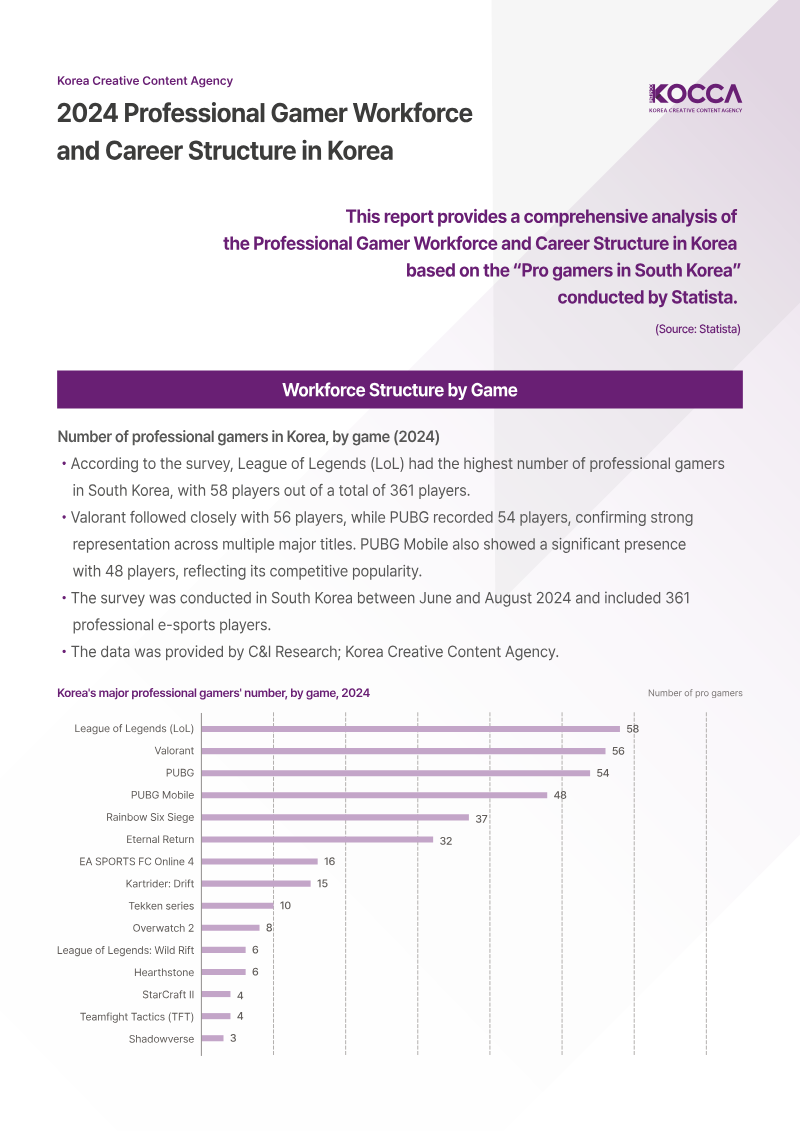
Domestic data identify 361 professional gamers, heavily clustered around four titles: League of Legends (58 players), Valorant (56), PUBG (54) and PUBG Mobile (48). Smaller but notable presences include Rainbow Six Siege (37) and Eternal Return (32). Internationally, 372 Korean e‑sports athletes were reported competing abroad, with League of Legends accounting for 169 participants and Overwatch 2 for 108, while StarCraft II, Valorant and other games each contributed fewer than 30 players.
Age distribution reveals a predominance of young adults, as 37.7 % fall within the 22‑24 year bracket, followed by 29.7 % aged 25 and older, 23.9 % aged 20‑21, and 8.7 % under 19. Career length shows a polarized pattern: 29.7 % have six or more years of experience, while the
- South Korea’s professional e-sports workforce consists of 361 domestic players and 372 athletes competing in overseas leagues.
- League of Legends is the dominant title for Korean professionals, accounting for 58 domestic players and 169 athletes competing internationally.
- The professional player base is heavily concentrated in four domestic titles: League of Legends (58), Valorant (56), PUBG (54), and PUBG Mobile (48).
- Overwatch 2 serves as the second-largest destination for Korean talent abroad, with 108 players currently competing in international leagues.
- The workforce is primarily composed of young adults, with 61.6% of professionals aged 20 to 24 and only 8.7% under the age of 19.
+2
KOCCA – Korea Creative Content AgencyJan 2024
Report7 pages
2024 E‑Sports Viewership and Engagement Trends in Korea
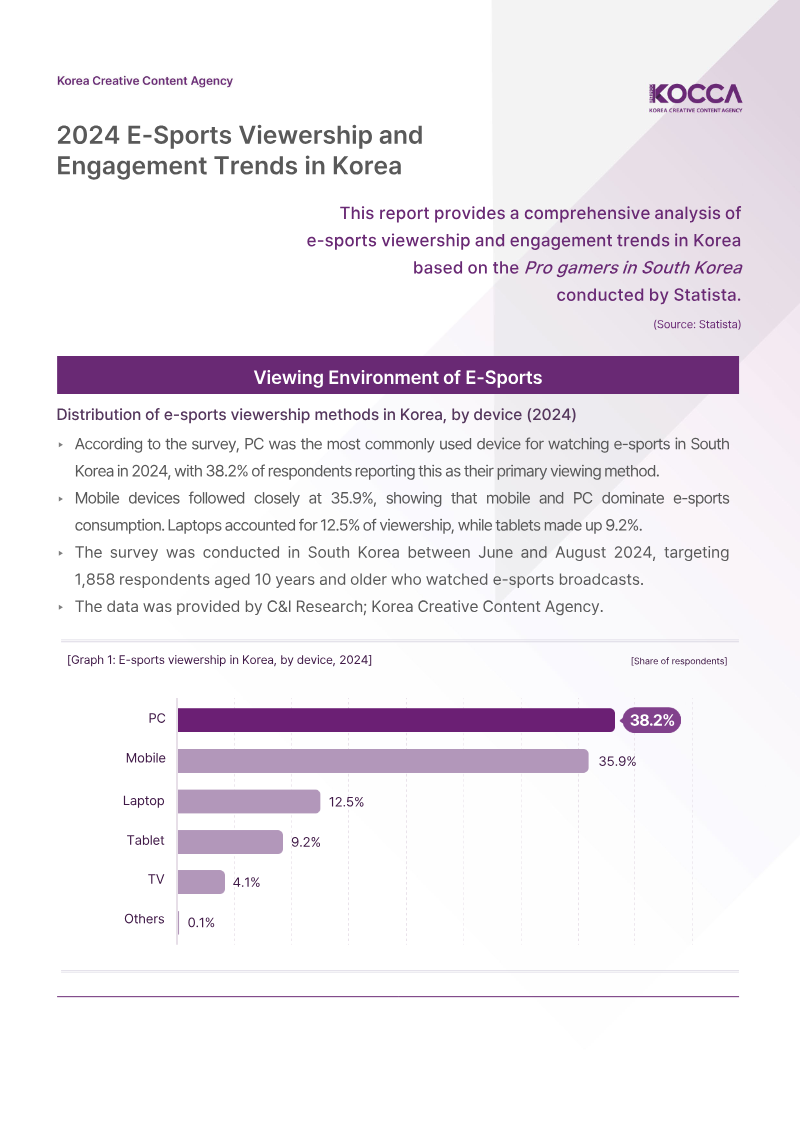
The analysis aims to map current e‑sports viewership and engagement patterns among South Korean audiences, highlighting how consumption devices, platforms, and motivations shape the market and indicating the potential for offline event conversion. Findings reveal a sharply concentrated viewing environment: personal computers account for 38.2 % of primary devices and mobile phones 35.9 %, together representing 74.1 % of usage, while laptops, tablets and televisions capture smaller shares. Platform preference is even more centralized, with YouTube commanding 78.5 % of respondents, far ahead of SOOP (14.1 %) and CHZZK (7.2 %).
Regularity of consumption is high; 38.5 % of participants watch e‑sports 1–2 times per week and 20.4 % watch 3–4 times weekly, meaning at least 58.9 % engage at least once a week. Weekday sessions cluster around one hour for the majority, whereas weekend viewing extends, with 22 % spending two hours on weekdays and 28.6 % doing so on weekends; longer sessions of five hours or more occur for 4.7 % of weekday viewers and 8.1 % of weekend viewers.
Motivational drivers are dominated by entertainment and self‑improvement: 62.1 % watch because the game is fun, 41.9 % seek to enhance their own gameplay, and 37.5 % cite stress relief. Additional reasons include boredom or free access (27.3 %), support for specific players (22.1 %), and social bonding with friends or coworkers (8.6 %).
The survey, conducted between June and August 2024, sampled 1,858 South Korean e‑sports viewers aged ten and older, with data supplied by C&I Research and the Korea Creative Content Agency. A clear majority—62.7 %—expressed willingness to attend live e‑sports events, while 26.9 % remain undecided and 10.4 %
- YouTube dominates the South Korean e-sports market with a 78.5% platform share, significantly outpacing competitors SOOP (14.1%) and CHZZK (7.2%).
- E-sports consumption is primarily mobile and desktop-driven, with PCs (38.2%) and mobile phones (35.9%) accounting for 74.1% of all viewing devices.
- Engagement is frequent and consistent, as 58.9% of viewers watch e-sports content at least once a week, with 20.4% watching 3–4 times weekly.
- Viewer motivation is driven primarily by entertainment (62.1%), gameplay improvement (41.9%), and stress relief (37.5%).
- There is strong potential for offline market growth, as 62.7% of the 1,858 surveyed viewers expressed a willingness to attend live e-sports events.
+1
KOCCA – Korea Creative Content AgencyJan 2024
Report33 pages
Italian Esports Report 2024: Market & Streaming Trends
The analysis evaluates Italy’s esports ecosystem in 2024, aiming to map its audience composition, revenue structure, and strategic priorities for industry participants. Findings reveal a core fan base of 7.3 million individuals, of whom 3.3 million regularly watch esports content. This audience skews younger, resides in urban centres, is predominantly male, and is more likely to hold full‑time employment than the broader gaming population, indicating a segment with disposable income and commercial appeal.
Revenue streams are heavily weighted toward advertising and sponsorship, with 80 % of organisations citing these as primary income sources and accounting for roughly one‑third of total market revenue. This concentration underscores the sector’s dependence on brand partnerships and suggests that monetisation beyond traditional media rights remains limited.
The study draws on a balanced consumer survey of approximately 1,000 Italian internet users aged 16‑65, conducted in September‑October 2024, and a complementary questionnaire administered to an equal number of esports‑industry stakeholders in partnership with IIDEA. All quantitative data are rounded, sourced from publicly available information, and have not undergone independent verification.
Overall, the Italian esports market emerges as a youthful, urban‑centric niche with significant advertising potential, yet its financial model remains narrowly focused. Stakeholders are likely to continue prioritising sponsorship acquisition and related promotional activities to capitalise on the identified demographic strengths.
- Italy’s esports ecosystem comprises 7.3 million fans, with 3.3 million identified as regular viewers of esports content.
- The Italian esports audience is characterized by a younger, urban-centric demographic that is predominantly male and more likely to be employed full-time than the general gaming population.
- Revenue generation is heavily concentrated, with 80% of organizations relying on advertising and sponsorship as their primary income source.
- Advertising and sponsorships account for approximately one-third of the total Italian esports market revenue.
- Monetization strategies in the Italian market remain limited, showing a significant reliance on brand partnerships rather than diversified income streams like media rights.
+1
IIDEA – Italian Interactive Digital Entertainment AssociationJan 2024
Report41 pages
Essential Facts About Video Games in Italy 2024
1. Italian Video Games Market...............................10 2. Italian Players ..................................................16 3. Italian Video Games Industry ............................23 4. Responsible Gameplay ......................................32 5. IIDEA ...............................................................38 • Total turnover of the sector.
- There are 14 million video gamers in Italy, an 8% increase from 2023, representing 1 in 3 Italians aged 6-64.
- The growth in Italian video gamers is primarily driven by women, with a 14% increase compared to a 3% increase among men in 2023.
- Mobile devices are the most popular gaming platform, used by 74% of gamers, followed by consoles (44%) and PC (34%).
- Purchases of new video games generated €562 million in 2023 (a 3% decrease from 2023), while in-game purchases and subscription services generated €354 million (a 24% increase from 2023).
- Digital downloads for consoles and PCs saw a 15% increase in sales, reaching €362 million, while physical packaged video games decreased by 24% to €201 million.
+1
IIDEA – Italian Interactive Digital Entertainment AssociationJan 2024
Report36 pages
Localization in the MENA Region
The Middle East and North Africa (MENA) gaming market, specifically within the Gulf Cooperation Council (GCC), represents a high-growth frontier projected to reach $3.24 billion in player spending and 38.9 million gamers by 2028. This expansion is fueled by 96% internet penetration, high per capita income, and substantial government investment. Despite Arabic being the fifth most spoken language globally, a significant supply gap persists, as only 3.5% of Steam titles are currently localized for the region. This disparity exists even though 41% of regional gamers prioritize localized titles and over 50% highly value content tailored to their linguistic and cultural background.
Successful market entry demands a sophisticated approach to localization that transcends literal translation. Technical execution must account for right-to-left user interface formatting and complex cursive script rendering to avoid the legibility errors that have plagued previous major releases. Strategically, developers should utilize Modern Standard Arabic for text while employing regional dialects for voice-overs to enhance immersion. Culturalization is equally critical, as 40% of players are more likely to recommend games that include accurate religious considerations and regional festivals. Conversely, 27% of players will abandon a title if it relies on inaccurate stereotypes or disrespectful portrayals, highlighting the reputational risks of superficial localization.
Case studies indicate that deep culturalization can lead to exponential growth, with some titles seeing their MENA-based revenue and daily active users jump from 3% to 80% of their global total within months. Achieving these results requires integrating regional voice talent, ensuring historical accuracy, and leveraging local influencers for community engagement. To navigate these sensitivities and technical requirements effectively, international developers benefit most from partnering with regional experts. Such collaborations ensure that games resonate authentically with Arabic-speaking audiences, transforming a title from a foreign product into a culturally relevant experience.
- The MENA gaming market is a high-growth frontier projected to reach $3.24 billion in player spending and 38.9 million gamers by 2028.
- There is a significant supply gap in the region, as only 3.5% of Steam titles are currently localized despite 41% of regional gamers prioritizing localized content.
- Deep culturalization can drive exponential growth, with some titles increasing their MENA-based revenue and daily active users from 3% to 80% of their global total.
- Technical localization must account for right-to-left UI formatting and complex cursive script rendering to avoid legibility errors.
- Developers should use Modern Standard Arabic for text while employing regional dialects for voice-overs to enhance immersion and authenticity.
+1
Saudi Esports FederationJan 2024
Report372 pages
Türkiye Game Market Report: 2024
The Turkish gaming market has emerged as a global powerhouse, reaching a valuation of approximately $810 million in 2024 with a trajectory toward $1 billion by 2029. This growth is supported by a massive domestic audience of over 48 million players and a population characterized by high digital engagement, with 76 million internet users spending nearly seven hours online daily. While mobile gaming remains the dominant segment—accounting for $490 million in revenue—the industry is currently undergoing a strategic pivot. Developers are shifting focus from hyper-casual mobile titles toward more complex PC and console projects, exemplified by the global success of titles like Supermarket Simulator and Liars Bar.
The ecosystem is bolstered by a sophisticated infrastructure of over 1,400 active studios, 26 incubation centers, and a robust financial network of 60 regulated payment institutions. Despite economic headwinds, such as high interest rates affecting hardware sales and the removal of local pricing on major platforms, investment remains resilient. In the first half of 2024, the sector saw over $120 million in deal flow across 20+ transactions. Furthermore, Türkiye has solidified its status as an esports leader, ranking second globally at the World Esports Championship and maintaining a licensed athlete base of nearly 100,000.
However, the market faces significant regulatory and technical challenges. New legal frameworks mandate that foreign platforms appoint local representatives, while recent bans on platforms like Discord and Instagram have disrupted community engagement. Additionally, with Türkiye ranking 65th globally in English proficiency, professional localization—including Turkish characters and voiceovers—is identified as a critical factor for market penetration. Moving toward 2025, the industry is expected to integrate AI-driven development tools and 5G technology more deeply, leveraging its position as a top European gaming hub to attract further international investment and expand its influence across the MENA region.
- The Turkish gaming market is valued at $810 million in 2024, with a projected growth to $1 billion by 2029 supported by a domestic player base of over 48 million.
- Mobile gaming currently leads the market with $490 million in revenue, though developers are strategically pivoting toward more complex PC and console titles like Supermarket Simulator and Liars Bar.
- Investment remains resilient despite economic headwinds, recording over $120 million in deal flow across more than 20 transactions in the first half of 2024.
- The industry ecosystem is supported by over 1,400 active studios, 26 incubation centers, and a network of 60 regulated payment institutions.
- Türkiye maintains a strong position in esports, ranking second globally at the World Esports Championship with a licensed athlete base of nearly 100,000.
+1
Gaming in TurkeyJan 2024
Report17 pages
Essential Facts About the U.S. Video Game Industry
The U.S. video game industry has evolved into a mainstream, multigenerational pastime that encompasses 190.6 million weekly players. Findings indicate that 61% of the American population plays at least one hour of video games per week. The demographic profile of the average player has shifted significantly over the last two decades; the average age is now 36, compared to 29 in 2004. This aging player base has fostered a strong culture of family gaming, with 83% of gaming parents playing alongside their children to strengthen bonds and improve communication.
Technological advancements have fundamentally altered how and where Americans engage with games. Mobile devices are now the primary platform, used by 78% of players, a dramatic increase from 33% in 2012. Furthermore, the rise of internet connectivity has transformed gaming into a social hub, with 88% of players engaging in online gameplay and 72% agreeing that video games create a sense of community. Beyond entertainment, players report significant mental health and cognitive benefits, with over 75% of adults agreeing that games provide stress relief, mental stimulation, and joy.
Economically, the industry remains a powerhouse, contributing nearly $66 billion to the U.S. GDP in 2023 and supporting over $101 billion in total economic impact. Total consumer spending reached $57.2 billion during the same period. The data, gathered by YouGov via a survey of 5,000 respondents and supplemented by qualitative ethnography, highlights that 63% of players view video games as providing the highest value for their money compared to other entertainment media. This comprehensive look at the 2023-2024 landscape confirms that video games are an inclusive, essential component of American social and economic life.
- The U.S. video game industry contributed nearly $66 billion to the GDP in 2023, with total consumer spending reaching $57.2 billion.
- Video games are a mainstream activity in the U.S., with 190.6 million weekly players representing 61% of the total population.
- Mobile devices have become the dominant gaming platform, utilized by 78% of players compared to only 33% in 2012.
- The average age of a U.S. gamer has risen to 36 years old, up from 29 in 2004, driving a trend where 83% of gaming parents play with their children.
- Gaming is a primary social outlet, with 88% of players engaging in online play and 72% reporting that games foster a sense of community.
Entertainment Software AssociationJan 2024
Report47 pages
Study Report on African Video Games: Premier Results in Francophone Countries
The study investigates the emerging video‑game ecosystem in West Africa, focusing on Senegal, Côte d’Ivoire and Cameroon, to assess current player demographics, awareness of locally produced titles, and the factors shaping market potential. By surveying 785 gamers between July and August 2023, the research aims to inform development initiatives such as the Game Hub Senegal incubator, which seeks to nurture talent, provide mentorship and financing, and foster a community around African‑themed games.
Findings reveal a heavily male‑skewed player base—approximately 80 % men—and a concentration of respondents aged 19‑25, who together account for roughly 45 % of participants in each country. Android devices dominate, with over 80 % of gamers using this platform, and most players engage in one to two sessions per day. Despite this activity, exposure to African‑origin games is minimal: 60‑66 % of respondents have never played a locally developed title, and more than 82 % report never having heard of such games. Among the few who have, evaluations are generally positive, describing the experiences as “good” or better.
Motivations for playing centre on “challenges and evolution,” cited by about 37 % of respondents, followed by social interaction with friends (16 %) and graphics quality (8 %). Financial barriers are pronounced; roughly 51 % lack a bank card, limiting their ability to spend on games. For those who do make purchases, the primary drivers are acquiring the game itself (≈ 42 %) and unlocking new levels (≈ 18 %).
Overall, the data suggest that while payment infrastructure and awareness of African‑produced games constrain current consumption, the region’s youthful, mobile‑centric audience and strong appetite for challenging content position the market for rapid expansion in the near term.
- Awareness of locally developed games is extremely low, with over 82% of gamers in Senegal, Côte d’Ivoire, and Cameroon reporting they have never heard of an African-produced title.
- Financial infrastructure is a major barrier to monetization, as approximately 51% of surveyed gamers lack a bank card to facilitate in-game purchases.
- The market is dominated by a young, mobile-first demographic, with 45% of players aged 19–25 and over 80% utilizing Android devices.
- The player base is heavily skewed toward men, who account for approximately 80% of the 785 gamers surveyed between July and August 2023.
- Despite low exposure, 60–66% of respondents have never played a local game, yet those who have report positive experiences, describing them as 'good' or better.
+1
The Game Hub SenegalJan 2024
Report230 pages
Turkey Game Market 2022 Report
The Turkish gaming market in 2022 serves as a critical case study of a high-growth production hub navigating significant domestic economic volatility. While the player base expanded to over 44 million users—with 81% of adults engaging in mobile gaming—total market revenue saw a sharp correction, falling from $1.2 billion in 2021 to approximately $625 million. This decline was primarily driven by the depreciation of the Turkish Lira and weakened consumer purchasing power, which has accelerated a shift toward free-to-play titles, subscription services, and a demand for high-quality localization to reach a population with generally low English proficiency.
Despite these fiscal challenges, Türkiye has solidified its position as a global leader in gaming investment and development. Istanbul ranks second in Europe and fifth globally for gaming transactions, securing over $424 million in investments across dozens of deals. The domestic ecosystem is maturing beyond its historical focus on hyper-casual mobile titles, with over 2,943 publishers on Google Play and a strategic pivot toward indie, PC, console, and hybrid-casual development. This evolution is supported by a robust infrastructure of 25 entrepreneurship centers and 19 university programs, though a deficit in qualified instructional talent remains a hurdle for long-term sustainability.
The region has also emerged as a premier esports destination, evidenced by hosting the VALORANT Champions Tour and the formal legal recognition of the Turkish Esports Federation, which oversees more than 15,000 licensed players. While traditional segments like internet cafes have declined due to rising operational costs, the integration of gamification into e-commerce and corporate sectors is expanding. Moving forward, the industry is expected to maintain a compound annual growth rate of 24.1% through 2026, driven by blockchain integration, AI technologies, and a transition toward more complex, mid-core gaming experiences.
- The Turkish gaming market experienced a significant revenue contraction in 2022, falling to $625 million from $1.2 billion in 2021 due to currency depreciation and reduced consumer purchasing power.
- Despite the revenue decline, Istanbul remains a global investment hub, ranking second in Europe and fifth globally with over $424 million secured across gaming transactions in 2022.
- The industry is projected to maintain a 24.1% compound annual growth rate through 2026, driven by a strategic shift toward mid-core, PC, and console development alongside AI and blockchain integration.
- The domestic player base reached 44 million users in 2022, with 81% of adults participating in mobile gaming and a strong market preference for free-to-play models and localized content.
- The Turkish gaming ecosystem is maturing beyond hyper-casual titles, supported by 2,943 Google Play publishers and a specialized infrastructure of 25 entrepreneurship centers and 19 university programs.
+1
Gaming in TurkeyApr 2023

Report68 pages
The 50-Plus Gamer of Today and Tomorrow
The population of gamers aged 50 and older has expanded to 52.4 million individuals, with average weekly engagement rising over 40% since 2019 to reach 12 hours per week. While mobile remains the dominant platform due to the popularity of puzzle, card, and word games, there is a notable increase in console and PC usage among high-engagement segments. This demographic is segmented into five distinct cohorts, where the most passionate 26% of players—classified as Enthusiasts and Immersives—account for nearly half of all total spending. Although current biannual spending averages $49 per person, the market is poised for significant growth as the 40-49 age bracket, which boasts a 62% participation rate, transitions into this older demographic.
Primary motivations for play center on mental acuity and passing time, with 70% of these gamers viewing play as an essential component of healthy aging and cognitive stimulation. Despite this high level of engagement, a significant gap exists between consumer behavior and industry representation. Approximately 70% of older gamers feel the industry treats them as an afterthought, citing a lack of age-inclusive design and a dearth of marketing that reflects their demographic. Furthermore, these players express strong dissatisfaction with aggressive monetization strategies, such as progress-gating ads and microtransactions, which serve as primary barriers to enjoyment.
The industry currently faces a critical disconnect where older adults struggle to find titles specifically designed for their needs. While gaming peaks for this group during evening hours, their preferences remain concentrated in logic and tile genres, though higher-engagement segments increasingly seek narrative-driven and social experiences. To capture the full potential of this expanding market, developers must address sensitivities regarding cost and representation while leveraging the deep-seated belief among older players that gaming is a vital tool for maintaining mental health and social connection.
- The 50-plus gaming population has reached 52.4 million individuals, with average weekly engagement increasing by over 40% since 2019 to 12 hours per week.
- A high-engagement segment comprising 26% of the demographic—classified as Enthusiasts and Immersives—accounts for nearly 50% of total spending.
- 70% of gamers aged 50 and older believe gaming is essential for cognitive stimulation and healthy aging, yet 70% feel the industry treats them as an afterthought in design and marketing.
- Current biannual spending averages $49 per person, but the market is positioned for growth as the 62% participation rate of the 40-49 age bracket transitions into this demographic.
- Aggressive monetization strategies, specifically progress-gating ads and microtransactions, are identified as the primary barriers to enjoyment and retention for this age group.
+1
AARPApr 2023

Report73 pages
2023 Serbian Gaming Industry Report
The report demonstrates that Serbia’s gaming sector has experienced a dramatic expansion in 2023, with the workforce more than doubling from roughly 1,700 to over 4,300 employees. Revenue climbed 17 % year‑on‑year to €175 million, largely driven by mobile titles and original intellectual property, while about a third of earnings originate from overseas markets. The growth is underpinned by an influx of talent from Russia, Ukraine and Belarus, a robust mix of large international studios—such as Ubisoft Belgrade, Playrix Serbia and Wargaming—and a vibrant indie scene that includes boutique developers like Yboga, Art Bully and Flat Hill Games.
Key findings reveal that mobile gaming dominates the revenue landscape, with Android accounting for 60 % of market share and large studios (40+ staff) capturing the majority of profits. Smaller firms, though experiencing higher employee growth, face heightened client concentration and single‑client risk. The industry’s service arm also flourishes; firms such as GameBiz Consulting manage substantial revenue streams and provide financial, tax and user‑acquisition support to local studios.
Serbia’s strategic positioning on the European stage is evident through participation in mentoring programs, visibility at Gamescom, and targeted funding from Creative Europe’s €16 million grant pool. Partnerships with global players like Google, Epic Games and major publishers reinforce the country’s reputation as a regional hub.
Education and talent pipelines have expanded markedly, with universities, technical schools and informal hubs offering comprehensive programs that feed a growing workforce. Initiatives such as the Serbian Games Association’s “Playing Narratives” and Shift2Games demonstrate successful placement of graduates into industry roles.
Overall, the sector’s rapid growth is tempered by regulatory complexity, limited funding access and emerging legal challenges around AI‑generated content. Continued policy support and diversification of revenue sources will be essential to sustain Serbia’s ascent as a leading contributor to AAA, mobile F2P and emerging VR experiences across Europe.
- Serbia’s gaming workforce grew significantly in 2023, more than doubling from approximately 1,700 to over 4,300 employees.
- Industry revenue reached €175 million in 2023, a 17% year-on-year increase driven primarily by mobile titles and original intellectual property.
- Mobile gaming dominates the market with a 60% share on Android, while large studios with 40+ staff capture the majority of industry profits.
- The sector is bolstered by a mix of major international studios like Ubisoft Belgrade, Playrix Serbia, and Wargaming, alongside a growing indie scene and specialized service firms like GameBiz Consulting.
- Growth is supported by an influx of talent from Russia, Ukraine, and Belarus, paired with expanded local educational pipelines like the 'Playing Narratives' initiative.
SGAJan 2023
Report42 pages
How Different Generations Engage with Video Games Today
Gaming has evolved into the primary entertainment medium for younger generations, with 94% of Gen Alpha identifying as game enthusiasts. This shift signifies a transition from gaming as a solitary hobby to a multi-dimensional "way of life" that encompasses playing, viewing, and socializing. While mobile gaming maintains universal appeal across all age groups, younger cohorts like Gen Alpha and Gen Z are significantly more likely to engage across multiple platforms and participate in virtual social environments. These younger players demonstrate high spending conversion rates, with approximately 60% investing in games, often driven by a desire for social immersion and diverse genres such as Adventure and Battle Royale.
In contrast, older generations like Gen X and Baby Boomers exhibit more utilitarian engagement patterns. These cohorts primarily favor casual puzzle-solving titles and are motivated by achievement, mastery, and time-saving mechanics. While 70% of younger players are "player-viewers" who consume gaming video content for entertainment and social connection, older players use video content more informationally, such as for reviews or tutorials. This generational divide extends to brand discovery; younger players are increasingly open to discovering new brands within game worlds, making the medium a vital marketing tool for reaching modern consumers.
The global gaming landscape is characterized by both universal franchises and distinct regional preferences. Major titles like Call of Duty, Fortnite, and Genshin Impact maintain a massive international presence, yet markets such as China, Japan, and South Korea continue to support region-specific hits like Honor of Kings and Lineage. Across these diverse geographies, the 2023 data highlights that gaming has become a central pillar of social interaction and brand engagement, particularly as younger generations integrate virtual experiences into their daily identities and consumption habits.
- Gaming has become the primary entertainment medium for younger generations, with 94% of Gen Alpha identifying as game enthusiasts.
- Approximately 60% of younger players invest in games, driven by a preference for social immersion and genres like Adventure and Battle Royale.
- 70% of younger players are 'player-viewers' who consume gaming content for social connection, whereas older generations use such content primarily for information like reviews and tutorials.
- Younger cohorts engage across multiple platforms and virtual social environments, while Gen X and Baby Boomers favor casual puzzle titles focused on mastery and time-saving mechanics.
- Younger players are increasingly receptive to brand discovery within game worlds, positioning gaming as a critical marketing channel for modern consumer engagement.
+1
NewzooJan 2023
Report19 pages
European Key Facts 2023
This analysis provides a comprehensive overview of the European video game sector in 2023, detailing market health, player demographics, and regulatory priorities. The industry demonstrated resilience with annual revenues reaching €25.7 billion, representing a 5% year-on-year increase. Employment also saw significant growth, with the workforce expanding by nearly 7% to reach approximately 115,000 people across Europe.
The data reveals that video games are a mainstream cultural fixture, with 53% of the European population aged 6–64 identifying as players. Contrary to youth-centric stereotypes, the average player age is 31.4 years, and 75% of the gaming population are adults. Women represent 43.5% of the total player base, averaging 6.7 hours of play per week. While smartphones remain the most popular platform (68%), consoles (56%) and PCs (46%) maintain significant engagement. Despite the rise of digital media, average weekly playtime has remained stable for over a decade at approximately 8.9 hours.
A central thesis of the findings is the industry’s commitment to social responsibility and self-regulation. The Pan European Game Information (PEGI) system celebrated 20 years of operation, with 79% of parents aware of its ratings and 62% actively using parental tools to manage gameplay. Furthermore, the industry is increasingly focused on sustainability and diversity, noting that 44% of new hires in regions like Sweden are women and highlighting energy-saving agreements that have saved 54 TWh of electricity over the lifetime of major consoles.
The geographic scope covers the European Union and broader European markets, utilizing data from Ipsos, GameTrack, and Games Sales Data (GSD). Methodology includes online polling of 60,000 individuals across major markets, calibrated by nationally representative face-to-face surveys. Looking forward, the industry advocates for EU policy that recognizes video games as unique creative works, supports a robust talent pipeline through STEAM education, and maintains a fair regulatory framework that avoids distorting the single market.
- The European video game sector generated €25.7 billion in 2023, marking a 5% year-on-year revenue increase.
- Industry employment grew by nearly 7% in 2023, reaching a total workforce of approximately 115,000 people across Europe.
- Video games are a mainstream fixture with 53% of the population aged 6–64 identifying as players, maintaining a stable average of 8.9 hours of gameplay per week.
- The player base is mature and diverse, with an average age of 31.4 years, 75% adult representation, and 43.5% female participation.
- Smartphones are the leading platform at 68% usage, followed by consoles at 56% and PCs at 46%.
+1
Video Games EuropeJan 2023
Report60 pages
Digital Games' Impact in Denmark
The study evaluates how digital games shape everyday life in Denmark, measuring participation rates, motivations, and social outcomes among a representative sample of gamers. By linking behavioural data with self‑reported wellbeing, it argues that games have become a mainstream cultural activity that delivers measurable, though modest, emotional benefits while also fostering relational ties when played socially.
Among 1,172 respondents, 79 % reported playing a digital game within the past year, with weekly engagement ranging from 62 % of those aged 55‑79 to 74 % of 16‑24‑year‑olds. This high penetration underscores games as a routine leisure pursuit across age groups. Players rate gaming as an “active, rewarding break,” assigning an average relaxation score of 3.9 on a five‑point scale and an immersion rating of roughly 3.6, indicating that the activity is perceived as both soothing and engaging.
The majority of gaming occurs in solitary settings—91 % of participants play at home—and puzzle titles dominate preferences, attracting 65 % of respondents and achieving the highest relaxation scores. Nevertheless, social play, whether with friends, online strangers (12 % of gamers) or one’s own children (11 % of gamers), markedly elevates relational and community metrics; relational scores rise from an overall average of 2.1 to 2.9 for those who game with children, and empathy levels increase especially among action‑ and adventure‑game players. These findings suggest that shared gaming experiences amplify social connection, empathy, and cross‑generational bonding.
Overall, digital games in Denmark generate modest emotional gains while serving as a versatile tool for personal relaxation and, when played together, for strengthening social ties. The results highlight the dual role of games as both an individual stress‑relief mechanism and a catalyst for community cohesion within the Danish cultural context.
- Digital gaming is a mainstream activity in Denmark, with 79% of the population having played a game in the past year.
- Engagement is high across all age groups, ranging from 62% of those aged 55–79 to 74% of those aged 16–24 playing on a weekly basis.
- Puzzle games are the most popular genre, preferred by 65% of respondents and yielding the highest relaxation scores among all game types.
- Gaming is primarily a solitary, home-based activity, with 91% of participants playing at home.
- Social gaming significantly boosts relational metrics, with scores rising from an overall average of 2.1 to 2.9 when parents play with their children.
+2
NIMBI – Danish Institute for Game DevelopmentJan 2023
Report42 pages
Estudio sobre el Consumo de Videojuegos entre la Población Adulta Española y en Familia
The study investigates how video‑games are consumed in Spain, focusing on family interaction, the adoption of parental‑control tools, and the impact of streaming personalities on player behaviour. It draws on data collected in 2022 and compares it with earlier figures from 2015 to illustrate recent trends.
A striking finding is that nearly eight in ten Spanish parents reported playing video games together with their children in 2022, up from just over a third in 2015, indicating a rapid cultural shift toward shared digital entertainment within households. Despite this increase in joint play, only about thirty‑nine percent of gamers employ any form of parental control—seventeen point five percent do so regularly and twenty‑two percent occasionally—while more than forty percent never use such measures and almost twenty percent claim ignorance of them. This gap suggests limited awareness and uptake of safety mechanisms despite heightened parental involvement.
The research also highlights the growing relevance of streamers, noting that many families monitor the content creators their children follow, which further shapes consumption patterns and expectations. Overall, the findings point to a need for broader education on parental‑control options and for policies that address the influence of streaming platforms, as the Spanish gaming market continues to expand across all age groups.
- Shared family gaming in Spain has surged significantly, with nearly 80% of parents playing with their children in 2022 compared to just over 33% in 2015.
- Parental control adoption remains low, as only 39% of gamers use these tools, with 17.5% using them regularly and 22% occasionally.
- A significant portion of the gaming population is disengaged from safety measures, with over 40% of users never employing parental controls and nearly 20% reporting they are unaware of their existence.
- Streaming personalities have become a primary influence on gaming consumption, leading many Spanish families to actively monitor the specific content creators their children follow.
- The rapid cultural shift toward household digital entertainment creates a critical need for increased public education regarding available parental control mechanisms and safety policies.
+1
AEVIJan 2023

Report12 pages
Informe Mundial 2023: Comportamientos e Intereses de los Videojugadores
The 2023 Power of Play survey set out to map the motivations, social impacts and perceived wellbeing benefits of video gaming across a broad international sample. By combining responses from 12,847 active gamers who play at least once a week with findings from ten recent peer‑reviewed studies, the analysis argues that games deliver measurable social, emotional and cognitive value that extends far beyond pure entertainment.
Respondents from twelve markets—Australia, Brazil, Canada, France, Germany, Italy, Japan, Poland, South Korea, Spain, the United Kingdom and the United States—identified “having fun” as the top driver (69 % overall), followed by “entertainment” and “stress relief”. More than half of participants reported regular online play, while a third also engaged in face‑to‑face sessions. Nearly 45 % said they had met a close friend, partner or spouse through gaming, and 67 % believed games help them forge new relationships. Across the sample, 71 % felt games reduce stress, anxiety and isolation, 64 % described gaming as a healthy escape from daily problems, and 83 % reported increased happiness when playing.
Cognitive and creative gains were also prominent: 69 % linked gaming to improved problem‑solving, 65 % to greater adaptability, 60 % to enhanced communication, and 57 % to better linguistic skills. The report cites academic work that documents superior cognitive performance among gamers, reduced depressive symptoms during the COVID‑19 pandemic, and potential protective effects against age‑related memory decline and dementia. Studies of exergames and therapeutic titles further suggest benefits for pain management, motor coordination and social inclusion in clinical populations.
Methodologically, the survey employed an online, quota‑controlled panel designed to reflect each country’s demographic composition, with screening to ensure weekly gaming activity. Data were collected by AudienceNet, a market‑research firm accredited by the Market Research Society and compliant with GDPR standards. The integration of large‑scale consumer data with scholarly evidence provides a comprehensive picture of gaming’s evolving role in mental health, social connectivity and skill development worldwide.
- Gaming serves as a primary tool for emotional regulation, with 83% of players reporting increased happiness and 71% stating that games reduce stress, anxiety, and isolation.
- Social connectivity is a core outcome of gaming, as 67% of players believe games help them forge new relationships, and 45% have met a close friend, partner, or spouse through the medium.
- Players identify 'having fun' as the primary motivation for gaming (69%), followed by entertainment and stress relief as the leading drivers for engagement.
- Gaming is perceived as a driver of cognitive and professional skill development, with 69% of respondents citing improved problem-solving and 65% noting greater adaptability.
- Peer-reviewed academic research supports the survey findings, suggesting that gaming can provide protective effects against age-related memory decline and help manage depressive symptoms.
+1
AEVIJan 2023
Report12 pages
Global Report 2023
Power of Play: Global Report 2023 – Executive Summary
1. Scope & Methodology | Item | Detail | |------|--------| | Survey population | ≈ 12,847 active (weekly) gamers, ages 16 +, from 12 countries (Australia, Brazil, Canada, France, Germany, Italy, Japan, Poland, South Korea, Spain, United Kingdom, United States). | | Sampling | Quota‑based, nationally‑representative panels (AudienceNet). Each country ≈ 1,000 + respondents. | | Data collection | Online questionnaire covering motivations, mental‑health impacts, social behaviours, and skill development. | | Academic triangulation | Findings cross‑checked against ~10 peer‑reviewed studies (see References, p. 12). |
2. Why People Play (Top‑3 Reasons – Global)
| Rank | Reason | % of respondents (global) | |------|--------|----------------------------| | 1 | Fun / enjoyment | 69 % | | 2 | Pass the time | 63 % | | 3 | Stress relief / relaxation | 55 % |
Country‑level nuances: “Fun” dominates in every market (≥ 78 % in most). “Stress relief” is especially high in Australia (71 %) and Japan (73 %).
3. Self‑Reported Mental‑Health Benefits
| Benefit | Global agreement (average) | Range across countries | |---------|----------------------------|------------------------| | Reduces stress | 71 % | 55 % – 87 % | | Reduces anxiety | 61 % | 48 % – 78 % | | Reduces feelings of isolation/loneliness | 55 % | 45 % – 73 % | | Provides a healthy outlet for everyday challenges | 64 % | 52 % – 76 % | | Makes me feel happier | 63 % | 45 % – 83 % | | Helps me get through difficult times | 52 % | 33 % – 71 % |
> Interpretation: More than two‑thirds of gamers perceive video games as a stress‑relief tool, and roughly half feel less isolated because of gaming.
4. Social & Relational Outcomes
| Metric | Global % (approx.) | |--------|-------------------| | Play with others online (≥ weekly) | 51 % | | Play with others in‑person (≥ weekly) | 38 % | | Met a good friend, spouse, or significant other through games | 46 % | | Games helped develop deeper relationships | 43 % | | Games helped stay connected to friends/family | 46 % | | Games created lasting memories | 50 % | | Believe there is a game for everyone | 75 % |
> Key insight: Multiplayer and social features are central; almost half of respondents have formed meaningful offline relationships via gaming
- Video games function primarily as a mental health tool, with 71% of global gamers reporting that play reduces stress and 61% noting a reduction in anxiety.
- Fun and enjoyment remain the primary drivers for gaming, cited by 69% of the 12,847 respondents, followed by passing time (63%) and stress relief (55%).
- Social connectivity is a core component of the gaming experience, as 51% of players engage in online multiplayer weekly and 46% have formed meaningful personal relationships, including friendships and marriages, through games.
- Gaming serves as a significant social bridge, with 46% of respondents using games to stay connected with friends and family and 43% reporting that gaming helped them develop deeper relationships.
- The perception of gaming as an inclusive medium is high, with 75% of respondents agreeing that there is a game available for everyone.
+1
IIDEA – Italian Interactive Digital Entertainment AssociationJan 2023

Report32 pages
I Videogiochi in Italia nel 2023
I Videogiochi in Italia nel 2023 – Sintesi
1. Dimensione del mercato
Fatturato: € 2,3 miliardi, con una crescita del 5 % rispetto al 2022 e del 28 % rispetto al 2019. Posizione europea: l’Italia si colloca tra i cinque maggiori mercati videoludici d’Europa. Pubblico: 13 milioni di persone tra i 6 e i 64 anni (circa il 31 % della popolazione), con un’età media di 30 anni.
Questi dati confermano che il settore è in forte espansione, sia in termini di valore economico sia di penetrazione culturale.
2. Il ruolo dell’IIDEA
L’Istituto per l’Innovazione Digitale e l’Economia dell’Arte (IIDEA) è il punto di riferimento istituzionale per lo sviluppo dell’industria videoludica italiana. Le sue attività principali sono:
| Area di intervento | Azioni chiave | |--------------------|----------------| | Sviluppo business & internazionalizzazione | - Programmi di accelerazione con partner nazionali e internazionali<br>- Campagna di branding “Games in Italy” per promuovere i titoli Made‑in‑Italy | | Educazione e gioco responsabile | - Portale “Tutto sui videogiochi” per genitori e insegnanti<br>- Informazione su rating PEGI e strumenti di parental‑control | | Eventi e riconoscimenti | - First Playable (fiera di riferimento)<br>- Italian Video Game Awards (dal 2013)<br>- Italian Esports Awards (dal 2020) | | Visibilità globale | - Missioni commerciali e matchmaking con investitori/partner esteri<br>- Supporto alla partecipazione a fiere internazionali (e.g., Gamescom, GDC) |
Obiettivi strategici dell’IIDEA
1. Elevare la visibilità internazionale dei prodotti italiani, facilitando partnership e accordi di distribuzione all’estero. 2. Collegare i developer locali con reti di finanziamento, expertise tecnica e canali di marketing globali. 3. Valorizzare il contributo culturale ed economico del settore, posizionandolo come driver di innovazione e creatività nel panorama digitale italiano.
Conclusioni
Il 2023 segna un anno di consolidamento per il mercato videoludico italiano: un fatturato in crescita, una base di utenti ampia e giovane, e un ecosistema supportato da un ente pubblico (IIDEA) che combina sviluppo commerciale, promozione internazionale e educazione responsabile. Queste dinamiche creano le condizioni per un futuro ancora più competitivo, con il potenziale di trasformare l’Italia in un hub di riferimento per la creatività digitale a livello europeo e mondiale.
- The Italian video game market generated €2.3 billion in 2023, representing a 5% increase over 2022 and a 28% growth since 2019.
- Italy ranks among the top five largest video game markets in Europe, with 13 million players aged 6 to 64, representing 31% of the population.
- The average age of the Italian gamer is 30 years old, reflecting the sector's broad cultural and demographic penetration.
- IIDEA serves as the primary institutional body for the industry, focusing on business acceleration, international branding through 'Games in Italy,' and global networking at events like Gamescom and GDC.
- IIDEA manages key industry infrastructure, including the 'First Playable' trade fair, the Italian Video Game Awards, and the Italian Esports Awards.
IIDEA – Italian Interactive Digital Entertainment AssociationJan 2023