
Report47 pages
Study Report on African Video Games: Premier Results in Francophone Countries
The study investigates the emerging video‑game ecosystem in West Africa, focusing on Senegal, Côte d’Ivoire and Cameroon, to assess current player demographics, awareness of locally produced titles, and the factors shaping market potential. By surveying 785 gamers between July and August 2023, the research aims to inform development initiatives such as the Game Hub Senegal incubator, which seeks to nurture talent, provide mentorship and financing, and foster a community around African‑themed games.
Findings reveal a heavily male‑skewed player base—approximately 80 % men—and a concentration of respondents aged 19‑25, who together account for roughly 45 % of participants in each country. Android devices dominate, with over 80 % of gamers using this platform, and most players engage in one to two sessions per day. Despite this activity, exposure to African‑origin games is minimal: 60‑66 % of respondents have never played a locally developed title, and more than 82 % report never having heard of such games. Among the few who have, evaluations are generally positive, describing the experiences as “good” or better.
Motivations for playing centre on “challenges and evolution,” cited by about 37 % of respondents, followed by social interaction with friends (16 %) and graphics quality (8 %). Financial barriers are pronounced; roughly 51 % lack a bank card, limiting their ability to spend on games. For those who do make purchases, the primary drivers are acquiring the game itself (≈ 42 %) and unlocking new levels (≈ 18 %).
Overall, the data suggest that while payment infrastructure and awareness of African‑produced games constrain current consumption, the region’s youthful, mobile‑centric audience and strong appetite for challenging content position the market for rapid expansion in the near term.
- Awareness of locally developed games is extremely low, with over 82% of gamers in Senegal, Côte d’Ivoire, and Cameroon reporting they have never heard of an African-produced title.
- Financial infrastructure is a major barrier to monetization, as approximately 51% of surveyed gamers lack a bank card to facilitate in-game purchases.
- The market is dominated by a young, mobile-first demographic, with 45% of players aged 19–25 and over 80% utilizing Android devices.
- The player base is heavily skewed toward men, who account for approximately 80% of the 785 gamers surveyed between July and August 2023.
- Despite low exposure, 60–66% of respondents have never played a local game, yet those who have report positive experiences, describing them as 'good' or better.
+1
The Game Hub SenegalJan 2024

Report26 pages
Global PC Games Market Report 2024
The global PC gaming market reached record heights in 2023, generating $9 billion in revenue from 580 million units sold on Steam. This performance represents a significant growth spurt following a period of stagnation between 2020 and 2022. The market was primarily driven by a strong slate of premium releases, particularly in the RPG genre, and benefited from a lagging supply of current-generation consoles. Despite nearly 14,000 games being released during the year, the market remains highly concentrated; the top 10 games accounted for 61% of total revenue, while the top 100 games captured 91% of the market share.
A notable shift in consumer preference occurred in 2023, as high-quality, story-focused premium titles without microtransactions outperformed live-service models. Success was not limited to major publishers, as several breakout hits were developed by small indie teams. However, financial success remains elusive for the vast majority of developers, with only 5% of new releases earning more than $100,000. While Action and Adventure remain the dominant genres, RPGs saw the most significant growth, whereas Simulation and MMO categories lost market share.
The outlook for 2024 suggests a temporary contraction due to a lighter release schedule and increased competition from discounted consoles and subscription services. However, long-term forecasts through 2028 remain positive, driven by the continued expansion of Steam’s global user base and the migration of formerly console-exclusive titles to PC. Growth is expected to be fueled by rising average prices for both AAA and indie titles rather than rapid increases in unit sales. Data for these findings was derived from proprietary algorithms and the Boxleiter method, which estimates sales and revenue based on Steam reviews and public platform metrics.
- The global PC gaming market is highly concentrated, with the top 10 games generating 61% of total revenue and the top 100 titles capturing 91% of the market share.
- In 2023, the PC market reached $9 billion in revenue from 580 million units sold on Steam, marking a recovery from stagnation between 2020 and 2022.
- Consumer preference shifted toward high-quality, story-focused premium titles, causing them to outperform live-service models during the 2023 period.
- Financial viability is difficult for most developers, as only 5% of new releases on Steam earned more than $100,000 in 2023.
- While Action and Adventure remain the dominant genres, RPGs experienced the most significant growth, whereas Simulation and MMO categories saw a decline in market share.
Video Game InsightsJan 2024

Report20 pages
The Mobile Economy and Digital Ad Space in 2022 and Beyond: An Analysis of Global Trends
The analysis evaluates how the mobile ecosystem and digital advertising evolved through 2022 and projects future dynamics, using Sensor Tower’s App Store and Google Play data, quarterly download and revenue estimates, and ad‑spend figures from North America and major European markets. It frames the mobile economy as still expanding beyond pre‑COVID levels while noting a slowdown in install growth, with India, the United States, Brazil and Indonesia leading global downloads and emerging markets such as Africa poised for rapid gains as smartphone penetration rises.
Mobile games retained dominance, accounting for over 50 billion downloads and generating roughly $79 billion in revenue, yet 2022 marked the first year of year‑over‑year revenue decline, driven by reduced spending in the United States, Japan and other major economies. Utilities—particularly VPN apps in India—became the fastest‑growing category, while Turkey showed the sharpest adoption increase but faced inflation‑driven limits on consumer spend. Venture‑capital funding contracted, raising concerns about the emergence of new app disruptors, and Android revenue fell 30 percent year‑over‑year, contrasted with a modest 1 percent iOS growth.
Spending patterns shifted as entertainment apps eclipsed social networking in the United States, with TikTok, HBO Max and Disney+ leading a surge that doubled 2019 levels and made entertainment revenue twice that of the next‑largest non‑game category. In Japan, a manga‑reader app topped overall gross revenue for the first time, highlighting diversification beyond games.
- Mobile gaming revenue experienced its first year-over-year decline in 2022, generating $79 billion from over 50 billion downloads as consumer spending dropped in major markets like the United States and Japan.
- Android revenue fell by 30 percent year-over-year in 2022, while iOS revenue saw a modest 1 percent growth.
- Entertainment apps have overtaken social networking in the United States, with revenue from platforms like TikTok, HBO Max, and Disney+ doubling 2019 levels to become the largest non-game category.
- India, the United States, Brazil, and Indonesia lead global app downloads, with emerging markets in Africa expected to see rapid growth due to increasing smartphone penetration.
- Utilities, specifically VPN apps in India, emerged as the fastest-growing app category, while Turkey recorded the sharpest adoption increase despite inflation-related constraints on consumer spending.
+1
Sensor TowerMar 2023

Report52 pages
Global Games Market Report: August 2023
The global games market is entering a period of recovery in 2023, characterized by a projected revenue of $187.7 billion and a total player base of 3.38 billion. This 2.6% year-on-year growth signals a stabilization following the post-pandemic market correction of 2022. While mobile gaming remains the largest revenue segment, console gaming serves as the primary catalyst for this year’s expansion, rebounding significantly from previous development delays. Looking toward 2026, the industry is expected to maintain this upward trajectory, with total revenues forecasted to reach $212.4 billion.
Regional performance remains uneven, as strong console demand in Western markets contrasts with slower growth in the Asia-Pacific region, where regulatory challenges in China continue to dampen momentum. To mitigate rising production costs and extended development cycles, studios are increasingly prioritizing live-service monetization models and integrating generative AI into their workflows. While these technologies offer potential for streamlined asset creation and prototyping, their long-term viability is complicated by unresolved legal and ethical concerns regarding copyright and intellectual property.
The industry is undergoing a structural shift toward digital-first engagement, evidenced by the continued decline of physical media and the rise of transmedia strategies and influencer-led development. Hardware diversification is also accelerating, with the emergence of complementary handheld devices expanding the reach of traditional platforms. Despite these advancements, specific genres are experiencing shifting player preferences; while adventure and shooter titles remain dominant, the battle royale genre is losing traction. Furthermore, the mobile sector faces persistent headwinds in monetization and user acquisition, largely driven by evolving privacy policies that have impacted the performance of previously lucrative genres like RPGs.
- The global games market is projected to reach $187.7 billion in 2023, reflecting a 2.6% year-on-year growth and a total player base of 3.38 billion.
- Console gaming is the primary driver of 2023 market expansion, rebounding from previous development delays to help push total industry revenues toward a forecasted $212.4 billion by 2026.
- Studios are increasingly adopting live-service monetization and generative AI to combat rising production costs and longer development cycles, despite ongoing legal and ethical uncertainties surrounding IP.
- Regional growth is uneven, with strong Western console demand contrasting with slower performance in the Asia-Pacific region due to regulatory challenges in China.
- The mobile gaming sector faces significant headwinds in user acquisition and monetization as evolving privacy policies negatively impact the performance of genres like RPGs.
+3
NewzooJan 2023

Report14 pages
5 Mobile App Predictions for 2024
The mobile app market is poised for a transformative year in 2024, characterized by the integration of artificial intelligence, a shift in social media monetization, and a rebound in gaming expenditures. This analysis, based on proprietary market estimates and historical data, identifies five critical trends that will define the industry landscape. The findings suggest that while macroeconomic headwinds have previously constrained growth, strategic pivots toward direct consumer monetization and AI-driven functionality are creating new avenues for revenue.
A primary driver of 2024 growth is the proliferation of generative AI, with 2.3 billion downloads expected to feature AI-integrated functionality. This represents a 40% year-over-year increase, fueled by the rapid adoption of chatbots and photo-editing tools. Simultaneously, the mobile gaming sector is projected to recover from recent declines, with consumer spending expected to reach $111.4 billion—a 4% year-over-year increase. The United States, Japan, and South Korea are identified as the primary engines for this recovery, with RPG and match-based genres leading the growth.
The social media landscape is undergoing a structural shift as microblogging platforms face declining daily active users in favor of video-first platforms. TikTok is positioned to become the highest-grossing app in history, projected to surpass $14.6 billion in lifetime consumer spend. This success is driving a broader industry trend where social networks are moving away from pure ad-based models toward in-app purchases and creator-tipping features. Media-sharing networks are expected to see a 152% increase in consumer spend, reaching $1.3 billion as platforms increasingly shift costs from advertisers to end-users. These trends collectively indicate a move toward more diversified, direct-to-consumer revenue streams across the global mobile ecosystem.
- Mobile gaming consumer spending is projected to recover in 2024, reaching $111.4 billion, a 4% year-over-year increase led by the U.S., Japan, and South Korea.
- Generative AI integration is accelerating rapidly, with 2.3 billion app downloads expected to feature AI functionality in 2024, a 40% year-over-year increase.
- TikTok is set to become the highest-grossing app in history, with lifetime consumer spending projected to surpass $14.6 billion.
- Social media platforms are shifting from ad-based models to direct-to-consumer revenue, with media-sharing networks expected to see a 152% increase in consumer spend to $1.3 billion.
- RPG and match-based genres are identified as the primary drivers for the projected growth in the mobile gaming sector.
+1
data.aiJan 2023

Report13 pages
5 Mobile App Forecasts: 2023
Global mobile market projections for 2023 indicate a complex landscape defined by shifting consumer priorities and economic pressures. While total mobile advertising spend is expected to reach $362 billion, growth is projected to slow due to macroeconomic headwinds. Short-form video apps are anticipated to be the primary drivers of this ad spend, helping to offset a decline in performance marketing budgets. Conversely, mobile gaming is facing a downturn, with consumer spending forecasted to drop to $107 billion in 2023. This decline is attributed to a combination of the global economic squeeze and tightening privacy regulations, such as IDFA and Google’s upcoming changes, which complicate the targeting of high-spending users.
Despite the contraction in gaming spend, specific high-performing titles continue to reach massive financial milestones. Fourteen new apps and games are projected to surpass $2 billion in lifetime consumer spend during 2023, with eleven of those being games. Notably, the video streaming sector remains robust, with platforms like HBO Max and iQIYI expected to join the $3 billion lifetime spend club, reflecting a sustained consumer shift toward mobile-first entertainment.
The broader mobile economy is also seeing a migration of retail dollars toward experiential sectors. As discretionary income tightens, consumers are prioritizing travel, live events, sports, and wellness over physical goods. This shift is supported by a long-term trend of increasing mobile engagement; total time spent in apps is forecasted to surpass 6 trillion hours by 2028. This growth is fueled by 5G rollout and the deepening personalization of apps, with emerging markets in Latin America, Southeast Asia, and the Middle East driving significant engagement. These findings are based on proprietary market estimates and historical data analysis of global app store performance and consumer behavior.
- Mobile gaming consumer spending is projected to decline to $107 billion in 2023 due to macroeconomic pressures and stricter privacy regulations like IDFA.
- Global mobile advertising spend is expected to reach $362 billion in 2023, with short-form video apps serving as the primary growth driver to offset reduced performance marketing budgets.
- Eleven of the fourteen new apps projected to surpass $2 billion in lifetime consumer spend during 2023 are games, demonstrating that top-tier titles remain resilient despite the broader market downturn.
- The video streaming sector is showing sustained growth, with platforms like HBO Max and iQIYI expected to reach the $3 billion lifetime consumer spend milestone.
- Consumer spending is shifting away from physical goods toward experiential sectors like travel, live events, sports, and wellness as discretionary income tightens.
+1
data.aiJan 2023
Report58 pages
PC & Console Gaming Report 2023
The PC and console gaming market entered a corrective phase in 2022, generating $92.3 billion in revenue despite a 2.2% year-on-year decline and a 15% drop in playtime. This contraction represents a stabilization toward pre-pandemic levels rather than a long-term downturn, as the market still outperformed pre-COVID forecasts by more than $32 billion. While total engagement fell, particularly among hardcore players who reduced playtime by 37%, the industry maintains a massive global audience of 1.1 billion PC and 611 million console players. This foundation is increasingly defined by a shift toward recurring revenue, with microtransactions and downloadable content now accounting for nearly half of all consumer spending.
Market dynamics are currently shaped by the dominance of established live-service titles and the successful integration of transmedia strategies. Games like Fortnite and Roblox continue to lead in monthly active users, while media adaptations have proven effective at revitalizing older intellectual properties. The player base has also become more diverse and socially driven, with women comprising 40% of the audience and 72% of users engaging across multiple platforms. Beyond traditional gameplay, three-quarters of players participate in social activities or content creation, indicating that gaming has evolved into a broader lifestyle ecosystem where multi-platform "core gamers" represent the highest-value consumer segment.
The outlook for 2023 and beyond suggests a robust recovery fueled by stabilized hardware supply chains and a dense schedule of highly anticipated blockbuster releases. While PC revenue is expected to grow steadily, console gaming is positioned as the primary driver of market expansion over the next three years. High consumer awareness for upcoming major titles, combined with the continued pivot toward hybrid monetization and cross-media expansion, points toward a resilient industry capable of sustaining growth well above historical norms. This trajectory reinforces the transition of the sector from a product-based model to a service-oriented landscape defined by long-term engagement and social connectivity.
- The PC and console market generated $92.3 billion in 2022, representing a 2.2% year-on-year decline that signals a stabilization toward pre-pandemic levels rather than a long-term downturn.
- Microtransactions and downloadable content now account for nearly 50% of total consumer spending, reflecting a fundamental industry shift from product-based sales to a service-oriented model.
- Engagement metrics saw a significant contraction in 2022, with total playtime dropping 15% and hardcore player activity falling by 37%.
- The industry maintains a massive reach of 1.1 billion PC players and 611 million console players, with 72% of users now engaging across multiple platforms.
- Console gaming is projected to be the primary driver of market expansion over the next three years, supported by stabilized hardware supply chains and a dense pipeline of blockbuster releases.
+2
NewzooJan 2023
Report43 pages
Global Cloud Gaming Report: 2022
The global cloud gaming market is entering a phase of maturity, with 2022 revenues projected to reach $2.4 billion supported by a base of 31.7 million paying users. Despite high-profile shifts in the ecosystem, such as the closure of Google Stadia, the industry remains fundamentally viable as major platform holders like Xbox and PlayStation successfully integrate cloud technology to complement traditional hardware. This evolution is primarily driven by the increasing seamlessness of services, which allows players to bypass local hardware limitations and access high-end content instantly across a diverse range of devices.
Market projections indicate a robust growth trajectory through 2025, at which point paying users are expected to reach 86.9 million and annual revenues are forecasted to climb to $8.2 billion. This expansion is underpinned by the global rollout of 5G networks, improved service profitability, and the emergence of cloud infrastructure as the foundational backbone for the metaverse. Strategic scaling by major players, including Alibaba’s YuanJing, aims to support massive concurrent user experiences while overcoming the constraints of physical hardware on a global scale.
Technological innovation in infrastructure-as-a-service models is further accelerating adoption by lowering costs for both telecom operators and consumers. By utilizing GPU edge computing within carrier networks, providers can deliver high-quality gaming experiences with reduced latency. The industry is also refining its internal metrics and consumer segmentation, distinguishing between cloud-enabled and cloud-native content to better target diverse player demographics. These developments suggest that cloud gaming is transitioning from a niche technology into a central pillar of the broader interactive entertainment landscape.
- The global cloud gaming market is projected to grow from $2.4 billion in 2022 to $8.2 billion by 2025.
- The paying user base is expected to expand significantly from 31.7 million in 2022 to 86.9 million by 2025.
- Cloud gaming is shifting from a niche technology to a core industry pillar as major platforms like Xbox and PlayStation integrate cloud services to complement traditional hardware.
- Technological advancements, specifically the deployment of 5G networks and GPU edge computing within carrier networks, are reducing latency and lowering costs for providers and consumers.
- Cloud infrastructure is increasingly positioned as the foundational backbone for the metaverse, with companies like Alibaba’s YuanJing scaling to support massive concurrent user experiences.
+1
NewzooSept 2022

Report48 pages
Mobile Gaming Market Outlook 2022
The global mobile gaming landscape has entered a period of stabilization following pandemic-era surges, with quarterly downloads maintaining a steady baseline of 14 billion. Although total revenue experienced a 6% year-over-year decline to $21.2 billion in early 2022, the market remains significantly larger than its pre-pandemic state. Casual games continue to lead in volume, representing 80% of all downloads, yet Mid-Core titles remain the primary economic engine, generating 60% of total player spending. While the United States maintains its position as the leading consumer market, the Asia-Pacific region exerts increasing influence, evidenced by Taiwan’s rise to the fifth-largest global market and the region's dominance in high-monetization genres like MMORPGs and Card Battlers.
Strategic advertising and intellectual property integration have become essential for navigating this competitive environment. Strategy and RPG titles are increasingly prioritizing YouTube for share of voice, while the acquisition of MoPub by AppLovin has shifted the advertising landscape for strategy games. Success in the rapidly growing Card Battler sub-genre, which earns 62% of its revenue from the APAC region, is largely driven by high-performing titles like Yu-Gi-Oh! Master Duel and the effective use of Live Ops and Season Passes. Furthermore, cross-media synergies, such as the impact of the Netflix series Arcane on game downloads, demonstrate the power of multimedia IP in driving user acquisition.
The market outlook suggests a temporary correction phase with a projected return to growth by 2023. While Asian markets currently account for 80% of MMORPG revenue, Western interest is growing, as seen with the successful U.S. launch of Diablo Immortal. Similarly, the Real-Time Strategy sector is seeing a geographic shift, with China overtaking the U.S. as the top market for the sub-genre. Future expansion across these segments will likely depend on localized IP collaborations and sophisticated user acquisition strategies tailored to specific regional preferences.
- The mobile gaming market is in a stabilization phase, with quarterly downloads holding at 14 billion despite a 6% year-over-year revenue decline to $21.2 billion in early 2022.
- Casual games dominate volume at 80% of all downloads, while Mid-Core titles remain the primary revenue driver, accounting for 60% of total player spending.
- The Asia-Pacific region is a critical economic force, generating 80% of global MMORPG revenue and 62% of Card Battler revenue.
- Success in high-monetization genres like Card Battlers is increasingly driven by Live Ops, Season Passes, and high-performing titles such as Yu-Gi-Oh! Master Duel.
- Cross-media IP integration, exemplified by the impact of the Netflix series Arcane on user acquisition, has become a vital strategy for driving game downloads.
+2
Sensor TowerMay 2022
Report51 pages
Global Esports & Live Streaming Market Report 2022
The global esports and live streaming industry is undergoing a period of robust expansion, with total esports revenue projected to reach $1.38 billion in 2022 and an audience base of 532 million people. This growth trajectory is expected to continue, with market valuations potentially hitting $1.86 billion by 2025. While sponsorship remains the dominant revenue stream, accounting for nearly 60 percent of total earnings, the industry is actively diversifying its financial models. Organizations are increasingly pivoting toward direct-to-fan strategies, including digital merchandise, loyalty programs, and educational initiatives, to mitigate risk and transition toward sustainable, lifestyle-oriented business models.
The live streaming sector serves as a critical pillar of this ecosystem, with its audience projected to grow to 1.41 billion by 2025. Market dominance is currently split between major platforms like Twitch, YouTube Gaming, and Facebook Gaming, each leveraging distinct regional strengths. Twitch maintains a stronghold in Western PC and console markets, whereas YouTube and Facebook are capitalizing on the rapid proliferation of mobile gaming in emerging economies. These platforms are further evolving by integrating non-gaming content and interactive features to enhance user retention and broaden monetization opportunities.
Despite the positive outlook, the industry must navigate potential volatility stemming from shifting media consumption habits, evolving publisher investment strategies, and the lingering economic effects of the pandemic. Nevertheless, the sector remains highly attractive to stakeholders due to its core demographic of young, high-income professionals. As the market matures, the integration of co-streaming and the expansion into emerging regions—supported by localized platforms—will be essential for maintaining long-term growth and fostering deeper engagement with a global, digitally native audience.
- Global esports revenue is projected to reach $1.38 billion in 2022, with a total audience of 532 million, and is expected to grow to $1.86 billion by 2025.
- Sponsorship currently accounts for nearly 60% of total esports revenue, though organizations are shifting toward direct-to-fan models like digital merchandise and loyalty programs to improve financial sustainability.
- The live streaming audience is forecast to reach 1.41 billion by 2025, driven by the integration of non-gaming content and interactive features to boost user retention.
- Market dominance in live streaming is split between Twitch, which leads in Western PC and console markets, and YouTube Gaming and Facebook Gaming, which are capturing growth in mobile-first emerging economies.
- The industry remains highly attractive to stakeholders due to its core demographic of young, high-income professionals.
+3
NewzooJan 2022

Report53 pages
Mobile Market Forecast
Global mobile‑app consumer spending is projected to reach $233 billion by 2026, reflecting a rise of more than $100 billion from 2021. The App Store will drive a 14 % CAGR ($161 billion), while Google Play will grow at 9 % ($72 billion). Worldwide downloads are expected to exceed 180 billion, with Google Play contributing 143 billion (5.2 % CAGR) and the App Store about 38 billion (3 % CAGR). The United States remains the largest market, expanding at a 16.5 % CAGR; non‑game spending is set to rebound and equal game revenue by 2026.
In Europe, mature markets show limited upside. The United Kingdom’s growth is projected at only 1 %, and Germany and France are expected to decline slightly. The bulk of regional growth—about 5 %—will come from eastern European countries such as Ukraine, Romania, Poland and Russia. No other top European market is expected to exceed 10 % growth by 2026, underscoring saturation in Western Europe.
Across Asia and the Americas, the United States will continue to outpace China on both App Store spending and downloads. India remains the leader in Google Play adoption. Mobile‑game revenue is projected to decline on both platforms, with non‑game apps surpassing games in consumer spending by 2024. Overall app revenue growth will outpace game growth (CAGR 23% vs. 6%). The pandemic’s legacy is evident, with business‑app installs doubling and travel apps still lagging behind pre‑COVID levels.
The forecast emphasizes the importance of data‑driven decisions for organic growth, strategic benchmarking and financial analysis. Sensor Tower’s suite of tools—Top Charts, App Intelligence, Store Intelligence, Ad Intelligence and Usage Intelligence—provides competitive insights into app performance, store optimization, ad spend, SDK usage and user demographics. Daily market intelligence is available through the Sensor Tower blog, with demos offered for deeper engagement with its analytics platform.
- Global mobile app consumer spending is projected to reach $233 billion by 2026, with the App Store growing at a 14% CAGR to $161 billion and Google Play at 9% to $72 billion.
- Non-game app spending is forecast to surpass mobile game revenue by 2024, with overall app revenue growth (23% CAGR) significantly outpacing game revenue growth (6% CAGR).
- Worldwide annual app downloads are expected to exceed 180 billion by 2026, with Google Play accounting for 143 billion downloads compared to 38 billion for the App Store.
- The United States remains the largest market with a 16.5% CAGR, while Western European markets like Germany and France face stagnation or decline, shifting regional growth focus to Eastern Europe.
- India continues to lead in Google Play adoption, while the United States is projected to outpace China in both App Store spending and total downloads.
Sensor TowerJan 2022

Report48 pages
Market Outlook 2022
The analysis outlines a 2022 outlook for the global mobile‑gaming market, emphasizing that quarterly installs have plateaued at roughly 14 billion after a pandemic‑driven surge, with casual titles still accounting for about 80 % of downloads. Revenue dynamics have shifted: mid‑core games now generate 60 % of total earnings, while overall mobile‑game revenue fell 7 % year‑over‑year in Q1 2022, marking the first decline since the industry’s rapid expansion. The United States remains the largest spend market, yet Asia‑Pacific regions—especially Taiwan and Brazil—exhibit the fastest growth rates.
Advertising spend analysis reveals that role‑playing games dominate iOS channels, with YouTube capturing an 8.2 % share of voice and exceeding 10 % in Q2 2022; Android spend lags across all networks. Card‑battler titles emerge as the fastest‑growing sub‑genre, driven largely by Japan and China, which together account for 62 % of player spending. Yu‑Gi‑Oh! Master Duel leads launch revenue, reaching $80 million in five months and achieving a worldwide revenue per day of $20—twice that of its nearest competitor. MMORPGs hold the second‑largest spending position globally, with Diablo Immortal topping U.S. spend at $22 million in H1 2022 and maintaining a modest 10 % share of U.S. MMORPG installs.
In the United States, Diablo Immortal generated over $30 million in its first six weeks and captured 3.2 % of mid‑core revenue, yet U.S. players still lag behind Asian markets where Lineage M and Odin: Valhalla Rising amassed $225–$350 million in the same period. The report underscores that U.S. MMORPG revenue represents only about 4 % of the global total, highlighting the critical need for localized market strategies in future mobile RPG releases.
- Global mobile-game revenue declined 7% year-over-year in Q1 2022, marking the first such contraction after a period of rapid expansion.
- Quarterly mobile-game installs have plateaued at approximately 14 billion, with casual titles continuing to represent 80% of total downloads.
- Mid-core games now drive 60% of total mobile-game earnings, despite the U.S. market accounting for only 4% of global MMORPG revenue.
- Card-battler titles are the fastest-growing sub-genre, with Japan and China accounting for 62% of global player spending in this category.
- Yu-Gi-Oh! Master Duel achieved $80 million in revenue within five months, maintaining a daily revenue of $20 per player—double that of its nearest competitor.
+1
Sensor TowerJan 2022
Report4 pages
Southeast Asia’s Games Market
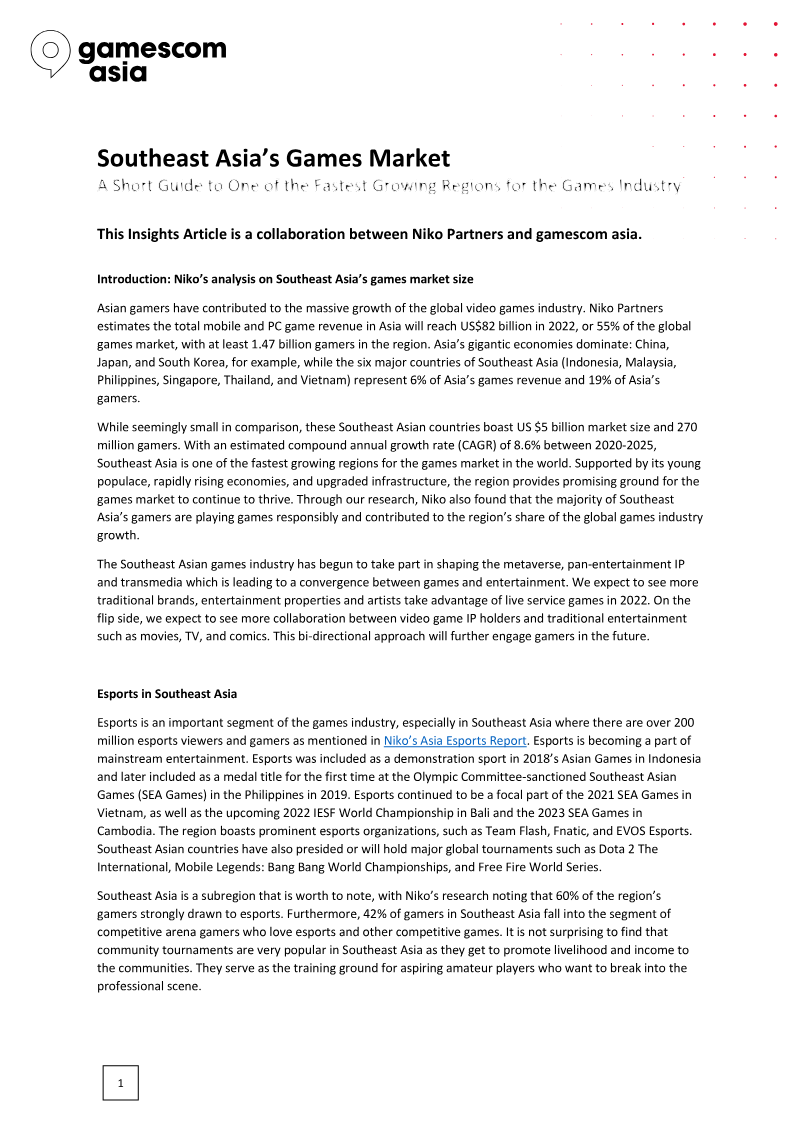
Southeast Asia represents one of the world’s fastest-growing video game markets, characterized by a young population, improving infrastructure, and a rapidly expanding digital economy. Data indicates that the six major countries in the region—Indonesia, Malaysia, the Philippines, Singapore, Thailand, and Vietnam—account for approximately $5 billion in market size and 270 million gamers. While this represents 6% of total Asian games revenue, the region is projected to maintain a compound annual growth rate of 8.6% through 2025.
Esports serves as a primary driver for this growth, with over 200 million viewers and gamers in the region. Approximately 60% of Southeast Asian gamers are strongly drawn to esports, and 42% are classified as competitive arena gamers. This interest has led to the integration of esports into major regional athletic events like the SEA Games. Furthermore, the audience is becoming increasingly diverse; female gamers now make up 40% of the total gaming population, with growth rates in this demographic outpacing the general market average. In specific markets like Indonesia and Singapore, women comprise nearly half of the gaming audience.
The region has also emerged as a pioneer in blockchain and play-to-earn gaming, exemplified by the success of titles like Axie Infinity, which reached over one million daily active users. However, the market faces unique challenges, including parental skepticism, fluctuating government regulations regarding game approvals and bans, and complex cultural sensitivities. Successful expansion requires navigating diverse religious and social landscapes, as localized content can significantly boost revenue while cultural oversights can lead to public backlash or censorship. Ultimately, Southeast Asia offers significant opportunities for global stakeholders, provided they adopt localized strategies rather than a one-size-fits-all approach.
- The Southeast Asian games market across six major countries generates approximately $5 billion in revenue from 270 million gamers and is projected to grow at a compound annual rate of 8.6% through 2025.
- Esports is a primary market driver, with over 200 million viewers and 60% of the regional gaming population expressing a strong interest in competitive play.
- Female gamers represent 40% of the total gaming population, with growth in this demographic outpacing the general market and reaching nearly 50% in Indonesia and Singapore.
- The region has pioneered blockchain and play-to-earn gaming, evidenced by titles like Axie Infinity achieving over one million daily active users.
- Market expansion requires localized strategies to navigate complex religious and social landscapes, as cultural oversights frequently lead to censorship or public backlash.
Niko PartnersJan 2022
Report15 pages
Mobile Games on iOS: Winter Results and Forecasts for Spring 2022
This analysis examines the performance and distribution of iOS mobile applications during the winter of 2021–2022 while providing a strategic forecast for the spring 2022 season. The primary objective is to identify market trends by comparing pre-order data with actual release statistics. The scope is global, focusing specifically on the iOS App Store ecosystem across various categories and gaming genres. Data was sourced exclusively from the Apptica platform, utilizing its pre-orders section to gauge developer intent and market direction.
Findings indicate that while games were expected to dominate the winter release cycle at 81% of all upcoming apps, the actual market composition was more diversified. By the end of winter, games represented 11.3% of total new releases, followed closely by Lifestyle and Utilities at 10% each. Within the gaming sector, over 12,400 titles were launched. Although Simulation games were predicted to lead, Puzzle games emerged as the most frequent release, totaling approximately 2,200 titles and accounting for 17.1% of new games. Other significant genres included Action and Adventure, while Role-playing and Sports categories saw fewer releases than initially projected based on pre-order volume.
The forecast for spring 2022 suggests continued dominance for the gaming category, which accounts for 82.4% of apps currently in the pre-order phase. Simulation and Role-playing games are tied as the most anticipated genres, each representing 26.5% of upcoming titles. The analysis also notes a shift in non-gaming categories, with an increase in Productivity, Dating, and Medical apps, while Food and Drink applications have disappeared from the spring pre-order list. Key takeaways emphasize that Puzzle, Role-playing, and Simulation genres remain the primary drivers of the iOS market, maintaining steady growth and developer interest moving into the next quarter.
- Games accounted for 11.3% of all new iOS releases during the winter 2021–2022 period, significantly lower than the 81% share initially anticipated by pre-order data.
- Puzzle games were the most active gaming genre in winter 2021–2022, with approximately 2,200 new titles representing 17.1% of all game releases.
- Gaming is projected to dominate the spring 2022 release cycle, currently accounting for 82.4% of all apps in the pre-order phase.
- Simulation and Role-playing games are the most anticipated genres for spring 2022, each comprising 26.5% of upcoming titles.
- Over 12,400 new game titles were launched on the iOS App Store during the winter 2021–2022 season.
+1
AppticaJan 2022

Report44 pages
Newzoo Trend Report 2022: An Overview and Outlook of Virtual Reality
The global virtual reality market is undergoing a significant resurgence, transitioning from a niche hardware segment into a sustainable ecosystem. This evolution is primarily driven by the proliferation of affordable standalone 6DoF devices, such as the Meta Quest and Pico 4, which have lowered barriers to entry for mainstream consumers. While these standalone units may lack the raw performance of high-end PC VR setups, their accessibility has catalyzed rapid growth in the active install base. Data indicates that nearly 60% of VR gamers engage with their headsets at least once a week, signaling high retention and a shift toward consistent usage patterns.
Gaming remains the primary gateway for consumer adoption, bolstered by the emergence of high-quality "killer apps" and the popularity of adventure and shooter genres. The market is also seeing a shift toward hybrid monetization models, including downloadable content and subscriptions, alongside an increase in social and fitness-oriented virtual environments. Beyond entertainment, VR technology is becoming increasingly essential for industrial applications. Powerful 3D engines like Unreal and Unity are facilitating the expansion of immersive technology into healthcare simulations, remote architectural planning, and education.
The global active VR hardware install base is projected to reach 46 million units by the end of 2024, reflecting a compound annual growth rate of 42.0% since 2019. This sustained momentum is supported by continuous advancements in motion tracking and haptic feedback, as well as substantial investments from major software and hardware firms. As the technology matures, the integration of VR into both consumer lifestyles and professional workflows suggests a long-term trajectory toward widespread cross-industry utility.
- The global active VR hardware install base is projected to reach 46 million units by the end of 2024, representing a 42.0% compound annual growth rate since 2019.
- Market growth is primarily driven by the transition to affordable standalone 6DoF devices, such as the Meta Quest and Pico 4, which have significantly lowered barriers to mainstream entry.
- VR gaming shows strong user retention, with nearly 60% of gamers engaging with their headsets at least once a week.
- Gaming serves as the primary consumer gateway, with market monetization shifting toward hybrid models including subscriptions and downloadable content alongside social and fitness-oriented environments.
- Immersive technology is expanding beyond entertainment into industrial sectors like healthcare, architecture, and education, facilitated by 3D engines such as Unreal and Unity.
+1
NewzooJan 2022

Report53 pages
Mobile Market Forecast 2022‑2026
The forecast projects a decisive shift in the global mobile app economy between 2022 and 2026, positioning the United States as the pre‑eminent App Store market for both consumer spending and download volume, overtaking China for the first time. While the United States already leads Google Play revenue, India continues to register the highest adoption rates, and Brazil is expected to break into the top tier of markets by the mid‑term horizon. Growth is predicted to decelerate in 2022, reflecting macro‑economic headwinds, but a robust rebound is anticipated from 2023 onward, driven by renewed consumer confidence and expanding monetisation strategies across emerging regions.
The analysis draws on comprehensive data covering major geographic territories—including North America, Europe, East Asia, South Asia, and Latin America—and spans the full spectrum of mobile industry segments, from app store transactions and download activity to advertising spend and software‑development‑kit performance. By integrating these variables, the forecast delivers a granular view of revenue trajectories, market share dynamics, and user‑acquisition trends that inform strategic planning for developers, marketers, and investors.
Underlying the outlook is Sensor Tower’s suite of intelligence products—Store, App, Ad, Usage, and Benchmark Intelligence—designed to support organic growth, optimise paid acquisition, and evaluate SDK efficacy. The firm’s proprietary data and analytical tools underpin the projections, while usage policies restrict unauthorised redistribution of the findings. Contact channels for demonstrations, media, and sales are provided to facilitate deeper engagement with the platform’s capabilities.
- The United States is projected to overtake China as the global leader in both total consumer spending and download volume by 2026.
- Global mobile app market growth is expected to decelerate in 2022 due to macroeconomic headwinds before rebounding in 2023.
- The United States currently maintains the lead in Google Play revenue, while India holds the highest global adoption rates for mobile apps.
- Brazil is forecast to emerge as a top-tier market for mobile app activity by the 2026 mid-term horizon.
- Future market expansion will be driven by a combination of renewed consumer confidence and the implementation of new monetization strategies in emerging regions.
Sensor TowerJan 2022

Report149 pages
Brazil Games Industry Report 2022
Brazil has established itself as the preeminent games market in Latin America and the 12th largest globally, generating approximately USD 2.3 billion in 2021. The ecosystem is defined by rapid professionalization and internationalization, evidenced by a 102% increase in active studios since 2018. With over 1,000 companies and a workforce exceeding 12,000 professionals, the industry has transitioned from a historical period of informality to a sophisticated hub for original intellectual property and high-quality external development services. While the Southeast and South regions remain the primary geographic hubs, the sector’s reach is global, with over half of local companies serving international markets, particularly in the United States and Europe.
The industry demonstrates increasing maturity through longer studio lifespans and a shift toward diverse platforms. While mobile and PC development remain dominant, console production grew significantly to 17% of the market by 2021. Beyond entertainment, Brazilian studios maintain a strong presence in educational and corporate gamification. Despite this growth, structural challenges persist, including a lack of formal inclusion policies for underrepresented groups and a "wage war" for senior talent driven by the rise of remote work for foreign firms. Furthermore, the workforce is navigating a transition where 93% of companies now focus on proprietary IP, moving away from a pure service-provider model.
Economic and regulatory hurdles continue to shape the landscape. Federal funding has reached historic lows, forcing a reliance on founder capital and state-level initiatives. Developers face significant "legal insecurity" due to the absence of a specific regulatory category for games and a tax system that treats development hardware as luxury entertainment rather than capital goods. Nevertheless, the resilience of the sector is underscored by a 336% revenue increase in USD since 2015 and the emergence of "unicorns" like Wildlife. The industry remains a vital component of the global value chain, increasingly recognized for its technical proficiency in engines like Unity and its expanding role in emerging technologies such as blockchain and the metaverse.
- Brazil is the 12th largest games market globally and the leader in Latin America, generating approximately USD 2.3 billion in 2021.
- The industry has experienced rapid expansion, with a 102% increase in active studios since 2018 and a 336% revenue increase in USD since 2015.
- The sector is shifting toward original intellectual property, with 93% of companies now focusing on proprietary IP rather than a pure service-provider model.
- The ecosystem comprises over 1,000 companies and 12,000 professionals, with more than half of these businesses exporting services to international markets, primarily in the U.S. and Europe.
- Console production has grown to represent 17% of the market, diversifying a landscape previously dominated by mobile and PC development.
+1
AbragamesJan 2022
Report61 pages
Global Games Market Report 2022
The global games market entered a corrective phase in 2022, with annual revenues projected to decline by 4.3% to $184.4 billion. This contraction follows a period of unsustainable pandemic-driven expansion and is further exacerbated by macroeconomic inflation, supply chain disruptions, and a sparse release schedule for major titles. Despite this short-term dip, the industry maintains a massive engagement base of 3.2 billion players and is expected to resume an upward trajectory, reaching an estimated $211.2 billion by 2025. While mature markets like North America and Asia-Pacific are experiencing revenue declines, emerging mobile-first regions such as Latin America and the Middle East & Africa continue to show positive growth.
The industry is currently undergoing a structural shift toward platform-agnostic ecosystems and hybrid monetization strategies. As traditional mobile advertising faces challenges from privacy policy changes like Apple’s IDFA, console and PC developers are increasingly adopting programmatic in-game advertising to monetize the hundreds of millions of players who do not make direct purchases. This shift is supported by major platform holders like Sony and Microsoft, who are integrating non-intrusive, blended advertisements to create recurring revenue streams. Furthermore, the rise of user-generated content, cloud gaming, and blockchain-based models is redefining how players interact with and derive value from digital environments.
Future market stability is increasingly tied to ecosystem-based analysis rather than hardware-specific metrics, reflecting a broader trend of cross-platform play and industry consolidation. Regulatory shifts in China have also prompted a strategic pivot toward global expansion in other emerging markets. As the industry evolves, success will likely depend on balancing diverse monetization models with authentic player experiences, while leveraging new technologies in virtual reality and cloud infrastructure to maintain long-term engagement across a diversifying global audience.
- The global games market is projected to decline 4.3% to $184.4 billion in 2022, marking a corrective phase after pandemic-driven expansion, before recovering to an estimated $211.2 billion by 2025.
- The industry maintains a massive global reach of 3.2 billion players, with growth shifting away from mature North American and Asia-Pacific markets toward mobile-first regions like Latin America and the Middle East & Africa.
- Developers are increasingly adopting programmatic, non-intrusive in-game advertising to monetize non-paying users, a strategy supported by platform holders like Sony and Microsoft to counter mobile privacy policy changes such as Apple’s IDFA.
- Market analysis is shifting from hardware-specific metrics to ecosystem-based models, driven by the rise of cross-platform play, industry consolidation, and the integration of cloud gaming and user-generated content.
- Regulatory changes in China are forcing developers to pivot their growth strategies toward global expansion in emerging markets.
NewzooJan 2022

Presentation55 pages
FY2021 Presentation Material
CyberAgent achieved record-breaking financial performance in fiscal year 2021, characterized by consolidated sales of 666.4 billion yen and a more than threefold increase in operating profit to 104.3 billion yen. This surge was primarily catalyzed by the Game business, which experienced 68.6% year-over-year growth following the massive commercial success of Uma Musume Pretty Derby. While the Game segment provided the most significant profit contribution, the Internet Advertisement business maintained steady double-digit growth, and the Media segment narrowed its operating losses through the expansion of ABEMA and the WINTICKET betting platform.
The strategic focus for the period centered on leveraging high-performing assets to fund long-term growth initiatives. WINTICKET emerged as a critical driver within the Media segment, capturing 25% of the Keirin online betting market and tripling its transaction volume. Simultaneously, the company utilized profits from its established advertising and gaming pillars to invest in ABEMA’s digital transformation and content offerings, including pay-per-view services. This diversification strategy aims to stabilize the inherent volatility of the gaming industry, which led to the omission of specific earnings forecasts for the upcoming fiscal year.
Future growth is predicated on a robust pipeline of high-profile intellectual properties and strategic partnerships with industry leaders such as Nintendo, SEGA, and Bandai Namco. Upcoming releases, including titles based on the Final Fantasy VII and Jujutsu Kaisen franchises, are expected to sustain the momentum established in 2021. By aligning its corporate purpose with digital innovation and cross-media expansion, the organization seeks to transition from a gaming-heavy profit structure toward a more balanced ecosystem where media and advertising provide consistent, long-term value.
- CyberAgent achieved record-breaking FY2021 performance with 666.4 billion yen in consolidated sales and a 104.3 billion yen operating profit, representing a more than threefold increase.
- The Game business was the primary profit driver, recording 68.6% year-over-year growth fueled by the commercial success of Uma Musume Pretty Derby.
- WINTICKET captured 25% of the Keirin online betting market and tripled its transaction volume, significantly contributing to reduced operating losses in the Media segment.
- The Internet Advertisement business maintained steady double-digit growth, serving as a stable financial pillar alongside the high-volatility gaming segment.
- Management opted not to provide earnings forecasts for the upcoming fiscal year due to the inherent revenue volatility associated with the gaming industry.
+1
CyberAgentOct 2021

Report34 pages
Global Mobile Market Report 2021
The 2021 global mobile market analysis underscores a rapidly expanding ecosystem in which smartphone ubiquity, rising active‑device counts, and the early rollout of 5G networks are driving unprecedented growth in mobile gaming. By integrating socio‑economic indicators, device‑usage data from more than 400 million monthly active devices, and revenue tracking from major app‑store partners, the study projects that mobile‑game spending will climb from $90.7 billion in 2021 to $116.4 billion by 2024, reflecting an 11.2 % compound annual growth rate. Smartphone penetration reached 3.9 billion users in 2021, a 6 % year‑over‑year increase, while 5G‑ready devices are beginning to reshape gameplay experiences and monetisation models.
Regulatory shifts, notably Apple’s App‑Tracking Transparency and Google’s parallel privacy policies, together with the high‑profile Apple‑Epic litigation, are redefining user‑acquisition strategies and prompting developers to explore platform‑driven revenue streams such as in‑game advertising, subscriptions, and direct storefronts. Revenue distribution remains heavily skewed: the top 20 % of spenders—players who spend $25 or more per month—account for roughly 80 % of total income, favouring socially rich, competitive titles and showing greater openness to ads and subscription offers.
A consumer survey of 5,400 gamers aged 10‑50 across the United States, China, Germany, and Japan reveals modest regional variation in intellectual‑property preferences, suggesting that aligning established entertainment IPs—books, comics, movies, and TV series—with appropriate game genres can enhance engagement. Overall, the findings highlight a market poised for continued expansion, driven by technological adoption, evolving privacy landscapes, and a concentrated core of high‑value players.
- Mobile game spending is projected to grow from $90.7 billion in 2021 to $116.4 billion by 2024, representing an 11.2% compound annual growth rate.
- The top 20% of players, defined as those spending $25 or more per month, generate approximately 80% of total mobile gaming revenue.
- Smartphone penetration reached 3.9 billion users in 2021, marking a 6% year-over-year increase that continues to drive market expansion.
- Regulatory changes, including Apple’s App-Tracking Transparency and Google’s privacy policies, are forcing developers to pivot toward in-game advertising, subscriptions, and direct storefronts for user acquisition.
- The rollout of 5G-ready devices is actively reshaping mobile gameplay experiences and monetization models.
NewzooSept 2021