Updated Mar 23, 2026 by Dutch Game Garden
Report · January 1, 2020
Published by Dutch Game Garden
This update provides an analysis of the Dutch video game industry’s performance during 2020, specifically examining the operational and economic impacts of the COVID-19 pandemic. The findings are based on a survey of over 100 industry professionals conducted in late 2020, supplemented by desk research and database updates. The report tracks industry growth, employment trends, and the shift in business dynamics necessitated by global lockdowns. The Dutch games sector demonstrated resilience, growing from 575 companies in 2018 to 615 by the end of 2020, with total employment reaching approximately 4,000 jobs. While the industry largely transitioned to remote work with minimal impact on output quality, the pandemic created a divide between business-to-consumer (B2C) and business-to-business (B2B) entities. B2C entertainment companies generally benefited from increased consumer demand for home-based entertainment. Conversely, B2B and applied game developers faced significant challenges in the spring of 2020 as client projects were paused or canceled, though some firms in the healthcare sector identified new opportunities. Operational challenges were primarily centered on human resources and networking. While productivity remained stable for most, employee engagement declined due to the loss of informal office culture, and nearly half of respondents reported increased stress levels. The absence of physical industry events hindered the establishment of new business relationships, with one-third of respondents unable to pursue new business opportunities effectively. Despite these hurdles, the industry maintained its growth trajectory, supported by government labor cost subsidies that assisted approximately 85 companies during the initial lockdown phases. Overall, the sector proved adaptable, leveraging digital infrastructure to sustain operations while navigating a volatile market environment.
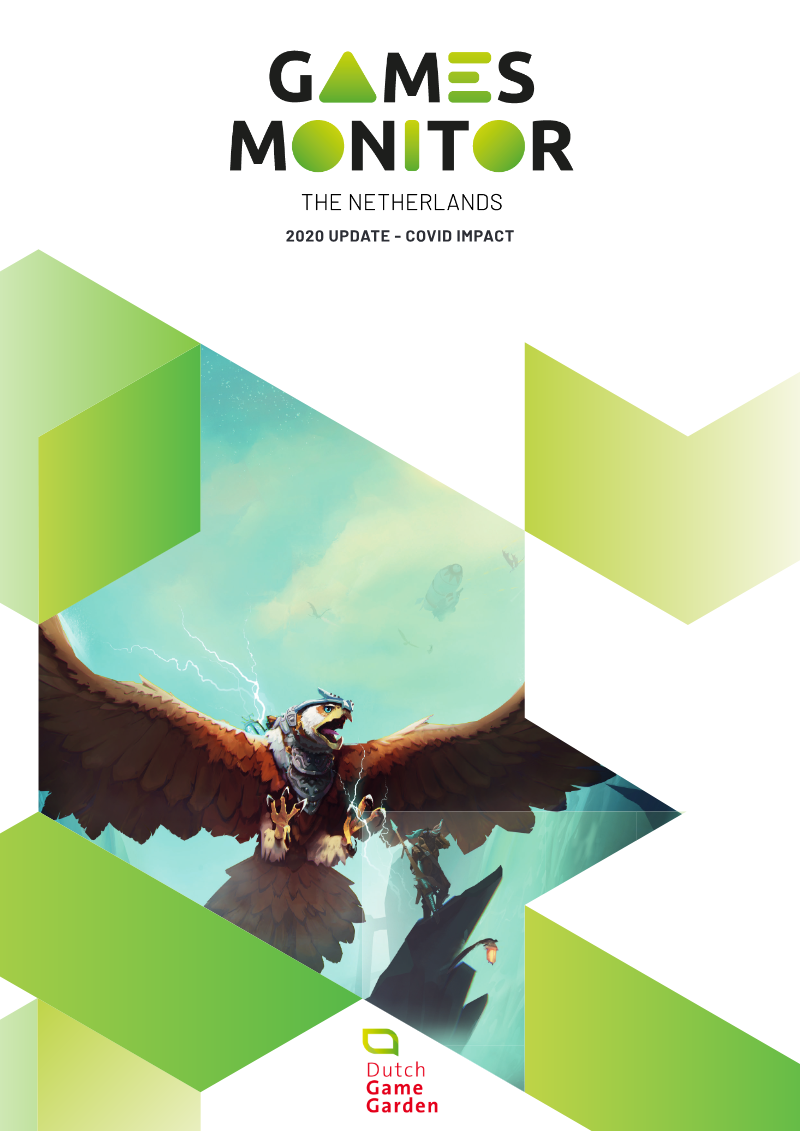
Since 2012 Dutch Game Garden, in collaboration with the Dutch Games Association, keeps track of developments in the Dutch video games industry roughly every three years. By combining extensive desk research and a broad survey within the games industry we capture these developments in the Games Monitor report. The Games Monitor has 3 editions so far, looking into the state of the industry for the years 2012, 2015, and 2018. If we follow this pattern a new Games Monitor is due in the first half of 2022 presenting the numbers for 2021. The year 2020 however, has had such an enormous impact on everybody that we felt the urge to present a short update on the Games Monitor report and provide insights on the impact the COVID-19 crisis has had. We sincerely thank everybody who has contributed to this update! And we are looking forward to having continued conversations and discussions about the growth and development of the Dutch Games Industry. For this overview we have used the same criteria for the games industry as in the earlier Games Monitor reports, for a full explanation we refer to chapter 7 of the Games Monitor 2018 (pages 48-51 of the full report) 1. We have updated our database according to these criteria and based on a limited survey we can give indications on the development of the turnover and the number of people employed in the Dutch games industry. In the next monitor, we will provide a more detailed analysis. At the end of November 2020, we sent out a survey to around 500 people. A little over 100 respondents filled in the survey. COVER IMAGE The Falconeer by Tomas Sala
urnover and the number of people employed in the Dutch games industry. In the next monitor, we will provide a more detailed analysis. At the end of November 2020, we sent out a survey to around 500 people. A little over 100 respondents filled in the survey. COVER IMAGE The Falconeer by Tomas Sala PARTNERS BACKCOVER IMAGE Blightbound NERS by Ronimo Games All rights reserved
GAMES MONITOR UPDATE 2020 NUMBER OF GAME COMPANIES The number of game companies in the Netherlands has risen from 575 in 2018 to 615 by the end of 2020. This growth mainly took place in the number of solo developers and/ or freelancers. Compared to the 2018 edition 88 companies were discarded from the list of active game companies. Some of these companies ended their registration at the Chamber of Commerce, some of them merged into a larger company and several companies still have a Chamber of Commerce registration but are not actively engaged in the company anymore (for example no social media activity for more than a year, website down and/or the employees and founders are all working elsewhere). In the past 2 years, 6 companies filed for bankruptcy. 3 companies out of these 6 made a new start in another entity, for the other 3 procedures haven’t been concluded yet. Another 10 companies shifted their focus and are not active in games anymore or games are just a small part of eor games their portfolio. LOCATION In the past two years, a lot of companies changed their company address. We counted more than 110 new addresses in our database (not counting the new companies), meaning that more than 20% of the existing companies relocated! Most of these new offices were found within the original city of business. In terms of the number of companies, Amsterdam and Utrecht are the cities with the most companies. Together these two cities house about one-third of the Dutch game companies. Rotterdam, Groningen, The Hague, and Eindhoven also house more than 20 companies each.
ithin the original city of business. In terms of the number of companies, Amsterdam and Utrecht are the cities with the most companies. Together these two cities house about one-third of the Dutch game companies. Rotterdam, Groningen, The Hague, and Eindhoven also house more than 20 companies each. In terms of employees, Amsterdam remains the most important hub, housing some of the country’s largest game companies. Paladin Studios Good Job! KL 1https://www.dutchgamegarden.nl/project/games-monitor/
COVID IMPACT The COVID-pandemic obviously had its impact on the Dutch games industry in 2020. As in all sectors of the economy, companies had to deal with working from home and with the fact that all physical events were canceled since March. We asked companies how these circumstances impacted their company and their work. WORKING REMOTELY 85% of the respondents of our survey answered that they work remotely more than before the pandemic. The other 15% were mostly freelancers or small companies who were already used to working remotely. Working from home was a straightforward transition for most, as game company infrastructure generally, already has been set up to work in a digital environment. We’ve asked the respondents if the increase in remote working impacted their productivity, creativity, stress levels, quality of work, and employee involvement. Working remotely had little impact on the quality of work, about 75% of respondents stated that the impact was neutral. Not surprisingly the largest impact of working remotely was experienced in employee engagement. Despite efforts of employers in organizing digital drinks, presents sent to employee’s homes etc. employee engagement was lower
lity of work, about 75% of respondents stated that the impact was neutral. Not surprisingly the largest impact of working remotely was experienced in employee engagement. Despite efforts of employers in organizing digital drinks, presents sent to employee’s homes etc. employee engagement was lower for more than half of the companies. For instance, the informal work culture was more difficult to maintain and people missed the casual talks during coffee or lunch breaks. Stress levels were higher for almost half of the respondents. The impact on creativity showed a more diverse picture. Overall, 43% experienced lower creativity. But for applied game companies this was 80%. In general, applied game companies make several games for clients each year, meaning they have to go through the cycle of coming up with new ideas several times per year. Many entertainment companies work on one game for a longer period. Therefore, the effect on creativity varies depending on the development phase of the game they are working on. The effect on productivity was mixed as well. For about a third of the companies, productivity was lower, for more than 40% the effect was neutral, and for almost a quarter of the companies, productivity was higher. Within companies, employers saw a difference between more extroverted and introverted people, where the latter category adjusted easier to working from home or even thrived. And of course, the home situation (children at home or not, having ample space or not) had a huge effect on individual employees.
TEXT AND ANALYSIS DESIGN All rights reserved NEO Observatory COVER IMAGE This publication is made possible with Walter Manshanden Horizon Forbidden West the support of Province of Utrecht, by Guerrilla Games Gemeente Utrecht, HKU: University of PROOFREADING AND the Arts Utrecht, Breda University of GENERAL SUPPORT SPECIAL THANKS TO Applied Sciences (BUAS), Hanze Marilla Valente ...
AUTHORS SPECIAL THANKS TO Manuel Kerssemakers (Abbey Christel van Grinsven APPLIED Games) Arjan Terpstra Bowie Derwort (Game Tailors) Laurens Rutten (CoolGames Matthijs Dierckx Michaël Bas (&ranj) & Dutch Games Association) Roger ter Heide (Improvive) Tuur Hendrikx (Sonic Picnic) RESEARCH CHAPTER 1 ...
The Dutch Games Monitor 2022 provides a comprehensive analysis of the Netherlands' video game industry, covering the period from 2018 to 2021. The primary objective is to evaluate the sector's growth, maturity, and structural evolution. The research methodology incorporates desk research, roundtable discussions, and a survey of approximately 500 companies, yielding nearly 200 responses. The analysis focuses on two distinct domains: entertainment games and applied (serious) games, which serve sectors such as healthcare and education. The industry demonstrates significant maturation, characterized by a shift from an initial increase in the number of companies to a more recent surge in revenue and employment. By the end of 2021, the sector comprised 630 companies, generating between €420 million and €440 million in annual revenue. This represents an average annual revenue growth of nearly 18%, outpacing global industry averages. Employment also expanded, reaching 4,560 jobs with an annual growth rate exceeding 5%. This job creation is particularly concentrated in larger organizations, with the number of scale-ups employing over 50 people doubling to 12 companies over the three-year period. Geographically, the Greater Amsterdam region leads in total employment, while Utrecht maintains the highest concentration of applied game developers. Although the number of dedicated game education programs has slightly decreased, the industry is seeing a rise in diversity, with the percentage of women in the workforce reaching 23% by 2021. Furthermore, the sector is increasingly characterized by international expansion, a rise in external investments, and a growing number of mergers and acquisitions, signaling that the Dutch games industry is successfully transitioning into a more mature and globally competitive market.
The Games Monitor 2018 provides a comprehensive analysis of the Dutch video games industry, tracking its evolution and maturation between 2015 and 2018. The industry is defined by companies whose core activities involve the development, production, publication, or distribution of electronic games, categorized into entertainment and applied (serious) games. The research methodology combined desk research with a survey of 165 companies, supplemented by industry roundtable discussions to validate findings. The Dutch games sector experienced accelerated growth during the 2015–2018 period, characterized by an average annual job increase of 10 percent. By the end of 2018, the industry comprised 575 companies and 3,850 jobs, generating an estimated annual turnover of €225–300 million. While the average company size remains small at approximately seven employees, there is a clear trend toward scaling up, evidenced by a significant increase in mid-sized firms employing between 11 and 100 people. Geographically, the industry is concentrated in major urban centers, with Amsterdam, Utrecht, and Eindhoven accounting for over 60 percent of net job growth. Market dynamics show a strong expansion in entertainment game development, which grew by 33 percent, while the applied games sector—primarily serving healthcare, education, and government—has stabilized. Business models in the entertainment sector rely heavily on premium monetization and in-app advertising, whereas applied studios frequently utilize work-for-hire models. The educational landscape remains robust, with 44 game-related study programs producing over 900 graduates annually. Overall, the industry is transitioning toward a more mature, competitive state, marked by increased productivity, strategic acquisitions, and international expansion.