Unreal
Game
Documents about Unreal
Tencent's Imminent Spending Spree: Possible Contenders for Acquisition
This analysis explores the strategic implications of Tencent’s move to secure a $6 billion loan, suggesting the Chinese conglomerate is preparing for a transformative acquisition valued between $20 billion and $30 billion.
- Tencent is positioning itself for a $20 billion to $30 billion acquisition by securing a $6 billion loan to supplement its existing cash reserves.
- Potential acquisition targets include Ubisoft ($13B EV) and CD Projekt Red ($7.1B EV), which are viewed as strategically attractive due to their European headquarters and lower regulatory hurdles compared to North American firms.
- Epic Games is a primary candidate for a high-value infrastructure play, with a valuation of $17.3 billion centered on the Unreal Engine.
The 5 Types of People That You Are Not Marketing to but Should Be
The primary purpose of this analysis is to guide game developers beyond traditional marketing channels by identifying five key stakeholder groups that can significantly amplify a game's reach.
- Build direct relationships with platform holders like Steam, Xbox, and Nintendo, as they often use human curation for store features, newsletters, and social media promotion rather than relying solely on algorithms.
- Leverage game engine companies like Unity, Unreal, and GameMaker by documenting technical innovations in your game, as these companies actively seek to showcase high-quality titles to highlight their technology's capabilities.
- Partner with third-party hardware and software providers like SteelSeries or Intel, who often have dedicated departments to promote games that integrate their specific APIs or hardware features.

Epic's $18B Valuation: Too High or Too Low?
The analysis evaluates the $18 billion valuation of Epic Games following a 2020 investment by Sony.
- Epic Games' valuation reached approximately $17.86B to $18B following a $250M investment from Sony and a planned $750M funding round.
- When compared to public game companies using 2019 EBITDA multiples, Epic Games appears to be fairly valued or potentially undervalued.
- The majority of Epic's valuation is currently driven by the Fortnite business, creating a significant risk if the title experiences a material decline in performance.

Epic Games $18B Valuation: Too High or Too Low?
The July 2020 analysis evaluates whether Epic Games’ $18 billion valuation, prompted by a $250 million investment from Sony, is justified or inflated.
- Following a $250 million investment from Sony for a 1.4% stake in July 2020, Epic Games reached a valuation of approximately $17.86 billion, with potential to exceed $18 billion pending further funding rounds.
- A sum-of-the-parts valuation analysis suggests Epic Games is worth roughly $25 billion plus additional 'option value' from emerging business lines, indicating the company may be undervalued compared to public gaming peers.
- The majority of Epic's current valuation remains heavily dependent on the performance of Fortnite, which generated $1.8 billion in reported revenue according to 2019 SuperData figures.

New Game Engines: To Live in Promise
The introduction of Unreal Engine 5 represents a significant leap in graphical fidelity and rendering technology, yet it highlights a persistent tension in the gaming industry between technical capability and economic viability.
- Epic Games' Unreal Engine 5 introduces a new royalty structure that waives fees on the first $1 million of revenue, significantly lowering the barrier to entry for medium-sized studios.
- High-fidelity, single-player experiences like Red Dead Redemption 2 and GTA V require massive budgets and teams, limiting their production to only a few major publishers per year.
- Despite the industry's focus on photorealism, market data shows that simple, stylized games like Minecraft and Fortnite often outperform high-fidelity titles in popularity and revenue.

The Epic Games Primer
The Epic Games Primer provides a comprehensive analysis of Epic Games, arguing that the company is positioned to become a central pillar of the global digital economy and the primary architect of the future Metaverse.
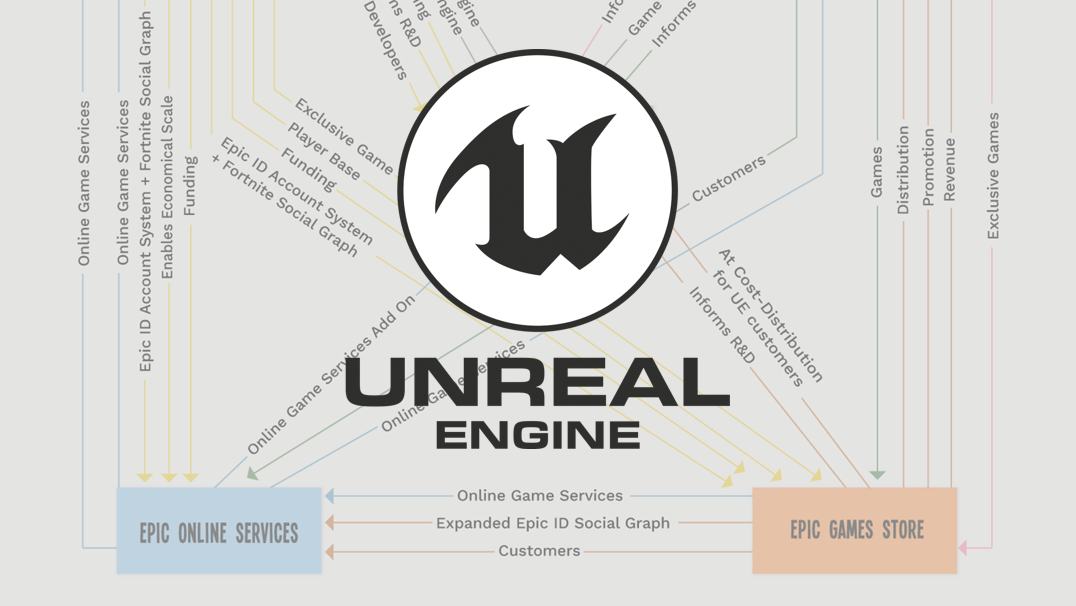
- Epic Games is positioning itself to be a central architect of the 'Metaverse' by building an integrated ecosystem that spans game development, distribution, publishing, and social networking.
- The Unreal Engine serves as the company's core business foundation, providing the technical infrastructure used to produce leading video games, films, and virtual experiences across the industry.
- Fortnite has become a massive social platform with over 350 million users and 2.3 billion social connections, generating more revenue in three years than the rest of the company produced in its previous decades.

Epic Games Primer: Epic's Philosophy and Unprecedented Aspirations
Epic Games pursues a strategy of aggressive market disruption by offering high-value infrastructure, engine technology, and distribution services for free or at significantly reduced costs.
- Epic Games pursues a strategy of providing high-value infrastructure, such as Unreal Engine 5 and Epic Online Services, for free or at low cost to reduce industry reliance on closed platforms like Steam, Sony, and Microsoft.
- Tim Sweeney’s goal is to expand the total addressable market (TAM) of the gaming industry—currently valued at approximately $120 billion—rather than maximizing Epic's direct revenue capture, which is estimated to be capped at roughly $15 billion even under ideal market dominance.
- Epic is deliberately eschewing traditional 'walled garden' business models by refusing to share or sell user data and by offering tools that do not require developers to use the Epic Games Store or Unreal Engine.
Epic Games Primer (Pt V): Fortnite & How It Built the Epic Flywheel
Fortnite serves as the central engine of the Epic Games ecosystem, functioning not merely as a video game but as a foundational social platform and a critical research and development vehicle.
- Fortnite functions as a social network rather than a traditional game, with users spending significant time 'loitering' in virtual spaces to socialize, fish, or dance rather than engaging in competitive gameplay.
- The platform has three primary modes: Battle Royale (competitive), Party Island (non-violent social space), and Creative Mode (a user-generated content engine similar to Roblox).
- Fortnite generates approximately $2 billion in annual revenue through a free-to-play model that relies exclusively on non-competitive cosmetic purchases, proving the viability of this monetization strategy at scale.

Epic Games Primer: Epic Online Services
Epic Online Services (EOS) represents a strategic effort by Epic Games to dismantle the siloed, platform-specific infrastructure that has historically defined the gaming industry.
- Epic Online Services (EOS) provides developers with a free, cross-platform suite of multiplayer tools—including matchmaking, social graphs, and account management—that are engine-agnostic and store-independent.
- Unlike Steamworks, which historically locked developers and players into the Steam ecosystem to maintain network effects, EOS is designed to function across any store or device without requiring the Epic Games Store.
- The shift toward cross-platform play was accelerated by the success of Fortnite, which forced platform holders like Sony to abandon restrictive, siloed multiplayer policies to avoid losing players to competitors.

Epic Games Primer: Epic Games Store and Epic Games Publishing
The digital distribution landscape for PC gaming has long been defined by a 30 percent commission model, a standard solidified by Steam’s early integration of social and matchmaking services.
- The Epic Games Store (EGS) disrupts the industry standard 30% commission fee by charging developers only 12%, while waiving the 5% Unreal Engine licensing fee for games built on that engine.
- Epic Games utilizes exclusive distribution deals and revenue-share incentives to challenge the market hegemony of Valve’s Steam, which has historically locked in users through social graphs, matchmaking services, and extensive feature sets.
- Epic estimates the actual cost of digital distribution to be 5–7% of revenue, covering payment processing (2.5–3.5%), customer service (1.5%), and bandwidth/hosting (1%).
Epic Games Primer (Pt I): Epic's Flywheel & Unreal Engine
The Unreal Engine serves as the foundational core of Epic Games’ business model, acting as a critical technology suite that enables developers to produce high-fidelity virtual experiences across gaming, film, and enterprise sectors.
- Unreal Engine functions as a foundational suite of tools that allows developers to build virtual experiences without engineering core code, typically charging a 5% revenue share fee.
- The modern gaming landscape is dominated by two primary engines: Unreal, which is preferred for high-fidelity, multiplayer console and PC games, and Unity, which leads the mobile market with a subscription-based model.
- Unity operates a massive mobile advertising network that delivers 23 billion ads across 2.2 billion devices monthly, providing developers with an integrated monetization solution.
Unity Readies up for IPO Roadshow: Can It Get Out of Epic's Shadow?
This industry analysis examines the strategic positioning of major gaming entities during a period of significant transition in early 2020.
- Unity Technologies is preparing for an IPO with $500 million in revenue while attempting to differentiate itself from Epic Games through acquisitions like Bolt and Finger Food and expansion into non-gaming verticals.
- Tencent’s online game revenue grew 31% year-over-year to $5.3 billion, highlighting strong performance in the Asian market during early 2020.
- Sony’s annual gaming revenue declined 14% to $18 billion as the PlayStation 4 lifecycle ended, though its PlayStation Plus service reached 41.5 million subscribers.