1 free read left. Create a free account for unlimited reading + AI research.
Create free accountWhitepaper DiGRA
1 free read left. Create a free account for unlimited reading + AI research.
Create free accountWhitepaperDiGRA
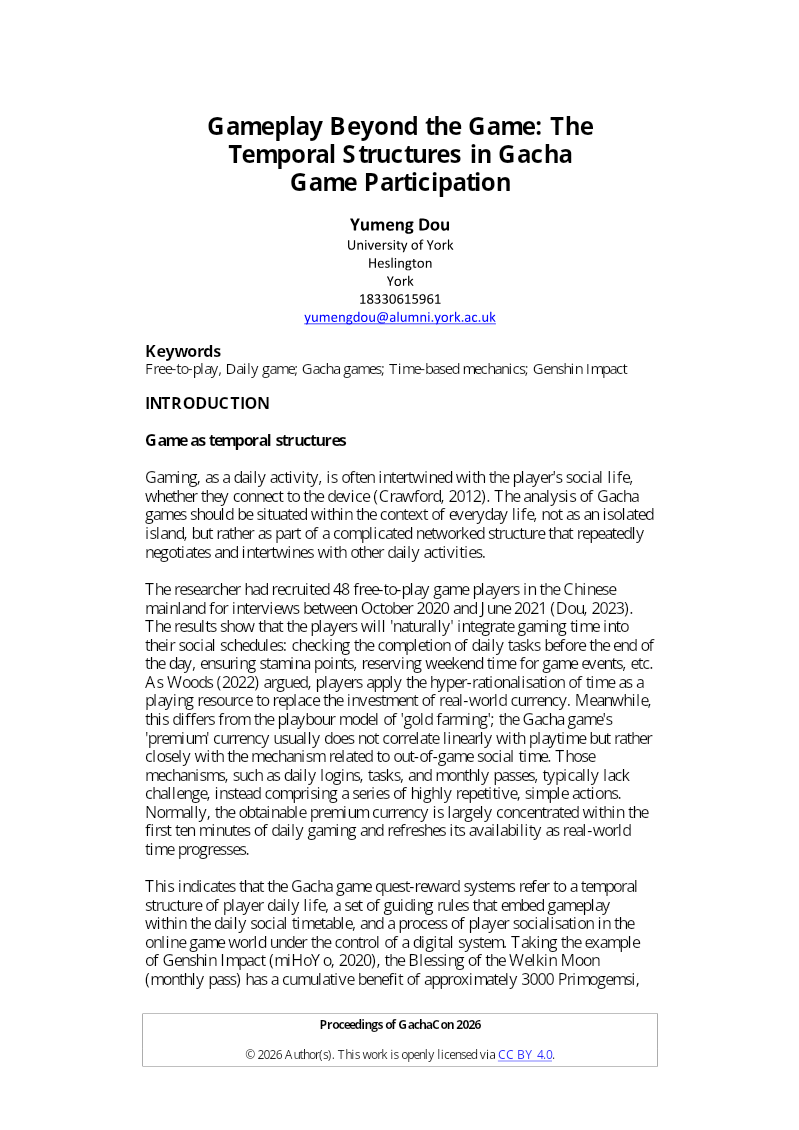
The paper frames a tension between a steady stream of consumable linear content and the need for deep, skill-based gameplay.
This paper examines what it calls the "Paradox of Profit" in the gacha genre: the tension between monetizing new characters through a steady stream of consumable, linear narrative content and the need for deep, skill-based gameplay that sustains long-term player retention. Using the MDA (Mechanics-Dynamics-Aesthetics) framework as its analytical lens, the paper focuses primarily on Genshin Impact, which it presents as a case study in how monetization requirements shape design decisions. Its central argument is that the genre's commercial success has produced a "content treadmill" in which permanent, challenging content that might reduce players' perceived need for new characters is structurally discouraged, a constraint the authors term "monetization lock-in."
The authors identify several concrete design weaknesses. Daily quests and resin expenditure loops are described as frictionless and minimally challenging, reinforcing a sense of financial obligation rather than engagement. Quest rewards are dominated by Primogems, which turns story progression into a means of funding gacha pulls, and engagement is said to drop once a pull is resolved. The paper also notes the widely reported absence of meaningful endgame content, which it links to player churn once linear story material is exhausted.
To address these problems, the paper proposes three feasibility-focused directions within the existing live-service model. The first is horizontal replayability through diversified, non-Primogem rewards such as cosmetics and interactive instruments earned through exploration and secret missions. The second is skill-based, non-resource-gated modes, with Zenless Zone Zero's Simulated Battle Trial offered as a favorable model compared with Honkai: Star Rail's Arbitration Challenge, which the authors characterize as resource-heavy. The third is systemic cross-title collaboration across the miHoYo ecosystem, using shared storylines and mechanics to convert linear story flow into a cyclical experience.
The paper's evidence base is qualitative and argumentative rather than empirical. It draws on design analysis of several miHoYo titles, a small set of academic and industry sources, and the authors' own player experience, and it does not report survey data, player-behavior metrics, or revenue figures to support its claims about retention and churn. Its feasibility assertions, such as the claim that skill-based modes require only retuning of enemy logic and damage values, are presented as design reasoning rather than tested outcomes.
 Genshin ImpactGame · HoYoverse · 2020 · 265 documents
 miHoYoCompany · China · founded 2012 · 96 documents
 Honkai: Star RailGame · HoYoverse · 2023 · 76 documents
 Zenless Zone ZeroGame · miHoYo · 2024 · 36 documents
 HoYoverseCompany · Singapore · founded 2021 · 48 documents
 Honkai Impact 3rdGame · HoYoverse · 2016 · 5 documents
Each row is a game or company this document names, each column a document, oldest first. A mark means that document names it. Select a row to see those documents.
DiGRA · 2026