1 free read left. Create a free account for unlimited reading + AI research.
Create free accountWhitepaper DiGRA
1 free read left. Create a free account for unlimited reading + AI research.
Create free accountWhitepaperDiGRA
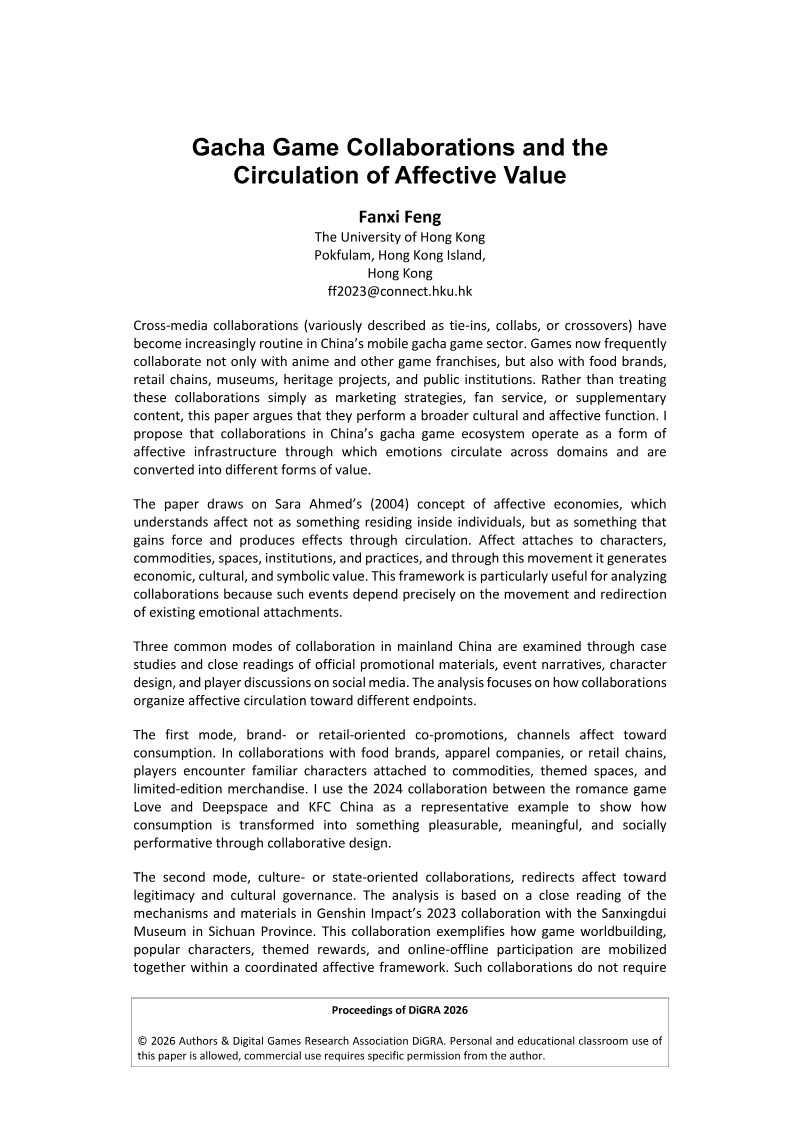
It examines how Genshin Impact players accept and defend the game's gacha model through user-generated content.
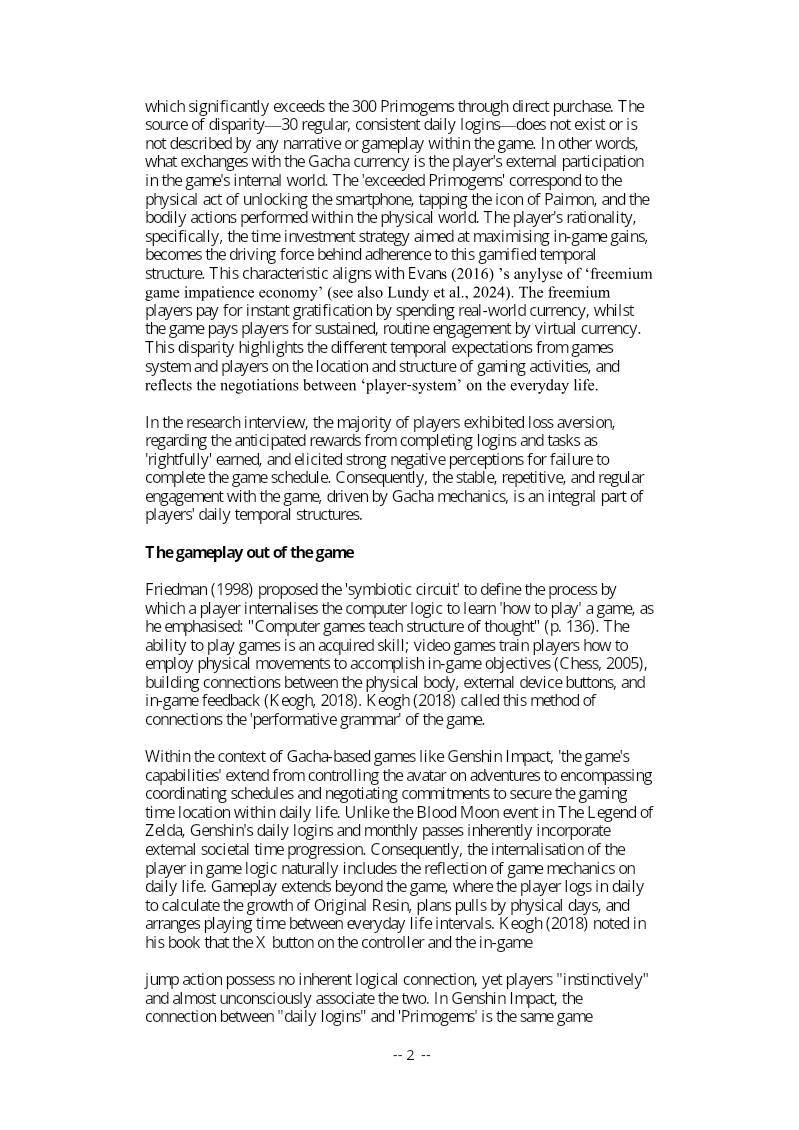
This study examines how players of Genshin Impact come to accept and defend the game's gacha monetization model, asking how players internalize and reproduce its legitimacy through user-generated content. Drawing on the concept of free labor, it argues that players' cultural outputs, such as videos, artworks, and analyses, contribute value to publishers even when they are framed as leisure, and that revenue-focused discourse reveals more explicit rationalizations of spending than prior research on play has captured.
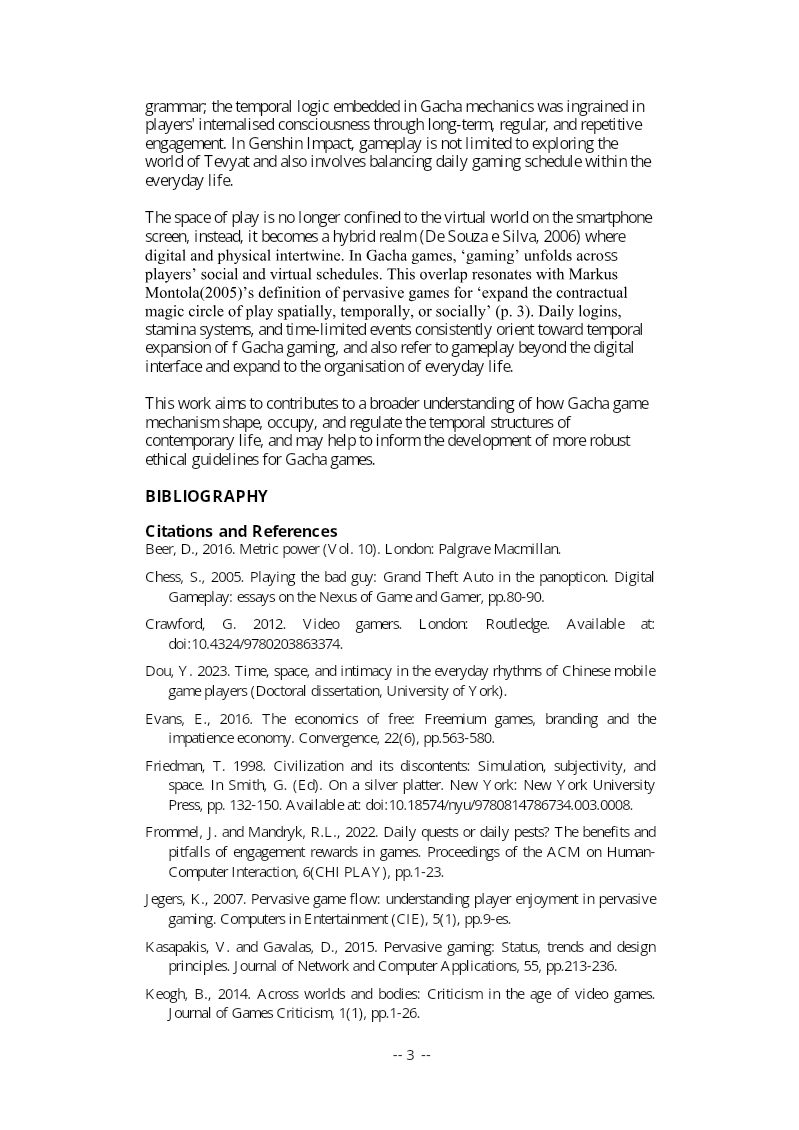
The empirical basis is a targeted search on a major Chinese video-sharing platform conducted in October 2025 using the vernacular term for game earnings. The top 100 recommended videos were archived under both logged-in and logged-out conditions, and their content, uploader profiles, and comments were examined. A manually coded benchmark of 500 comments was used to guide analysis of a broader stratified sample of roughly 2,000 comments, with BERTopic applied as a supplementary robustness check rather than a primary discovery tool.
Explicit criticism of monetization proved rare across both videos and comments, while discussions frequently celebrated the game's financial performance. The analysis identifies several interlocking strategies: spending is framed as an investment that sustains production quality and future content, transforming consumption into participation; developers are portrayed as both passionate technical enthusiasts and competent entrepreneurs, aligning players with the company's self-presentation; and tension between player spending and corporate profit is displaced onto other social groups and rival anime, comic, and game products, with comparative success generating symbolic rewards of pride and distinction.
The study concludes that technology and capital become rhetorically intertwined, with technological advancement serving as justification for commercial accumulation. Through the normalization of monetization within shared cultural values, player-produced UGC helps sustain the game's economic model and shapes wider perceptions of monetization in digital games, presenting spending as mutually beneficial rather than exploitative.
Each row is a game or company this document names, each column a document, oldest first. A mark means that document names it. Select a row to see those documents.

DiGRA · 2026

DiGRA · 2026



DiGRA · 2026
DiGRA · 2026