1 free read left. Create a free account for unlimited reading + AI research.
Create free accountWhitepaper DiGRA
1 free read left. Create a free account for unlimited reading + AI research.
Create free accountWhitepaperDiGRA
The authors describe console gaming as historically imported and city-based, now a youth sub-culture reached mainly by urban middle-class families.
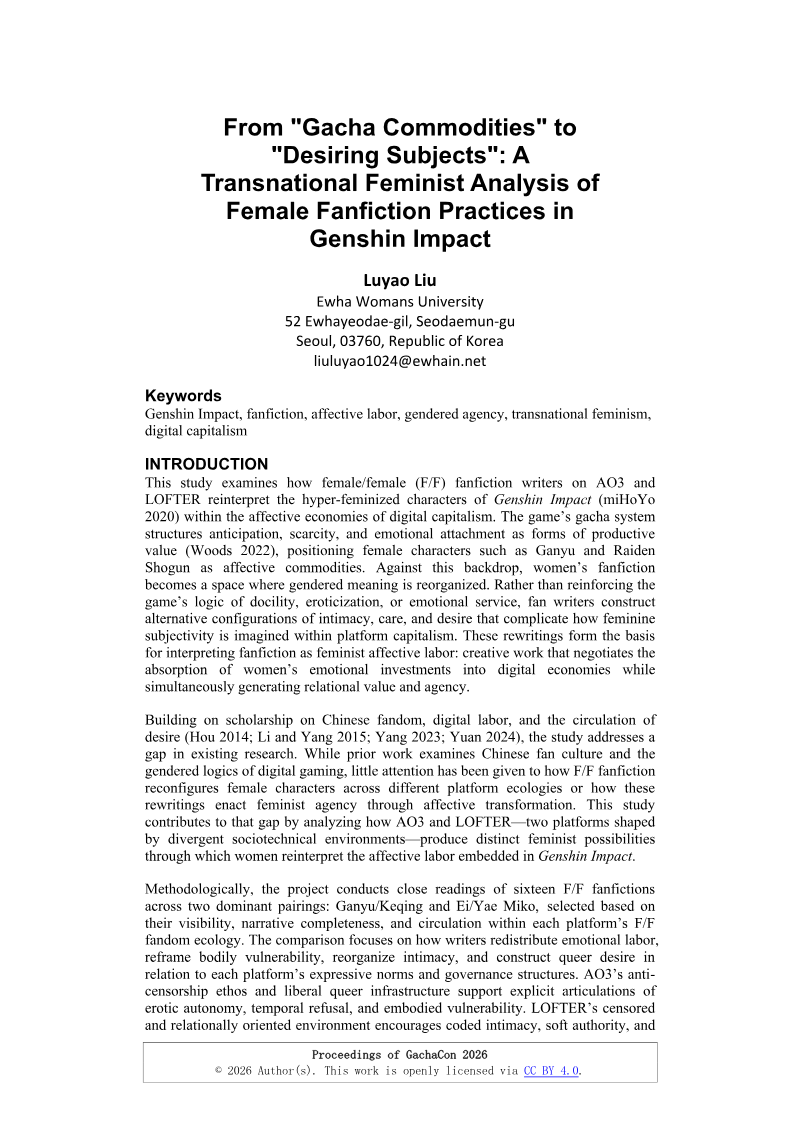
This study examines the console gaming experiences of girls aged four to ten in mainland China, addressing a gap in research that typically groups young girls either with boys under the broad category of children or with adolescent girls. Its primary purpose is to locate these young players within the spaces they inhabit, using console games as a lens to reach a specific population: girls from middle-class families in urban areas. The authors argue that console gaming, historically an imported and city-based pursuit that has evolved into a youth sub-culture, functions as a socioeconomic filter, and that the gendered associations of video games as a male domain remain strong despite near parity in player numbers.
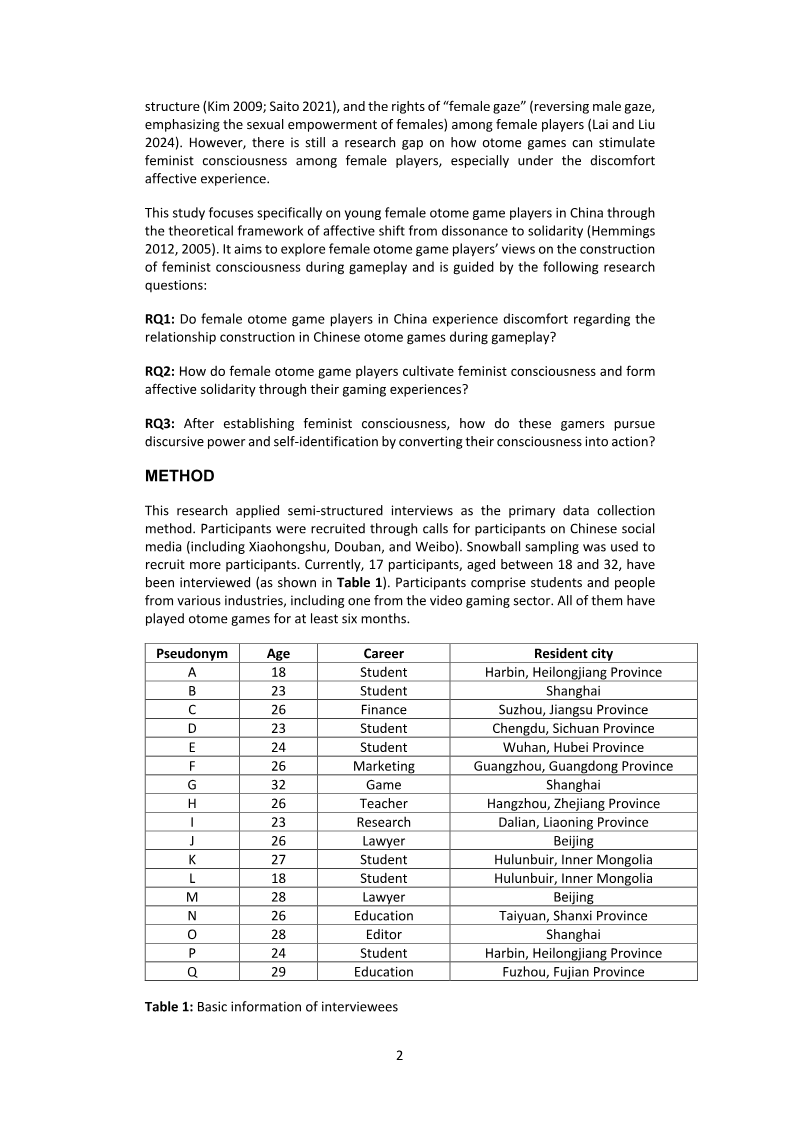
The research is qualitative and draws on twelve participants recruited through non-probability sampling. Data were gathered through online gameplay-led interviews, observation, and participant-generated drawings. Participants were selected on three criteria: middle-class family background, access to developmental resources spanning school, family, and social networks, and growth environments in developed cities, most of them located in China's advanced coastal belt. The authors note that this geographic concentration supports their assumption linking console gaming to urban culture, though it also limits generalizability.
The study frames its analysis around two objectives drawn from a doctoral project in progress. The first examines four dynamics between girls and their nuclear family members during gameplay, interpreting how girls position themselves in a blended environment of virtual play space and domestic real space through Merleau-Ponty's phenomenology of perception. The second investigates how younger girls understand the concept of "being strong," offering an alternative perspective for rethinking the design of hero and heroine characters in video games. The work situates these questions within the context of China's one-child generation, whose parents came of age during the post-1978 reform era, and draws on developmental and neurological research emphasizing the lasting influence of early childhood experience.

DiGRA · 2026

DiGRA · 2026



DiGRA · 2026



DiGRA · 2026



DiGRA · 2026



DiGRA · 2026



DiGRA · 2026



DiGRA · 2026

DiGRA · 2026



DiGRA · 2026



DiGRA · 2026

DiGRA · 2026
DiGRA · 2025