1 free read left. Create a free account for unlimited reading + AI research.
Create free account
How Voodoo hit Five Billion Downloads
Key insights
6 takeaways- 01Voodoo achieved five billion global downloads by treating hyper-casual game development as an industrialized, data-driven process rather than a game of chance.
- 02The business model includes weekly coaching and access to a proprietary knowledge base of KPIs to help studios identify and salvage prototypes with hidden potential.
- 03The company utilizes a structured funnel that mandates rigorous testing and rapid prototyping to ensure only high-potential projects reach full production.
- 04Publishing operations are centralized to handle user acquisition, creative development, and monetization, allowing partner studios to focus exclusively on core gameplay mechanics.
- 05Market trends as of 2021 shifted the industry focus away from low-cost-per-install (CPI) titles toward games with deeper engagement and longer retention mechanics.
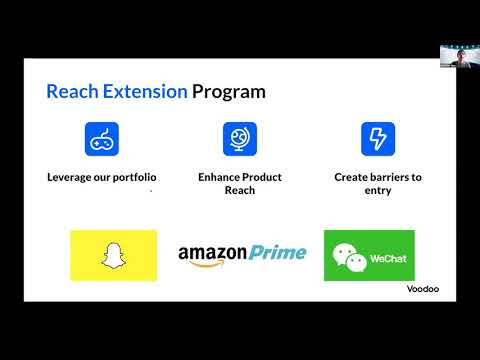
- 06Voodoo is diversifying its distribution strategy by expanding hyper-casual content beyond traditional app stores through partnerships with platforms like Snapchat and Amazon.
Ask AI about this video
Transcript
we go i'm going to introduce alexander shea head of publishing at voodoo will be in the room here he is hello alexander can you hear me hi sure i can uh can you hear me again yeah yeah awesome you're looking and sounding fantastic okay great i'm gonna that's the first good well we're all we're we're all with you we're all supporting you um and um you're gonna tell us about how voodoo hit five billion downloads so i think we're ready to rock i'm gonna disappear and then i'll come back in 20 minutes with a q a good luck perfect thanks so uh um yeah just to start things off let me maybe share screen because i've got just a couple slides i wanted to go through with you guys um as a as a first way of introducing maybe
voodoo a little bit um our success to date some of the things that we've been seeing uh lately and also i really want to make sure that we leave plenty of time for some questions at the end because i think that i can't actually see your questions until then which is fine but i should be actually fairly quick i'm hoping to get through this in 15 20 minutes maybe tops so that we have plenty of questions so please feel free to share them as you go along i find that it's a usually really good way of of sharing knowledge makes it less boring for you guys as well so you know the title of this presentation is the science of publishing and i don't want to over promise here i there is no magic formula there is no guarantees that you can give in gaming and hyper casual reflects that although what we found at
voodoo is that hyper casual is a more a much more certain industrialized process than most other segments of gaming meaning that it is more like a science than many other areas within gaming where chance will be a big factor and we'll go into that and why we feel that um that our role as a publisher is to reduce is really to reduce the chance factor and make big hits uh something that you can aspire to in a realistic way if you're putting all the ingredients for them on your side as well so going into uh the topics today as i said we'd love to go into a little bit more about who we are as a publisher so how we work with studios and some of our historical performance what we see as being new emerging trends in 2021 and it's been a uh it's been a volatile
year with everything going on from idfa to cobit and so forth and it has had an impact we feel on the types of games that make it and the last part was about how we feel we can stay as a publisher on top of the list when it comes to studios and what they're looking for so jumping right in as as you me as stuart just mentioned we've been fortunate enough in the last three years and performing enough to to be on top to have downloaded uh to have our games downloaded over five billion times in the world which is which is pretty crazy when you think about it and um and if you just look at the top publishers i think we took this fairly recently over the month of june mostly we were also very much on top of the downloads list and worldwide free downloads for for
iphone and i think android is is broadly reflective of that as well and and this is really not to brag because as a publisher our dna is not downloads based we're not looking for visibility we're not looking for downloads frankly uh it's a nice thing to have because it demonstrates that you're really gaining traction and that your users are quite satisfied with the games you're shipping but what we do look for much more is to ensure that at the end of the day our studios are making more than commercial viability that they are finding great success uh maybe not every month certainly um but in a in a frequent enough way down the line once they've ramped up so that this doesn't only make sense as a segment of gaming for them to to be active in as fantastic developers and studios but that it actually is a very lucrative business for them because unless we can find
more than sustainability for them um we have no reason of being and so downloads is not the way for for them to achieve profitability it all comes down to for every download that you're that you're generating through your great games um what is you know how many cents are you making off of that what is the payout because when you fail 10 times in a row and you've hit a massive success we want to make sure that that success is is really more than paying off for that single game and for all the failures that came before it and there are failures um uh that that are necessary to define define success so you know big summary is that yes we've done a lot of downloads we're very proud of that and we're very proud of the studios um you know the partner studios that we've done this with and i'll get into that in a second but
actually we're even more proud of the success that we've brought to them financially because that ultimately means that many of them have been able to grow the first to sustain survive while testing their prototypes and getting coaching from from all of our publishing managers um and then in a second place to grow their studio once they hit success bring in more talent maximize the chances and achieve repeatability in their success so this is a quick overview of what we do and what many publishers and studios do right now so there's nothing there's nothing new here i just wanted to give you a bit of a background because we've applied this from day one uh really from 2017 uh end of 2017 onwards you know we developed our the first publish which has changed tremendously since then where we encourage studios to uh to test all of their first builds for obviously marketability and and engagement uh but what we've added to this probably is
acting earlier in the funnel by really being a part of the studios we coach and to do that what you need is weekly calls you need ideation sessions with your studios you need to define what an ideation mindset is about and approach what are the products that work well fundamentally and what are the products that work well this given month or week and then you need to shortlist with the studio and the publishing manager we found that you need to shortlist together uh the list of games broadly uh in the universe of ideas that you've had as a studio maybe with your publishing manager or not you need to shortlist them to make sure that the most valuable projects and only those are retained in order to see okay what are we what are we moving into production what are we going to work on and then obviously when the kpis come through that's when i i guess the science part of it takes over and we test a lot of prototypes so we have a
high visibility in the market and that gives us a much more fine-tuned approach to what are the kpis that work what are the kpis that don't work and so we're able to go from testing to prep as you see here in a very certain way so we make sure that obviously there are no false negatives that we're not we're not killing any prototypes that might have made it that's that's a priority but we also make sure that the projects that won't make it based on the data we have and based on thousands of data points that we've built through time that those studios are able to go back to the ideation phase rather than go down this funnel which is a one which is a dead end for many games so we want to make sure that the funnel isn't a dead end and that no no prototype that does have potential gets retained and goes to the phases with that said we do have an edge also in uh in our launch process we've also fine-tuned this tremendously and we've
had built many many teams even in the last six to twelve months around the launch process we have a launch ops team we have a game ups team uh we obviously have ua monetization creatives team market devs we've got cpi squads and all of these different teams kind of fit right into the initial communication channel with the studios that a publishing manager holds and can centralize in many ways and the studio so we try to make sure that any complexity or or large amount of resources that are warranted on our side never interfere with this kind of one-on-one super lean super fast approach to communicating with our studios and uh with that said i'm just gonna pause for a second because i see there's already a bunch of interesting questions so i think i'll start taking a few um as we go along so you know one question is uh how do we advise developers to make the most of the successes without being stuck on the same game
rerun uh forever now i'm not sure what you mean i'll take that at the end actually because i'm not sure what we mean by game rate run on that one uh another a uh another question that just rose from what i just said so i'll take it now which was you know what is a false negative that you mentioned well typically a false negative is going to be a game where you you think that it's indicating negative marketability and engagement metrics so maybe your cpi is a bit higher than you thought it it might be in order to achieve success and maybe your day one retention is a little uh a little low but there are other things you can spot and that we're much more agile at spotting and careful like maybe the play time is a little bit higher than you would expect and therefore that balances out with a tougher uh marketability metrics or maybe your ctr is actually quite high and there's something weird going with the cpi whereby maybe the app store optimization that failed
maybe the wrong choice of names or another false negative that we try to avoid is well maybe your game actually has a lot of potential in terms of virality on tick tock so we cover that base as well and we do that without ever interfering with this methodical systematic approach that says well at the beginning we're not going to over invest the studio's time on a project unless it it indicates one kpi of potential in it and when we start looking at the kpis it's very hard to describe because it's it's uh case by case so we built up big teams to address the case by case to make sure that every different case deserves the attention it it warrants and as soon as we spot potential success that's when that's when we step in and we focus on this so that we can lift the the lagging metrics anyways i'll i'll come back to this at the end if there are additional questions on
on on the false negatives because it's a good question to summarize some of the things that that this process that this approach this mindset this relationship with the publishing team and the experience that we've built frankly uh with a fantastic team it's a lean team where we're just 12 which is which is quite small actually if you look at the number of successes but it also means that every publishing manager you work with they've all launched big hits that are very profitable and that's important because it means that the studios that they've coached that have that have made those hits have been compensated julie and a short list it's a very small short list of these studios there are many more than in this list but i did want to mention these because i mean we've omitted some studios here that have had multiple success but we wanted to make it fit on on a single slide so we had to pick uh but what you can tell from this slide is we've been able to find repeat success and these are not launches these icons are games that have made
uh tremendous downloads numbers but also financial success for the studio they've been very very profitable games and what you can tell and so you have to multiply it to look at the list of launches and games that were otherwise profitable if you want to uh if you want to see what repeat success in that sentence looks like but this is a slide we find quite representative of our ability to get studious to succeed and succeed again and oftentimes what you find is that once the studio launches his first game like pokeball with lawson or bounce forever with cassette or a castle rec with orbital knight that's flashy with app advisory this is back in 2018 or even fire rise with h8 which is this much smaller game than helix jump which i think everyone knows is the second logo there which is a massive massive game our biggest game ever and then we've got mopoli which is an internal team but still a fantastic team you'll notice three very familiar logos which are paper one two three um which are all each
in their own right amazing games and it's not easy to build sequels and hyper casual uh we happen to um to know a little bit about that but they've also built whole that i o and crowd city and those were in you know in their own right fantastic games as well finally you have uh you have ohm and they've in the last just in the last 14 15 months they've done basically four big hits uh with with one big one off the starting block these days so what i'm trying to say in this slide is that yes it's an art because every conversation about an idea starts with opinions gut feeling hunch and all these things are based on experience otherwise there's no way you can you can make it in this in this sector um but they also start from a hunch and and a feeling of newness and you can't learn that from past success you really can't and you can't learn it from a recipe
but in terms of mindset approach discipline rigor and really a set of guidelines that hold true or need to evolve depending on the ones you look at in that sense we are able to build machines and we want to do that not just for ourselves but we really want to do it with our best studios with all of our studios because it turns out that they respect it and stay with us for it so moving on um you know we do see a large portion of the market before it hits it hits the stores and that's something that we take seriously because it means that some of the learnings that we see on some prototypes they may or may not work on those prototypes and make it through the whole funnel or their learnings we can take and bring to other prototypes from the same studio or from other studios if they're comfortable with it and apply very early insights on what works an example of that last year was the end of level random reward um but skill-based
end-of-level systems that we applied first to games like bike sale pokeball and then gradually we deployed on all of the uh all of the games that you saw last year very soon the market replicated this but the lag of time between uh when you you've heard it from voodoo as a voodoo studio and when the market has heard it is actually can be a six month period and within that time oftentimes some features and some um and you know some features and some visuals can can change significantly so the market has already changed but we've been able to capture the opportunity early on that's quite important now moving on maybe to leave ten minutes for questions which i promise to do i think one of the things that we've seen in 2021 that really makes it different from 2020 from our perspective from where we're looking at is that 2021 is a is a different ball game in terms of cpi's as everyone has seen in the market um but also in terms of ltvs and so what we
found is that the games that are functioning the best in this market especially in the second quarter are games that have very high engagement metrics obviously easier said than done but but not necessarily harder in our view than looking for very low cpis which was something that we did last year last year uh you know maybe 15 out of the 20 massive hits that we published were all focused on you know low cpi they all you know 80 of them had really low cpi's you know around 10 cents or so investing um and what we see this year is very different what we see is that games that have uh succeeded quite well uh this year have been high playtime games uh what you can see is a list of play times uh and day one day seven retentions and launch apis nothing secret there um you know these are all testing metrics they change a lot uh when you launched um
they evolve so all of this data is obsolete but the truth is we've seen high uh high engagement games over perform in 2021 probably due to the market uh dynamics and uh and that's a good thing we feel that that means that there is a way to publish very big games i think there's a question that was asked previously what do you do in this in this market environment well you build deep games that are high engagement games you kind of ignore this this crazy cbi curve and hope um and hope that the product that you're building fundamentally is strong and that tends to get you there obviously you need a big machine behind you for those assumptions to work you need a big marketing team creative teams market devs uh huge ideation sessions with your publishing manager with the creative teams here we set that all up before before we even launch games and and the key is that if you can
if you can do your part as a studio in these high retention high engagement games we will do our part as a publisher we'll make sure that we'll get those to count towards those five billion dollars to date uh and counting so um the last point very quickly uh uh an additional maybe uh selling point i guess that we've built out this year we didn't really have it last year was we've been quite active in extending the reach of your games beyond the app store so we've had partnerships with snap amazon prime when we chat we're working on some other really interesting partnerships and social and so forth and that just means that your games don't only generate financial interest for you guys studios within the stores but also beyond and so you know the user base in hyper casual is healthy and growing and we want to bring it to a further step of going beyond the stores um so more on that to come but um we've all we've already had massive success you know games like aquapark.io um are played by millions of users on
snapchat already and uh and that's just one example among many with that said i think uh stewart if if you want to uh kick off the q a pmp yeah thank you very much for that that was really informative um i'm going to dive in with a question for you with which is the trade body for the uk games industry um i looked to that list of of the biggest hyper casual publishers and none of them were were british are you working with a good pro a good number proportion of uk developers or is this a space that is dominated you know much more by other territories other countries so you're saying are the are the uk developers covered more by other publishers no this this space hyper casual obviously you did a list of the biggest publishers none of them were british but the publishers the publishers are
signing working with countless developers okay yeah is is the uk um contributing well is it is it a good proportion of hyper casual or is it a sector that is dominated by developers from other countries if you see what i mean yeah well i mean it all depends are you looking at so i think you're you're mentioning the the publisher list that i mentioned at the beginning right um so on a publisher basis yes you don't have too many of the quality maybe a couple of others and you know they're happy with it with a smaller market share but um so the short answer is no i mean in terms of publishing it's not a big geography but if you're looking at the studios then yes there are some fantastic studios based in uk i personally worked uh back when i was doing games directly you know i worked with neon play with full fat worked with um with tapped and all these guys they made some major hits frankly i mean you had roller splat which got you know hundreds of millions of users i
think you had um just a bunch of games flip dunk uh and scribble writer last summer from tapped and these are all uk-based studios so uh the answer is yes the uk is a big go for studios for publishers less less so what is it that what is it that draws you to uh when you decide to start working with a studio um do you make them work with you exclusively for a number of titles is it is it a single title deal um do you invest in them and fund the title yeah so we really do i think one of the big parts of how we invest in studios and and what they value the most is we will invest our time to be honest from day one so a studio does not have need to have traction they just need to show potential potential usually demonstrated by a couple couple games you've built you know and i don't care whether you've built two games you know and you started six months or two months ago
or whether you built 20. it doesn't matter what matters is what is your ideation process what is your approach what is the coachability of your studio your game leads what are the types of execution skills that you have you can tell that very quickly from a prototype or two and so studios like that really value the fact that they've suddenly have on the other end of the line once a week once every two weeks um a publishing manager that has done you know generated millions and millions of dollars with other studios a publishing manager that has advice on what's the next step how do you grow what's my roadmap on this next project but also free testing a free platform a knowledge base weekly live streams we really cover our studios with a lot of insights and they value that much more at the end of the day than you know any retainer fee or minimum capital because you can go much much faster with a quick success than um than with the rest of it
and in terms of the games that you're signing you talked about the successes you had in the past 12 months or so and you said that the games have been a bit deeper yeah does that mean that the that you are looking for deeper games and you're moving a little bit away from hyper casual or does it mean that the hyper casual sector is evolving uh that's a good question i mean off the bat it's the second uh whereby you still have a bit of everything frankly and you don't want all of your pipeline to go into one single insight but what we have seen is that games that that tend to demonstrate strong retentive features or core gameplays and repeatable mechanics games that are forgiving rewarding and so forth those are all basic rules of hyper casual that we really emphasized back in 2018 they still hold true maybe more so than even then and we feel that this is definitely a
hyper casual um phenomenon rather than a voodoo phenomenon and we think that it a portion of games can benefit from them from this insight you'll still have some traditional runners that bring in users turn them out um and we're not saying you need to build some complex meta and uh you know very long tail ltb features even though we do have some teams that deploy them in your games but that you need to look for that really satisfying repetitive core just as you did three years ago and obviously with the the huge growth in the mobile market as a um as a proportion of global games market and hyper casual being clearly a fantastic space um is it kind of over for there used to be a casual game space in console and pc do you think mobile has basically destroyed that forever i know there was um
uh nintendo had a fantastic year on switch but it doesn't seem to be that casual gaming um drives any kind of growth on steam or playstation or xbox and therefore sorry well basically mobile has as has wiped that out as a as a genre for us for some of the other games formats because mobile is is the go-to place for hyper casual or tablet or whatever yeah no i definitely think that's that's true and i think that hyper casual on mobile is it's growing still growing tremendously and what you're seeing also is pockets of new areas maybe not on twitch and on other platf other non-mobile platforms but you are seeing html games social games um and what i was mentioning about reach extension is that the great opportunity for hyper casual studios is that we can take their games support them ourselves if we need to um get the the technical capacities because we're
you know we're almost a 400 person company now we can we can click our fingers it's done it's up and it can go on you know different android stores in china it can go on on snap it can go on plenty of different platforms um and that's the beauty of mobile just one last question before we move on um do you think there's anything in a in a post-pandemic world that will become a trend in hyper casual do you think the market will reduce because consumers want to go and do other things than play games whilst they're indoors do you think it will affect what they expect from a game that's a great question it comes back to actually it's because it ties into this high engagement type of games working out because some of them like lumber craft or city takeover or even bouncing and collect those those 2021 titles that we found were very retentive that was on the slide
they are games that don't necessarily require you to be on a commute or they're less snackable intrinsically and maybe that is a side effect of covid and maybe you will be seeing a 2022 that is going back towards what 20 20 19 or 2020 looked like in terms of the proportion of games that are successful in each segment and maybe more snackable low cpi games again what i would say is that kovid didn't have a tremendous impact what we found on our segment positive or negative um and so it you know it doesn't really change the game in terms of hyper casual studios okay thank you alexander i hope you enjoyed that as much as we did we had a lot of people watching there very very valuable um good luck with uh the road to the next five billion downloads absolutely and they'll come much faster trust me the curve the curve is like this uh and thanks very much for having me stewart uh really appreciate it always always fun to be on on with you guys
excellent thanks very much see you next time you
Summary
Voodoo, a prominent publisher in the hyper-casual gaming sector, attributes its milestone of five billion global downloads to a systematic, data-driven approach to game publishing. The company operates on the thesis that hyper-casual gaming is an industrialized process rather than a game of chance. By leveraging extensive market data and a structured funnel, the publisher aims to minimize risk and maximize the commercial viability of partner studios. The core business model focuses on coaching developers through ideation, rapid prototyping, and rigorous testing to ensure that only high-potential projects proceed to full production.
The publishing strategy relies on a lean team of experts who provide studios with weekly guidance, ideation sessions, and access to a vast knowledge base of key performance indicators (KPIs). This methodology allows the publisher to identify and mitigate "false negatives"—prototypes that might initially appear underperforming but possess hidden potential in areas like playtime, virality, or marketability. By centralizing operations such as user acquisition, creative development, and monetization, the company enables studios to focus on core gameplay mechanics while scaling successful titles.
Market trends in 2021 shifted toward games with higher engagement and longer playtimes, moving away from the previous focus on low-cost-per-install (CPI) titles. The publisher emphasizes that while the industry remains rooted in core hyper-casual principles, it is evolving to include deeper, more retentive mechanics. Furthermore, the company is actively expanding its reach beyond traditional app stores through partnerships with platforms like Snapchat and Amazon, ensuring that hyper-casual content remains accessible across diverse digital environments. This approach has fostered a network of successful, repeat-performing studios capable of sustaining long-term growth in an increasingly competitive mobile landscape.














Comments