VideoPocketGamer.biz
D2C is a go to market strategy, not a trend | Inês Ramalho from Xsolla
17 Sept 202610 min video
Transcript
We are now joined by Ines Hamel from Exola. How are you doing today?
Great. It's always good to see Barcelona in attend TGC.
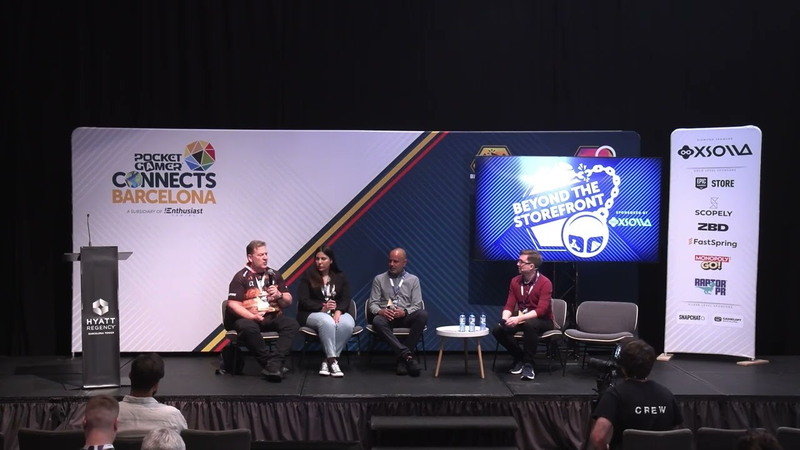
Yeah, likewise. We're always happy to be here. Now, we were speaking earlier, you were on a panel and you were talking specifically about the D2C trend that has been going on for the last couple of years and it's evolving to a point where I think you were talking earlier, it's not really so much of a trend anymore. What's Exola's position on D2C these days?
So, we what we have been observing worldwide while we attend conferences and talk with developers and studios from all sizes is that D2C is no longer an emerging trend, but rather go-to-market strategy that studios from all sizes are adopting in order to reach
out their audience in a more broad and efficient way.
The appeal originally was that ability to avoid the App Store 30% fee, to build an audience kind of independently, to try and drive retention and stickiness via people coming to your website rather than other people's. Firstly, how has that resulted in profit margin increase basically for developers? What have you seen? Has it Has it been working? Have people been using it? Has it been trending upwards?
So, as for Exola, nowadays we have more than 700 web shop including those from big studios that are day-by-day seeing their incremental revenue and margins grow, which is great for the market because while we are also dealing with some um, constraints and with the app stores, we are also
shifting the developers and gaming studios' mindset to see D2C as an alternative, but solid income revenue stream. So, they can also be closer to their players, know their audience better. And also for publishers, this is very important because they it enables them to provide to be provided with data and insights, whereas traditional stores, um they are more of, let's say, rigid structures in that sense.
That makes sense. And I think the people used to turn black box an awful lot, where it's like they they give you some information, you have no idea how they got it. So, it's nice to have that transparency if it's your own store, if it's your own your own user interface. It's also as important to be able to see who's playing, when they're playing, and what they're spending cuz user acquisition seems to be getting more expensive over time. It's and some of
the top grossing games that are on the app store, like the top 20, they're still making a lot of money, but it seems like they sort of plateaued a little bit. It's So, the idea that that the games are still making money, not quite as much, but the cost of getting new users is increasing. So, it becomes more important to monetize the users that you do have, the ones that you're actually, as you say, developing relationships with. Um, when it comes to that D2C side of things it does look like the app stores are pushing back a little bit. They're now talking about monetization strategies for linking out and maybe breaking that 30% into different chunks. Is the era of like the kind of free link, the the free window into D2C, is that starting to close a little bit? Is there still time to get in and, you know, take advantage of the of the no fee situation?
Although the user acquisition costs still exist, I I think the markets are shrinking. There are markets that evolve faster than others in that sense with the D2C strategies. Um but I do not believe that they are
um somehow uh getting stuck with uh with those costs.
Okay. Well, that's very good to hear, obviously. Um on the other side of the coin, we've got uh uh other people reaching out and and doing this kind of D2C thing. Lots of other series publishers as it continues to grow. Do you think there are areas in which the D2C audience is being underserved? Because it is a relatively new thing, only 2 years. Are there some best practices? How have you know, can you look at app stores that were made 2 years ago and go, "They're doing this wrong. They're doing this wrong. Here's how we would do it now to ensure, you know, better user interactions, better retention, that sort of thing?"
Underserved, I would say um so-so for probably uh small studios. Whereas mid-size and triple-As uh have other sort of structures and teams. So, for them to deal with all uh
I wouldn't say complexity, but all the work uh education mindset shifting that D2C involves, it's a little bit uh it it processes a little bit slower than than for other solid uh studios that already have our experience with uh monetizations.
I think it required a bit of re-education, not just on behalf of the publishers, but for the players as well. Do you understand the value they are going through and linking out to another shop and to trust that process.
Exactly. Because usually studios, there are here two types of challenges. On studios' behalf, you have uh all that requires uh all the universe related to payments, uh to legal, to regulatory. So, this is from operational standpoint. From a player standpoint, now we have this mission of education of educating the
players in order to trust the D2C because D2C's biggest advantage is to bring both studios and players closer together and enhance that relationship.
No, it it makes sense. But there's always that thing whenever I click on a site and you you read something and you click on a link and rather than it opening it to you, like bumps you over to another browser, there's that sense of like, well, I'm not sure about this. And it was ensuring players understood that they were going somewhere safe, somewhere that they could they could trust. And then there's also the element that once they have done that for the first time, they can potentially just revisit that store independently. They don't have to go through the app anymore. Which is I know is something that they've been talking about for avoiding any future kind of payment, like
one-off fee and then you can bookmark it and just keep going back there and and and keep it safe, which seems to make sense. So, in terms of friction points, is that the main one, that hyperlink going out?
Definitely, making the payment, the checkout process
as frictionless as possible is definitely one of the biggest missions and this has been a concern for Xsolla throughout the years to make this experience as smooth and as seamless as possible, yes.
Got you. And outside of the the D2C landscape, the clients that you're working with now, the folks that you are are are doing busy business with, I imagine you're maybe advising them to, as a part of their rollout strategy, have a D2C store, have have an app store, web store available rather to them. Are there other things that you are advising folks, whether they're large-scale publishers, developers, or indies in terms of the best way to get eyes, hands, and indeed money into their games.
I will never get tired of saying to small, mid-size, and big studios that the key for their success is to build their community, to listen to their audience, to understand in which
channels their community is, and build trusted voices. So, understanding that scaling globally is primarily scaling locally at the first glance. It's the most important things because different regions, different markets they demand different strategies in terms of communication, in terms of tone, in terms of really understanding what is the player behavior. So, as sooner as you build your community and you listen to them, the sooner you'll be succeeded with your projects, no matter what size they are. And we have been seeing studios here in Southern Europe succeeding by applying this simple principle of communicating with their audience, whether through Discord, whether through social media platforms. Because nowadays what we have is a huge
call for attention, demand for attention. So, trust is definitely what you're seeking for. You're no longer seeking for attention only, but also for trust.
It's a good note to go out on. Ideal. Thank you so much for talking to me today in this Thank you so much.
Auto-generated captions from YouTube — names and numbers may be misheard.
Key insights
5 takeaways · ~2 min read- 01Direct-to-consumer (D2C) web shops have transitioned from an emerging trend to a standard go-to-market strategy for game studios of all sizes, with Xsolla currently supporting over 700 such storefronts.
- 02D2C strategies allow developers to bypass traditional app store fees and gain access to granular player data, providing transparency into spending habits and engagement that is often unavailable in the 'black box' environment of major app stores.
- 03The primary operational challenge for studios adopting D2C is managing the complexities of global payments, legal compliance, and regulatory requirements, while the primary player-facing challenge is building trust in the external checkout process.
- 04As user acquisition costs continue to rise and top-grossing game revenues plateau, D2C serves as a critical mechanism to increase profit margins and improve the monetization of existing, loyal player bases.
- 05To succeed in a competitive market, studios must prioritize building community trust and localizing their communication strategies, as global scaling is most effectively achieved by first understanding and engaging specific regional audiences.
Ask AI about this video
Cite this video
Citation
Generating citation…






















Comments