1 free read left. Create a free account for unlimited reading + AI research.
Create free account
Superstar Session: Dr. Hyper & Mr. Casual - How to Stay in the Top Charts for Ten Years in a Row
Key insights
6 takeaways- 01To remain competitive in the US iOS market, hypercasual games must hit specific performance benchmarks: a click-through rate above 3%, a cost-per-install below $0.20, and Day 1 retention rates exceeding 43%.
- 02Studios should maintain a diversified portfolio of multiple concepts to mitigate the high volatility and frequent failures inherent in the hypercasual genre.
- 03Long-term success relies on a 'fail fast' strategy that prioritizes rapid iteration and marketability testing before committing significant production resources.
- 04A lean team structure is required to maintain the agility needed to iterate frequently based on objective, data-driven performance metrics.
- 05Protecting intellectual property from app store copycats is essential for revenue stability, as smaller studios often lack the resources to combat cloning independently.
- 06Partnering with established publishers provides the necessary legal infrastructure and competitive intelligence to systematically identify and remove infringing titles from app stores.
Ask AI about this video
Transcript
all right and now that we're talking about crazy labs anyway um i'd love to introduce our first speaker um uh rotem eldor from crazylabs who's going to tell us uh more about dr hyper and mr casual how to stay in the top charts for 10 years in a row hello hey martin how are you i'm good how are you i'm doing great thanks all right well whenever you're ready feel free to kick off okay so i am ready let me just share my screen i'm hoping that you will see it in a second so hello everyone thanks for coming and virtually joining us um here in tel aviv is quite sunny so we have no reason to stay indoors but if
you are indoors or wherever you are we're welcoming you of course to today's talk about dr hyper and mr casual these are tough times of course and we are all still going in and out of lockdowns but we're doing the best we can of course we what we have and today we'll speak about how to actually stay relevant and stay in this industry of constantly changing and this is what we'll talk about today especially inspiring studios which might want to shift their primary business or people who are still having tough times staying or keeping up with uh with the constantly changing environment so this is our agenda for today um it's been said that in order to succeed in the mobile gaming industry you have to stay focused however in the long run we see that studios need to diversify their portfolio in order to minimize risks
so today we'll speak a little bit about the history of hyper casual and how to level up in the top charts will have an amazing bonus tip so it's worth to stay for that and we'll also discuss of what brought crazy labs into the hyper casual gaming industry to begin with and what was the effect of having an internal team as well as a team of publishing experts and how it helps us as a studio and of course the developers that we're working with to reach the top charts so apart from publishing games were also a gaming studio as i mentioned we have the hyper casual lab we have the casual lab and we also have another top secret lab which is doing some very cool stuff so it's worth to stay tuned a little bit about us crazylabs is a top
three publisher with over 3.9 billion downloads for our games we're really reaching the 4 billion download mark we have over 100 million unique monthly active users we have offices in tel aviv shanghai scorpio kiev so if you're also searching for your next job you might find it here with us just a little about me my name is autumn i'm a senior publishing manager here in crazylabs i've been working in the gaming industry for the last eight years so and as a true gamer myself i'm always looking for really cool new games to work on i'm not a hyper casual gamer but still when i'm playing some cool hyper casual games it really gets me it gets me going and i think that is really the the key of working in this crazy industry so it's not a history lesson and i'm not going to i'm hoping i'm not going to be boring uh in the talk i don't want to
tell you the entire history of the gaming industry or the hyper casual industry but it's very important to understand the past when we're looking in the future especially when we're trying to make the best use of our time as creators and not work on something that might be even off trend or not even as successful anymore so i know you all know these rules by heart but sometimes we all know that we forget to pay attention to the right things when we're working on a game especially when we're working on something that we think is very cool and we kind of forget all the rules that come with the hyper-casual um guidelines as we say so what is the what is hyper-casual hyper-casual games are simple they're short they're satisfying they're easy to learn easy to master in just about five minutes of game time you will have a beginning a core and an
end so it's something that doesn't happen in casual games doesn't happen in mmos in pc games in console games it doesn't happen anywhere but in the hyper casual industry so you can have a five minute session and feel like you accomplished something it could be played by you by your kids by your grandmother it has mass appeal right so when we're talking about who is the core audience of let's say a strategy game so these are people with high enough concentration and attention and the skill to play strategy games or shooter game or a casual game or any other game but when we're talking about hyper casual it could be anyone and we see that in fact it is everyone who plays these games these games are highly replayable meaning you don't have to have a very sophisticated gld or a very sophisticated level funnel you do of course need to look at the data and we encourage everyone to
install a level funnel and work only by the data but we also see that these games are addictive enough to have a more simplified level final in gld than other games also it's easy to monetize right we're not looking for too sophisticated game economy most of the revenue the vast majority of the revenue of these games is monetized through in-app ads and of course and we'll talk about it more uh in depth later on this uh presentation it's speedy in production it doesn't take you six months six weeks even to create a game it's very fast and we iterate very fast in order to see if we're in the right direction or not and let's let's talk about it more in depth in a few slides so when we're looking at the
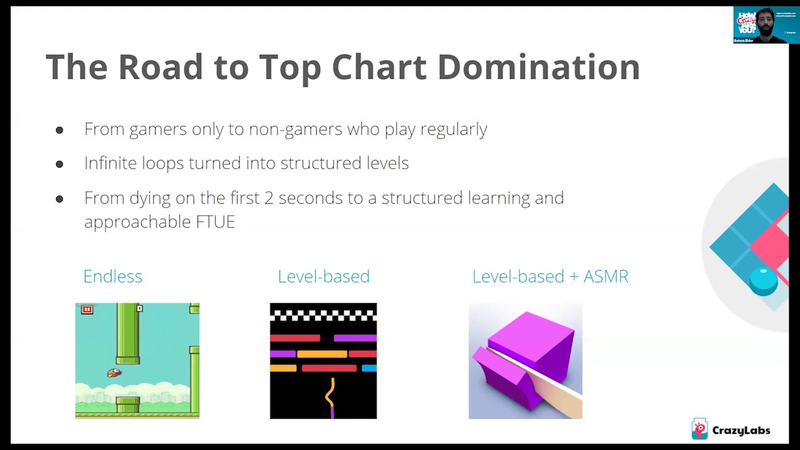
road to uh top jar domination we see that you know for the ones of you who are long enough in this industry we understand that the hyper casual industry and the gaming industry itself has changed through the years if we had a flappy bird in 2013 where endless impossible loops were the trend um we understand that it's not the case anymore if the if any of you ever played flappy bird it took you about i don't know five six seven tries to pass the first two seconds of the game it takes skill if i play it and i've played it i don't know for 20 minutes and the new guy comes out and he plays it we won't be at a different it won't be at the same level we will be in a different level because this game requires skill nowadays we don't ever see these games anymore it might come back there's a lot of people saying that flappy bird will come back in one way or another
but at the moment we don't see it we saw the exact opposite in the evolution of hyper casual right landscape mode is gone people like to uh where's my phone people like to play like this and not like that because they want to move between screens and then talk to their friends while they're doing it or talk to the mothers on the phone while doing it so they don't need to have full concentration at these games the games move to level based and they're easy to to learn easy to master you don't fail at the first one two three levels you just don't and if you do it's a bad gaming experience for the users and on top of that in the last year we see that most of the games you can't even fail if you want to it might take you a little bit longer to pass the level but you will not be able to fail what will happen next and what will be in 2021 or 2022 we have no idea that's why it's fun and that's why we are here uh but we do see an evolution in the
hyper casual games in the last two years year six months and we see that it gets easier so again uh crazy labs the company has gone a long way reinventing itself over the years from casual games to what they used to call super casual games to what we all know and love today which is hyper casual games the point here is not to talk about our history but i do want to inspire the teams who are at this point of thinking of shifting to follow trends you might be working on casual games for five years now or rpg or other storytelling games and you're kind of not finding yourself in the industry this is an inspiration talk for the ones who are thinking to shifting to this hyper-casual uh genre i wouldn't call it the trend but it is a genre um and see how with a small change you
can turn your lives around so since hyper casual production is very fast and snappy we i will always like to give the best case scenario and the worst case scenario of developing a hyper-casual game it's always more fun to start with the best case scenario so that's where i start um you find an idea that you like you find a trend that you like you find a game play that you like you're thinking about you know what i can create a game this mechanic looks fun this trend looks fun this art style looks fun and you kind of combine them together you create a gameplay video think about like a storyboard that you're building and you test it only for ctl you don't even have to have a build on the store some people really like to create a build test for cpi it's also fine you test it for either cpi or ctr and you see if you're on the right direction or not
first part is the marketability hyper casual games are highly marketable meaning high ctl low cpi lots of people want to download these games very cheap cpi and that's how you scale your games if you don't have it it's not a good hyper-casual game it could be something else but it's not a good hyper-casual game let's say you do have it best case scenario you start working with the game start working on either cpi if you tried ctrl before or if you already passed cpi build the game for retention create a level base create uh 20 25 30 minutes of game time just to test and check that people want to come back to your game the next day meaning you have high day one retention right we're testing two things one that the game is marketable meaning people want to play the game and second that they want to stay in the game once we pass this and it's also important to have a lot of communication with your publisher
because they are highly experienced in releasing games and if they don't give you them enough attention you should demand it and you test for output output is the average revenue per user right so very simple equation how much it cost us to to acquire a user on average versus how much we gain from them so if the cpi is higher than the output we're not in a good situation if the cpi is lower than the output we are in a good situation and we're ready to start scaling that was the best case scenario it shouldn't take you long to take you around one or two weeks to understand if you are in the right direction or not let's move to the worst case scenario which you will see it's not that bad so let's say you spent time on working on a ctrl test working on a cpi test trying to see if the game has a market now worst case scenario you failed in
either of those and you spent two or three weeks working on a game that you understand that is not highly potential and you throw it away first you learn from it and second you need to know that it's very very hard to nail it with a great ctl or great cpi we also fail a lot as a company as publishers as developers as a studio people always fail and that's very important to learn to understand that but we allow our developers to fail because we support them and we try to help them learn from their mistakes right that way we can move to the next idea and make it better so let's say in eight weeks you can test four or even six videos and with the right publisher you also might cover some of your expenses now i want to share some tips regarding creating a hyper casual game which will be super relevant to the guys
who are shifting from other genres but also very important for people who are currently working on hyper casual games and they might have a portfolio of 30 games so the portfolio itself you got a portfolio great don't hide it you can you can have in your portfolio a lot of genres you can have casual hyper casual strategy whatever you do it doesn't matter you don't have to hide your current portfolio if you are working on hyper casual games if you change your direction it's great focus on what you're doing and make sure that everyone you're working with will see their portfolio and that's also very important to actually show what you can do as a studio but reworking games which didn't work might not be worth your while if something fails it fails don't try to resuscitate it and don't try to overwork something that already showed that it doesn't have
promise keep thinking about the time you're wasting and utilize your time to do good things and to work on things that have potential the pitch i can talk about pictures all day i can talk about it on and on in fact we have another talk only about pitches uh next week so stay tuned if i can sum it up to one slide i would say that make sure that your pitching and your pitch that you're working on is something that has marketability look it up on youtube look it up on instagram look it up on tick tock see what you're pitching and also check always the top charts to make sure that you are with the trend and you're not falling behind um think about the storyboard i already said it a couple slides ago but it's very important so when you're building a video and you're creating a video to test either ctl or cpi you're not showing the game you're showing a video you're showing a
storyboard so when someone sends me a pitch or a video or a gameplay me as autumn the publisher i'm concentrated at looking at the video or playing the game or doing whatever is necessary to understand what i'm looking at when autumn the user sees the ad for the first time or not for the first time doesn't even matter i'm watching the ad while i'm scrolling on facebook or on instagram or on tiktok or in any social media that there is right i'm not interested in watching the ad i don't care about the ads so it has to be something that has a good on boarding that catches my eye in the first three seconds because otherwise i'm gone you can you won't even see me again but this impression to see that the user wants to stop what he's doing right now to stop seeing his friends feed or pictures of cats or whatever it is and stop where is what he's doing watch the
ad click the ad and download the game that means that the game has high marketability let's talk a little bit about the team so some people came to me and said uh i want to increase the team i want to build a team for hyper casual i want to create 10 videos a month i want to create 50 videos a month wait before you do it no don't don't overdo it start small two three people game designer developer and an artist it could be only one it could be two people and test a few prototypes create two three four prototypes and see how they perform learn from your mistakes also let your publisher guide you right so a good publisher tests around 300 games per month while you test i don't know three or four so i never say that the publisher is always smarter than anyone but he is more experienced he does have the experience of telling you where you went wrong also
the publisher lives and breathe the top charts i play all of the game in the top charts every day so i kind of know what's trendy and what's not we all have examples right and we all you know we can hear about success stories all day uh but i just want to say a few things about the team i'm sure you all remember the game soap cutting it was created on christmas uh last year was created by three people by a small team that that's all they did they created uh well they created a few prototypes before but then they created soap cutting two developers one designer that's it then they worked live ops for the game for four months five months six months and then they said okay now let's create new prototypes and then they created more prototypes they failed they failed they failed and then they succeeded with acrylic nails that's all being done by two devs one designer and now after they have two top chart hits they
can start thinking of the increasing the team they started increasing the team and that's how you should do it you shouldn't overthink it and start increasing the team before you have something in your hands the potential um so we all know the potential of a hit hyper casual game right it does bring a lot of revenue to both ends and it can fund you for a long time ahead but think about also the potential of what you're testing so i wouldn't start testing and building a game for retention for game for game time for features for whatever it is without knowing the potential of the marketability also i wouldn't put in-app ads to check out before i know the day one retention i wouldn't go ahead and waste my time first we test ctl or cpi then we test dpi then we test day one and then we'll
test the output we work very fast but with short iterations and short milestones i wouldn't say go work on a game come back in six weeks and let's test no i would start testing because i know that the time is valuable we do want to work fast but we do also want to work smartly and last but not least the publisher so you need the publisher with experience in pushing games to the top charts we need experienced publisher in as many genres as you can sub-genres in the hyper-casual genre because we know that there are many of them so you need someone who is more diverse in portfolio as well i would talk about the technology because you need someone to help you with sdks you need someone to help you with development you need someone to help you with dashboards and learning from your mistakes so it's very important when
you're looking and searching for a publisher also growth we all want to grow our games we all want to grow our portfolio but don't do it on account of hurting your core game don't bombard the users with rewarded videos and interstitials and then hurt the game and and wonder to yourselves why the retention has gone bad right think smartly on how to grow your game your portfolio your team whatever you need but do it smartly and of course communication you have to have feedback from your publisher but also keep in mind that you're the game owner right you're the creator of the game so you need to own it you need to own your game of course i would always always look for feedback from my publisher and if you're not getting it demand it but you also need to know that you own the game and you know everything in and out about your game
so um it always feels too short right when when we talk about hyper casual games and i feel like i can go forever but we need to sum it up so we have five points that we want to convey i will talk briefly about three because we have a very cool bonus tip ahead of us um so first don't overdo it work with small iterations don't create the game before you know the marketability don't put ads before you have retention don't overthink it and don't over complicate it most of the chances that your first games or most of your games will fail the marketing test because that's how it is so i wouldn't go ahead and push games and push complexity and create features and think you know five or six updates ahead don't do it think about the marketability of the game before you start testing anything else second i
was i would always always always work on the next game while i'm waiting for the game to be approved or tested right it takes a couple of days to test for ctl cpi retention whatever you know hope for the best expect the worst start working on your next game because there is a big chance that your game will fail so don't just click refresh on the dashboard every couple of minutes it doesn't work it doesn't help anyone just to stay at home in refresh work on your next ideas always best case scenario your game succeeds great digit come back to this game a couple months later and last but not least marketability tests are a must don't move forward without seeing test results first so we have a bonus tip which is the human factor uh it's personally something that i love so if you're taking anything one thing from this presentation take these slides
let's have a hypothetical situation that it's not that hypothetical i'm sure it happened to all of you it happened to me at least a couple of times you're working on a game you find a pitch you fall in love with it you start working on the idea you start working on the storyboard on the pitch on the game or whatever it is you fall in love with this you feel you think to yourself this is my hit game this is what it's going to bring me to the top child you show to your friends to your girlfriends to your family they all love it you all love it you get your hopes up you get your expectations up you test the game for cpi or ctl and it fails the entire team gets demotivated and you have no idea what you're doing next so first don't consider this as a failure it's just a minor setback on the road to success that's it we also fail a lot everybody does when you're looking at the top chart you're seeing the top hundred games
the top hundred succeeding games right these are all successes but you have no idea behind them how many tests they failed they failed a lot and i can promise you and every person you will speak to will tell you that you fail a lot before you succeed and that's how it goes so i wouldn't get demotivated we always we all have the basic knowledge right i spoke about five tips of getting your hyper-casual game to the top charts and these are great tips and you should all follow that but it doesn't guarantee you success if i knew what's going to work i wouldn't stand here talking to you i would just sit in my basement and i would work 24 hours a day on a game that will get me to the top charts but it's not the case and that's how it happens we have no idea what is going to be a hit and you know what that's that's what's fun about this industry as well and that's so fun what's so fun about hyper casual games and that's also the foundation of the relationship
between the publisher and the developer the constant communication and motivating each other so if i would take something from this talk is to do not get demotivated so we're going to finish off with uh some fun stuff we have um an unlimited pool prize in our endless campaign in case you missed it so go to our website submit your game send it to me send it to your publishing manager and you can get revenues just for submitting and testing your games also in case you missed we have uh two hubs that we open one in mumbai india and one in tel aviv israel uh if and we're not just uh financially supporting them of course but we're also bringing them and guiding them along the way currently we have these two hubs and we're opening new ones very soon so stay tuned wherever you are
here is uh our latest boot camp from the israeli hub these are the highlights and the sessions that we gave them we really injected them with everything there is to know and everything we know about hyper casual games and i'll give you a small spoiler very soon one of these teams is going to release their first hit with us um so stay tuned and it's it's a really fun game uh it's a shame i can't show it to you right now but you will soon see it everyone thanks for coming i hope you're staying safe i see there's uh some questions in the q a so we'll be happy to take them and uh answer everything if you are looking for your next uh hit and if you're looking for a publisher feel free to ping me ping any of the publishing managers in the team and will be happy to speak all right great thank you so much for an amazing talk and yeah you're right there's a lot of
questions waiting in the q a so we have a few minutes left so let's dive straight in it um two questions has kind of come to the same thing and that is if you can share benchmark figures uh about ctr cpi and day one retention of course um so when we're looking at cpi cti and they want retention and we're looking for us ios i'm looking for ctrl which is higher than three percent cpi that is lower than 20 cents and their own retention higher than 43 percent whoo that's some crazy competitive numbers great so it is so much for sharing i'm sure they'll be very helpful for everyone uh trying to break into this market um the next question from mr x nelson he's asked he's asking if you have a small team and you test earlier quickly what do you think about the risk of being copycatted by a bigger team who have the ability to develop and skill content more yeah so um
it's always a risk right but that's that's the plus side of working with a big publisher and all of the big publisher will say to you as well they have marketing intelligence they have competitive intelligence and they're searching the app store every day so in case you are first and someone really copycat you copy copied you and not just got inspiration from you we have big legal teams behind us that will be able to uh reach out to apple to google to the guys uh directly and get them removed if you search anytime on the google play store for soap cutting you will see at least 20 clones every day and every day we remove all of them at least the bigger ones but new ones pop up so if you do it alone there's no chance you can go through it but when you have a legal a big legal team behind you that's something that uh we can help all right cool thanks um there's
actually a lot more questions but we do need to close down to make space for the next speaker um but uh perhaps you i can invite you to join the discord server so you can answer some more questions there great i'm there cool well for all the people who asked some questions you hear it wrote will be on our discord server uh if you need a link to your discord server it is on your meet to match page so rosim thank you so much once again and uh thank you it was great to be here again you
Summary
Sustaining long-term success in the hypercasual mobile gaming market requires a disciplined, data-centric approach that prioritizes rapid iteration over extended development cycles. The primary objective is to minimize risk by validating marketability before committing significant resources to full production. By focusing on low cost-per-install metrics and high click-through rates, developers can identify viable projects early, effectively failing fast when concepts do not resonate with the target audience. This strategy allows studios to maintain agility and focus their efforts on titles with the highest potential for mass-market appeal.
To remain competitive within the US iOS landscape, developers must target specific performance benchmarks, including a click-through rate exceeding 3%, a cost-per-install below $0.20, and Day 1 retention rates above 43%. Achieving these figures necessitates a lean team structure and a willingness to iterate frequently based on objective performance data. Because the hypercasual genre is inherently volatile, diversifying a portfolio across multiple concepts is essential to insulating a studio against the inevitable failures that occur during the testing phase.
Beyond technical development, protecting intellectual property remains a critical challenge for independent creators. The prevalence of app store copycats poses a significant threat to revenue and market share, as smaller studios often lack the resources to combat widespread cloning. Partnering with established publishers provides a necessary layer of protection, as these entities possess the legal infrastructure and competitive intelligence required to systematically identify and remove infringing titles from major platforms. By combining rapid, data-driven development with robust legal support, studios can navigate the complexities of the mobile ecosystem and maintain a presence in the top charts over an extended period.