VideoPocketGamer.biz
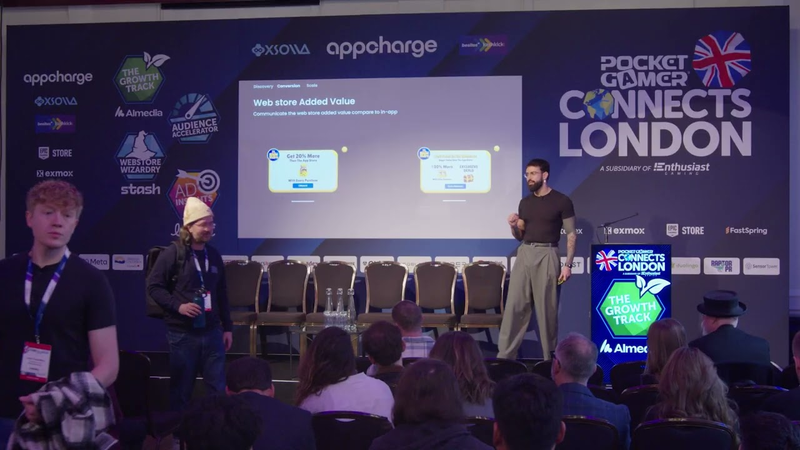
Session: How Much D2C Revenue Are Publishers Actually Making? - Craig Chapple, PocketGamer.biz
14 Aug 202624 min video
Transcript
And now Craig is going to come up and he's going to talk to us about how much D to C revenue are publishers actually making. Craig, tell us more.
All right. Thank you very much. Hopefully I don't get reverb from this one. Uh cool. I'm going to figure out how
this actually works. I've not actually done a PGC presentation. I know I've done one years ago in person at different company, different life. Um Get on with it. Right. Uh so if I just press the button, we're going to get Uh give him 2 seconds. He says. All right. Well, firstly anyway, thank you for coming to the presentation. I am Craig Chapple. I'm the head of content at pocketgamer.biz and today I'll be hosting a talk that asks the question, how much D to C revenue are publishers actually making? I've done a few articles about this uh in our weekly newsletter. Skipped ahead. Why not? Um There we go. Uh we've done a couple newsletters on this in our weekly uh newsletter. So we're doing it covering it for a couple of quarters. The latest one seems to have done pretty well, so I thought I'd do a live version
of it. Um Okay. So, firstly, you're probably wondering, other than Pocket Gamer, who who the hell am I? So, I actually been doing this for nearly 15 years now as a in the industry as a journalist and as an analyst. Uh I've been at I started at Develop magazine, which is a B2B games magazine when we did print. It does still exist as MCV Develop these days. I later I left country and joined Nintendo very briefly in marketing. Realized marketing wasn't for me, so went straight back to journalism and thankfully Chris here hired me at pocketgamer.biz. Uh as an editor then senior editor. And uh later I left at Sensor Tower, which is where I was an analyst for a while. Um basically worked with press, uh wrote wrote blog posts, uh helped do their reports, uh which is really good time. A few years later I went freelance for a bit. I was head of content at part-time at Rakuten PR, uh which is actually here at
the in the in the expo. And then I come back cuz you can never leave Steel Media. I've come back uh for the last few years as the head of content at pocketgamer.biz and also help Charlie Scowan uh with Pocket Gamer Connects putting the agenda together. All right, a couple quick things. So, obviously, yeah, we have our PGC. You're at one, Barcelona. Uh we've also got our PGC Summit Shanghai up July 29th, PGC Nordics in Helsinki October 20th-21st. Got a bunch of other events this year. Uh and if you see this lying around the venue, there's some in the entrance as you come in. There's some at the Steel Media booth. We did a region report in association with Exola about Iberia. It's got a bunch of interviews with people from Spain, Portugal. A lot of data, the top 30 Iberia game makers. [snorts] well worth checking out. A lot a lot of information about the local industry there. Okay, so what you're actually here for is the D2C opportunity.
So, first I'm going to dive into some general market numbers. Just sort of set the scene. So, in Sensor Tower's State of Mobile 2026 report, it said the global mobile games industry uh generated 81.75 billion dollars worldwide from in-app purchases. That is the App Store and Google Play only. That marks the third straight year of growth. Though this is only up 1.3% uh year over year. Uh just as a comparison, revenue between 2023 to 2024 rose by 6% to 80.7 billion dollars. Uh the growth was skewed towards Europe, apparently. Uh the US was flat, which actually surprised me. Um interestingly, at the same time, downloads have declined uh to 50.4 billion. Uh total time spent was over 444 billion hours is I think how I read that. Which is which is mental. Um I
think the main takeaway here, as we all know, uh is we're not reaching kind of double-digit growth uh currently. Uh we're in a mature market, so publishers will be looking for how to increase their margins uh on their existing user base, such as through direct-to-consumer. And cuz I'm a journalist, I thought I'd show another data point.
[laughter]
Uh which is actually vastly different. Uh just as comparison, I grabbed this forecasted revenue prediction from Newzoo for 2025. I couldn't actually find the latest one. Sometimes they revise uh their previous forecast. So, they said that the mobile sector would grow 7.7% year over year to 108 billion, which is quite different. Uh I think they actually count some uh China revenue in that as well. I looked, it's not ads, it's not hardware. So, it must be China. Or just vastly different estimates. So, a few stats. These are courtesy of
Xsolla and AppCharge first, but I will go to the actual publisher data, don't worry. But, a few things on here that come from their reports and articles. So, Xsolla says reclaiming up to 30% in platform fees represents an immediate 25% increase in profit per transaction. They also cited that D2C web blended payment cost is 7%, and that was based on cost estimates for Stripe, Adyen, and PayPal. I have heard that it's the cost of basically anywhere between 5% and 15%. 15% sounds high, but that is what I was told. I think it's like 5% for the basic, and then it can go up to 10% for extras. Like, I think they help you actually put together your web store. AppCharge crossed said it crossed the $1 billion the $1 billion mark in annualized D2C consumer transactions in March 2026. AppCharge claimed top publishers are still losing an estimated $41 million
per day on platform fees. I guess I didn't check that, but I you know, that's that's what they're claiming at the moment at least. Interestingly, we don't actually know the total value. We'll go into this a bit later. We don't know the total value of the direct-to-consumer market, which is kind of a problem. AppCharge is aiming for $10 billion in annualized D2C transaction volume within the next two years, which would be pretty staggering growth. Skipped ahead there. Right. So, this is all going to focus on mobile, but I thought this was interesting just to see the PC opportunity. This is from an Xsolla report. Games companies saved apparently this is just through Xsolla, saved 280 million from platform fees in 2025. Apparently 90 games took more than 1 billion dollars. That's 1 billion 1 million dollars in D2C transactions last year. Over 300 games exceeded 100k
and 15 PC games surpassed 10 million. And apparently over 1 billion dollars in direct consumer PC transactions were processed by Xsolla. I thought I'd very quickly, if it is even possible to do this quickly, cover the state of regulation around the world for anti-steering and platform fees. So obviously famously Epic kicked everything off. They put their own payment method into Fortnite knowing that it the game would then get taken down and they just happened to have, I think it was like within weeks or like a month or two that they launched Fortnite on Google Play and then then they put the payment system in and then it got taken down. And they also just happened to have prepared a 1984-esque marketing campaign against Apple. And though that is only really just now, I'd say, coming to a head with actual decisions being made many years later. I guess things went pretty well for Epic
by the end. Epic's legal case saw the App Store cracks open basically entirely. They were not We're now waiting on the courts to decide an appropriate fee for Apple to take. Epic [snorts] also cut a deal with Google around the world which I believe is also still technically waiting approval by a US judge at least for the US. They actually did multiple changes, all very strange. They were At one point they were like, "Well, let's just base it on how you monetize your game." Which is very strange. But the latest deal is Google will create a 20% store fee. Sorry. Uh Google will create a 20% store fee and it will have a 5% optional charge for its own payment system. I was on a panel yesterday and they actually expressed kind of disappointment about the deal, which I think is I think a lot a few a lot of people are not very happy with that. Uh I actually
asked Epic Games Store GM Steve Allison uh about it and he said to me, "Would we like it to be 12% or 10%? Of course, but where we land is where we land."
[snorts] [laughter]
Uh I think it for them they've spent a lot of money. It's time to just kind of move on from the legal cases. Um and then elsewhere just quick, um in Japan we have the mobile software competition act that I think basically creates a framework for publishers to get around the fees, but I don't think that's actually been tested. Um but that is what the government is aiming for. Uh in the EU Apple's fined 500 million euros for breaching the Digital Markets Act. Uh and Apple has made some very complex changes. I don't know if anyone understands them. I'm not clever enough uh to understand them. Uh and I think it's this all still wrapped up in appeals cuz it just suddenly went quiet, never heard about it again. Um and I don't actually know if the EU actually accepted those changes. Uh in the in the UK we're just really behind.
[laughter]
Um it's just like we just woke up one day and was like, "Oh yeah, we should probably do something about this." And and now we're doing [snorts] something, probably. Um I don't think it'll be anything like elsewhere in the world. Yeah, well well now we are actually doing stuff. Uh famously yesterday uh social media banned for under 16s. Um and then globally as I said it's the the Google deal and I think uh as Epic even said, "What happens in the Apple case might be a framework for the rest of the world as well." Okay, right. All of that, onto the thing you're actually here for, the DTC numbers from the publishers themselves. So, these are the public mobile games companies that release like the actual figures of what they're making. So, Playtika had another record-breaking quarter in Q1 for direct-to-consumer as revenue rose 16.7% from the previous quarter and up 62.8% year-over-year.
It said DTC accounted for 39% of sales during the quarter and the company claims it's actually grown to a $1.2 billion annual run rate for its own platform. You can see the chart here that there's actually quite quite a recent spike there, which is quite interesting. It's kind of really going into overdrive in their DTC operation and they were already kind of known as a market leader for for that anyway. Their CEO, Robert Antokol, said, "When you own the transaction, you improve unit economics and gain more direct tools to engage and serve players over time, which supports durability. Every quarter this becomes more central to how we operate." So, I made this chart. Someone else can probably understand it better than I can even though I made it. But, I what I did what I was trying to do is show basically the overall revenue, the EBITDA, and then the DTC. And so, you can see like what's going up, what's going down, and how much does DTC actually make a difference to your profitability.
So, interestingly here, sales were up, EBITDA actually went down by nearly 38% from the previous quarter and 25% year-over-year to 125 million. Playtika said this was due to front-loading investment into Superplay. It was they bought for $2 billion. And this was still from sales. So, their portfolio includes various companies like Goodgame, Babel Games. They reported 44% of bookings are now going through their DTC platform, which is up from 36% This means that in Q1, Stillfront actually made the same from approximately the same from DTC bookings as third-party stores. Uh the rest 12% uh came from ads. Curiously, the I I don't actually know what this means. The curiously the they said that this was negative for net revenue, but creative to gross profit and gross margin. I I wonder if that was cuz they're trying to get people onto the store.
And as you can see here, DTC stayed stable, even growing, while revenue and a bit back cuz cuz that's one of these uh falls. Uh Stillfront blames the decline on increased user acquisition spends during the quarter that it said was to capture attractive growth opportunities. I'll go into this a bit later, but obviously UA costs are going up anyway. Um So, I think some of the benefits of DTC just kind of end up getting sucked up into marketing costs. But then in theory, you can make more money out of that, so. Um I think one of the lessons there was that DTC can do a lot for your business, but it won't miraculously grow it. All right. Um Modern Times Group sales. So, they own Hutch Games, Snowprint, Innogames, Plarium, Play Simple, and Ninja Kiwi, maybe some others. Uh they said DTC made 39% of group revenue in Q1 compared to 24% the year
prior. They specifically noted the mid-core district of its portfolio saw 49% of its sales come from DTC during the quarter, which is up from 32% the year prior and 42% Q4. Uh I think the chart on the right there tells a good story of how DTC is converging with platform uh revenue just like it has been with Playtika and Stillfront. Um Go to the next slide. So, on this one you can kind of see DTC revenue and a bit of all growing, which is a different story from Playtika and Stillfront. Uh who saw these four I think the thing that I probably haven't mentioned on here was MTG acquired Plarium. I can't remember when it was, it was in the last couple of years and Play- Plarium with Rachel and her Legends famously makes quite a lot of money from DTC. So, that might be one of the reasons for that boost in particular. And then just some other quick ones. So, Huge Games hit a record high share
of 41% in Q1 for DTC rising to approximately 42% in April. I stole this from the investor slide. But, Tencent sorry, Ten Square Games said DTC now accounts for 20% of group bookings with Fishing Clash alone seeing a 33% share from off-store purchases. The company's CTO labeled its efforts its DTC efforts as of strategic importance. And then I just quickly rounded up some of the others. So, SciPlay saw DTC grow to a record $50 million in Q1 85% year-on-year. G5 as of Q1 the G5 store now accounts for 22.6% of total group revenue up from 16 sorry, up from 16.9% the year prior. There's a lot of numbers.
And then quickly Play Studios saw DTC sales rise approximately 150% year-over-year in Q1. And then like I said, Huge Games and Ten Ten Square Games both said about the strategic importance or strategic priority of DTC for them. Okay. So, I have some questions that I don't really have the answers to.
[laughter]
But, I thought they were they're interesting questions that come out of this kind of DTC movement. So, [snorts] have user acquisition costs eaten up the direct-to-consumer returns and effectively replaced platform fees? So, I'll skip ahead a slide. I thought this was interesting. And they're so interesting that we've lost the we've lost the slides.
[laughter]
It's I've I probably pressed it too hard. Let's skip to the end. All right. I'll tell you what, I'll go to that slide in a minute. Uh before I ruin it. So, I'll get to that again in a sec. So, how much
My other question was how much revenue does the global mobile games industry generate from ads? So, it's not really DTC, but like it comes it will come back to we don't actually know how much the mobile games market is fully worth. Um and as you can see in there with like the market value they don't um the likes of App Magic Sensor Tower only track in-app purchases from the App Store and Google Play at the moment. So, we don't know what ads is worth, which is worth a lot. We don't know what the DTC revenue is, which is worth increasingly more. So, how can we even know like the estimates we get that they're directionally accurate? There's very clever people that work at these companies, but uh it it does make things uh difficult. I think famously Niantic uh with Pokémon Go, there was that articles that were like, "Oh, revenue is falling year over year." But, then they told us it's actually been going up like each year for like a few years. Uh this was when they got acquired. Um I don't Yeah. I don't know how much
it went up. They could be saying it's gone up by 0.1% or just not telling the truth. But, I'll believe them on that one. Um and then regulations uh there's just a lot going on, a lot of different things around the world, so it's curious how one of the complexity of that affects everyone and we still don't know the actual outcome. Hopefully we have an answer this year. Um and yeah, currently no visibility on DC revenue, etc. So, I'm going to try and do this again. There we go. I So, on UA, I just thought this was an interesting comparison which may not mean a lot. I think it means something. So, I compare still front end MCG's DTC revenue to the UA expenditure and for MTG in particular, so that's Modern Times Group, the two were very close and and actually like UA and DTC have kind of risen in step. So, I wonder I don't know. I wonder if their strategy is partly, "Okay, we'll just because we're making more, we'll put more out to make more."
Uh but I thought that was interesting. Like, where that money is actually going. Now, if we lose the platform fees or that declines, is it all just going to the our new overlords of AppLovin and other ad networks and platforms? All right. Amazingly, I actually hit the 20-minute mark.
[laughter]
Uh I hadn't run through this before, but uh yeah, thank you very much for attending this presentation. Uh if you want to get in touch with me, you can email me, contact me on LinkedIn. And if you want more stuff like this, please sign up to our newsletter. So, yeah, thank you very much.
[applause]
Thank you. Um do you think we can sneak in a question before your panel?
Uh yes, sure.
Anyone got a quick question for Craig whilst we're on it? I I I think this is fantastic. I think the the mapping of the the UA cost increase versus the actual DTC is really interesting. It really kind of opens out uh what are we getting? Where is it? And your your comment about the new overlords, yeah.
All right. I've got the real experts covered up here.
Yeah, okay. Well, I was going to Well, you can ask yourself afterwards then. I still don't know how much the industry is worth. I I think all these things make it harder and harder. We've got all these numbers everybody goes Newzoo 197 whatever. But that doesn't include ads which is itself a grey area. It doesn't include hardware sales. D2C I don't know who's getting the accurate D2C numbers now cuz presumably they don't that Sensor Tower can't just see them unless they're given them by Do you maybe know better cuz you were in Sensor Tower? Do they already know exactly how much these companies are making?
If they don't tell them.
So actually thing I forgot to say was Sensor Tower has said that they are working on and I think they're going to release it this year a feature in their platform that will give you estimates for direct consumer revenue and they're going to do that through their user panel which is like a limited number I don't know how many be in the millions of probably of users. And then they're going to somehow pull it from like direct consumer receipts
from that.
It's just it's quite a variance cuz like some people are saying it's almost half their revenue from the IPs. Some are saying it's like 10% so it's it's a a kind of big I think it's 15% was in a panel yesterday that was mentioned overall but anyway I'm just curious be nice just to get a you know a number we can
And it's not even just the things that you said it's like we don't really have insights into how much the Android stores in China make or WeChat mini games or even their own platform revenue over there so.
I I just takes me back to the old days when we had a chart track we could actually look at the retail sales for games and know what was going on.
Yeah that's not really
I wouldn't accuse the industry of being completely transparent.
No far from it far from [laughter] it.
[music] [music]
[music]
Okay.
Auto-generated captions from YouTube — names and numbers may be misheard.
Key insights
6 takeaways · ~2 min read- 01Direct-to-consumer (D2C) channels are becoming a critical strategy for publishers to improve margins in a mature market where overall industry growth has slowed to single digits.
- 02Major publishers are seeing significant D2C adoption: Playtika reports a $1.2 billion annual run rate from its own platform, while Modern Times Group (MTG) saw D2C revenue grow to 39% of total group sales in Q1, with mid-core titles reaching 49%.
- 03There is a strong correlation between rising D2C revenue and increased user acquisition (UA) spending, suggesting that savings from avoided platform fees are often being reinvested into marketing to capture growth.
- 04The PC market demonstrates the scale of the D2C opportunity, with Xsolla reporting that 90 games processed over $1 million in D2C transactions, 15 games surpassed $10 million, and total processed volume exceeded $1 billion in 2025.
- 05The industry lacks a standardized, transparent view of total D2C market value, complicating efforts to accurately benchmark performance or assess the true impact of global anti-steering regulations.
- 06Regulatory efforts to bypass platform fees, such as the EU's Digital Markets Act and Japan's Mobile Software Competition Act, remain complex and largely untested, leaving the long-term impact on platform fee structures uncertain.
Ask AI about this video
Cite this video
Citation
Generating citation…























Comments