GameAnalytics
Research18 documents
Documents
Article
Key Roblox and Roblox Game Metrics: 2026
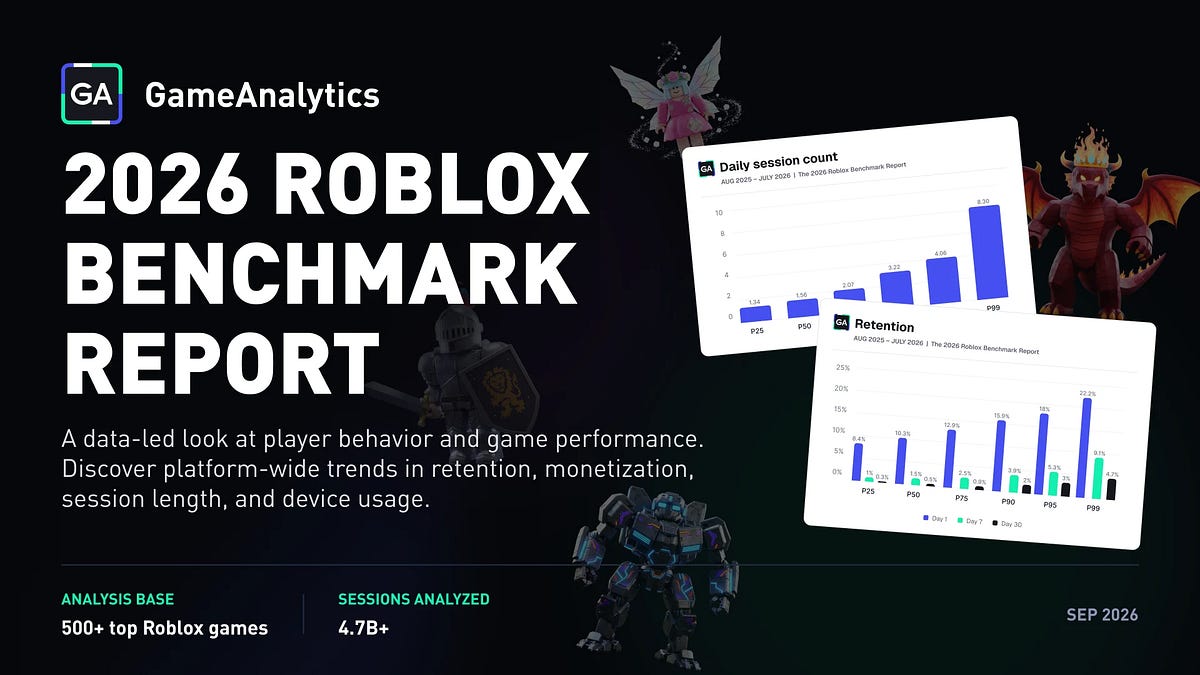
The 2026 analysis of Roblox platform and game metrics reveals a period of contraction for the ecosystem, characterized by declining daily active users and shifting player engagement patterns. Based on data from over 500 Roblox games with at least 1 million monthly active users, the study covers the period from August 2025 to July 2026, encompassing 4.76 billion total game sessions. The findings highlight a challenging environment for developers, as platform-wide daily active users have fallen from 152 million in the third quarter of 2025 to 123 million by the second quarter of 2026.
Player behavior data indicates that while 44% of users engage across both mobile and PC, there is a notable rise in platform-exclusive play, with PC-only users reaching 40.76% and mobile-only users accounting for 11.55%. Console usage remains marginal at 3.69%. Monetization remains highly concentrated, as only 3.80% of the player base makes any in-game purchases. Among those who do spend, the median annual expenditure is $0.81, while the top 1% of payers contribute significantly more, averaging $86.36.
Game-level performance metrics suggest that retention has declined compared to previous years, with a median Day 1 retention rate of 10.3%, dropping to 0.5% by Day 30. The median session duration within individual games is 9.8 minutes, with players opening these titles 1.56 times per day. The analysis concludes that success on the platform now requires a dual focus on retention and monetization, as these combined metrics have become the primary drivers for visibility on the Roblox home page. These benchmarks emphasize that high-performing titles are increasingly defined by deep progression systems or established intellectual property.
- Roblox platform DAU has declined consistently since Q3 2025, falling from 152 million to 123 million by Q2 2026.
- Only 3.80% of Roblox players make in-game purchases, with the median paying user spending just $0.81 annually.
- Median D1 retention for games with over 1 million MAU is 10.3%, while D7 and D30 retention rates drop to 2.5% and 0.5% respectively.
- The top 1% of Roblox games significantly outperform the market, achieving an ARPPU of $55.31 compared to a median of $0.70.
- Player engagement is highly skewed, with the median player spending 22.4 minutes daily in games, while the top 1% spend nearly seven hours (404.98 minutes).
+4
GameAnalyticsSept 2026
Report34 pages
2026 Mobile & PC Gaming Benchmarks
The global gaming landscape in 2026 is defined by a widening performance gap between a small elite of top-tier titles and the broader market. Data derived from over 16,000 live mobile games indicates that retention metrics, including D1, D7, and D30, are in a state of decline. With median D30 retention falling below 1%, the industry has become increasingly unforgiving, necessitating a strategic shift toward immediate, high-quality onboarding and the refinement of core gameplay loops to mitigate rising churn rates.
Mobile gaming engagement remains characterized by high-frequency, habitual daily play, yet the industry suffers from a stagnation in innovation and an over-reliance on monetization at the expense of genuine engagement. Success in this segment requires developers to move beyond generic feature sets and instead prioritize behavioral loops that foster long-term habit formation. Conversely, the PC gaming sector operates on a different paradigm, where success is measured by depth, session length, and content longevity. On this platform, retention and engagement metrics serve as indicators of long-term player commitment and the intrinsic value of immersive, long-form experiences rather than simple return frequency.
To navigate these challenges, studios are increasingly turning to advanced data-driven infrastructure to optimize player experiences. By leveraging real-time insights and sophisticated market intelligence, developers can better align their growth strategies with evolving player behaviors. Ultimately, the ability to sustain a competitive advantage in both mobile and PC markets depends on a rigorous focus on content quality and the implementation of robust, data-informed engagement strategies that cater to the specific demands of each platform.
- Mobile gaming retention is in decline, with median D30 retention rates falling below 1% across a sample of over 16,000 live titles.
- The gaming market is experiencing a widening performance gap where a small elite of top-tier titles increasingly dominates the broader landscape.
- Mobile success now requires a strategic pivot toward immediate, high-quality onboarding and core gameplay loops to counter rising churn rates.
- Mobile engagement is currently stagnant due to an over-reliance on monetization, necessitating a shift toward behavioral loops that foster long-term habit formation.
- PC gaming success is defined by long-form, immersive experiences where metrics like session length and content longevity are the primary indicators of value.
+3
GameAnalyticsJun 2026
Article
Mobile and PC Game Benchmarks: 2026
Mobile game benchmarks derived from a sample of 16,262 titles with at least 1,000 monthly active users reveal that first‑day retention (D1) has slipped in 2025 compared to 2024, with the top quartile achieving just over 30 % and the top decile reaching roughly 40 %. The uppermost 1 % of games attain D1 retention between 64‑68 %, while median seven‑day (D7) retention sits below 4 %. Top performers exceed 25 % D7, and the leading 1 % reach 13‑15 % for thirty‑day (D30) retention, a threshold associated with sustainable revenue streams. Daily playtime varies markedly by region; Africa shows the highest overall playtime, whereas Europe favors longer sessions. Top 25 % titles average 22‑24 minutes of daily play, with the best 1 % surpassing 94 minutes. Session length averages 5.2 minutes for the top quartile, extending to 22 minutes for the elite 1 %. Across all regions, weekday play accounts for 13‑14 % of weekly time, rising to about 16 % on weekends.
For PC titles, a dataset of 3,582 games with at least 100 MAU indicates lower absolute D1 retention than mobile; the top quartile records 15‑16 %, while the elite 1 % matches mobile leaders at 50‑60 %. D7 retention for the top 1 % exceeds 20 %, and D30 retention climbs to 10 % for the same group, though a decline is noted over 2025. Median daily playtime on PC stands at 32‑33 minutes, with the top quartile reaching 70 minutes and the best 1 % exceeding 300 minutes. Session lengths average 18 minutes, extending beyond 100 minutes for the top 1 %. Daily session counts average 1.65‑1.7, doubling for the top 10 % and reaching 7‑10 sessions for the elite 1 %. DAU/MAU ratios hover at 4‑5 % median, rising to nearly 40 % for the top 1 %. New player acquisition mirrors these patterns, with median games drawing 600‑900 new users monthly and the top 1 % attracting 400,000‑500,000.
- Top-tier mobile games achieve D1 retention of 64–68% and D30 retention of 13–15%, the latter being the critical threshold for sustainable revenue.
- PC engagement significantly outpaces mobile, with top 1% titles averaging over 300 minutes of daily playtime and session lengths exceeding 100 minutes, compared to 94 minutes and 22 minutes for mobile leaders.
- Mobile D1 retention has declined in 2025, with top quartile performers now achieving just over 30% and median D7 retention falling below 4%.
- PC top 1% titles demonstrate high stickiness with a 40% DAU/MAU ratio, while the median PC title maintains a significantly lower 4–5% ratio.
- Top 1% of PC games attract 400,000–500,000 new users monthly, whereas the median title draws only 600–900 new users.
+2
GameAnalyticsJun 2026

Whitepaper10 pages
Your Data Tracking Plan: A Step-by-Step Guide for GameAnalytics
GameAnalytics presents a structured framework for designing and implementing data tracking within games, emphasizing the creation of a comprehensive tracking plan that aligns analytics teams with development stakeholders. The guide outlines five sequential steps: first, brainstorming core questions about player behavior and business objectives; second, translating those questions into specific events using predefined categories such as Session, Business, Resource, Progression, Error, Ads, and Impression; third, defining dimensions and attributes to contextualize events with user identifiers, device details, and custom fields; fourth, integrating the plan through GameAnalytics SDKs tailored to various platforms; and fifth, maintaining an iterative process that revisits questions and updates events as the game evolves. Key recommendations include limiting custom events to a maximum of 50 unique identifiers, adopting a Category > Sub‑Action framework for clarity, and ensuring rigorous validation to avoid duplicate or misleading data. The document stresses the importance of consistent documentation, ownership assignment, and cross‑functional collaboration to prevent redundant data collection and maintain analytical integrity. By following this step‑by‑step methodology, developers can establish a reliable data pipeline that supports accurate KPI measurement and informed decision‑making throughout the game’s lifecycle.
- Establish a structured tracking plan by aligning business objectives and player behavior questions with seven predefined event categories: Session, Business, Resource, Progression, Error, Ads, and Impression.
- Limit custom events to a maximum of 50 unique identifiers to maintain data integrity and prevent system clutter.
- Adopt a consistent Category > Sub-Action naming framework to ensure clarity and prevent redundant or misleading data collection.
- Contextualize all events by defining specific dimensions and attributes, including user identifiers, device details, and custom fields.
- Assign clear ownership and maintain rigorous validation processes to ensure the analytical pipeline remains accurate throughout the game's lifecycle.
+1
GameAnalytics
Report23 pages
2025 Mobile Gaming Benchmarks
The mobile gaming landscape in 2024 faced significant challenges regarding player loyalty, as 75 percent of titles failed to maintain a 3 percent retention rate by the 28th day. This decline underscores a critical industry shift where long-term viability is increasingly tethered to sophisticated content pacing, refined progression systems, and seamless onboarding experiences. Because retention serves as the primary engine for both user acquisition return on investment and sustainable monetization, developers must prioritize data-backed strategies to mitigate rising churn rates across the global market.
Engagement metrics reveal a nuanced performance gap between platforms and regions. While iOS continues to demonstrate superior early-stage engagement compared to Android, regional behaviors vary significantly; the Middle East currently leads in retention, whereas Africa and Oceania report the highest average playtime and session lengths, respectively. Genre-specific performance further complicates these trends, as Board and Card games exhibit robust long-term retention, contrasting sharply with Multiplayer titles that struggle to retain users despite commanding the longest average session durations of 8 to 9 minutes.
These insights, derived from an expansive dataset of over 100,000 active games, highlight the necessity of granular performance benchmarking. By comparing individual game metrics—including monetization, engagement, and retention—against global standards filtered by genre and player spending habits, studios can effectively optimize their development cycles. Ultimately, the industry is moving toward a model where success is no longer defined by broad acquisition, but by the precise, data-driven calibration of the player experience to ensure longevity in an increasingly competitive mobile ecosystem.
- 75 percent of mobile games failed to achieve a 3 percent retention rate by day 28 in 2024, highlighting a widespread struggle to maintain long-term player loyalty.
- Retention is the primary driver for both user acquisition ROI and sustainable monetization, making it the most critical metric for long-term viability.
- Multiplayer titles command the longest average session durations of 8 to 9 minutes but struggle significantly with long-term user retention.
- Board and Card games currently demonstrate the most robust long-term retention performance compared to other genres.
- Regional engagement varies significantly, with the Middle East leading in retention, while Africa and Oceania lead in average playtime and session length, respectively.
+2
GameAnalyticsJan 2025
Report23 pages
Mobile Gaming Benchmarks 2025
Mobile Gaming Benchmarks 2025 delivers a comprehensive, data‑driven reference for developers seeking to refine acquisition, monetization and content strategies across the global mobile market. The study aggregates 11 600 titles spanning nine regions, two platforms (iOS and Android), and 16 genres, capturing roughly 1.48 billion monthly active users and an average of 4.7 regions per game. By offering global, regional and genre‑specific metrics—retention at D1, D7 and D28; playtime; session length; and session count—the report positions retention as the pivotal driver of long‑term engagement, revenue, and user acquisition return on investment.
Key findings reveal a pronounced shift toward bite‑size play. Average session lengths have fallen, with top‑tier games averaging 8–9 minutes and the median tier around 5–6 minutes. Midcore titles generate the highest daily session counts (six to seven sessions per day), while Android users exhibit higher session frequency than iOS, reflecting the dominance of casual titles on that platform. These trends underscore the necessity for design that supports rapid, repeated engagement loops.
The benchmark framework is underpinned by GameAnalytics’ processing of over 27 billion daily events across 100,000 active games. Percentile data for playtime (98 % quantile), session length (97 % quantile) and new‑user acquisition are segmented by genre, platform, region and spending tier. Real‑time analytics, LiveOps tools and customizable reporting enable studios to scale optimization efforts, tailoring strategies to the nuanced performance profiles identified in the 2025 benchmarks.
- Retention is the primary driver of long-term engagement, revenue, and user acquisition ROI across the 11,600 titles analyzed.
- Average session lengths have decreased, with top-tier games averaging 8–9 minutes and median-tier games averaging 5–6 minutes.
- Midcore titles lead in engagement frequency, generating six to seven sessions per day.
- Android users exhibit higher session frequency than iOS users, a trend attributed to the prevalence of casual titles on the Android platform.
- The 2025 benchmark data is derived from 1.48 billion monthly active users and the processing of 27 billion daily events across 100,000 active games.
+1
GameAnalyticsJan 2025
Report19 pages
Hyper-Casual 9 Games Benchmark Report: Q3 2022
The report presents a quantitative assessment of hyper‑casual mobile games for the third quarter of 2022, focusing on acquisition costs, retention performance, and geographic distribution. It identifies a narrowing cost‑per‑install (CPI) gap between Android and iOS, now at 10 cents compared with an average of 15 cents over the previous four years, suggesting intensified competition on Android. Retention benchmarks reveal a consistent advantage for iOS across all performance tiers: top‑tier games achieve 51 % day‑1 and 22 % day‑7 retention versus 42 % and 16 % on Android; top‑25 games show 33 %/9 % versus 26 %/5 %; median titles record 25 %/6 % against 19 %/3 %. These figures illustrate a pronounced disparity between platforms, with iOS retaining users more effectively at every level.
Geographically, the analysis lists leading markets by player volume and revenue potential. The United States, Japan, South Korea, Brazil, the United Kingdom, Canada, Germany, India, France, and Indonesia appear repeatedly as key regions, with Japan and South Korea consistently ranking among the top three. The data imply that hyper‑casual titles should prioritize these territories for user acquisition and monetization strategies.
Methodologically, the study aggregates data from over 100 k games tracked by GameAnalytics, a leading analytics provider that serves one‑third of global mobile players. The benchmark draws on CPI figures, retention rates, and regional player counts to deliver actionable insights for developers and publishers seeking to optimize performance in the hyper‑casual segment during Q3 2022.
- iOS maintains a significant retention advantage over Android across all performance tiers, with top-tier iOS games achieving 51% day-1 and 22% day-7 retention compared to 42% and 16% on Android.
- The cost-per-install (CPI) gap between Android and iOS has narrowed to 10 cents, down from a four-year average of 15 cents, indicating intensified competition on the Android platform.
- Median hyper-casual titles show a clear performance disparity between platforms, with iOS recording 25% day-1 and 6% day-7 retention versus 19% and 3% on Android.
- Japan and South Korea consistently rank among the top three global markets for both player volume and revenue potential in the hyper-casual segment.
- Key regions for user acquisition and monetization strategies include the United States, Japan, South Korea, Brazil, the United Kingdom, Canada, Germany, India, France, and Indonesia.
TenjinJan 2025

Report8 pages
Tower Defense Games - Industry Snapshot
Tower Defense games represent a high-performing sub-genre within the casual arcade category, characterized by exceptional monetization and engagement depth. Analysis of 2020 industry data reveals that the top 5% of Tower Defense titles significantly outperform related sub-genres like Idlers, Platformers, and Board Games in financial efficiency. Specifically, these top-tier games achieve a conversion rate of 3.83%, more than double that of their closest competitors, and maintain an Average Revenue Per Daily Active User (ARPDAU) of $1.66. This financial strength is further evidenced by an Average Revenue Per Paying User (ARPPU) of $83, suggesting a highly committed and spending-prone player base.
Engagement metrics for the genre are equally robust, with top-performing titles commanding an average daily playtime of 130 minutes. While Day 1 retention sits at 40%, slightly lower than some competing sub-genres, Day 7 retention remains competitive at 15%. Geographic performance varies by metric; Italy leads in Day 7 retention at 39%, while France sees the highest daily playtime at 210 minutes. China stands out as the most lucrative market for conversion, reaching a rate of 8.7%.
The success of the genre is attributed to its accessible core mechanics, high replayability, and the ease with which developers can integrate meta-features such as PvP modes, daily challenges, and RPG elements. These features allow for significant meta-game shifts with minimal content overhead. Notable titles entering the market in 2020, such as Rush Royale and Towerlands, exemplify the trend of blending traditional defense mechanics with strategy and role-playing elements to drive long-term player investment. This data is derived from a network of over 134,000 integrated games and 1.8 billion monthly cross-title players.
- Top-tier Tower Defense games achieve a 3.83% conversion rate and an ARPDAU of $1.66, significantly outperforming Idlers, Platformers, and Board Games.
- The genre sustains a highly committed player base with an Average Revenue Per Paying User (ARPPU) of $83 and an average daily playtime of 130 minutes.
- China is the most lucrative market for the genre, reaching a conversion rate of 8.7%, while France leads in engagement with 210 minutes of daily playtime.
- Retention metrics for top titles show a 40% Day 1 rate and a 15% Day 7 rate, with Italy notably achieving a 39% Day 7 retention rate.
- Successful 2020 titles like Rush Royale and Towerlands demonstrate that blending traditional defense mechanics with RPG elements and PvP modes drives long-term player investment.
+2
GameAnalyticsJan 2025
Report21 pages
2023 Roblox Report: Behind the Data
The 2023 Roblox Report, produced by GameAnalytics, provides a comprehensive analysis of player behavior and performance benchmarks across the Roblox platform. The study is based on 2023 data from thousands of games that utilize the GameAnalytics SDK, representing over 50% of total player engagement on the platform. The dataset includes a significant sample of high-performing titles, featuring 300 games with over one million monthly active users and 60 titles exceeding ten million monthly sessions.
The findings reveal a highly fluid player base, with 47% of users accessing the platform via both mobile and desktop devices. Engagement is characterized by high frequency rather than single long sessions; over 50% of players engage at least twice daily, and the top 5% of games successfully bring players back more than 3.5 times per day. While the average session length for half of the tracked games is under six minutes, elite titles in the 95th percentile sustain engagement for nearly 30 minutes per session.
Monetization remains a significant challenge on the platform. Only 4.2% of players spend Robux within games, and more than half of those spenders contribute less than $1 annually. However, a small segment of high-value "power spenders" drives the majority of revenue, with the top 5% of games earning approximately $77 per playing player annually. Retention is identified as a universal struggle across the platform regardless of game quality; Day 1 retention typically ranges between 12% and 15%, dropping to near 1% by Day 90. The report concludes that success on Roblox requires optimizing for cross-platform play, implementing aggressive LiveOps to counter natural retention decay, and focusing on session frequency to drive monetization.
- Retention is a universal challenge on Roblox, with Day 1 retention averaging 12% to 15% and falling to approximately 1% by Day 90.
- Monetization is highly concentrated, as only 4.2% of players spend Robux, with over half of those spenders contributing less than $1 annually.
- Top-tier games in the 95th percentile generate approximately $77 per playing player annually, significantly outperforming the broader platform average.
- Player engagement is driven by frequency rather than session length, with over 50% of users playing at least twice daily and top games achieving over 3.5 sessions per day.
- While the median session length for half of tracked games is under six minutes, elite titles in the 95th percentile sustain sessions of nearly 30 minutes.
+1
GameAnalyticsMar 2024
Report24 pages
Mobile Gaming Benchmarks: Q1 2024
The Q1 2024 mobile gaming benchmarks provide a comprehensive analysis of player engagement metrics, specifically retention rates, session lengths, and session counts across 15 game genres. The analysis is based on data from over 10,000 games utilizing the GameAnalytics platform, representing 1.67 billion monthly active users across North America, Europe, the Middle East, and Asia. The primary objective is to offer developers a standardized framework to evaluate game performance, identify areas for optimization, and refine mechanics to improve long-term player retention and engagement.
Key findings indicate that global median retention rates for the first quarter of 2024 were 22.91% for Day 1, 4.20% for Day 7, and 0.85% for Day 28. Classic games—encompassing board, card, casino, and trivia titles—consistently outperformed other genres across most regions and metrics. While North America and Europe generally exhibit higher retention averages, the Middle East shows a distinct preference for classic games, which achieve their highest regional performance there. Puzzle games also demonstrate notable stability, maintaining consistent engagement metrics across all monitored territories.
Regarding session behavior, the global median session length is 4.45 minutes, with most genres averaging 4 to 5 sessions per day. Europe leads in session duration, while the Middle East records the highest frequency of daily sessions, particularly within the puzzle and word genres. The analysis suggests that session length and frequency are highly correlated with game pacing and social features. To optimize these metrics, the findings recommend a data-driven approach involving A/B testing, funnel analysis, and the implementation of LiveOps to adapt to player behavior in real-time.
- Global median retention rates for Q1 2024 were 22.91% for Day 1, 4.20% for Day 7, and 0.85% for Day 28.
- Classic games, including board, card, casino, and trivia titles, consistently outperformed all other genres across most regions and metrics.
- The global median session length is 4.45 minutes, with most genres averaging between 4 and 5 sessions per day.
- The Middle East records the highest frequency of daily sessions globally, particularly within the puzzle and word genres.
- Europe leads all regions in average session duration, while North America and Europe generally exhibit higher retention averages than other territories.
+2
GameAnalyticsJan 2024
Report24 pages
Mobile Gaming Benchmarks for Q1 2024
The benchmark study presents a comprehensive snapshot of mobile gaming performance during Q1 2024, focusing on key engagement metrics—retention, session length, and session count—across North America, Europe, the Middle East, and Asia. Data derive from over 10 000 games tracked by GameAnalytics, with each title typically released in at least three regions, yielding a combined monthly active user base of approximately 1.67 billion.
Retention figures reveal that the global median day‑1 retention stands at 22.91 %, day‑7 at 4.20 %, and day‑28 at 0.85 %. Classic games (board, card, casino, trivia, word) dominate retention performance, especially in the Middle East where they lead all regions. Casual and mid‑core titles lag behind, with puzzle games maintaining stable but lower retention across all markets.
Session length analysis shows a global median of 4.45 minutes, with casino and card games achieving the longest sessions in North America (≈20 min) and Europe (card games exceeding 25 min). In the Middle East, casino titles surpass 15 minutes, while Asia’s top casino games reach nearly 23 minutes. Session count averages range from 3–5 daily sessions per game, with puzzle and word games in the Middle East achieving the highest counts (≈10 sessions/day).
Methodologically, metrics are reported in quantiles—top 25 %, median, and bottom 25 %—to illustrate performance across the spectrum of developers. The report underscores that high retention, longer session lengths, and frequent session counts correlate with stronger player engagement, offering actionable insights for studios aiming to benchmark against industry leaders.
- Global median retention rates for Q1 2024 are 22.91% for day-1, 4.20% for day-7, and 0.85% for day-28.
- Classic genre titles, including board, card, casino, trivia, and word games, consistently outperform casual and mid-core titles in retention metrics across all tracked regions.
- The global median session length is 4.45 minutes, though casino and card games significantly exceed this, reaching up to 25 minutes in European markets.
- Daily session frequency typically ranges from 3 to 5 sessions, with puzzle and word games in the Middle East achieving a peak performance of approximately 10 sessions per day.
- The Middle East region shows a distinct preference for classic games, which lead retention performance in that market compared to other global regions.
+1
GameAnalyticsJan 2024
Report17 pages
Hyper-Casual Games Benchmark Report: Q4 2022
The benchmark focuses on hyper‑casual mobile games during the fourth quarter of 2022, comparing performance metrics across iOS and Android and highlighting shifts from the previous quarter. Data are drawn from GameAnalytics, which tracks more than 100 000 titles and reaches roughly one‑third of the global mobile player base, providing a broad, cross‑regional view of the segment.
Cost‑per‑install (CPI) reached an all‑time high of $0.20 median on both platforms, with the overall median CPI rising to $0.42. Android’s median CPI grew by $0.05 while iOS saw a larger increase of $0.17. Among the top ten ad‑spending countries, the United States posted the highest iOS median CPI at $0.80, overtaking France and Germany, while Brazil dropped out of the ranking. South Korea and Canada recorded the steepest CPI hikes on Android, each climbing $0.06 from Q3 2022. The report covers major markets in North America, Europe, Asia‑Pacific and Latin America, reflecting a worldwide scope.
Retention benchmarks reveal a consistent advantage for iOS. In the top‑2 % of games, Day 1 retention was 45 % on iOS versus 38 % on Android, and Day 7 retention stood at 19 % versus 14 %. For the top‑25 % tier, Day 1 rates were 33 % (iOS) and 28 % (Android), with Day 7 at 10 % and 6 % respectively. Across all titles, median Day 1 retention was 24 % on iOS and 23 % on Android, while median Day 7 retention was 7 % versus 4 %. The gap between elite, good and average games is pronounced, underscoring the importance of early‑stage player engagement.
Overall, Q4 2022 saw rising acquisition costs and modest but platform‑dependent retention
- Hyper-casual median CPI reached an all-time high of $0.42 in Q4 2022, with iOS experiencing a significant $0.17 increase compared to the previous quarter.
- iOS consistently outperformed Android in retention, with top-tier (top 2%) games achieving 45% Day 1 retention on iOS compared to 38% on Android.
- The United States recorded the highest iOS median CPI among top ad-spending countries at $0.80, while Brazil fell out of the top ten ranking.
- Android median CPI grew by $0.05 in Q4 2022, with South Korea and Canada seeing the steepest regional increases at $0.06 each.
- Day 7 retention for the top 25% of games reached 10% on iOS versus 6% on Android, highlighting a widening performance gap between platforms.
+3
TenjinDec 2022