Updated Mar 21, 2026 by Take-Two Interactive
Legal · February 28, 2026
Published by Take-Two Interactive
The Supplier Code of Conduct for Take-Two Interactive Software, Inc., updated in April 2023, establishes the ethical, legal, and professional standards required of all third-party partners. The primary thesis is that all suppliers, consultants, and vendors must mirror the company’s internal commitment to honesty, integrity, and human rights. This mandate extends globally to any entity providing goods or services, including distribution, marketing, and manufacturing, and requires these partners to ensure compliance among their own subcontractors and employees. The document outlines specific legal requirements across several critical domains. Suppliers must strictly adhere to competition and antitrust laws, anti-bribery and corruption statutes such as the US Foreign Corrupt Practices Act and the UK Bribery Act, and anti-money laundering regulations. Furthermore, the scope includes strict compliance with trade sanctions and export controls, specifically highlighting high-risk regions such as Iran, Cuba, Syria, North Korea, and certain areas of Ukraine. Partners are also prohibited from engaging in insider trading based on non-public information gained through their relationship with the company. Beyond legal compliance, the standards emphasize social responsibility and operational integrity. Key provisions include the prohibition of child or prison labor, the protection of fundamental human rights, and the maintenance of a work environment free from discrimination and harassment. Suppliers are required to maintain accurate financial records, protect intellectual property, and avoid conflicts of interest. To ensure adherence, the company reserves the right to conduct periodic audits and requires immediate notification of any legal investigations or violations. A global reporting infrastructure is provided, featuring a 24-hour ethics hotline available across more than twenty countries, supported by a non-retaliation policy for those reporting grievances in good faith.
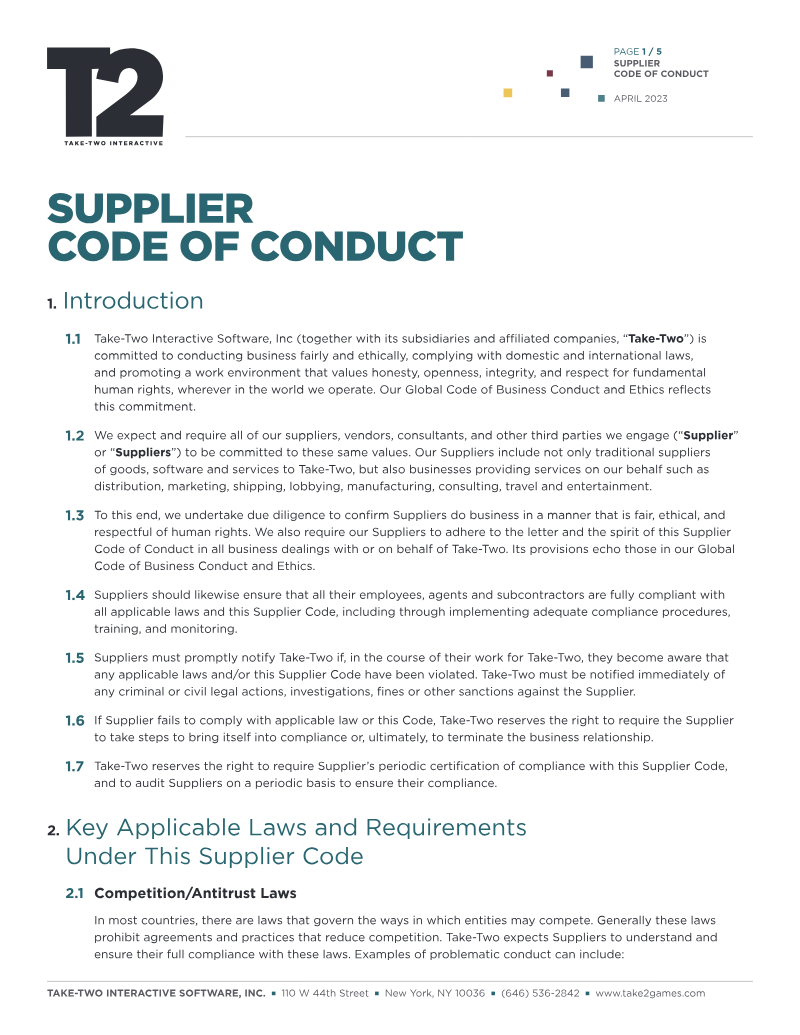
PAGE 1 / 5 SUPPLIER CODE OF CONDUCT APRIL 2023 SUPPLIER CODE OF CONDUCT 1. Introduction 1.1 Take-Two Interactive Software, Inc (together with its subsidiaries and affiliated companies, “Take-Two”) is committed to conducting business fairly and ethically, complying with domestic and international laws, and promoting a work environment that values honesty, openness, integrity, and respect for fundamental human rights, wherever in the world we operate. Our Global Code of Business Conduct and Ethics reflects this commitment. 1.2 We expect and require all of our suppliers, vendors, consultants, and other third parties we engage (“Supplier” or “Suppliers”) to be committed to these same values. Our Suppliers include not only traditional suppliers of goods, software and services to Take-Two, but also businesses providing services on our behalf such as distribution, marketing, shipping, lobbying, manufacturing, consulting, travel and entertainment. 1.3 To this end, we undertake due diligence to confirm Suppliers do business in a manner that is fair, ethical, and respectful of human rights. We also require our Suppliers to adhere to the letter and the spirit of this Supplier Code of Conduct in all business dealings with or on behalf of Take-Two. Its provisions echo those in our Global Code of Business Conduct and Ethics.
, and respectful of human rights. We also require our Suppliers to adhere to the letter and the spirit of this Supplier Code of Conduct in all business dealings with or on behalf of Take-Two. Its provisions echo those in our Global Code of Business Conduct and Ethics. 1.4 Suppliers should likewise ensure that all their employees, agents and subcontractors are fully compliant with all applicable laws and this Supplier Code, including through implementing adequate compliance procedures, training, and monitoring. 1.5 Suppliers must promptly notify Take-Two if, in the course of their work for Take-Two, they become aware that any applicable laws and/or this Supplier Code have been violated. Take-Two must be notified immediately of any criminal or civil legal actions, investigations, fines or other sanctions against the Supplier. 1.6 If Supplier fails to comply with applicable law or this Code, Take-Two reserves the right to require the Supplier to take steps to bring itself into compliance or, ultimately, to terminate the business relationship. 1.7 Take-Two reserves the right to require Supplier’s periodic certification of compliance with this Supplier Code, and to audit Suppliers on a periodic basis to ensure their compliance. 2. Key Applicable Laws and Requirements Under This Supplier Code 2.1 Competition/Antitrust Laws
7 Take-Two reserves the right to require Supplier’s periodic certification of compliance with this Supplier Code, and to audit Suppliers on a periodic basis to ensure their compliance. 2. Key Applicable Laws and Requirements Under This Supplier Code 2.1 Competition/Antitrust Laws In most countries, there are laws that govern the ways in which entities may compete. Generally these laws prohibit agreements and practices that reduce competition. Take-Two expects Suppliers to understand and ensure their full compliance with these laws. Examples of problematic conduct can include:
PAGE 2 / 5 SUPPLIER CODE OF CONDUCT APRIL 2023 (a) agreements to fix prices, co-ordinate or rig bidding activities, allocate markets or customers, or limit product or sales of products; (b) exchanging competitively sensitive information with competitors; or (c) placing certain restrictions on to whom, where and at what price products are re-sold. 2.2 Anti-Bribery and Corruption Laws Take-Two expects full compliance with anti-bribery and anti-corruption laws, including the US Foreign Corrupt Practices Act and the UK Bribery Act. It is illegal and unacceptable for Suppliers to be in any way involved in the payment or receipt of bribes, or with corrupt practices. In particular: (a) Suppliers must not give, offer, receive, or request anything of value (e.g., cash, gifts, business opportunities, charitable donations, favors, etc.) if such is intended to secure an improper benefit. Suppliers must also not pay or receive bribes through third parties, agents, consultants and other intermediaries. Particular care should be taken when Suppliers deal, directly or indirectly, with public officials. In particular, Suppliers may not on behalf of Take-Two, or in relation to any activity of the Supplier that may benefit Take-Two, give anything of value to a public official without written approval in advance from Take-Two’s Chief Legal Officer or his designee within the legal department.
als. In particular, Suppliers may not on behalf of Take-Two, or in relation to any activity of the Supplier that may benefit Take-Two, give anything of value to a public official without written approval in advance from Take-Two’s Chief Legal Officer or his designee within the legal department. (b) Suppliers must be vigilant in monitoring and ensuring the compliance of agents, consultants and anyone performing services on their behalf. Conducting appropriate due diligence and implementing effective compliance procedures relating to third parties is central to mitigating the risk of bribery and corruption. 2.3 Anti-Money Laundering and Tax Compliance Laws Anti-money laundering laws exist in many countries, imposing significant penalties for possessing or dealing with the proceeds of crime, as well as concealing the identity of illegally obtained money. Suppliers must understand and ensure full compliance with anti-money laundering laws. Suppliers must also comply with all tax laws and regulations (including sales, income, and other taxes, customs duties and fees, and other types of direct and indirect taxes) that relate to their work for Take-Two. In particular, Suppliers must be vigilant in monitoring for “red flags” in transactions that may indicate non-compliance with these laws, such as requests by third parties to submit or receive payment through unrelated entities or countries; large cash sums or anonymous payment forms (e.g. prepaid cards); or any other oddly structured transactions. 2.4 Trade Sanctions and Export Control Laws
dicate non-compliance with these laws, such as requests by third parties to submit or receive payment through unrelated entities or countries; large cash sums or anonymous payment forms (e.g. prepaid cards); or any other oddly structured transactions. 2.4 Trade Sanctions and Export Control Laws Suppliers must act in accordance with all applicable laws, rules and regulations relating to trade sanctions, export controls, and anti-boycott or blocking activity. Particular care is required at present for any transactions related directly or indirectly to Iran, Cuba, Syria, North Korea or certain areas of Ukraine (Crimean Peninsula, Luhansk and Donetsk) and for any transactions which may involve a party designated under sanctions laws. Suppliers must understand and ensure full compliance with these laws.
Take-Two Interactive maintains a comprehensive framework of mandatory ethical standards designed to ensure integrity, legal compliance, and the protection of human rights across its global operations. These standards apply to all employees, directors, and third-party partners, covering a broad geographic scope that includes specific restrictions regarding sanctioned territories such as Iran and North Korea. By establishing strict protocols for non-discrimination, the protection of corporate assets, and the disclosure of potential conflicts of interest—including outside employment and romantic relationships—the organization fosters a culture of accountability. Compliance is reinforced through biennial training and a rigorous enforcement mechanism where violations may lead to termination. Corporate integrity is further supported by mandates for financial transparency and fair competition. All financial records must accurately reflect transactions, and the unauthorized disclosure of sensitive information to shareholders or the media is strictly prohibited. To prevent market manipulation, the framework forbids insider trading and establishes clear antitrust guidelines that prevent the exchange of commercial data with competitors or interference with the pricing rights of distributors. Furthermore, the organization enforces a zero-tolerance policy toward bribery, corruption, money laundering, and tax evasion. This extends to third-party agents, who must undergo due diligence to ensure all business dealings, particularly those involving public officials, remain ethical and legal. To facilitate the reporting of misconduct, a 24/7 anonymous hotline is provided, allowing for the confidential disclosure of grievances to the Chief Legal Officer or Audit Committee. Strong anti-retaliation protections ensure that individuals reporting concerns in good faith are shielded from adverse actions, though disciplinary measures apply to those who provide knowingly false information. Waivers of these ethical requirements are exceptionally rare, requiring formal approval from the Board of Directors or the Chief Legal Officer, with any executive-level exceptions disclosed publicly to shareholders to maintain institutional transparency.
Take-Two Interactive Software establishes a comprehensive framework for maintaining ethical business practices and safeguarding human rights across its global operations as of October 2025. The primary objective is to eliminate modern slavery, forced labor, and human trafficking within the organization and its extensive supply chains. This commitment extends across all major publishing labels, including Rockstar Games, 2K, Private Division, and Zynga, covering the development and distribution of interactive entertainment for console, PC, and mobile platforms. The policy outlines rigorous hiring and employment standards, mandating that all employees be at least 16 years of age and that employment is strictly voluntary. Compensation and benefits are reviewed annually to ensure they meet or exceed legal minimums and market standards. Furthermore, the company enforces a strict non-discrimination policy, ensuring that recruitment and career advancement are based solely on ability and merit rather than protected characteristics. These internal standards are reinforced by a Global Code of Business Conduct and Ethics that applies to all directors, officers, employees, and contractors. To ensure compliance throughout the supply chain, which includes disc replicators, printers, and logistics providers in regions such as North America, Europe, and Japan, the company utilizes a dedicated Supplier Code. This requires third-party partners to represent that they do not utilize child, prison, or slave labor. Oversight is maintained through biennial training for employees and targeted training for consultants. Additionally, the company provides a confidential reporting hotline managed by an independent third party, protecting whistleblowers from retaliation. Key suppliers are also expected to conduct periodic internal or independent audits to verify adherence to labor, health, and safety standards.
Enad Global 7 (EG7) establishes a comprehensive framework for ethical business conduct and legal compliance across its global subsidiaries, including Daybreak Games, Piranha Games, and Toadman Studios. The primary thesis is that fair, reliable, and transparent operations are essential to protecting the group’s reputation and avoiding the severe legal consequences of non-compliance. This policy applies to all directors, officers, employees, and third-party contractors acting on behalf of the company. The scope of the guidelines is global, aligning with international standards such as the UN Global Compact, the International Charter of Human Rights, and the United Nations Convention against Corruption. Key mandates include a zero-tolerance policy toward bribery, corruption, and facilitation payments. The framework also emphasizes strict adherence to anti-money laundering laws, export controls, and trade sanctions administered by the EU, US, and UN. As a publicly traded entity on the Nasdaq First North, the company enforces rigorous standards regarding accurate financial record-keeping and the prohibition of insider trading. Labor and environmental standards form a significant portion of the requirements. The company commits to non-discrimination, the prevention of modern slavery, and the protection of employees' rights to collective bargaining. Environmental responsibility is framed as a core corporate objective, requiring regular reviews of business partners to ensure sustainable practices. Compliance is managed through the legal department, which oversees mandatory reporting of suspected violations. The policy guarantees protection from retaliation for whistleblowers acting in good faith. Enforcement is maintained through periodic audits, with violations potentially resulting in disciplinary action, termination of employment, or criminal prosecution. This document serves as a foundational guide for all EG7 group companies to adapt into local compliance procedures.
The April 2023 misconduct reporting policy for Take-Two Interactive Software establishes a mandatory framework for identifying and addressing violations of law, regulation, and the Global Code of Business Conduct and Ethics. The policy applies to all employees, consultants, and agents acting on behalf of the company and its global subsidiaries. It emphasizes the necessity of reporting financial irregularities, including fraud, embezzlement, kickbacks, and accounting or auditing discrepancies. By mandating transparency, the company aims to maintain internal controls and ensure compliance with international business standards. The scope of the policy is global, providing specific toll-free hotline numbers for twenty-four countries across North America, Europe, Asia, and Oceania. Reporting mechanisms are designed for accessibility and include in-person or telephonic communication with supervisors, legal counsel, human resources, or the Board of Directors. Additionally, a third-party ethics hotline operates twenty-four hours a day, allowing for anonymous reporting where permitted by local law. The company commits to prompt, discrete investigations and appropriate remedial actions while maintaining confidentiality to the fullest extent possible. A central tenet of the policy is the strict prohibition of retaliation against individuals who report suspected misconduct in good faith. It explicitly forbids interference with the reporting process, aligning with statutory protections such as Section 806 of the Sarbanes-Oxley Act and Section 922 of the Dodd-Frank Act. Furthermore, the policy clarifies that internal procedures do not preclude individuals from reporting violations directly to governmental agencies or whistleblowing entities without prior company clearance. This dual approach ensures that the organization remains accountable to both internal ethical standards and external regulatory requirements.