Niko Partners
Research29 documents
Documents

Report15 pages
Access for All: Expanding Opportunities for Players and Publishers Worldwide
This analysis explores the strategic shift toward out-of-app monetization in the global gaming industry, with a specific focus on Southeast Asia and China. The primary thesis posits that while Apple and Google have historically dominated distribution, publishers are increasingly adopting alternative channels—including third-party web stores, first-party direct-to-consumer platforms, and alternative app stores—to bypass high "take rates" and better serve unbanked populations in emerging markets.
Key findings indicate that out-of-app monetization is already a mature practice in Asia. In Southeast Asia, these channels account for 21% of mobile game revenue, while in China, they represent 53% of the market. Data from 2023 highlights that in the "SEA-6" countries (Indonesia, Malaysia, Philippines, Singapore, Thailand, and Vietnam), 40-50% of the adult population remains unbanked, making the credit card-centric models of primary app stores ineffective. Consequently, gamers in these regions prefer e-wallets, carrier billing, and physical vouchers. A case study of Mobile Legends: Bang Bang in the Philippines demonstrated that a localized promotion using an e-wallet partner led to a 133% increase in daily purchase volume and a 167% rise in transactions.
The scope of the research covers the evolution of digital distribution over the last 15 years, with a forward-looking projection through 2027. It emphasizes the impact of regulatory momentum in the EU, UK, South Korea, and Japan, where new legislation is forcing primary stores to allow alternative payment systems. Methodology relies on Niko Partners’ 2023 market model, gamer surveys, and proprietary data from Coda Payments. The findings conclude that publishers who fail to localize their monetization and discovery strategies risk losing significant market share to regional competitors who offer more flexible, lower-cost payment solutions.
- Out-of-app monetization is a dominant force in Asia, accounting for 53% of the mobile gaming market in China and 21% in Southeast Asia.
- In the SEA-6 region, 40-50% of the adult population is unbanked, rendering traditional credit card-centric app store models ineffective for a large segment of potential players.
- Publishers are increasingly bypassing primary app stores to avoid high take rates and to implement localized payment methods like e-wallets, carrier billing, and physical vouchers.
- Localized payment strategies drive significant growth; a case study of Mobile Legends: Bang Bang in the Philippines showed a 133% increase in daily purchase volume and a 167% rise in transactions via e-wallet partnerships.
- Global regulatory pressure in the EU, UK, South Korea, and Japan is mandating that primary app stores allow alternative payment systems, accelerating the shift toward decentralized distribution.
Niko PartnersJan 2025
Report7 pages
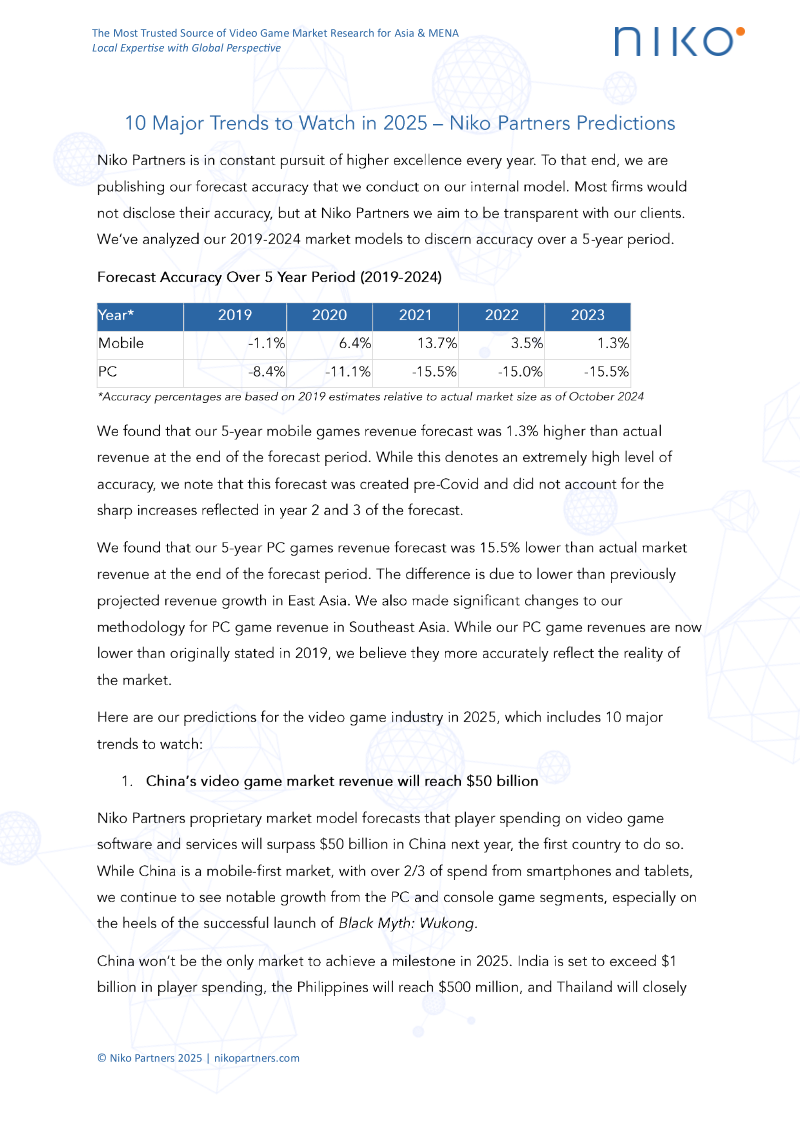
10 Major Trends to Watch in Asia & MENA
The video game industry across Asia and the Middle East and North Africa (MENA) is undergoing a period of significant transformation as of 2025, driven by shifting player demographics and evolving monetization strategies. These regions represent the primary engines of global gaming growth, characterized by a massive mobile-first audience and a rapidly expanding middle class with increasing discretionary income. Market dynamics are increasingly defined by the convergence of social media, competitive gaming, and cross-platform accessibility, which have collectively lowered the barrier to entry for new consumers while deepening engagement among existing enthusiasts.
Strategic focus in these territories has shifted toward hyper-localization and the integration of emerging technologies to enhance user retention. In the MENA region, government-backed initiatives and large-scale investments are accelerating the development of local infrastructure and talent, positioning countries like Saudi Arabia and the United Arab Emirates as central hubs for international esports and game development. Meanwhile, the Asian market continues to lead in the refinement of live-service models and the adoption of innovative payment ecosystems that bypass traditional storefront limitations.
The current landscape emphasizes the necessity of understanding regional regulatory environments and cultural nuances to achieve commercial success. As the industry moves forward, the integration of artificial intelligence in content creation and the rise of niche gaming communities are expected to further diversify the market. Companies that prioritize local expertise and adapt to the unique technological preferences of these diverse populations will be best positioned to capitalize on the sustained upward trajectory of the Asia and MENA gaming sectors.
- Asia and MENA are the primary engines of global gaming growth, driven by a mobile-first audience and a rising middle class with increased discretionary income.
- Government-backed investments in Saudi Arabia and the UAE are rapidly establishing these nations as central hubs for international esports and game development infrastructure.
- Market success in these regions now requires hyper-localization and the adoption of innovative payment ecosystems that bypass traditional storefront limitations.
- The convergence of social media, competitive gaming, and cross-platform accessibility is successfully lowering barriers to entry while deepening user engagement.
- Future market growth will be defined by the integration of artificial intelligence in content creation and the strategic targeting of niche gaming communities.
+2
Niko PartnersJan 2025
Report3 pages
Asian & MENA Markets: 2025 Half-Year Report
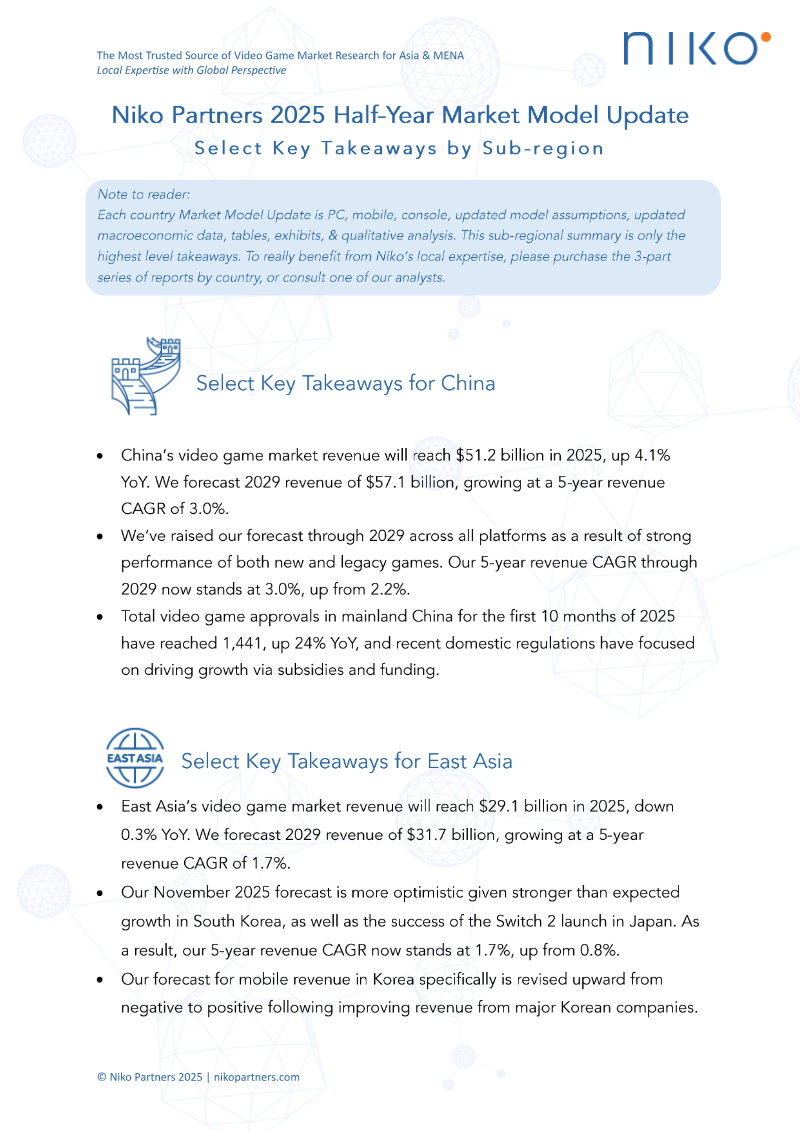
The video game markets across Asia and the Middle East are entering a period of recalibrated growth, with total revenues across key sub-regions projected to reach significant milestones by 2025. China remains the dominant force, with revenues expected to hit $51.2 billion in 2025, supported by a 4.1% year-over-year increase. This growth is fueled by a 24% rise in game approvals and proactive government subsidies. While China maintains a steady long-term outlook with a 3.0% five-year compound annual growth rate, India emerges as the fastest-growing market. India is projected to surpass the $1 billion threshold in 2025 with a 16.2% year-over-year increase, driven by the PROG Act of 2025, which pivoted the industry away from real-money gaming toward traditional video games and esports.
Regional performance varies significantly based on local macroeconomic conditions and hardware cycles. East Asia, comprising Japan and South Korea, shows a more optimistic outlook than previously anticipated, with a revised five-year growth rate of 1.7%. This shift is attributed to the successful launch of the Nintendo Switch 2 and a recovery in the South Korean mobile sector. Conversely, Southeast Asia and the MENA-3 region (Saudi Arabia, UAE, and Egypt) face more tempered expectations. Southeast Asia’s growth forecast was lowered to 3.5% due to headwinds in Thailand and Indonesia, despite strong performance in Vietnam. Similarly, the MENA-3 forecast was adjusted downward to a 6.4% growth rate as economic challenges in Egypt and slower mobile growth in Saudi Arabia offset increased government support for localization and age-rating reforms.
The data, derived from Niko Partners’ 2025 half-year market model updates, covers PC, mobile, and console platforms across 13 distinct markets. The methodology integrates proprietary market models, macroeconomic indicators, and qualitative regulatory analysis to provide a comprehensive five-year outlook through 2029. Overall, the findings suggest that while mature markets like China and East Asia are stabilizing, emerging markets like India and Vietnam are becoming critical drivers of global industry expansion.
- China remains the dominant regional market with projected 2025 revenues of $51.2 billion, supported by a 4.1% year-over-year increase and a 24% rise in government game approvals.
- India is the fastest-growing market, projected to exceed $1 billion in 2025 with 16.2% year-over-year growth following the PROG Act's shift toward traditional gaming and esports.
- The MENA-3 region (Saudi Arabia, UAE, and Egypt) has a revised growth forecast of 6.4%, as economic challenges in Egypt and slowing mobile growth in Saudi Arabia temper the impact of government-led localization efforts.
- East Asia’s five-year growth outlook has been revised to 1.7%, bolstered by the launch of the Nintendo Switch 2 and a recovery in the South Korean mobile sector.
- Southeast Asia’s growth forecast is 3.5%, with strong performance in Vietnam being offset by macroeconomic headwinds in Thailand and Indonesia.
+1
Niko PartnersJan 2025
Report15 pages
Japanese Esports on the Rise: Five Teams to Watch
Japan is rapidly evolving from a video game superpower into a significant esports market, overcoming historical regulatory and cultural hurdles. While the country previously lagged behind China and South Korea due to strict anti-gambling laws that capped prize pools and a lack of domestic titles in popular esports genres like MOBAs, recent policy shifts have transformed the landscape. Following the 2019 removal of most legal restrictions and the formation of the Japan Esports Union (JeSU), the market grew by 11% to reach $77 million in 2022.
The ecosystem is characterized by a unique "watching but not playing" culture, where livestreaming and content creation drive engagement among both gamers and non-gamers. This has led to the rise of prominent organizations such as Crazy Raccoon, DetonatioN FocusMe, FENNEL, SCARZ, and ZETA DIVISION. These teams increasingly operate as lifestyle brands, generating revenue through traditional sponsorships, merchandise, and specialized content partnerships. Notably, non-endemic brands like Nissin Foods have entered the space, with sponsorship fees reportedly increasing tenfold over the last five years.
Despite this momentum, the industry faces challenges, including a "Galapagos syndrome" where domestic game preferences differ from global trends, and a power imbalance where publishers maintain strict control over tournament formats. However, the outlook remains optimistic. Industry leaders anticipate further consolidation and professionalization, mirroring the evolution seen in Western markets a decade ago. As teams seek international expansion and venture capital, Japan is positioned to become a major hub for esports talent and tourism in Asia.
- Japan's esports market reached $77 million in 2022, marking an 11% growth following the 2019 removal of restrictive anti-gambling laws and the establishment of the Japan Esports Union (JeSU).
- Non-endemic brand involvement is surging, evidenced by companies like Nissin Foods entering the space and sponsorship fees increasing tenfold over the last five years.
- Leading organizations including Crazy Raccoon, DetonatioN FocusMe, FENNEL, SCARZ, and ZETA DIVISION are operating as lifestyle brands to monetize through merchandise, content partnerships, and sponsorships.
- The Japanese market is driven by a unique 'watching but not playing' culture, where high engagement in livestreaming and content creation attracts both gamers and non-gamers.
- The industry faces structural challenges including 'Galapagos syndrome,' where domestic game preferences diverge from global trends, and strict tournament control by game publishers.
+1
Niko PartnersFeb 2023
Report25 pages
The MENA Games Market: From Sand to Stardom
The Middle East and North Africa (MENA) gaming market is experiencing a period of rapid expansion, characterized by significant government investment, a growing base of digital natives, and an increasing emphasis on cultural localization. As of 2022, the MENA-3 region—comprising Saudi Arabia, the United Arab Emirates, and Egypt—generated $1.8 billion in revenue and supported 67.4 million gamers. This growth is underpinned by a strong mobile-first ecosystem and a burgeoning esports sector that benefits from high engagement rates and substantial public sector backing, most notably through Saudi Arabia’s National Gaming and Esports Strategy.
The industry’s trajectory is heavily influenced by the necessity of localized content. Data indicates that 86.6% of regional gamers prioritize language localization, and successful titles like PUBG Mobile have demonstrated that integrating regional celebrities, cultural themes, and Arabic-language support is essential for market penetration. Beyond content, the region is actively fostering a domestic development pipeline through workforce training, educational initiatives, and high-profile mergers and acquisitions, such as those led by the Savvy Games Group. These efforts aim to transition the region from a consumer market into a global hub for game development and esports.
Esports serves as a primary driver of engagement, with 73% of regional gamers participating in competitive gaming. The rise of local influencers and streamers, coupled with massive prize pools and the development of dedicated infrastructure like esports cities, has created a self-sustaining cycle of fan engagement and corporate sponsorship. Furthermore, the market is increasingly viewed as a strategic partner for international firms, particularly those from China, which have successfully utilized the region as a growth market. By leveraging social gaming trends—where voice chat and online socialization are central to the player experience—and prioritizing gender-inclusive gaming spaces, the MENA region is positioning itself as a significant, high-growth player in the global gaming landscape.
- The MENA-3 region (Saudi Arabia, UAE, and Egypt) generated $1.8 billion in revenue from 67.4 million gamers as of 2022, driven by a mobile-first ecosystem.
- Cultural localization is a critical success factor, with 86.6% of regional gamers prioritizing language support and successful titles integrating Arabic themes and local celebrities.
- Esports is a primary engagement driver, with 73% of regional gamers participating in competitive gaming supported by massive prize pools and dedicated infrastructure.
- The region is transitioning from a consumer market to a development hub through strategic initiatives like Saudi Arabia’s National Gaming and Esports Strategy and the Savvy Games Group’s M&A activity.
- International firms, particularly from China, are increasingly using the MENA region as a strategic growth market by capitalizing on high social gaming engagement and voice chat trends.
+3
Niko PartnersJan 2023

Report15 pages
Five Key Mobile Game Genres in Asia and MENA
The bulletin delivers a data‑driven assessment of the five most influential mobile game genres in Asia and MENA for 2022, combining a 9,000‑respondent survey from Niko Partners with AppMagic’s analytics of Apple and Google Play stores. The analysis covers China, India, Indonesia, Japan, Korea, Malaysia, Philippines, Saudi Arabia, Singapore, Thailand, UAE, Vietnam and Egypt, providing a comprehensive view of regional spending patterns, download volumes, and player demographics.
RPGs dominate the market, generating 50 % more revenue than the other four genres combined and achieving the highest monetization score (7.7) thanks to strong spend in East Asia. Strategy games rank second in revenue and third in downloads, yet exhibit the lowest engagement score (5.2) due to shorter play sessions and lower player longevity. MOBAs deliver the second‑highest revenue per download (5.4) and lead in average weekly playtime, but their esports engagement is modest. Puzzle titles enjoy the largest download base (highest engagement score of 6.0) but suffer from low monetization and esports relevance. Battle Royale games, while generating the lowest total revenue, excel in esports metrics (score 9.5) and maintain high engagement levels.
The methodology blends survey‑derived player profiles with AppMagic’s download, revenue, and esports viewership data across 21 metrics, weighted into four categories—monetization, engagement, esports appeal, and overall genre score. The resulting scores (1–10) rank RPG as the top genre overall, with Battle Royale leading in esports influence and Puzzle offering the broadest download reach. The bulletin concludes that developers targeting these markets should tailor monetization strategies to RPG’s high spend, leverage MOBAs’ loyal user base, and capitalize on Battle Royale’s esports traction.
- RPG titles are the dominant market force, generating 50% more revenue than the other four top genres combined and achieving the highest monetization score of 7.7.
- Puzzle games command the largest download volume and highest engagement score of 6.0, though they suffer from low monetization and minimal esports relevance.
- Battle Royale games lead the market in esports influence with a score of 9.5, despite generating the lowest total revenue among the five genres.
- MOBAs maintain the second-highest revenue per download at 5.4 and lead all genres in average weekly playtime.
- Strategy games rank second in total revenue but exhibit the lowest engagement score of 5.2, driven by shorter play sessions and lower player longevity.
+1
Niko PartnersJan 2023
Report23 pages
Peak Play: Trends in East Asian Videogame Streaming H1 2023
The East Asian videogame livestreaming market is a mature and culturally distinct ecosystem where competitive esports serve as the primary engine for audience engagement. During the first half of 2023, MOBA and Battle Royale titles accounted for over half of the region's most-watched content. While established franchises like League of Legends maintain a dominant presence, the market is increasingly shaped by the influence of Key Opinion Leaders and VTubers. These creators contribute up to 15% of total viewership for major titles and have demonstrated the power to revitalize older games such as Minecraft and Escape from Tarkov.
Regional preferences reveal a bifurcated landscape where specific titles command massive scale. In China, Honor of Kings remains the undisputed leader with 5.67 billion views, while VALORANT and Apex Legends dominate the Japanese and Korean markets, each surpassing 100 million hours watched. The barrier to entry for new releases is high, as only high-profile 2023 titles like Diablo IV, Honkai: Star Rail, and Street Fighter 6 managed to break into regional top-ten rankings. The rapid ascent of Honkai: Star Rail in China notably came at the expense of Genshin Impact, which saw a 31% decline in viewership as audiences shifted toward the newer release.
The integration of granular streaming analytics and market intelligence is essential for navigating this complex environment. By tracking metrics across platforms such as Twitch, YouTube, and AfreecaTV, stakeholders can monitor audience retention and demographic shifts. This data-driven approach highlights the volatility of the market, evidenced by the 68.5% decline in Splatoon 3 viewership following its launch period. Understanding these dynamics—ranging from the professional esports circuit to the rising prominence of virtual avatars—is critical for identifying growth opportunities and executing successful market entry strategies across Asia.
- Competitive esports, specifically MOBA and Battle Royale titles, drive over 50% of total viewership in the East Asian streaming market.
- Honor of Kings remains the dominant force in China with 5.67 billion views, while VALORANT and Apex Legends lead in Japan and Korea with over 100 million hours watched each.
- Key Opinion Leaders and VTubers are significant market drivers, contributing up to 15% of total viewership for major titles and successfully revitalizing older games.
- New title launches face high barriers to entry, with only Diablo IV, Honkai: Star Rail, and Street Fighter 6 breaking into regional top-ten rankings during H1 2023.
- Audience cannibalization is a measurable risk, as evidenced by Honkai: Star Rail’s growth contributing to a 31% decline in Genshin Impact viewership.
+1
Niko PartnersJan 2023
Report14 pages
Female Gamers in Asia: Version for Women in Games Asia Panel
Female gamers represent a primary engine of growth within the Asian interactive entertainment market, accounting for 35% of the region's 1.46 billion total gamers as of 2021. This demographic is expanding at a faster rate than the general gaming population, with a year-over-year growth of 7.6% compared to the total market increase of 5.0%. The scope of this analysis covers China and the Asia-10 markets, which include Chinese Taipei, India, Indonesia, Japan, Korea, Malaysia, Philippines, Singapore, Thailand, and Vietnam. Data was derived from a 2021 survey of over 6,500 randomized respondents who identified as active gamers across mobile, PC, and console platforms.
Mobile gaming is the dominant platform for this demographic, utilized by 95% of female gamers, while 60% engage with PC games and 17% use consoles. In terms of genre, female players in Asia show a strong preference for role-playing, racing, and strategy games. Discovery of new titles is primarily driven by social recommendations from friends, followed by the visual quality of graphics and core gameplay mechanics.
Monetization trends indicate that female gamers are highly engaged with in-game economies, with 84% of those willing to spend making in-game purchases. They are particularly inclined toward purchasing cosmetic items and participating in gacha mechanics. In 2021, female gamer spending reached $13.07 billion in China and $5.52 billion across the Asia-10 for mobile titles, while PC game spending reached $9.70 billion and $3.93 billion in those respective regions. These findings suggest that gender inclusivity and targeted development for diverse interests are essential for capturing the full economic potential of the Asian games industry.
- Female gamers in Asia represent 35% of the region's 1.46 billion total gamers, with a year-over-year growth rate of 7.6% that outpaces the 5.0% growth of the general gaming population.
- In 2021, female gamer spending on mobile titles reached $13.07 billion in China and $5.52 billion across the Asia-10, while PC spending reached $9.70 billion and $3.93 billion respectively.
- Mobile is the primary platform for this demographic, with 95% of female gamers playing on mobile devices, compared to 60% on PC and 17% on consoles.
- Female players in Asia demonstrate high engagement with in-game economies, as 84% of those willing to spend make in-game purchases, specifically favoring cosmetic items and gacha mechanics.
- New title discovery for this demographic is driven primarily by social recommendations from friends, followed by visual graphics quality and core gameplay mechanics.
+1
Niko PartnersOct 2022
Report4 pages
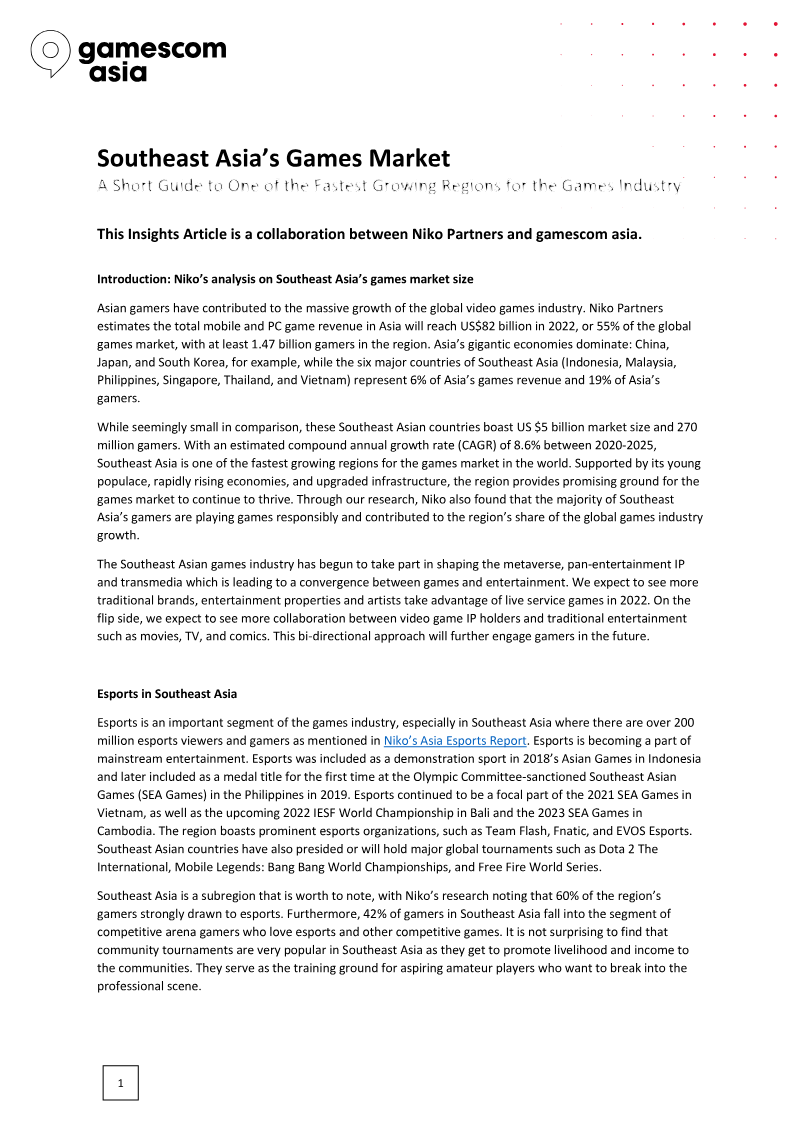
Southeast Asia’s Games Market
Southeast Asia represents one of the world’s fastest-growing video game markets, characterized by a young population, improving infrastructure, and a rapidly expanding digital economy. Data indicates that the six major countries in the region—Indonesia, Malaysia, the Philippines, Singapore, Thailand, and Vietnam—account for approximately $5 billion in market size and 270 million gamers. While this represents 6% of total Asian games revenue, the region is projected to maintain a compound annual growth rate of 8.6% through 2025.
Esports serves as a primary driver for this growth, with over 200 million viewers and gamers in the region. Approximately 60% of Southeast Asian gamers are strongly drawn to esports, and 42% are classified as competitive arena gamers. This interest has led to the integration of esports into major regional athletic events like the SEA Games. Furthermore, the audience is becoming increasingly diverse; female gamers now make up 40% of the total gaming population, with growth rates in this demographic outpacing the general market average. In specific markets like Indonesia and Singapore, women comprise nearly half of the gaming audience.
The region has also emerged as a pioneer in blockchain and play-to-earn gaming, exemplified by the success of titles like Axie Infinity, which reached over one million daily active users. However, the market faces unique challenges, including parental skepticism, fluctuating government regulations regarding game approvals and bans, and complex cultural sensitivities. Successful expansion requires navigating diverse religious and social landscapes, as localized content can significantly boost revenue while cultural oversights can lead to public backlash or censorship. Ultimately, Southeast Asia offers significant opportunities for global stakeholders, provided they adopt localized strategies rather than a one-size-fits-all approach.
- The Southeast Asian games market across six major countries generates approximately $5 billion in revenue from 270 million gamers and is projected to grow at a compound annual rate of 8.6% through 2025.
- Esports is a primary market driver, with over 200 million viewers and 60% of the regional gaming population expressing a strong interest in competitive play.
- Female gamers represent 40% of the total gaming population, with growth in this demographic outpacing the general market and reaching nearly 50% in Indonesia and Singapore.
- The region has pioneered blockchain and play-to-earn gaming, evidenced by titles like Axie Infinity achieving over one million daily active users.
- Market expansion requires localized strategies to navigate complex religious and social landscapes, as cultural oversights frequently lead to censorship or public backlash.
Niko PartnersJan 2022

Report23 pages
PaaS for Mobile Cloud Gaming
The white paper argues that Platform‑as‑a‑Service (PaaS) for mobile cloud gaming represents a transformative shift in the Asian mobile and free‑to‑play (F2P) game markets. It identifies a 1.5 billion‑strong Asian gamer base, with 1.4 billion already on mobile, yet only a small fraction have adopted cloud gaming; adoption is projected to take more than five years, driven by 5G rollout and government incentives. The analysis contrasts premium B2C cloud offerings—subscription or time‑based fee models—with the emerging B2B PaaS model, which allows developers to host titles on cloud infrastructure and monetize through F2P mechanics. Key players include Tencent, Now.gg, Ubitus, WeLink, and Alibaba Cloud, with China’s telecoms using cloud gaming to spur 5G uptake. The paper cites data such as China’s 1 million 5G base stations, 365 million 5G users, and an expected 80 % of smartphones being 5G‑capable by year‑end, underscoring the technical prerequisites for viable cloud play. Methodologically, the study draws on proprietary consumer panels of over 4 million in China and millions across other Asian markets, supplemented by industry interviews. The conclusion posits that mobile cloud PaaS will mature faster than premium B2C offerings, reducing acquisition costs, bypassing app‑store take rates, and enabling broader reach for high‑quality titles such as Genshin Impact. The report projects a global expansion of this model beyond Asia, reshaping monetization and discovery in the mobile gaming ecosystem.
- Mobile cloud Platform-as-a-Service (PaaS) is expected to mature faster than premium B2C cloud gaming models by enabling developers to bypass app-store fees and lower user acquisition costs.
- The Asian market contains 1.4 billion mobile gamers, yet cloud gaming adoption remains in its early stages with a projected maturation timeline exceeding five years.
- Technical infrastructure in China is rapidly scaling to support cloud play, evidenced by 1 million 5G base stations and 365 million 5G users, with 80% of smartphones expected to be 5G-capable by year-end.
- The B2B PaaS model allows developers to host high-quality titles like Genshin Impact directly on cloud infrastructure, utilizing F2P monetization mechanics rather than traditional subscription or time-based fees.
- Major industry players driving this shift include Tencent, Now.gg, Ubitus, WeLink, and Alibaba Cloud, with Chinese telecommunications firms actively leveraging cloud gaming to incentivize 5G adoption.
Niko PartnersJan 2021
Report12 pages
Rise of the Player-Fan: The Growing Opportunity of Mobile Esports in Asia
Mobile esports has emerged as a primary driver of player engagement and revenue across Asia, signaling a shift from traditional PC and console dominance to a mobile-first competitive landscape. The central thesis posits that Asia is the global epicenter of this evolution, fueled by a massive population of 1.5 billion gamers and a robust infrastructure of internet cafes, local streaming platforms, and increasing 5G penetration. By lowering hardware barriers to entry, mobile technology has transformed casual players into "player-fans" who both compete in and spectate high-stakes tournaments.
Key data points highlight the scale of this growth, with global esports prize pools increasing 40% between 2017 and 2019 to exceed $228 million. In 2019 alone, mobile esports generated $19.5 billion in global revenue, with Asia accounting for 68% of that total. China remains the largest single market, boasting 350 million esports fans, while Southeast Asia saw a 244% increase in tournament prize values between 2018 and 2019. The COVID-19 pandemic further accelerated these trends, with gamers in Asia spending up to 75% more time playing and viewership in China doubling during lockdowns.
The scope of this analysis covers major Asian markets including China, South Korea, Japan, India, and Southeast Asia, focusing on the period between 2017 and 2020. It examines industry segments ranging from hardware manufacturing and 5G infrastructure to specific game genres like MOBAs and Battle Royales. Methodology relies on primary data from Niko Partners, including consumer panels of over four million users, executive interviews, and market modeling to provide a comprehensive outlook on the region's competitive gaming trajectory.
- Asia dominates the global mobile esports landscape, accounting for 68% of the $19.5 billion in total global mobile esports revenue generated in 2019.
- China is the world's largest esports market with 350 million fans, while Southeast Asia experienced a 244% surge in tournament prize values between 2018 and 2019.
- Global esports prize pools grew by 40% between 2017 and 2019, reaching a total valuation exceeding $228 million.
- Mobile technology has lowered hardware barriers to entry for 1.5 billion Asian gamers, effectively converting casual players into active competitive participants and spectators.
- The COVID-19 pandemic acted as a significant growth catalyst in Asia, leading to a 75% increase in time spent gaming and a doubling of esports viewership in China.
+1
Niko PartnersJul 2020

Presentation1 pages
Play Like a Girl: Key Ways to Engage Asia's Growing Female Gaming Audience
The female gaming demographic in Asia represents a primary catalyst for regional market growth, expanding at a significantly faster rate than the male audience. In 2019, Asia accounted for 48% of global gaming revenue, totaling $69 billion. Within this landscape, female players grew to comprise 38% of the 1.33 billion total gamers in the region, up from 32% in 2017. This shift is particularly pronounced in China, where 45% of the gaming population is female, followed by South Korea, Japan, and Southeast Asia at 40% each.
Mobile technology serves as the dominant platform for this demographic, with 95% of Asia’s female gamers playing on mobile devices compared to much smaller shares for PC and consoles. While female players typically engage in shorter sessions than males—with 60% playing up to seven hours per week—their spending power is substantial. Female gamers contributed 35% of mobile gaming revenue in 2019, a figure projected to reach 39% in 2020. Contrary to casual stereotypes, these players show a strong preference for complex genres including MMORPGs, MOBAs, and shooters, particularly those featuring deep strategy, diverse character options, and immersive storylines.
The rise of female-specific esports leagues and professional teams further signals a maturing market with expanding sponsorship opportunities. This upward trajectory was accelerated by the COVID-19 pandemic; data from 2020 indicates that over 96% of female gamers in China increased their playtime during lockdowns, with a majority also increasing their in-game spending. To effectively engage this audience, developers and marketers must prioritize mobile-first strategies and integrate sophisticated gameplay elements that reflect the diverse interests of the modern female gamer.
- Female gamers in Asia grew to 38% of the 1.33 billion total regional gaming population by 2019, up from 32% in 2017.
- Mobile is the primary platform for this demographic, with 95% of female gamers in Asia playing on mobile devices.
- Female gamers contributed 35% of mobile gaming revenue in 2019, with projections estimating an increase to 39% in 2020.
- Contrary to casual gaming stereotypes, female players in Asia show a strong preference for complex genres including MMORPGs, MOBAs, and shooters.
- China leads the region with 45% of its gaming population being female, while South Korea, Japan, and Southeast Asia each report 40%.
+1
Niko PartnersJun 2020