1 free read left. Create a free account for unlimited reading + AI research.
Create free accountArticleKinephanos
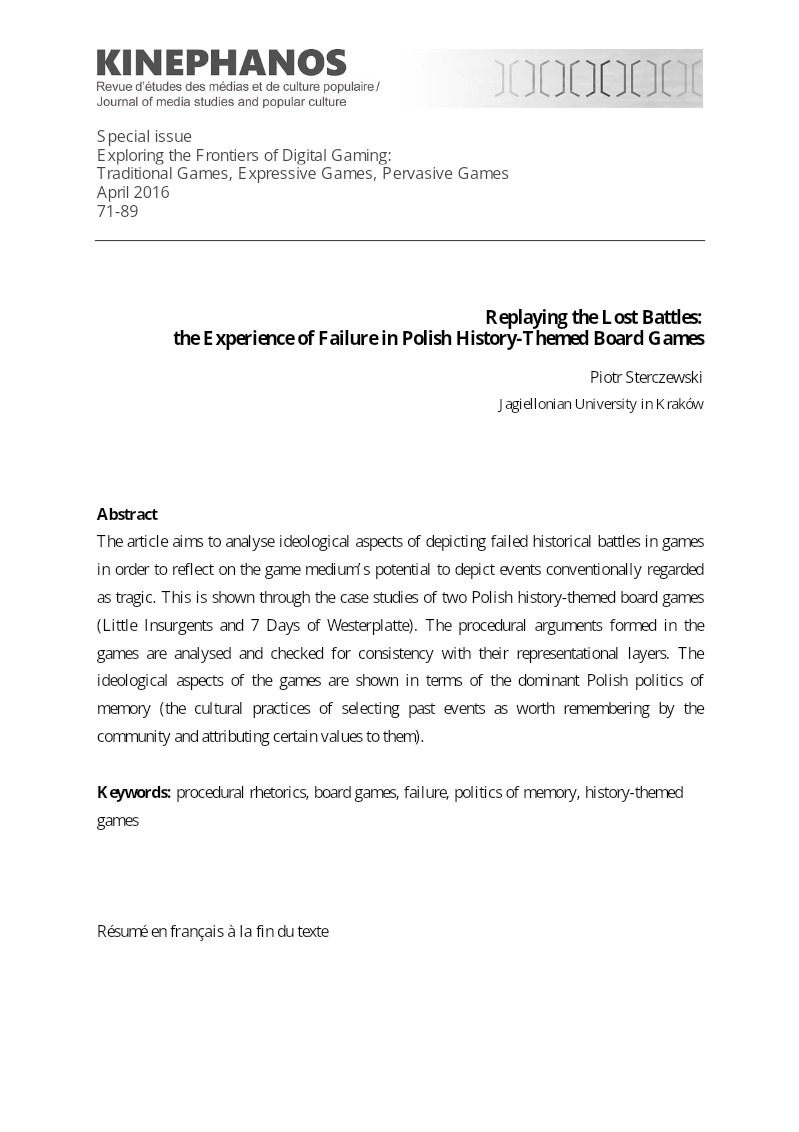
Polish history-themed board games serve as sophisticated instruments of procedural rhetoric, designed to align mechanical gameplay with state-sanctioned narratives of national identity. By focusing on pivotal military defeats such as the Warsaw Uprising and the defense of Westerplatte, titles like Little Insurgents and 7 Days of Westerplatte navigate the inherent tension between the ludic requirement for victory and the cultural imperative of honoring tragic historical sacrifice. These games prioritize a martyrological perspective, framing historical failure not as a strategic outcome, but as a moral triumph that reinforces a specific, ideologically charged vision of Polish heritage.
The design choices within these games often eschew the realistic, competitive simulations typical of traditional wargaming in favor of cooperative mechanics and sanitized depictions of conflict. By omitting graphic violence and simplifying complex social contexts, these titles function primarily as didactic tools rather than objective historical simulations. This approach creates a distinct dissonance between the mechanical design and the gravity of the subject matter, as players are encouraged to engage in ritualistic reenactments that emphasize emotional resonance and national heroism over counterfactual exploration or critical analysis.
Ultimately, these games demonstrate how interactive media can be leveraged to promote institutional memory. By transforming historical defeat into a form of symbolic success, the medium facilitates a unique discursive effect that prioritizes affective storytelling over historical accuracy. This trend highlights a broader shift in the Polish board game industry, where the primary objective is the cultivation of national pride through the selective framing of the past. Future research into this genre remains essential to understanding how such procedural rhetoric shapes public perception of history across diverse gaming demographics.



Kinephanos · 2026
Kinephanos · 2026
Kinephanos · 2026
Kinephanos · 2025
Kinephanos · 2025
Kinephanos · 2025
Kinephanos · 2025
Kinephanos · 2025
Kinephanos · 2025
Kinephanos · 2025
Kinephanos · 2025
Kinephanos · 2025
Journal of Games Criticism · 2023











Comments