1 free read left. Create a free account for unlimited reading + AI research.
Create free accountArticleKinephanos
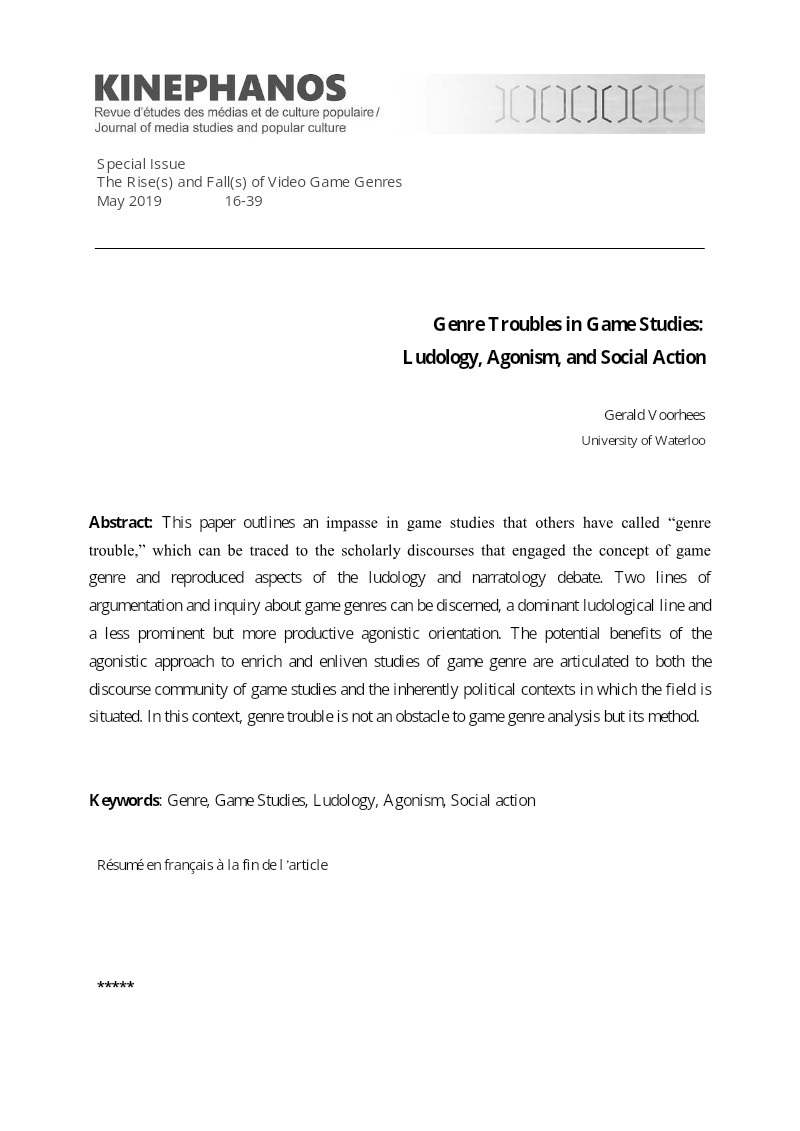
Game studies currently faces a persistent analytical impasse rooted in the historical tension between ludology and narratology. By prioritizing formalist, rule-based analysis and the mechanics of ergodic traversal, the field has historically constrained its own potential to address the broader cultural and social dimensions of interactive media. This reductive focus on static classification systems fails to capture the fluid, evolving nature of digital play, necessitating a shift toward a more inclusive and dynamic framework that treats genre as a site of ongoing contestation rather than a fixed taxonomy.
To resolve these methodological limitations, scholars should adopt an agonistic approach that embraces pluralism and social context. This perspective redefines genre as a form of social action, where the interplay between technology, player agency, and cultural discourse shapes the evolution of game forms. By moving away from exclusionary, singular methodologies, researchers can better analyze how games communicate complex values and respond to specific historical situations. This transition requires viewing the inherent instability of generic categories not as a failure of classification, but as a productive tool for mapping the emergence and dissolution of game forms.
Ultimately, the field must leverage this state of genre trouble to engage with the political and cultural complexities of the modern era. By treating the lack of stable generic unities as a reflection of broader cultural dynamics, analysts can participate more effectively in the formalization of game studies. This interdisciplinary strategy encourages a more nuanced understanding of how games function as both technical systems and social artifacts, ensuring that future scholarship remains responsive to the messy, multifaceted reality of contemporary interactive media.



Kinephanos · 2026
Kinephanos · 2026
Kinephanos · 2026
Kinephanos · 2025
Kinephanos · 2025
Kinephanos · 2025
Kinephanos · 2025
Kinephanos · 2025
Kinephanos · 2025
Kinephanos · 2025
Kinephanos · 2025
Kinephanos · 2025
International Journal of Role-Playing · 2026


































Comments