Key insights
5 slides
Historical context
Early 1980s strategy games should be analyzed on their own terms.
Retrospective narratives often incorrectly categorize these titles as early iterations of 1990s-style real-time strategy.
Distinct era. The early 1980s strategy gaming era fostered a unique multiplayer culture independent of modern genre definitions.
1 / 5
- 01Early 1980s strategy games like Eastern Front (1941) and Legionnaire were designed as solo tactical simulations rather than precursors to modern real-time strategy, prioritizing individual problem-solving over base-building or resource loops.See it on page 6
- 02The industry frequently hybridized traditional wargaming with arcade-style action, using terms like 'real-time' to describe continuous game flow rather than the high-intensity mechanics of contemporary standards.See it on page 4
- 03Multiplayer titles such as Commbat, Cytron Masters, and M.U.L.E. shifted the gameplay paradigm from solving static, pre-programmed puzzles to anticipating human opponent behavior.See it on page 19
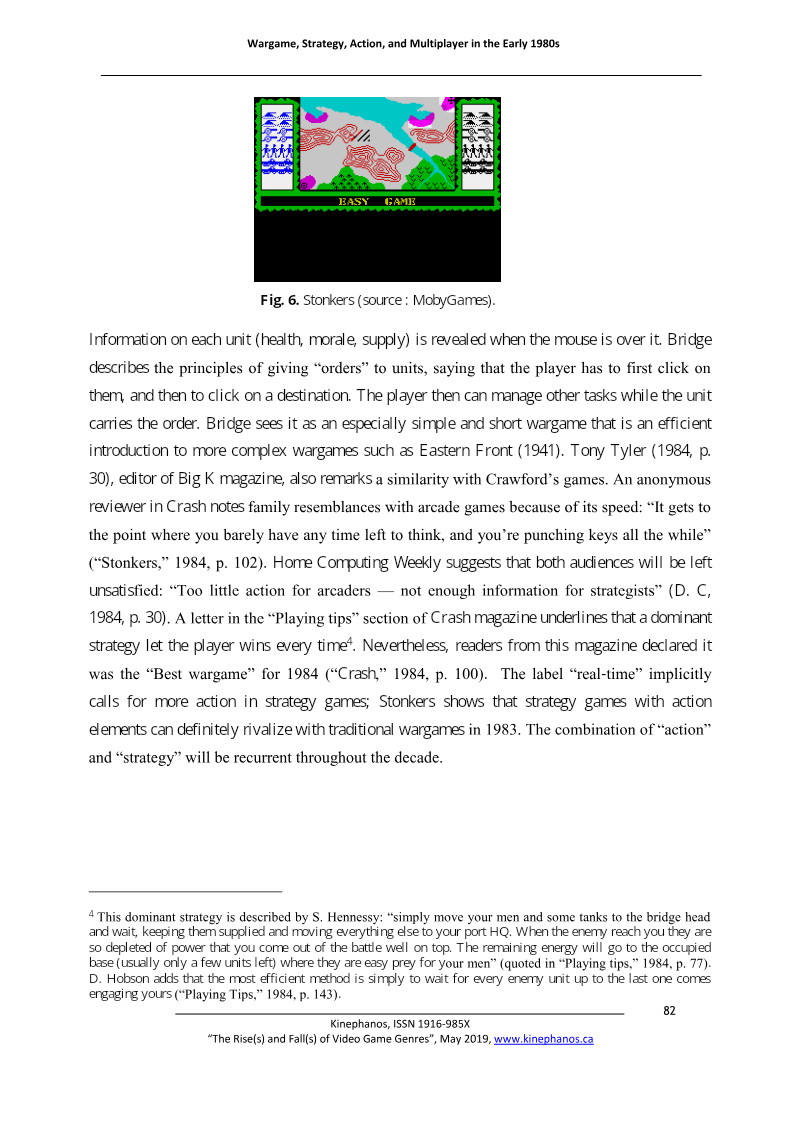
- 04Foundational concepts of unit management and resource allocation were established by titles including Stonkers, Computer Quarterback, and Utopia, which operated within a framework prioritizing tactical depth over standardized genre conventions.See it on page 9
- 05The evolution of strategy gaming in this era was a non-linear process that fostered a unique multiplayer culture independent of modern genre definitions.See it on page 3
- 06Historical analysis of this period requires viewing these games on their own terms, as retrospective narratives often incorrectly categorize them as early iterations of 1990s-style real-time strategy.See it on page 3
Ask AI about this report
Summary
Early 1980s strategy gaming represents a distinct era of experimentation that should be analyzed on its own terms rather than as a mere precursor to the modern real-time strategy genre. While retrospective narratives often categorize titles like Eastern Front (1941) and Legionnaire as early iterations of 1990s-style real-time strategy, these games were primarily designed as solo tactical simulations. Their focus on time-pressured decision-making prioritized individual problem-solving over the resource-management loops and base-building mechanics that eventually defined the genre in later decades.
The industry during this period was characterized by a fluid hybridization of genres, where developers frequently blended traditional wargaming with arcade-style action. Marketing terminology from the era, such as the use of the term real-time, often referred to continuous game flow or accelerated time rather than the high-intensity, constant-action mechanics associated with contemporary standards. Pivotal titles such as Stonkers, Computer Quarterback, and Utopia were instrumental in establishing foundational concepts like unit management and resource allocation, yet they operated within a unique design framework that prioritized tactical depth over standardized genre conventions.
Furthermore, the emergence of multiplayer titles like Commbat, Cytron Masters, and M.U.L.E. introduced a prediction paradigm that shifted the focus toward human-to-human interaction. Success in these environments relied on anticipating opponent behavior rather than solving static, pre-programmed puzzles. By examining these micro-histories of gameplay, it becomes clear that early 1980s strategy games fostered a unique multiplayer culture that evolved independently of modern genre definitions. Ultimately, these titles demonstrate that the evolution of strategy gaming is a complex, non-linear process that requires careful historical contextualization to fully understand the development of the medium.