
Jam City
Jam City is a mobile games developer and publisher behind titles such as Cookie Jam and Harry Potter: Hogwarts Mystery. It publishes articles on mobile game marketing, including advertising creative trends.
Documents
3 Successful Creative Trends for Mobile Gaming Ads
Mobile game publishers are increasingly relying on innovative creative strategies to secure user acquisition in a highly competitive market.
- Major publishers like Zynga and Rollic Games are successfully using intentionally misspelled ad copy, such as 'Only %1 poeple can pass this,' to drive engagement across platforms including TikTok, Facebook, and Snapchat.
- Playrix has shifted its creative strategy for Homescapes toward character-focused narratives involving infidelity and heartbreak, mirroring themes previously popularized by competitors like Matchington Mansion and Lily's Garden.
- KamaGames' Pokerist achieved a No. 1 ranking for Chartboost casino creatives in November 2020 by using a 'pause' button mechanic to surprise viewers and pivot into a multi-product showcase.
Reports about Jam City
30 documents by other writers name Jam City in the title or summary.

Harry Potter Mobile Games Reach $1 Billion in Revenue
Total player spending across Harry Potter-themed mobile games has surpassed $1 billion, driven by a diverse portfolio of titles.
- Harry Potter mobile games have surpassed $1 billion in total lifetime player spending across the franchise.
- Jam City’s 'Hogwarts Mystery' is the highest-grossing title with over $400 million in revenue since its April 2018 launch.
- NetEase’s 'Magic Awakened' has generated $358 million and is positioned to overtake 'Hogwarts Mystery' as the top earner, having been the highest-grossing book-based mobile title in the first nine months of 2022.


Global Gaming Report 2021
The global gaming industry experienced an unprecedented surge in financial activity during 2021, reaching a landmark $85 billion in total deal value across 1,159 transactions.
- The global gaming industry reached a landmark $85 billion in total deal value across 1,159 transactions in 2021, nearly tripling the previous year's figures.
- Mergers and acquisitions totaled $38 billion, driven by strategic activity from major players like Tencent and Embracer Group, while private placements hit a record $13 billion.
- Blockchain and NFT-based gaming emerged as a significant sector, securing $3.6 billion in total financing and accounting for nearly half of all private investment in the fourth quarter.

Playtime is Over, Apparently: Games Are an Antidote, Not an Addiction
This analysis examines the shifting cultural and regulatory landscape of the global video game industry, specifically challenging the narrative that gaming is a harmful addiction.
- China significantly tightened gaming regulations in 2021 by reducing the weekly online play limit for minors from 13.5 hours to just three hours.
- South Korea became the first nation to ban mandatory third-party payment restrictions on app stores, a policy shift aimed at reducing the market dominance of Apple and Google.
- The gaming industry is experiencing a cooling appetite for SPACs, exemplified by Jam City canceling a $1.2 billion valuation in favor of a $350 million private capital raise.

Games Radar Thursday
This analysis examines key developments in the mobile gaming industry as of July 2021, focusing on the importance of operational excellence and the volatility of public market entries.
- Dream Games' title Royal Match has successfully penetrated the mature Match-3 genre, reaching the #27 top-grossing position on AppAnnie as of July 29, 2021.
- Dream Games, an Istanbul-based studio founded by former Peak Games employees, secured a $1 billion valuation following a $155 million Series B funding round.
- Jam City terminated its $1.2 billion SPAC merger with DPCM Capital in July 2021, reportedly due to challenges in completing the PIPE (Private Investment in Public Equity) financing and disagreements over valuation.

PocketGamer.biz Mobile Games Awards 2021
The mobile gaming sector reached a pivotal maturation point in 2021, solidifying its position as the dominant force in the global interactive entertainment market.
- The mobile gaming sector reached a valuation between $91 billion and $120 billion in 2021, accounting for approximately 50% of the total global games market.
- The industry experienced significant financial consolidation and investment, characterized by over $60 billion in mergers and acquisitions alongside increased venture capital funding for studios and service providers.
- Growth is increasingly driven by high-fidelity experiences and sophisticated live operations, with industry leaders like TiMi Studio Group, Tencent, and Supercell setting the standard for development.
Game Company Growth Strategies in 2021 | Zynga, Applovin, Skillz, and Jam City
The mobile gaming industry is undergoing a fundamental transformation as traditional content-based mergers and acquisitions yield diminishing returns.
- The mobile gaming industry is shifting away from traditional content-based M&A toward vertical integration and cross-platform models to counter the impact of IDFA deprecation on user acquisition.
- AppLovin is attempting to transition from an ad-tech provider to a content-focused powerhouse, risking the alienation of its external client base by creating a potential walled garden.
- Zynga is pursuing ad-tech integration and cross-platform expansion, though its strategy faces significant industry skepticism regarding data privacy and trust.
Four Growth Paradigms: Zynga, AppLovin, Skillz, and Jam City
This analysis evaluates the growth strategies of Skillz and Jam City, two prominent entities within the free-to-play (F2P) mobile gaming sector as of mid-2021.
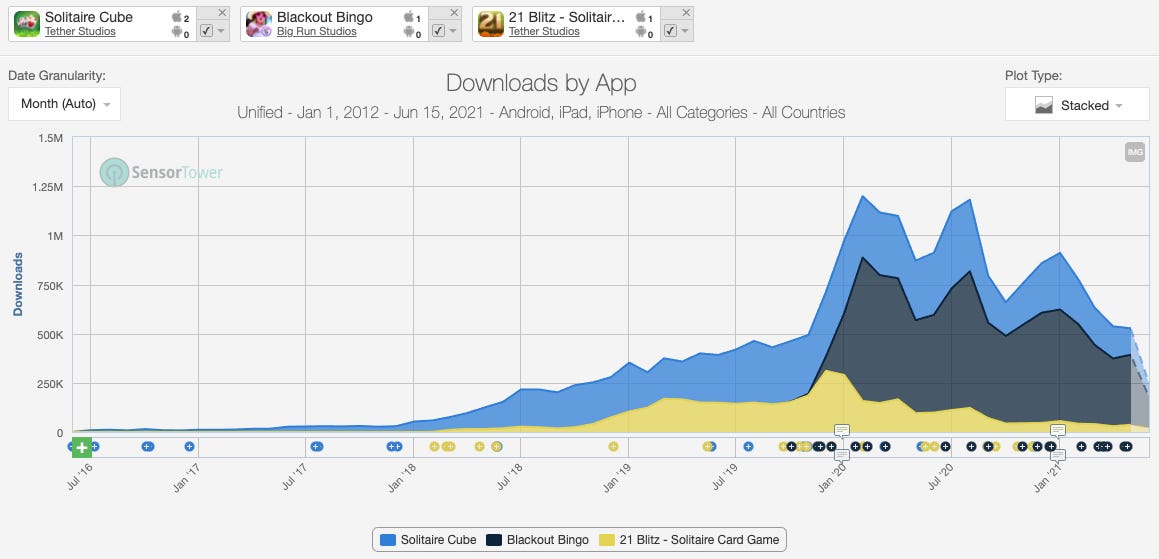
- Skillz relies heavily on a narrow product base, with Solitaire Cube, 21 Blitz, and Blackout Bingo accounting for 79% of its 2020 revenue.
- Skillz faces significant concerns regarding 'round-tripping' revenue, where the company issues 'Bonus Cash' to users that is then wagered and recorded as revenue, effectively inflating figures with virtual currency.
- Jam City is pursuing a growth strategy centered on early-stage M&A and licensed IP-based games, such as Harry Potter: Hogwarts Mystery and Disney Emoji Blitz, to mitigate risks associated with IDFA deprecation.
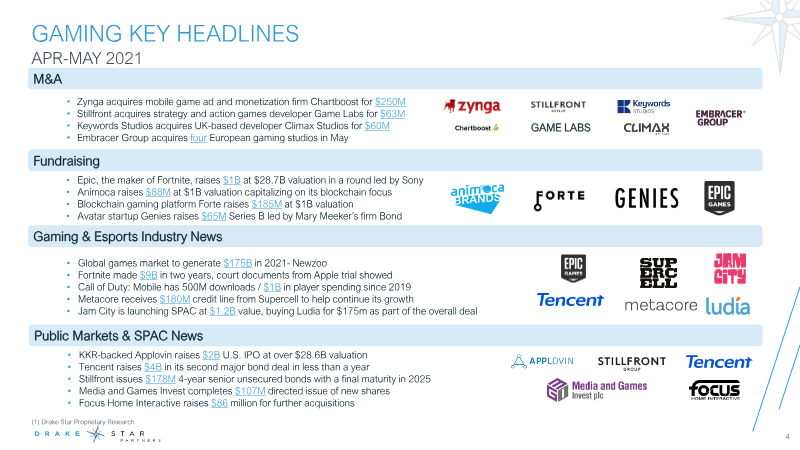
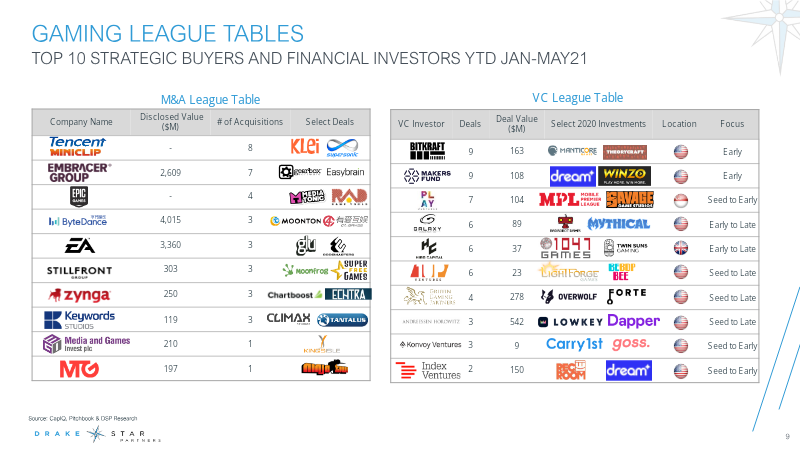

Global Gaming Industry Update: May 2021
The global gaming industry experienced unprecedented financial activity during the first five months of 2021, with total deal value surpassing that of any previous full year.
- The global gaming industry reached a record-breaking $49 billion in disclosed deal value during the first five months of 2021, surpassing the total deal value of any previous full year.
- Major industry players including Tencent, Embracer Group, Epic Games, and ByteDance drove aggressive market consolidation through high-volume M&A activity.
- Public markets experienced significant capital inflows, highlighted by the $2 billion IPO of AppLovin and a high volume of SPAC launches.

Mobile Gaming Markets Overview | Latin America (With Jam City Bogota, Lockwood/Avakin Life)
The Latin American gaming market is defined by a youthful demographic and a strong preference for free-to-play experiences, with mobile gaming serving as the primary driver of regional growth.
- Mobile gaming is the primary growth driver in Latin America, where a youthful demographic heavily favors free-to-play experiences on low-to-mid-tier Android devices.
- Developers must optimize for constrained data environments and older hardware due to economic volatility and high import duties on gaming consoles and high-end devices.
- Monetization strategies require adaptation to low credit card penetration and a reliance on prepaid plans, favoring low-cost entry packs, subscriptions, and ad-based models over traditional in-app purchases.
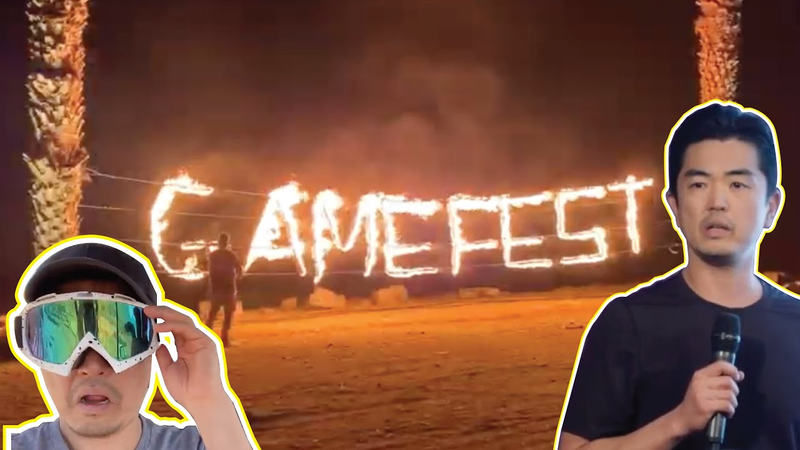
Ironsource Gamefest 2019 | Day in the Life at a Games Conference
The 2019 IronSource Gamefest in Tel Aviv served as a strategic nexus for the global mobile gaming industry, convening 120 senior leaders to address the sector's rapid evolution.
- The 2019 IronSource Gamefest in Tel Aviv convened 120 senior leaders from major studios including Jam City, SYBO Games, and Wildlife to address the mobile gaming industry's strategic evolution.
- Industry discourse focused on transitioning beyond the hyper-casual trend, specifically emphasizing the operational differences between zero-to-one game development and one-to-n scaling and optimization.
- Executives identified the cultivation of deep interpersonal relationships as a fundamental requirement for long-term success, particularly as the industry shifts toward remote operations.

The Game Makers Vlog: Season 1
The Game Makers vlog series, hosted by Joseph Kim, serves as an educational resource for mobile gaming professionals, focusing on the operational, marketing, and creative strategies that drive success in the industry.
- Jam City achieved 40 million installs for the mobile game Harry Potter: Hogwarts Mystery through specific user acquisition strategies and a balance of performance and brand marketing.
- The Game Makers vlog series covers mobile game product management, featuring insights from industry professionals working on titles such as Jurassic World Alive.
- Section Studios, an art production house that has collaborated with Riot Games on League of Legends, provides a look into the operational realities of running a professional game art studio.
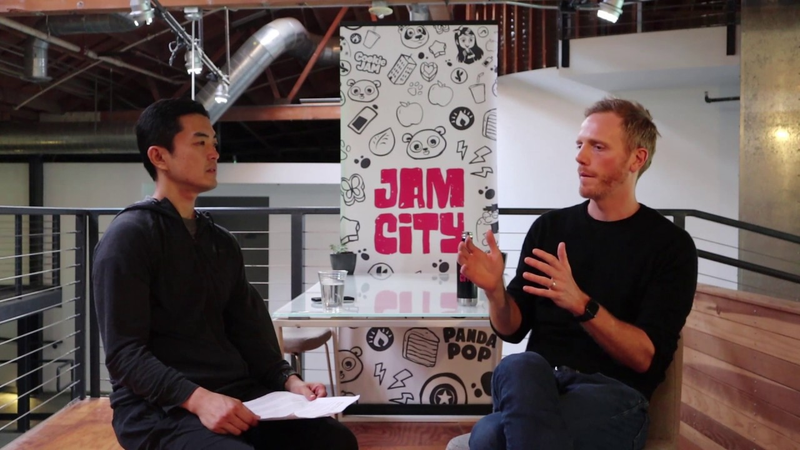
How to get 40M installs? Mobile Games Marketing | Brian Sapp VP User Acquisition at Jam City
User acquisition (UA) in the mobile gaming industry functions as a data-driven performance marketing discipline, distinct from brand marketing in its reliance on measurable key performance indicators (KPIs) such as cost per user and return on investment.
- User acquisition (UA) at Jam City is a performance-based discipline where marketing budgets are strictly allocated based on projected payback periods and the specific lifecycle phase of each game title.
- The UA process follows a structured R&D path: starting with technical stability in soft launches, moving to retention metrics in secondary markets, and concluding with predictive lifetime value (LTV) modeling in primary territories.
- UA departments should be organized into cross-functional 'supercells' consisting of media buyers, analysts, and creative strategists to ensure ownership and alignment between marketing and game production.