1 free read left. Create a free account for unlimited reading + AI research.
Create free accountArticleInternational Journal of Role-Playing
The study followed nine educators playing professor characters in the sandbox larp College of Wizardry. Their teaching and larping experience was substantial.
Playing a Professor Character: Professional Teachers at College of Wizardry
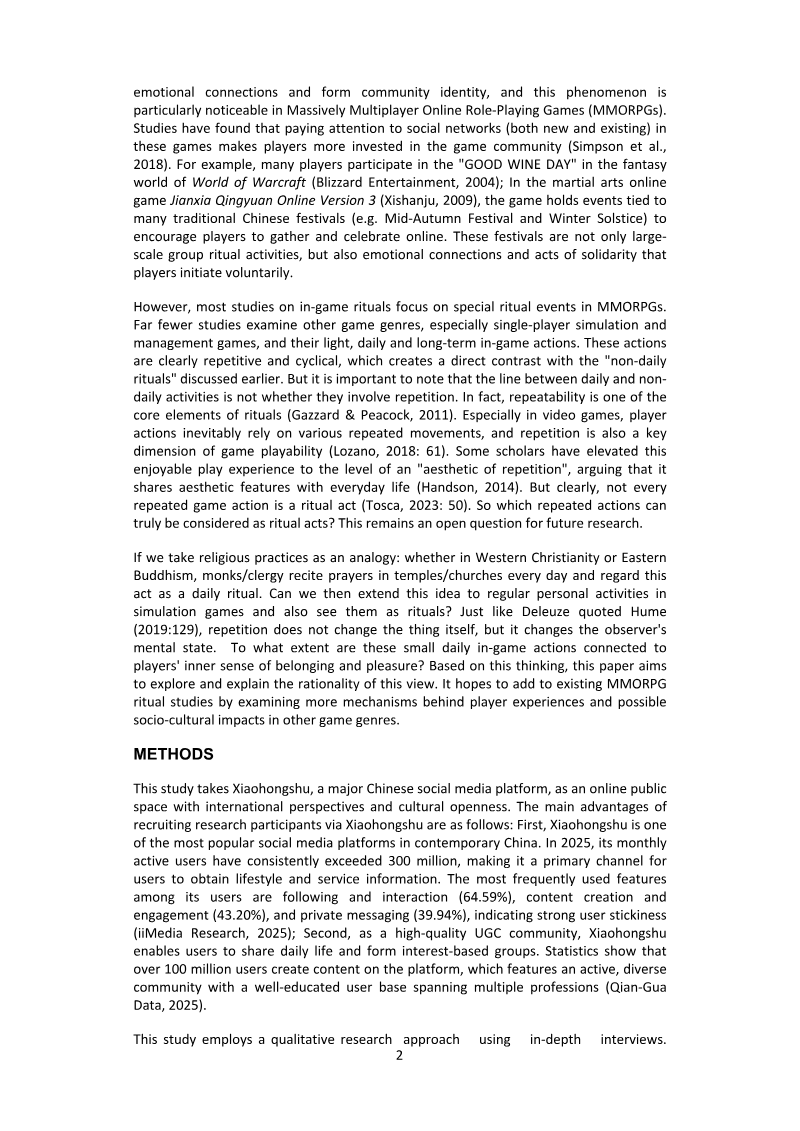
This study examines how nine professional educators experienced playing a professor character in College of Wizardry, a sandbox Nordic larp. Drawing on the concepts of spillover, bleed, and compensation from leisure studies, alongside role theory and Apter's reversal theory, the research asks how the skills, values, and emotional habits of real-world teaching carry over into a play-pretend classroom. Qualitative content analysis of guideline-structured interviews, conducted in February and March 2017 across six countries and all education levels, forms the empirical basis. Participants averaged 6.5 years of teaching and 14 years of larp experience.
The findings center on the consistent presence of professional expertise in play. All interviewees reported spillover of teaching methods, relational approaches, and attention to student needs into their in-game lessons, and several described bleed of emotions between the two contexts. Motivational states fell mostly in a mixed zone between playful and serious activity, with no discernible pattern linked to teaching or larping experience. Compensation emerged prominently in the form of creative autonomy and relief from professional constraints, particularly where role conflict and contrast were present. Role conflicts, such as discomfort with grading and tensions with personal professional self-expectations, arose for many participants.
The study rejects the hypothesis that participants acquired new teaching skills through play. Instead, it concludes that the experience reconnected educators with core professional values and provided a low-risk space to test unfamiliar teaching ideas, while the absence of real-world accountability offered room for experimentation. The authors acknowledge that the small, non-representative sample limits generalizability.
DiGRA · 2026