Key insights
5 slides
The starting point
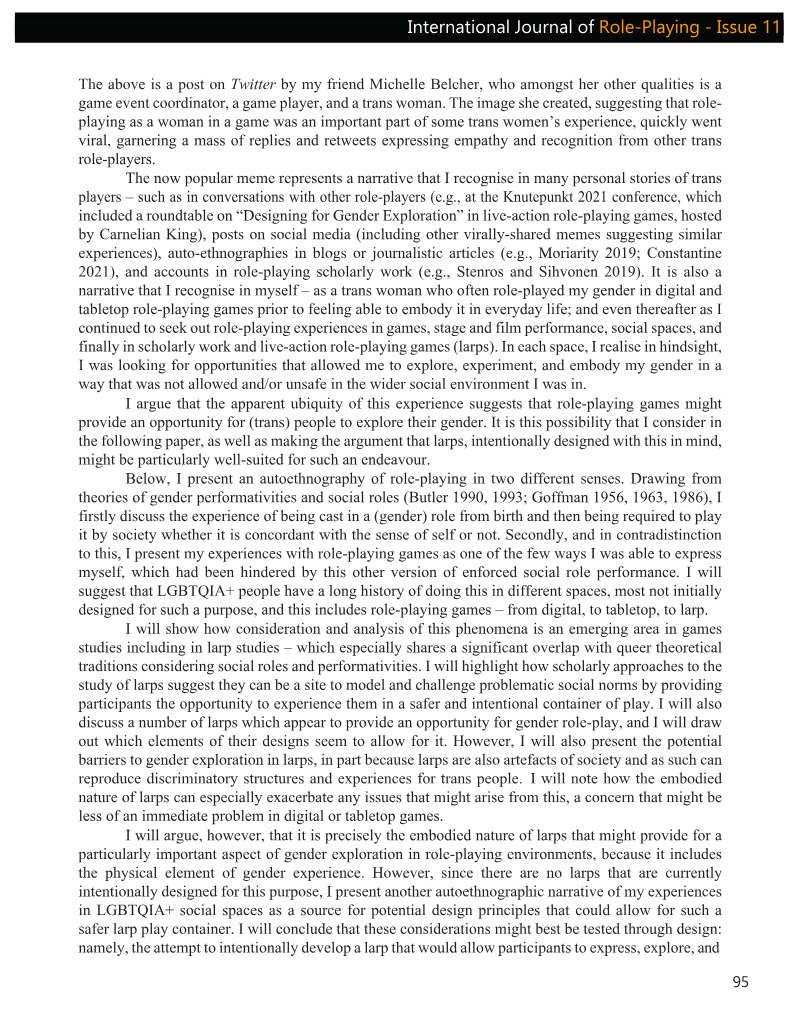
Trans people have long used role-playing games for gender exploration.
Digital RPGs, tabletop campaigns and live-action role-play have all served as spaces to explore and embody gender identities. Some of these identities cannot be expressed in everyday life.
1 / 5
- 01Trans people have long used role-playing games, including digital RPGs, tabletop campaigns, and live-action role-play (larp), to explore and embody gender identities they may not be able to express in everyday life.
- 02The paper argues that gender performance does not negate trans subjectivity, drawing on Judith Butler's theory of gender performativity, Erving Goffman's social role theory, and the author's autoethnographic experience.
- 03Larp is presented as an especially promising site for gender exploration because of its embodied, physical nature, though it can also reproduce transphobic social structures.
- 04Role-play can produce "emancipatory bleed," where experiences within a fiction carry over into everyday identity, while the "just a game" alibi can keep that exploration contained and unacted upon; peer validation and community interaction help close this gap.
- 05Case studies of Mellan himmel och hav, Mad About the Boy, and Just a Little Lovin' suggest out-of-character reflection, communal co-creation, and "thin" character play support self-expression, but embodied play remains precarious when co-players are transphobic or appearance-based prejudice shapes participation.
- 06The paper notes that no larp has yet been intentionally designed for trans gender exploration, and it closes with a research-through-design agenda for a trans-supportive larp organized around alibi, safety, bleed control, and community.
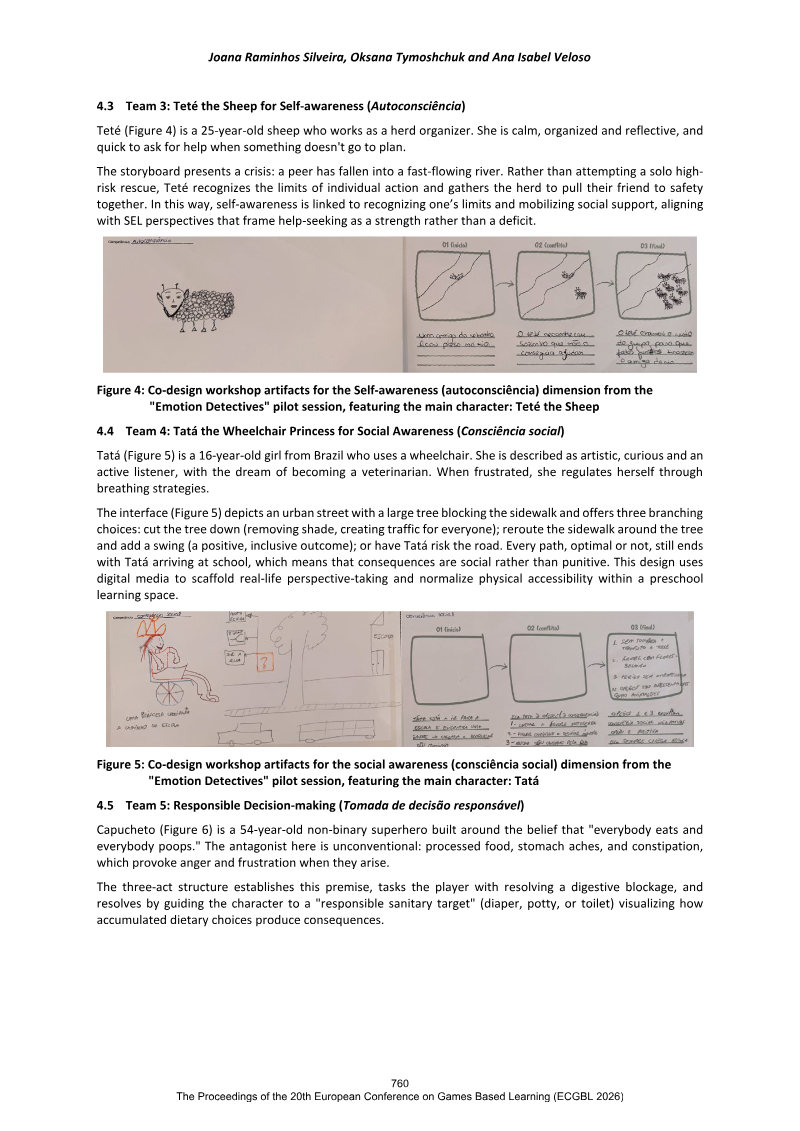
- 07Club Wotever's "Dressing-up Corner" functioned as an informal transformational container, offering validation and an optional tangible "bleed" souvenir despite lacking a designed fiction.
Ask AI about this report
Summary
Trans people have long used role-playing games, from digital RPGs and tabletop campaigns to live-action role-play (larp), as spaces to explore and embody gender identities they may not be able to express in everyday life. Drawing on Judith Butler's theory of gender performativity, Erving Goffman's social role theory, and the author's autoethnographic experience, this work argues that gender performance does not negate trans subjectivity. It contends that larp is an especially promising site for such exploration because of its embodied, physical nature, though it can also reproduce transphobic social structures. The paper notes that no larp has yet been intentionally designed for trans gender exploration, and it positions this gap as the basis for its design proposal.
The analysis situates this claim within a body of work on queer and trans play, showing how players have repurposed games for self-discovery. Role-play can produce "emancipatory bleed," in which experiences within a fiction carry over into everyday identity, but the "just a game" alibi can equally keep that exploration contained and unacted upon. Peer validation and community interaction appear to help close this gap. The author links these dynamics to identity verification theory in social psychology, grounding the argument in a personal account of playing a female character in a teenage tabletop group.
Case studies of Swedish and international larps, including Mellan himmel och hav, Mad About the Boy, and Just a Little Lovin', indicate that out-of-character reflection, communal co-creation, and "thin" character play can support self-expression. Embodied play, however, remains precarious when co-players are transphobic or when appearance-based prejudice shapes participation. The work concludes that larp's physicality offers distinctive potential for rehearsing gender, provided designers deliberately subvert social norms. It further examines Club Wotever, a queer nightclub whose "Dressing-up Corner" functioned as an informal transformational container, offering validation and an optional tangible "bleed" souvenir despite lacking a designed fiction. The paper closes with a research-through-design agenda for a trans-supportive larp, organized around alibi, safety, bleed control, and community.