1 free read left. Create a free account for unlimited reading + AI research.
Create free accountArticle International Journal of Esports
1 free read left. Create a free account for unlimited reading + AI research.
Create free accountArticleInternational Journal of Esports
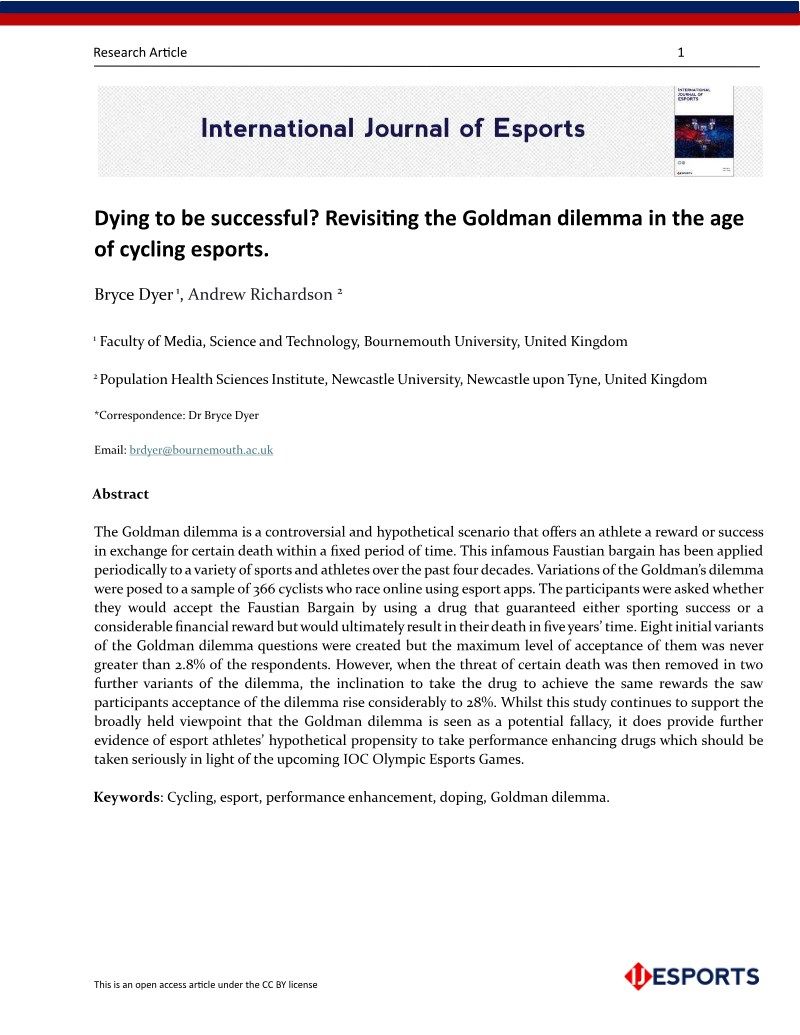
Cycle e-racing is a sector of esports in which riders pedal stationary bicycles on static trainers. Their avatars compete in virtual environments.
Cycle e-racing, a sector of esports in which riders pedal stationary bicycles on static trainers to compete as avatars in virtual environments, is the subject of this analytical perspective piece by Bryce Dyer of Bournemouth University. The paper argues that cycle e-racing has moved beyond being a mere simulation of road or track cycling and may now be considered a distinct competitive cycling discipline in its own right. Its central questions concern whether the activity qualifies as sport given its physical demands, and what new forms of cheating and performance enhancement it introduces relative to traditional sports technology.
The author outlines the basic equipment required, typically a computer, a smart or dumb static trainer, a standard bicycle and an internet connection, and notes that the activity received official recognition when cycling's governing body endorsed a virtual Tour de France and sanctioned the first Cycling Esports World Championships in 2020. Key concerns highlighted include a 2019 British e-racing championship disqualification involving a computerised bot used to unlock a favourable avatar, and vulnerabilities arising from self-reported rider data such as height, mass and power output, which underpin virtual physics. The paper suggests that such weaknesses could be addressed through measures like real-time mass measurement and formally staged competition.
Beyond cheating, the piece examines how gamified features such as power-ups, altered camera views and the rapid frequency of short races reshape tactics and training, and it raises the prospect of an equipment arms race in which optimised trainers, fan configurations and bicycle geometries could boost performance invisibly within the virtual environment. The author concludes that such developments may require formal governance and ongoing vigilance, but that a firm case can now be made for regarding cycle e-racing as a unique sporting discipline.

International Journal of Esports · 2026
International Journal of Esports · 2026

International Journal of Esports · 2026
International Journal of Esports · 2026

International Journal of Esports · 2026
International Journal of Esports · 2026
International Journal of Esports · 2025
International Journal of Esports · 2025
International Journal of Esports · 2025

International Journal of Esports · 2025
International Journal of Esports · 2025
International Journal of Esports · 2025
Deconstructor of Fun · 2026