1 free read left. Create a free account for unlimited reading + AI research.
Create free accountArticle International Journal of Esports
1 free read left. Create a free account for unlimited reading + AI research.
Create free accountArticleInternational Journal of Esports
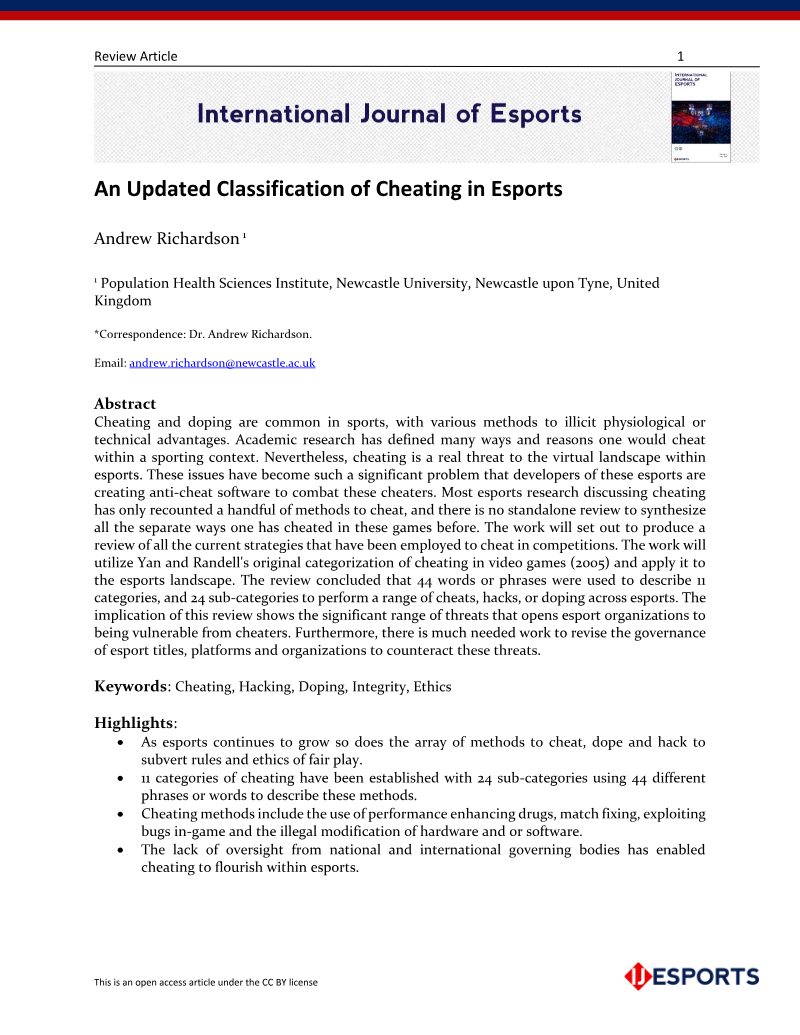
The report holds that incentives to cheat are strong, detection is unlikely, and current sanctions are too weak to deter misconduct.
Esports has grown into a multibillion-dollar industry, and with that growth has come a serious set of integrity problems. This analysis examines cheating, doping, and match-fixing in competitive gaming, defining each practice and assessing why these illegal activities persist. Its central argument is that the incentives to cheat are strong, the likelihood of detection is low, and the sanctions currently available are too weak to deter misconduct. The authors frame the issue through a game-theoretic lens, modeling the choices players and teams face when deciding whether to break the rules.
The economic reasoning underpinning the analysis rests on stark comparisons. Under assumed values of a $1,500 prize, a $3,000 fine, and a 10 percent detection probability, doping emerges as a dominant strategy. The model indicates that raising detection to roughly 17 percent, or setting fines above $5,000, would eliminate that incentive. Betting volume in 2020 reached about $13 billion, roughly 107 times the prize money distributed that year, a disparity the authors present as evidence of powerful motivation for match-fixing.
The governance landscape receives particular attention and is described as fragmented. Publishers, national associations, the international Esports Integrity Commission, and tournament organizers all hold overlapping and sometimes ambiguous enforcement roles, with sanctions ranging from fines to lifetime bans. Publishers hold a distinctive position because they control the rights to the games themselves, giving them the ability to exclude violators outright, yet this same authority raises concerns about their outsized political influence over competitors. Illustrative cases, including the Cloud9 Adderall incident and the iBUYPOWER match-fixing scandal, point to cheating and match-fixing as recurring problems, while doping controls have only recently gained traction.
The authors conclude that existing countermeasures are patchy, inconsistently regulated, and weakly enforced, with monetary penalties nearly absent and fraud remedies too inexpensive to deter. Their analysis suggests cheating can become a rational dominant strategy under present conditions. They call for a more unified sanctioning framework, stronger enforcement, comprehensive doping controls, and penalties substantial enough to impose meaningful costs on players and teams.
International Journal of Esports · 2026
International Journal of Esports · 2026
International Journal of Esports · 2026
International Journal of Esports · 2026
International Journal of Esports · 2026
International Journal of Esports · 2026
International Journal of Esports · 2025
International Journal of Esports · 2025
International Journal of Esports · 2025
International Journal of Esports · 2025
International Journal of Esports · 2025
International Journal of Esports · 2025
Niko Partners · 2026