
DiGRA
The Digital Games Research Association: the international association of academics and professionals who study digital games. Its Digital Library holds the proceedings of the DiGRA conferences since 2002.
Documents
Interactive Biotechnology: Design Rules for Integrating Biological Matter into Digital Games
This document argues that integrating live biological matter into digital games opens a design space far richer than conventional human-computer interaction, with the authors counting 64 possible interaction schemas compared with four for standard setups.
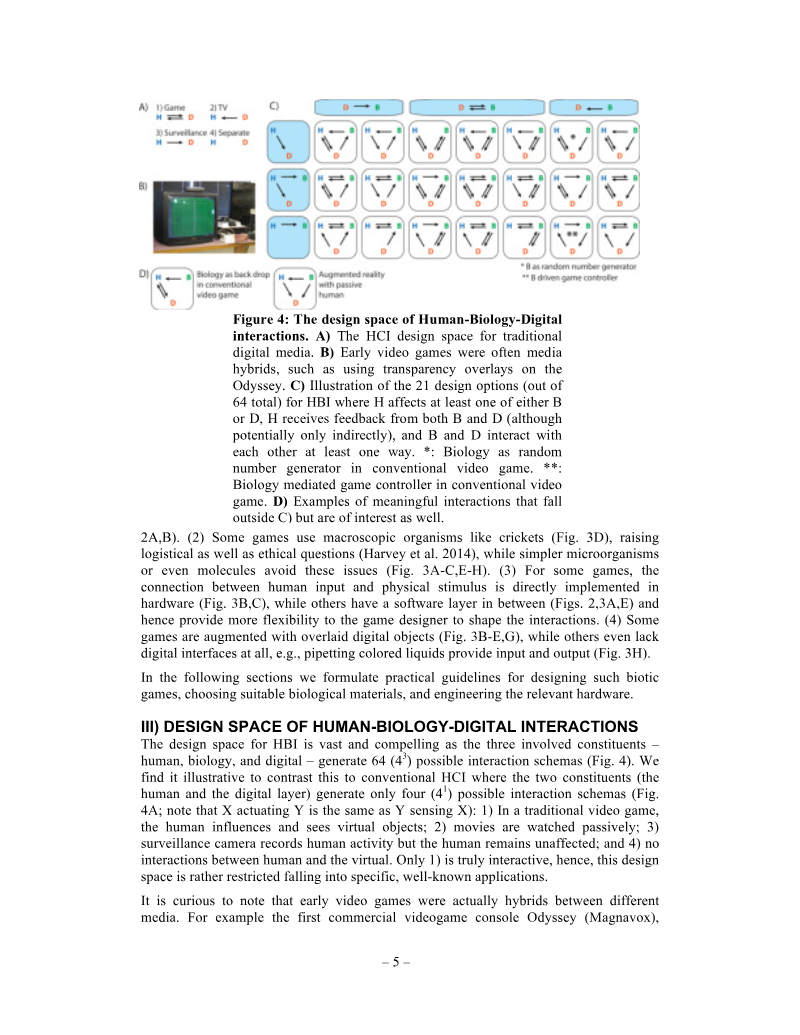
- The authors count 64 possible interaction schemas for integrating biology into games, compared with four for standard setups, and enumerate 21 arrangements of biology, digital systems, and human players.
- The report proposes the "biotic processing unit," treating biological components as abstracted hardware analogous to a GPU or physics engine.
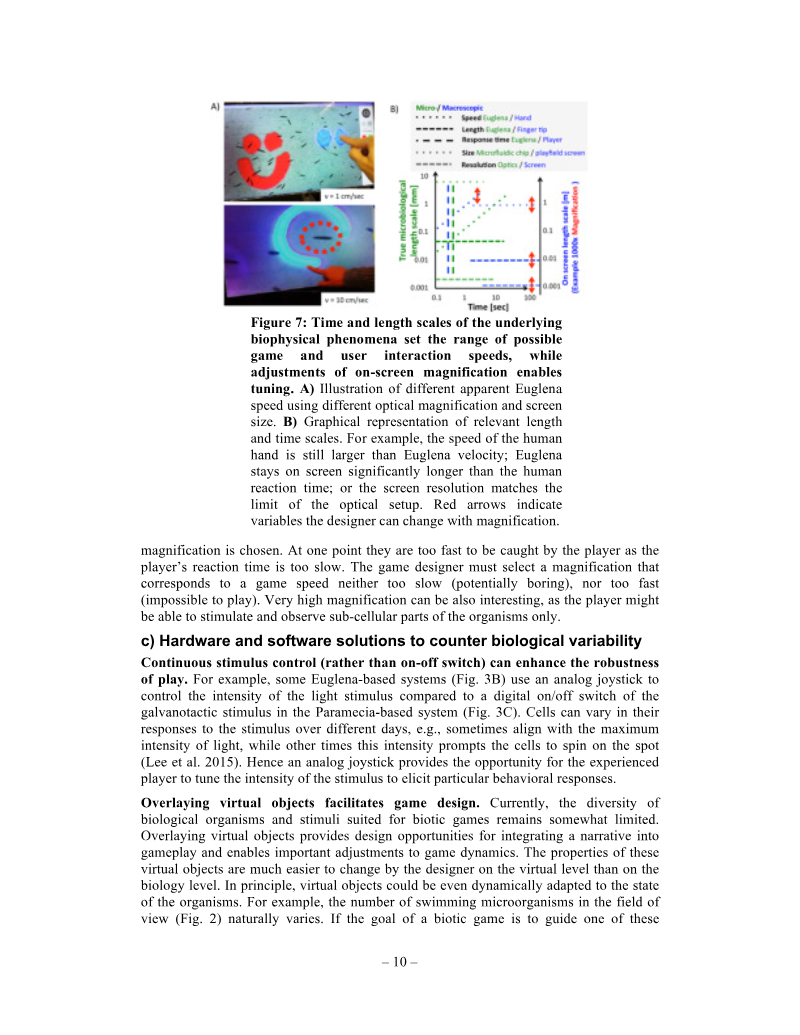
- Design rules address the mismatch between biological and human time scales, using on-screen magnification, analog controls, and virtual overlays that compensate for biological variability.

Four Lenses for Designing Morally Engaging Games
"Four Lenses for Designing Morally Engaging Games" argues that games can cultivate genuine moral engagement in players by attending to four distinct dimensions adapted from Rest's Four Component Model of moral psychology: moral focus, sensitivity, judgement, and action.
- Games often teach players to treat morality instrumentally, as a means to rewards, rather than as a concern worth prioritising for its own sake; the authors therefore recommend abandoning morality meters in favour of familiar moral roles and sympathetic non-player characters.
- The framework adapts Rest's Four Component Model of moral psychology into four lenses for game design: moral focus, sensitivity, judgement, and action, positioned as a complement to existing ethics-in-games frameworks.
- Overt signalling of moral content can diminish players' own capacity to perceive moral stakes, while unsignposted choices risk alienating them, so designers must balance signposting against subtlety.

Super Mario as a String: Platformer Level Generation Via LSTMs
Researchers applied Long Short-Term Memory (LSTM) recurrent neural networks to the procedural generation of Super Mario Bros. levels, arguing that LSTMs, by mitigating the vanishing gradient problem, can capture longer-range structural dependencies than the Markov-chain and graph-based generators that have struggled with global…
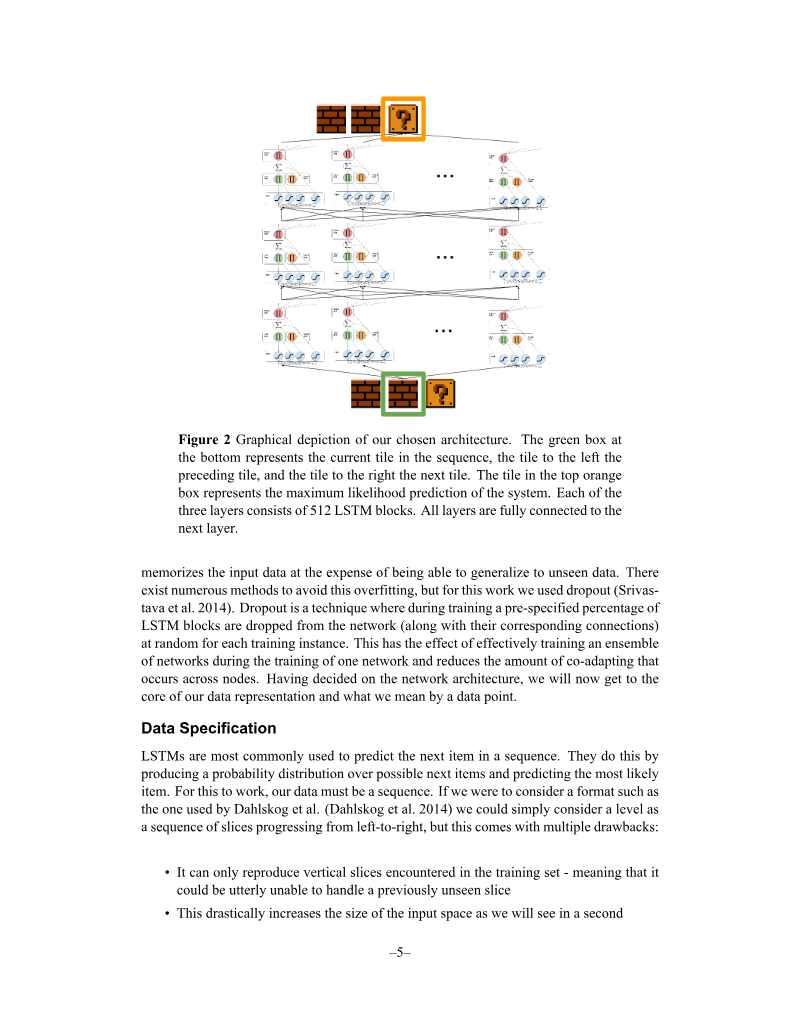
- Applying LSTM recurrent networks to Super Mario Bros. level generation aims to capture longer-range structural dependencies than Markov-chain and graph-based generators, which have struggled with global coherence.
- The strongest result came from encoding player path information: the best configuration, combining snaking tile ordering, path data, and column depth markers, reached a negative log-likelihood of 0.0177.
- The best configuration produced levels that a simulated agent could complete 97 percent of the time, compared with a previously reported best of 66 percent for machine-learning-based level generators.
The Impact of Co-Located Play on Social Presence and Game Experience in a VR Game
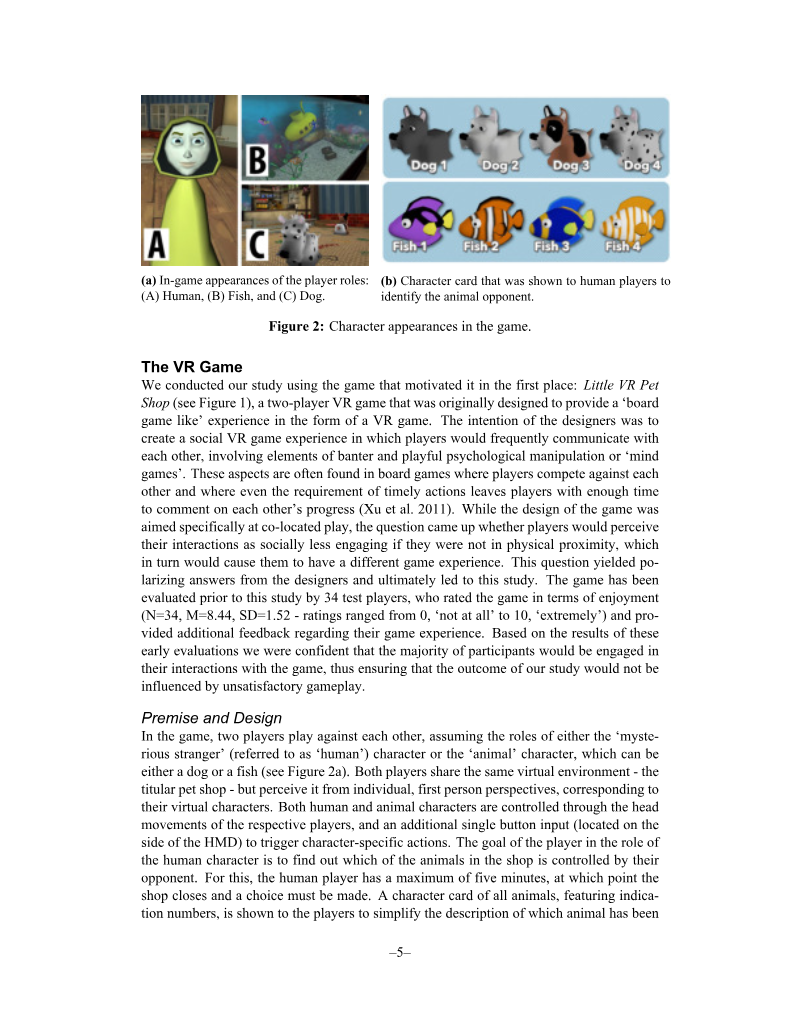
A study of 34 participants playing a two-player VR game, Little VR Pet Shop, examined whether co-located play in the same room produces a different social and experiential outcome than play across separate rooms connected by intercom.
- A study of 34 friend-pair participants playing the two-player VR game Little VR Pet Shop found no meaningful difference in game experience or social presence between co-located play in the same room and separated play connected by intercom.
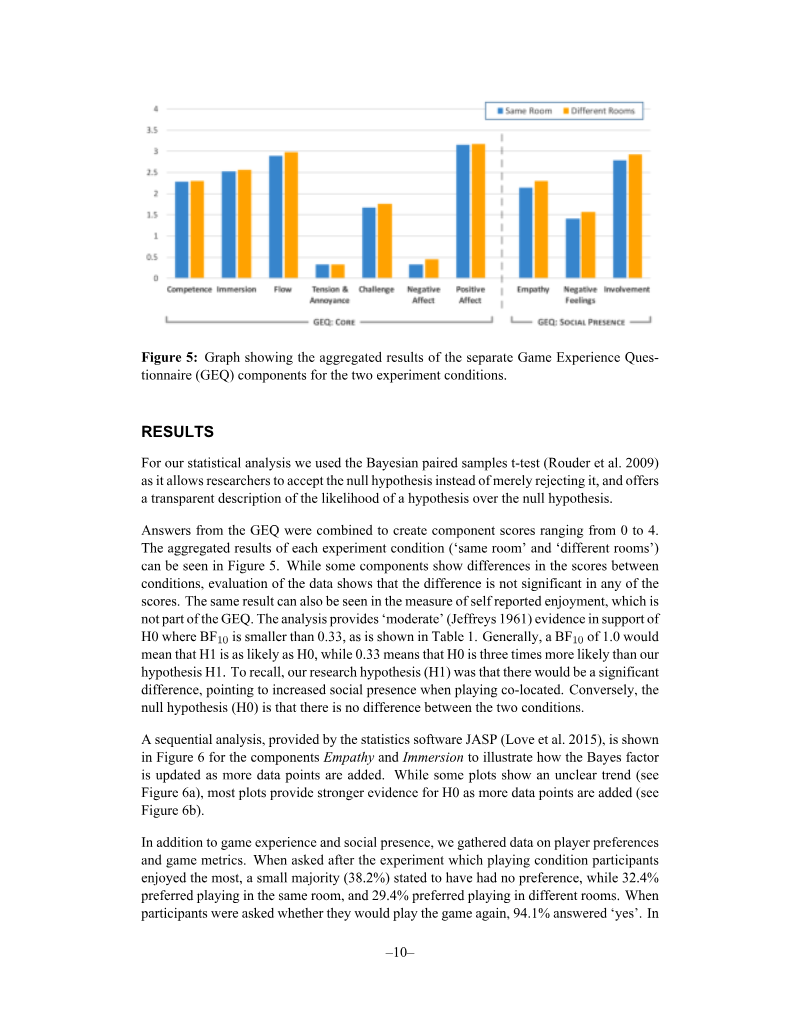
- Bayes factors mostly below 0.33 indicated moderate to anecdotal evidence in favor of the null hypothesis, with no significant differences across GEQ core dimensions, social presence components, or self-reported enjoyment.
- 94.1 percent of participants said they were willing to play again, and most expressed no preference between the shared-room and separated conditions.



"We Don't Sell Blocks": Exploring Minecraft's Commissioning Market
The study examines Minecraft's commissioning market, a community-driven economy in which players trade the time and creative labour involved in building custom in-game structures, rather than the structures themselves, since the game's end-user licence agreement prohibits selling in-game material.
- Minecraft's end-user licence agreement prohibits selling in-game material, so players instead trade the time and creative labour of building custom structures, forming a commissioning market.
- The market has three actor types: clients (mostly server owners, but also YouTubers and corporations), contractors (team managers, union members, and freelancers who route orders), and builders who create the work.
- Team managers typically keep a commission of roughly 30 to 40 percent to cover overhead, with builders receiving the remainder, a hierarchy that partly prompted the emergence of unions promoting direct client relationships and "fair pay for fair work."



Prank, Troll, Gross and Gore: Performance Issues in Esport Live-Streaming
Karhulahti's study examines how live-streaming of competitive esports is shaped by spectator interference, using a twelve-month observation of League of Legends streamer Gross Gore.
- Spectator interference in live esports streams, such as pranks, trolling, and mass food orders, disrupts the 'interview frame' of streamer-viewer conversation, and the streamer responds by sustaining a consistent, humorous persona.
- Live-stream viewers actively seek to alter match outcomes and broadcast direction, and the resulting unpredictability creates a distinctive dramatic appeal that drives viewership, differing fundamentally from traditional sport or esport spectatorship.
- The study's single case study, League of Legends streamer Gross Gore, drew over ten million viewers and £106,033 in fan donations in 2015, illustrating the economic scale of such performances.



4X Gamer as Myth: Understanding Through Player Mythologies
This paper argues that digital games can be analysed as textual systems whose constituent signs are continually renegotiated through player interaction, while the broader cultural "mythologies" surrounding those signs persist and shape how they are read.
- Digital games can be analysed as ergodic textual systems whose signs are continually renegotiated through player interaction, while surrounding cultural 'mythologies' persist and shape how those signs are read.
- The study grounds its framework in Espen Aarseth's cybertext, Ian Bogost's unit-operational criticism, and Roland Barthes's semiotics, extending Barthesian myth to the 'gamer' identity and sub-mythologies such as the 'true gamer'.
- The 4x strategy genre is the central case, examining how signs like hexagonal tiles, beakers, and heater-shields carry specific meanings for 4x players that may be opaque to others.



An Impression of Home: Player Nostalgia and the Impulse to Explore Game Worlds
Robin Sloan's paper, "An Impression of Home: Player Nostalgia and the Impulse to Explore Game Worlds," argues that nostalgia should be understood as an internal affective state experienced by players rather than simply a period aesthetic or a form of remediation.
- Nostalgia is framed as an internal affective state that motivates players to explore game worlds, rather than merely a period aesthetic or form of remediation.
- Nostalgia in the studied games arises mainly from generic familiarity (homely interiors, children's drawings, personal objects) that triggers players' own memories, not from explicit historical styling.
- Impressionistic, non-period audiovisual design, such as golden-hour lighting and a timeless orchestral score, can evoke personal nostalgia across a broader audience than period pastiche, which relies on shared cultural references.



Creative Communities: Shaping Process through Performance and Play
"Creative Communities: Shaping Process through Performance and Play" argues that play can disrupt entrenched assumptions within communities of practice and foster innovation, and it proposes a "context provider's framework" under which creative hubs and universities design spaces that support creative process.
- The authors argue that play can disrupt entrenched conventions in communities of practice, such as generic game-engine styles and oversaturated videogame genres, which they claim limit creative output.
- They propose a 'context provider's framework' in which creative hubs and universities design spaces and conditions that support creative process, while acknowledging that a community of practice itself cannot be designed.
- The Development Cultures study (2014) ran for six months with reflective seminars and two game jams, and participation grew from 23 to 46.



Toward Ludic Gerontechnology: A Review of Games for Dementia Care
Games designed for dementia care have become a growing area of gerontechnology, and this review takes stock of the field's current state, its design approaches, and its evidence base.
- The field of games for dementia care is still largely at a prototype or early-validation stage, with promising but preliminary results.
- Cognitive rehabilitation games dominate current work, yet their efficacy evidence is limited, and brain-training effects have proven highly task-specific, so larger clinical trials are still needed.
- People living with dementia can often play these games independently, though findings diverge by level of impairment and other variables that require further study.

The Limits of the Evolution of Female Characters in the BioShock Franchise
Across the BioShock franchise, from BioShock through BioShock 2 to BioShock Infinite, the female characters have become more independent on the surface, yet they remain largely confined to patriarchal roles.
- The report argues that female characters across the BioShock franchise (BioShock, BioShock 2, BioShock Infinite) have become more independent on the surface yet remain largely confined to patriarchal roles as supporting figures, gameplay rewards, or damsels in distress.
- The analysis uses a multimodal framework combining appraisal analysis, Kress and van Leeuwen's visual grammar, and Lim's gesture system, and is offered both to diagnose stereotypical representation and as a practical aid for designers seeking more diverse characters.
- In BioShock Infinite, Elizabeth is coded heavily for "reaction: impact" (572 tokens) and "insecurity" (31 tokens), positioning her as a guide who depends on the male protagonist.



Early Computer Game Genre Preferences (1980-1984)
Between 1980 and 1984, computer game genre preferences were shaped by two distinct audiences, and the sales data reveal a split that later accounts of video game culture tend to flatten.
- Arcade games dominated commercial sales in 1980–1984, accounting for roughly 61 percent of Softalk's monthly Apple II "Top Thirty" best-seller chart entries, while strategy games made up about 52 percent of Computer Gaming World reader preferences from 1982 to 1984.
- The gap between sales charts and reader preferences points to a hardcore hobbyist audience whose tastes diverged sharply from the broader consumer market.
- Wizardry and Choplifter! were the strongest performers across both the Softalk sales data and the Computer Gaming World reader ratings.