1 free read left. Create a free account for unlimited reading + AI research.
Create free accountWhitepaper DiGRA
1 free read left. Create a free account for unlimited reading + AI research.
Create free accountWhitepaperDiGRA
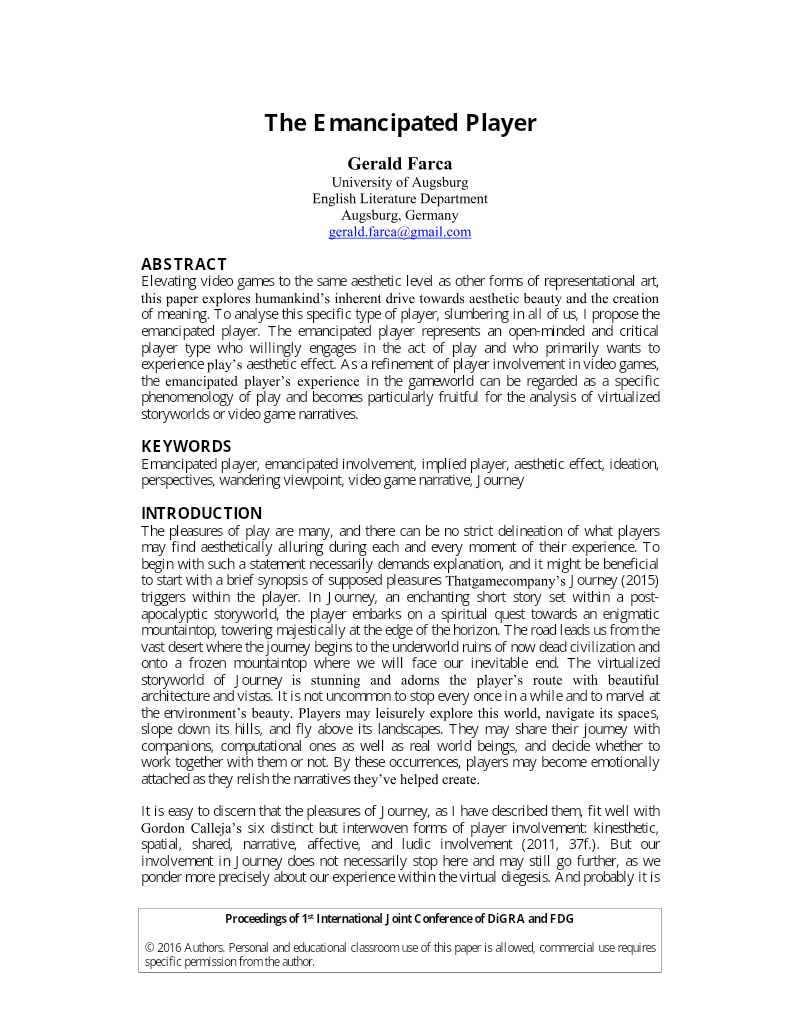
Robin Sloan's paper, "An Impression of Home: Player Nostalgia and the Impulse to Explore Game Worlds," argues that nostalgia should be understood as an internal affective state experienced by players rather than simply a period aesthetic or a form of remediation. Its central thesis is that nostalgia, which psychological research frames as a positive and hope-restoring emotion, can motivate players to explore game worlds. The argument is tested through close analysis of two adventure games, Everybody's Gone to the Rapture and Life is Strange, both of which are examined as exploration-based titles built around reflective, slow-paced play.
The analysis finds that nostalgia in these games arises less from explicit historical styling than from generic familiarity. Homely interiors, children's drawings, and personal objects act as tactile triggers that call up players' own memories, while themes of loneliness, memory, and light provide atmospheric cues. Nature imagery, contrasted with urban decay in Life is Strange to evoke an idealised past, works alongside golden-hour lighting, which draws on painterly traditions associated with Constable and Turner, and on a timeless, non-period orchestral score, most notably Jessica Curry's music for Everybody's Gone to the Rapture. Deliberate walking pace, time-based themes, and opt-in quiet moments further sustain a contemplative mood that encourages curiosity and approach behavior.
The study's principal conclusion is that impressionistic, non-period audiovisual design can evoke personal nostalgia across a broader audience than period pastiche, which depends on shared cultural references. Nostalgia is presented as a practical design lever for games where exploration is central, offering a means of counteracting loneliness and sustaining player motivation. The author acknowledges a notable limitation: both case studies depict predominantly Western, English-speaking, middle-class settings, which constrains how far the findings can be generalized across cultures and player populations.
Each row is a game or company this document names, each column a document, oldest first. A mark means that document names it. Select a row to see those documents.
DiGRA · 2016
DiGRA · 2016
DiGRA · 2016



DiGRA · 2016



DiGRA · 2016



DiGRA · 2016



DiGRA · 2016



DiGRA · 2016

DiGRA · 2015



DiGRA · 2015



DiGRA · 2015
DiGRA · 2015