
DiGRA
The Digital Games Research Association: the international association of academics and professionals who study digital games. Its Digital Library holds the proceedings of the DiGRA conferences since 2002.
Documents



Overwatch as a Shared Universe: Game Worlds in a Transmedial Franchise
Joleen Blom's paper contends that transmedia storytelling theory, as developed by scholars such as Jenkins, Klastrup and Tosca, Wolf, and Ryan, does not adequately account for the affordances of games, and it uses Blizzard's Overwatch franchise as a case study to argue for a different framing.
- Joleen Blom argues that transmedia storytelling theory (Jenkins, Klastrup and Tosca, Wolf, Ryan) does not adequately account for games, and uses Blizzard's Overwatch franchise to propose a different framing.
- The paper's central thesis is that Overwatch's game, comics, and short films do not form a single coherent transmedial storyworld; instead the franchise is a "shared universe" whose connections are constructed imaginatively by players, drawing on Benedict Anderson's concept of imagined communities.
- Following Aarseth, the paper contends that game arenas are objectively explorable, rule-bound, and often isolated and non-cumulative, so maps do not build into a continuous geography as fictional storyworlds do.



Avatars, Gender and Sexuality for Brazilian Players on Rust
This study examines how nine Brazilian players aged 19 to 32, based in Porto Alegre, relate to gendered avatars in Rust, a multiplayer survival game that randomly assigns male or female characters.
- Players largely treated avatars and their characters as distinct entities, distinguishing them mainly through customization and control, and showed no strong preference for particular avatars or evidence that avatar gender shaped behavior or identification.
- Gender and sexuality still structured social interaction in Rust: women were more cautious around male avatars, and avatar gender shaped how other players responded, with female avatars eliciting more cooperation and male avatars provoking more reactivity.
- A clear divergence appeared between participants' stated reasons for gender swapping and their stated reasons for choosing gendered avatars, suggesting that stated motivations and actual practices did not match.



Presence at History: Toward an Expression of Authentic Historical Content as Game Rules and Play
Schott and Redder's paper argues that game developers are increasingly functioning as historians, using practice-led research to build authentic historical experiences rather than treating the past as decorative backdrop.
- Game developers are increasingly acting as historians, using practice-led research to build authentic historical experiences instead of treating the past as decorative backdrop.
- The authors argue that a newer wave of historical games pursues authenticity as living socio-cultural systems rather than mere accuracy of surface detail.
- Some recent titles embed historical research directly into rules and mechanics: Assassin's Creed: Origins was built with Egyptologists and linguists, 1979 Revolution: Black Friday drew on more than forty interviews with people who were present, and Kingdom Come: Deliverance reconstructed combat from medieval fighting manuals with martial arts experts.



Localization from an Indie Game Production Perspective: Why, When and How?
Indie game developers in Sweden, China, and India are increasingly confronting localization as digital distribution opens global markets, and a study presented at DiGRA 2018 examines how these small studios approach it within their production processes.
- Steam's Simplified Chinese share rose from 8.97% in December 2016 to 63.9% in December 2017, a rapid market shift that motivated the study of how indie developers handle localization.
- Indie developers pursue localization chiefly to broaden audience reach rather than for immediate financial return, and resource constraints largely determine which localization decisions they make.
- Swedish developers often recognized localization's value only after early-access feedback revealed a global player base, and several said deferring it, due to assumptions about English proficiency or limited resources, led to later rework.

Fragmentation: Between Expansion Packs and Episodic Video Games
Fragmentation: Between Expansion Packs and Episodic Video Games argues that the rise of downloadable content and digital storefronts such as Xbox Live, PlayStation Network, and Steam has transformed the video game industry from a product-based model into a service-based one.
- The report argues that the shift to downloadable content and digital storefronts (Xbox Live, PlayStation Network, Steam) has turned the games industry from a product-based model into a service-based one.
- Its central thesis is that expansion packs and episodic releases share a common serial logic: both fragment a game's experience over time, delay gratification, and extend a title's lifespan like serialized media.
- The author distinguishes extensive DLC, which expands the original narrative (e.g., BioShock Infinite's Burial at Sea), from supplementary DLC, which adds gameplay without extending the story, but treats both as forms of the same fragmented structure.



Is My Avatar MY Avatar? Character Autonomy and Automated Avatar Actions in Digital Games
Willumsen's paper addresses a persistent question in game studies: when a player-controlled avatar acts, is the action expressing the player's agency or the independent will of a fictional character?
- Willumsen argues that the question of whether an avatar's action expresses player agency or a fictional character's independent will can be analyzed through two separately measured dimensions: avatar control and character complexity.
- The central claim is that avatar control and character complexity are not zero-sum, so they must be assessed independently before being compared.
- The framework distinguishes 'automated avatar actions' (mechanical behaviors handled by the game so players can focus on play) from 'character autonomy' (moments where character complexity is foregrounded while player control is deliberately reduced).
On Striated Wilderness and Prospect Pacing: Rural Open World Games as Liminal Spaces of the Man-Nature Dichotomy
Marc Bonner's paper examines rural open-world games such as Horizon Zero Dawn and Assassin's Creed Origins as contemporary carriers of a long Western tradition that stages a constructed, pristine "striated wilderness."
- Marc Bonner argues that rural open-world games such as Horizon Zero Dawn and Assassin's Creed Origins carry a long Western tradition of staging a constructed, pristine 'striated wilderness,' tracing its lineage to Puritan man-nature dichotomy thinking, colonial terra nullius logic, and the U.S. Wilderness Act of 1964.
- The paper's core concept, 'prospect pacing,' describes how staggered horizons and vantage points structure navigation and evoke a tourist-style romantic gaze, offering players an illusion of free, smooth roaming while channeling them through designed patterns, waypoints, and markers.
- Drawing on historical scholarship, Bonner notes the Americas were far more densely populated before European contact than romantic wilderness imagery suggests, with indigenous populations falling by roughly 90 percent through disease.
Stasis and Stillness: Moments of Inaction in Videogames
Rainforest Scully-Blaker's paper, presented at DiGRA 2018, introduces a framework for understanding inaction in videogames through two concepts: stasis, inaction produced by a game's mechanics whether designed by developers or injected by players, and stillness, inaction produced by aesthetics.
- Scully-Blaker's DiGRA 2018 paper distinguishes two forms of videogame inaction: stasis, produced by game mechanics (designed or player-injected), and stillness, produced by aesthetics.
- Injected stasis, where players halt their inputs to observe outcomes, often exposes design shortcuts or weak artificial intelligence, as seen in Man vs Wild and Mario Party 2, but its critical intent is usually undercut by entertainment-driven sharing contexts.
- Stillness can be encouraged through design, such as Animal Crossing discouraging running and inviting players to sit, but it cannot be forced, which is the key distinction between the two categories.
Good Game Feel: An Empirically Grounded Framework for Juicy Design
"Good Game Feel: An Empirically Grounded Framework for Juicy Design" addresses a gap in game design scholarship: the term "juicy design," which refers to large amounts of audiovisual feedback that enhance player experience, remains vaguely defined.
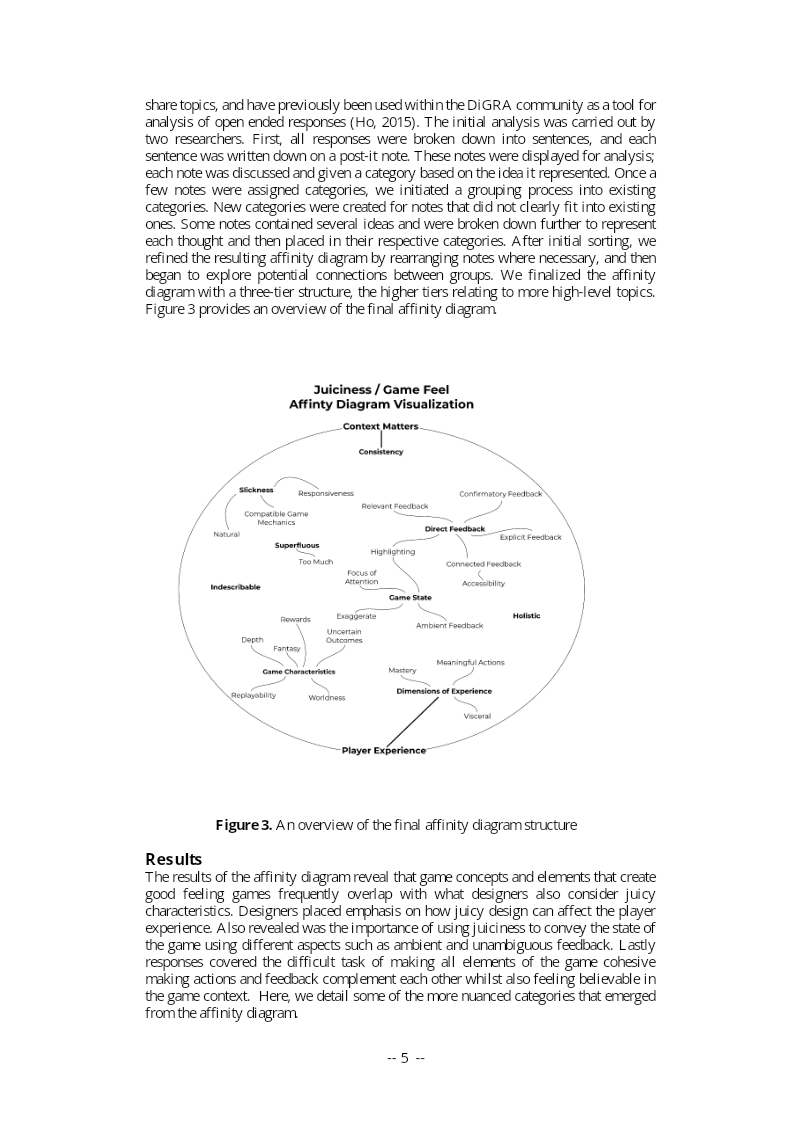
- The paper addresses the vague definition of "juicy design" by grounding it in a survey of 17 professional game developers, whose responses were organized via an affinity diagram into categories such as game characteristics, dimensions of experience, direct feedback, redundancy, and slickness.
- Developers stressed that juice must be integrated holistically with all game elements and matched to genre, since feedback alone is insufficient; effective feedback is exaggerated, multimodal, relevant, and non-overwhelming.
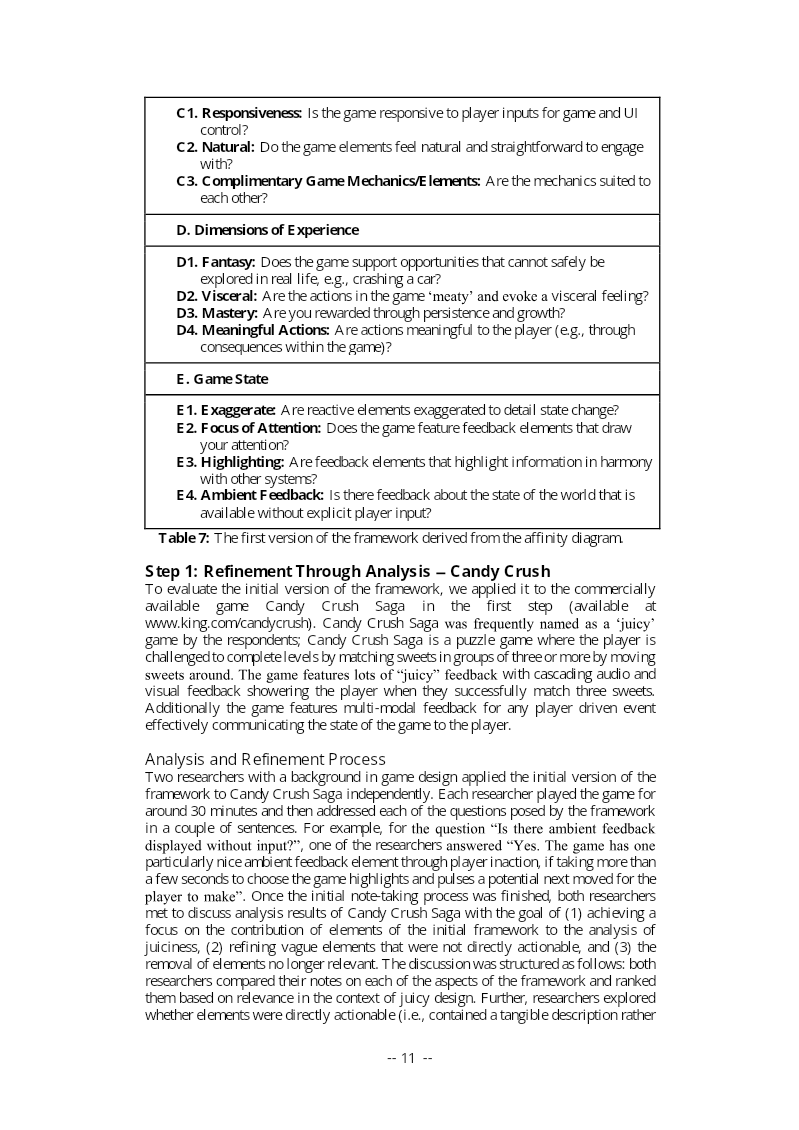
- The final analytical framework has three parts (Game Characteristics, Game State, and Direct Feedback) and 11 actionable questions, refined through two rounds of case analysis of Candy Crush Saga and Downwell.
Glitch Horror: BEN Drowned and the Fallibility of Technology in Game Fan Fiction
"Glitch Horror: BEN Drowned and the Fallibility of Technology in Game Fan Fiction" examines a emerging subgenre of horror rooted in anxieties about technological malfunction, using the 2010 4chan creepypasta BEN Drowned, a story about a haunted Majora's Mask cartridge, as its central case study.
- The report defines an emerging "glitch horror" subgenre whose dread comes from real, familiar technological frustrations such as corrupted saves, broken rules, and games behaving in unintended ways, rather than from supernatural invention alone.
- Its central case study, BEN Drowned (a 2010 4chan creepypasta about a haunted Majora's Mask cartridge), is analysed as a key example of how players' close identification with their avatars intensifies unease at malfunctioning technology.
- The analysis draws on Freudian and Mori-derived theories of the uncanny to argue that recognizable malfunctions provoke deep, involuntary unease in players.
Playing with Patriarchy: Fatherhood in BioShock: Infinite, The Last of Us, and The Witcher 3: Wild Hunt
This paper examines fatherhood and masculinity across three acclaimed games, BioShock: Infinite, The Last of Us, and The Witcher 3: Wild Hunt, through close reading and attention to procedural rhetoric.
- The paper argues that violence is the central device through which all three games reconcile hegemonic masculinity with the father role, claiming and sustaining a paternal bond that is not biological.
- Each game pairs its protagonist with an 'anti-father' (Comstock, David, and the Bloody Baron) whose excessive, inward-directed violence and community leadership serve to define what acceptable paternity looks like.
- The author concludes that the distance between protagonist and anti-father, combined with fatherhood consecrated through violence, tends to reinforce patriarchal models rather than prompt critical reflection.
If You Are Feeling Bold, Ask for $3: Value Crafting and Indie Game Developers
Consalvo and Paul's paper examines how indie game developers manage the risks of making, marketing, and pricing their games, a practice the authors term "value crafting."
- Indie games have no industry-standard price point, with prices ranging from free to roughly $30 and developers debating between $5, $10, or free-to-play, often based on anecdote rather than consistent evidence.
- Indie success has shifted from simply making a good game toward "value-crafting," which relies on analytics, pricing research, community engagement, and sustained marketing.
- By 2014 and 2015 Steam dominated indie sales, often accounting for the large majority of units sold, with Valve taking 30 percent of revenue.