1 free read left. Create a free account for unlimited reading + AI research.
Create free accountWhitepaper DiGRA
1 free read left. Create a free account for unlimited reading + AI research.
Create free accountWhitepaperDiGRA
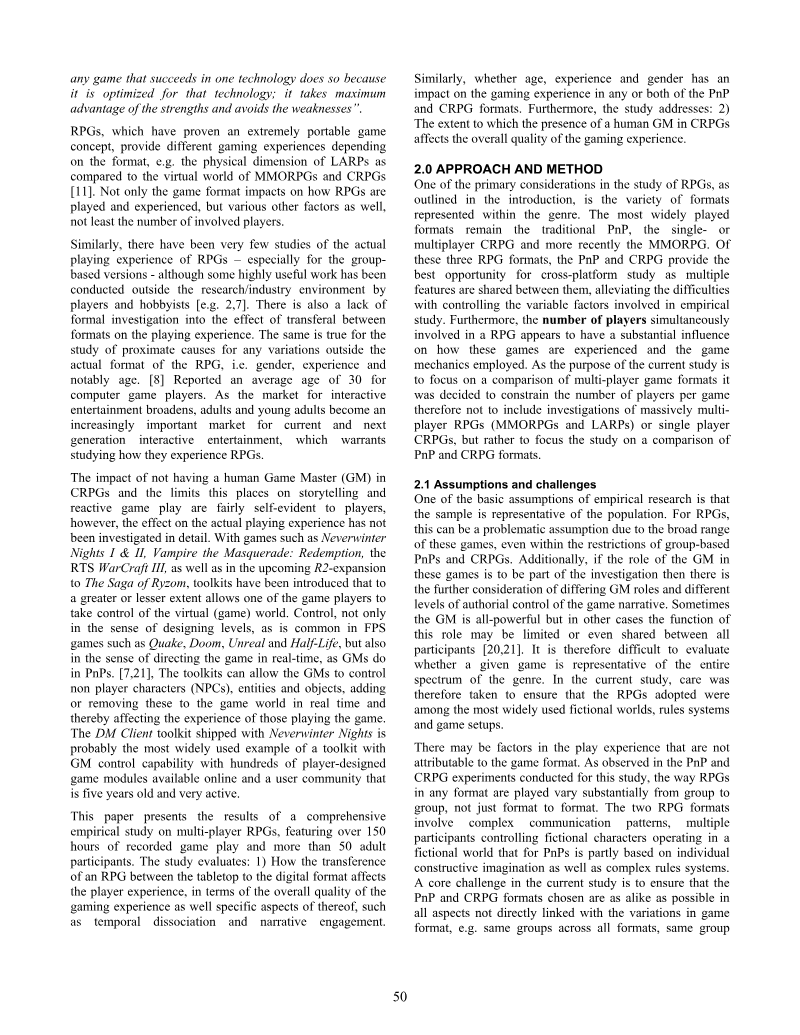
The paper examines how persistent online worlds can be designed to serve role-players. It is by Markus Montola of the University of Tampere.
This paper, by Markus Montola of the University of Tampere, examines how persistent online worlds can be designed to serve role-players, a growing audience whose motivations differ from those of regular gamers. Its central argument is that role-players construct subjective fictional worlds, called diegeses, and pursue goals chosen by their characters rather than goals built into a game's rules. The author distinguishes between exogenous goals (the player's own reasons for playing), endogenous goals (those encoded in game rules), and diegetic goals (those belonging to the character's imagined world), arguing that role-players often disregard endogenous goals and treat the idea of winning or losing as meaningless.
The paper draws on examples from World of Warcraft, City of Heroes, Star Wars Galaxies, and Eve Online, along with community rule sets from role-playing groups such as The League of Vigilance and the Europe-Chimaera Roleplayers Association. It proposes six criteria for effective online role-playing goals: diegetic desirability, plausibility, sensibility, consequentiality, relative optionality, and sociality. The author finds that scripted quest structures frequently fail these criteria because identical quests and reset objectives break immersion, while Eve Online's operator-supported emergent player activity satisfies them more often. Three sources of goal generation are identified: game masters, endogenous game structures, and goals arising within diegetic communities.
The paper concludes that many role-playing communities impose their own rules to add consequence to persistent worlds, and that scalable solutions may require combining volunteer game master networks with community-driven emergent activity. Citing Mulligan and Patrovsky, it argues that role-players are valuable both as paying customers and as free content providers, since they tend to retain other players.
DiGRA · 2016



DiGRA · 2016
DiGRA · 2007