1 free read left. Create a free account for unlimited reading + AI research.
Create free accountWhitepaper DiGRA
1 free read left. Create a free account for unlimited reading + AI research.
Create free accountWhitepaperDiGRA
The study followed 46 students aged 10 to 12 from two science classes taught by the same teacher. The outbreak was embedded within a teacher-led infectious disease curriculum.
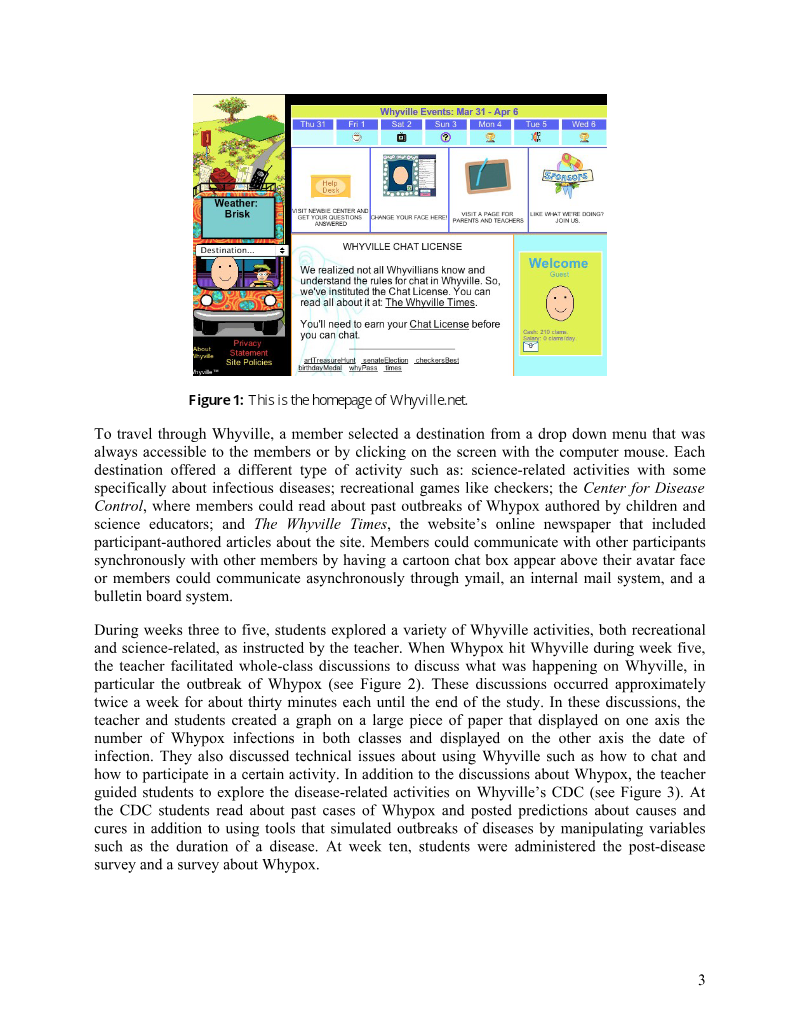
This study examines how sixth-grade students understand a virtual infectious disease, Whypox, which spread through Whyville.net, a multi-user virtual environment with more than 400,000 registered users at the time. The central research question asks how students' experiences of a virtual epidemic help them make sense of natural diseases. The researchers worked with 46 students aged 10 to 12 from two science classes taught by the same teacher at a laboratory school affiliated with a large urban university in Los Angeles, California. The virtual outbreak was embedded within a ten-week, teacher-led infectious disease curriculum that included videos, microscope work, hands-on transmission experiments, and worksheets.
The investigation combined pre- and post-unit surveys on natural disease, a Whypox-specific survey administered at the end, and analysis of videotaped whole-class discussions. Causal explanations were coded on a scale from pre-biological to biological for natural disease, and from pre-computational to computational for the virtual disease, with inter-rater agreement set at 80%. Classroom discussions showed that students and the teacher repeatedly used core terms such as contagion, symptoms, and immunity, and frequently mapped Whypox onto natural illnesses like the cold and the plague. Students also spoke of themselves as having Whypox, suggesting a strong sense of immersion.
Results indicated a significant shift in students' explanations of natural disease toward biological causal mechanisms, along with more comprehensive answers about causes and factors that increase spread. However, every student attributed Whypox transmission to contact, chat, or sneezing, with none invoking an embedded computational mechanism. The authors attribute this gap to the similarity of Whypox to familiar illnesses and to the absence of computational viruses in the curriculum, concluding that virtual disease designs should incorporate more biologically grounded causal models to better support conceptual understanding.
DiGRA · 2022
DiGRA · 2022
DiGRA · 2022
DiGRA · 2022
DiGRA · 2022
DiGRA · 2022
DiGRA · 2022
DiGRA · 2022
DiGRA · 2022

DiGRA · 2022
DiGRA · 2022
DiGRA · 2022
DiGRA · 2016