1 free read left. Create a free account for unlimited reading + AI research.
Create free accountWhitepaper DiGRA
1 free read left. Create a free account for unlimited reading + AI research.
Create free accountWhitepaperDiGRA
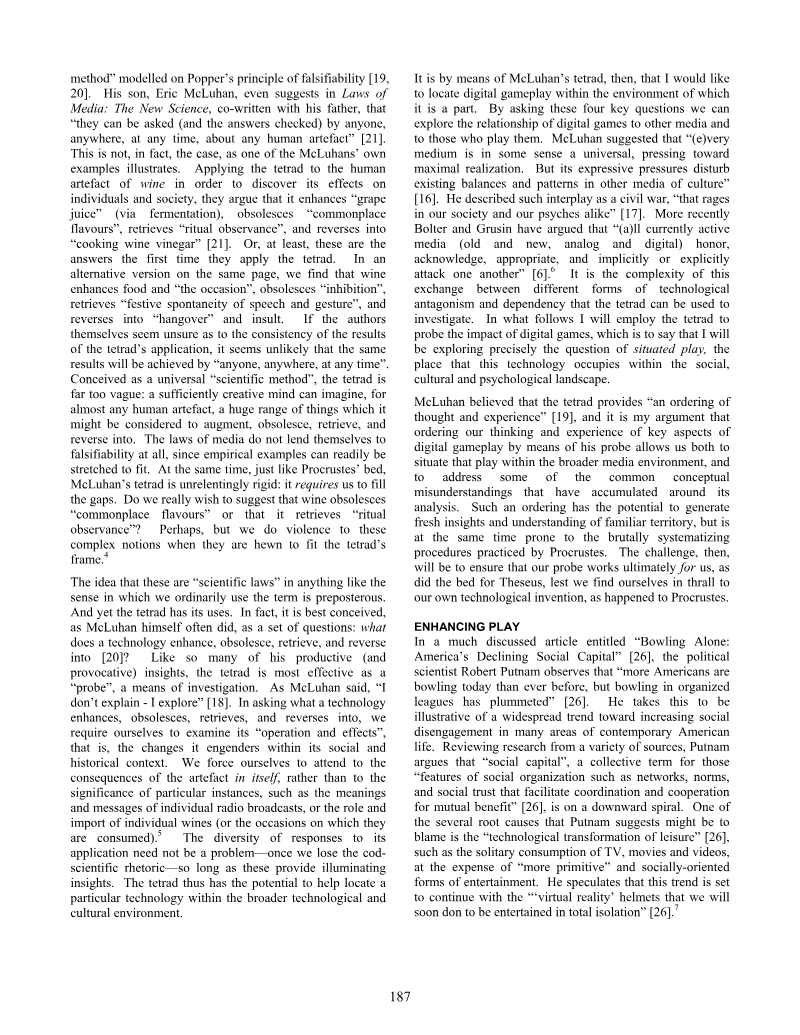
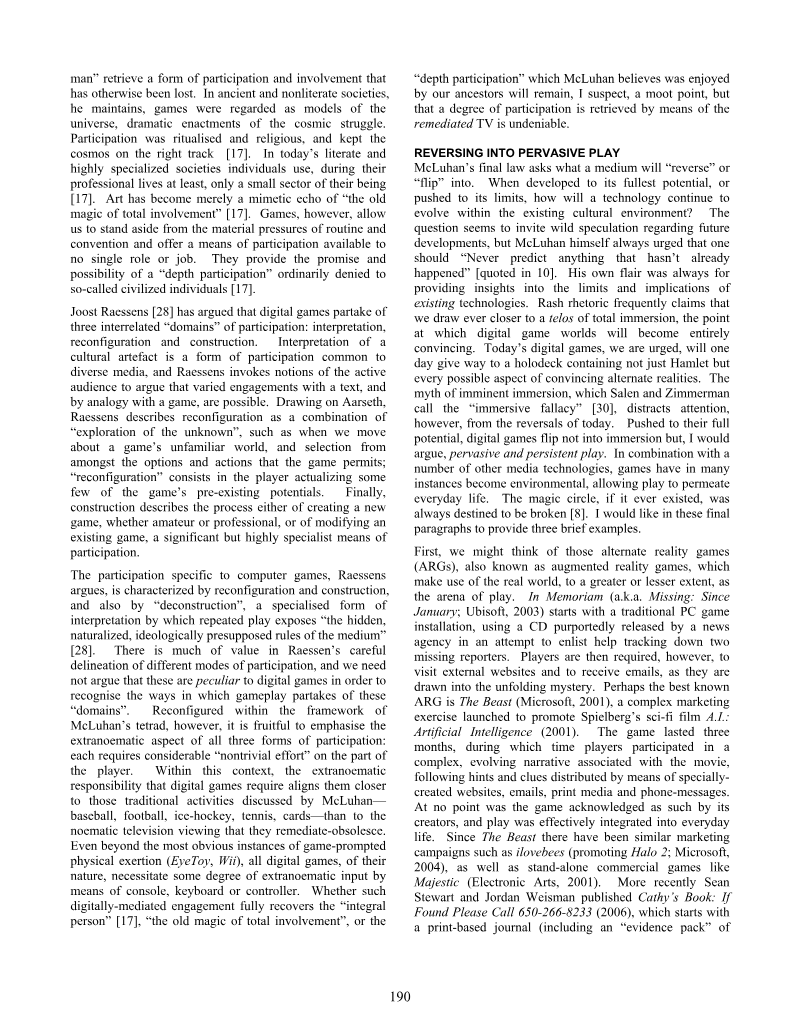
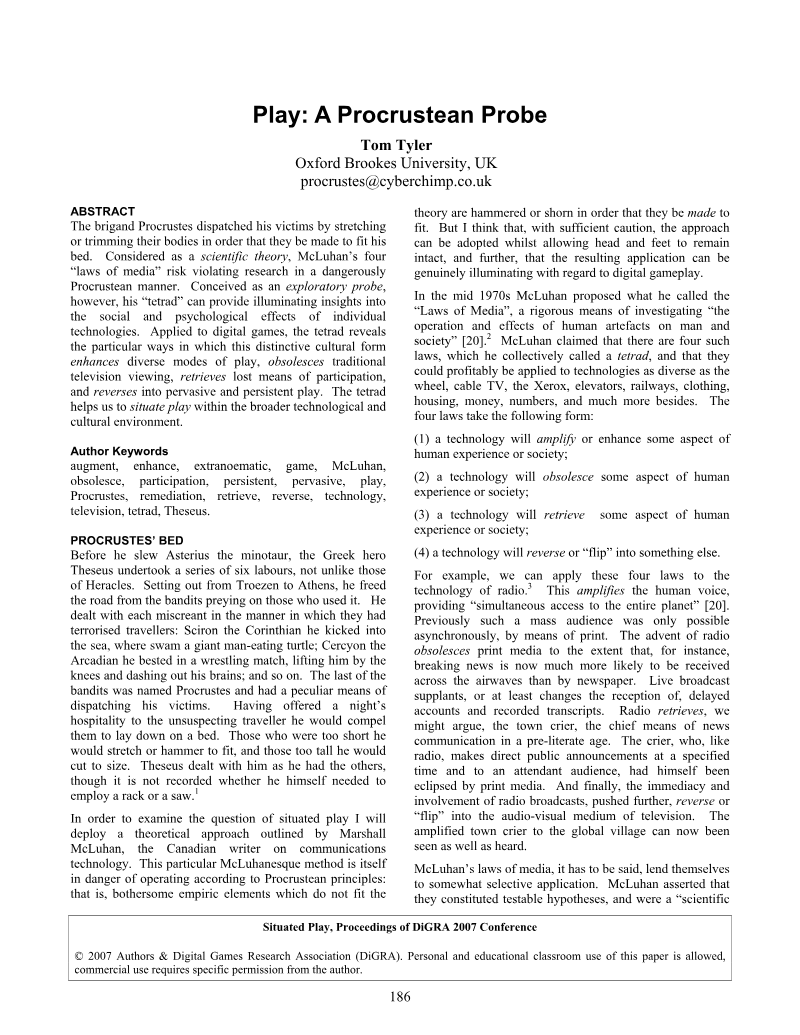
It applies the tetrad to situate play within its technological environment, rather than as a rigorous scientific method.
"Play: A Procrustean Probe" applies Marshall McLuhan's media "tetrad" to digital games, using it less as a rigorous scientific method than as an exploratory lens for situating play within its technological environment. The work's central thesis is that computerization transforms play in ways that challenge prevailing critiques. Against claims by Berger and Putnam that gaming is inherently isolating or a debased form of play, the analysis argues that digital games deepen solo play through computational complexity while also enabling large-scale multiplayer interaction, as seen in MMORPGs. Solitary play is traced back through board games, pinball, and solo role-playing books to show that isolation is a longstanding feature of play rather than a novel digital corruption.
A second line of argument holds that digital games obsolesce television by drawing players into physically engaged, "extranoematic" participation rather than passive viewing. The analysis further contends that games reverse into pervasive and persistent forms, including alternate reality games, virtual economies, and location-based mobile play. The supporting evidence is drawn from cross-sectional studies: a 1997 Dutch study showing electronic game play rising until age 13, a 2001 cross-European study ranking electronic games third among children's media use behind print and TV/audio, and Nick Yee's MMORPG survey reporting players averaging 21.0 hours of gaming weekly against 7.7 hours of television viewing, compared with a national average of roughly 28 hours of TV. The author is explicit that these figures do not establish causal displacement of television.
The work's scope spans developed-market contexts, principally the Netherlands, the United Kingdom, and broader Europe, and focuses on children's media use alongside adult MMORPG players. Its reference base includes UK national surveys and Dutch research on children's media time, which the author characterizes as indicative but inconclusive. The closing sections are largely bibliographic, and the remaining conceptual claims, such as the doubt that online interactions produce genuine communities and the comparability of digital games with other media in their engagement of the extranoematic, serve more as provocations than as established conclusions.



DiGRA · 2016



DiGRA · 2016



DiGRA · 2016



DiGRA · 2016



DiGRA · 2016



DiGRA · 2016

DiGRA · 2015



DiGRA · 2015



DiGRA · 2015
DiGRA · 2015
DiGRA · 2015
DiGRA · 2015












Comments