1 free read left. Create a free account for unlimited reading + AI research.
Create free accountArticle DiGRA
1 free read left. Create a free account for unlimited reading + AI research.
Create free accountArticleDiGRA
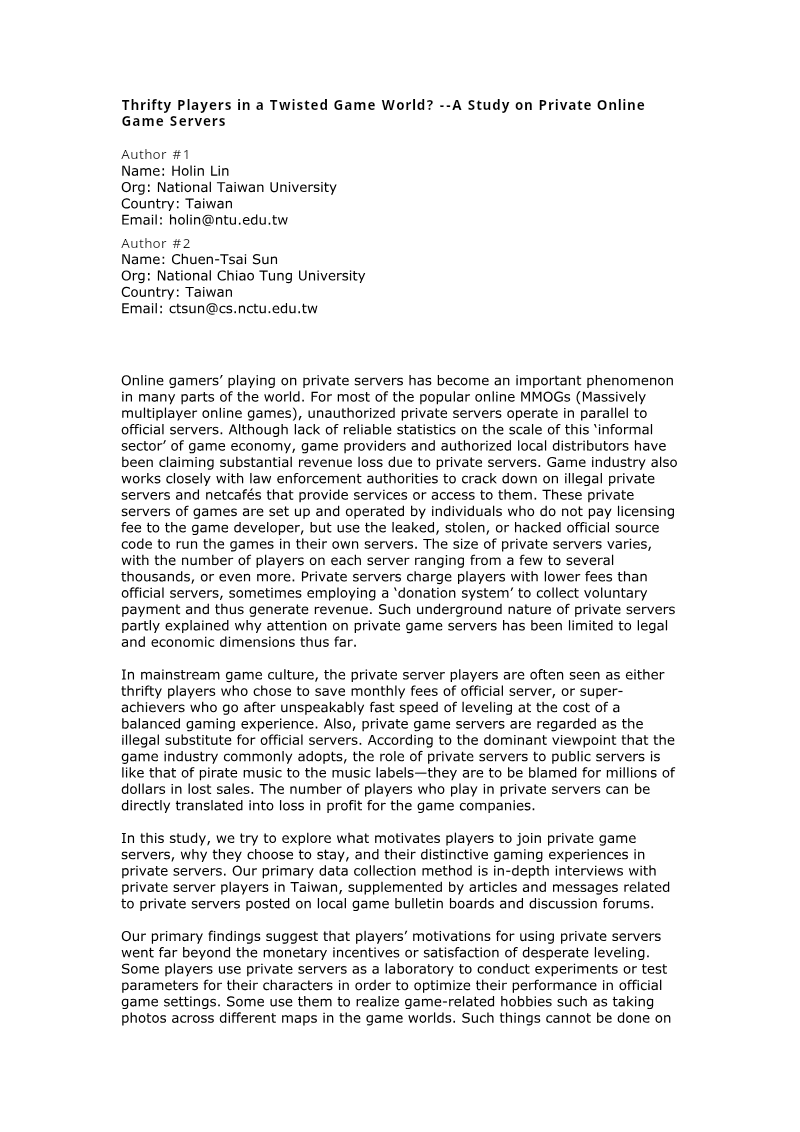
The study focuses on Taiwanese players, who began moving to free-to-play massively multiplayer online games from 2004 onward.
This study examines how the cash trading of virtual items in free-to-play massively multiplayer online games (MMOGs) affects players' sense of immersion, fairness, and the "magic circle," Huizinga's concept of a bounded play space. Focusing on Taiwanese players, who began migrating to free-to-play titles from 2004 onward and among whom an estimated 20 percent reportedly bought virtual props with cash, the authors frame commercial mechanisms as potential threats to the integrity of play. Their central argument is that free-to-play models have shifted players from community members toward consumers, thereby reshaping norms of fairness, immersion, and player self-image.
The analysis draws principally on player discourse from Taiwanese forums, including Gamebase and Bahamut, with a coded corpus of 1,176 posts addressing attitudes toward fairness, quality, fun, and game balance. Both supporters and critics of free-to-play games largely accept free-market logic, the "user-pay" principle, although critics voice concern over pay-to-win imbalances, a "one game, two experiences" divide between paying and non-paying players, and declining community order. Supporters defend these models through arguments about voluntary participation, player diversity, and self-discipline, while critics' discontent is often tempered by their acknowledgment that someone must pay for the game to continue.
Comparing business models, the authors find that free-to-play players are less likely to voice complaints, more inclined to exit, and show weaker community loyalty than monthly-subscription players, who report a stronger sense of ownership and greater concern with game balance. The findings rest largely on forum discussions and personal experience rather than systematic data, which tempers their generalizability. Ultimately, the authors locate the core tension in visible real-world inequalities between paid and unpaid advantages, and they conclude that questions surrounding item expiration, item longevity, and access to purchasable goods remain unresolved between industry and players.
DiGRA · 2022
DiGRA · 2022
DiGRA · 2022
DiGRA · 2022
DiGRA · 2022
DiGRA · 2022
DiGRA · 2022
DiGRA · 2022
DiGRA · 2022
DiGRA · 2022
DiGRA · 2022
DiGRA · 2022
Gamota · 2026