1 free read left. Create a free account for unlimited reading + AI research.
Create free accountWhitepaper DiGRA
1 free read left. Create a free account for unlimited reading + AI research.
Create free accountWhitepaperDiGRA
Sybille Lammes analyses Civilization III: Play the World as a commercial strategy title with built-in narrative and interface choices.
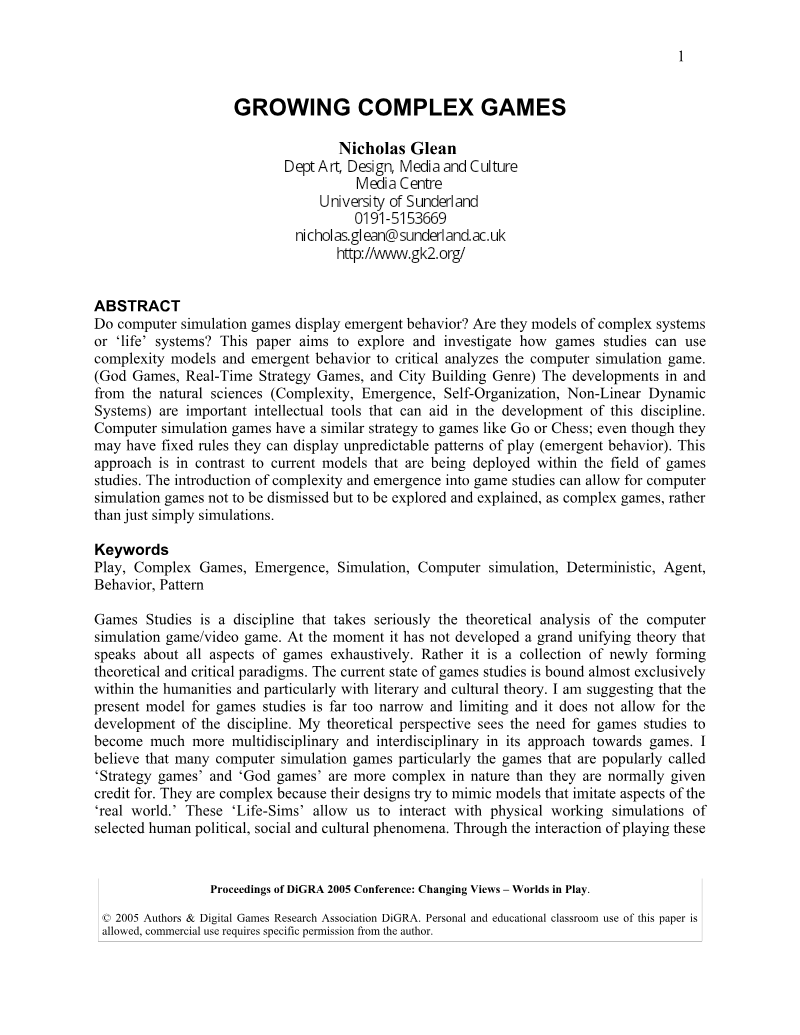
Sybille Lammes's analysis of Civilization III: Play the World argues that the game presents exploration and expansion as a colonialist progression, moving from "nature" toward a Western, white, male-centred "civilization." Drawing on postcolonial and science studies, the author reads the game's intro cinematics, such as the Tower of Babel imagery, and its setup options, including the framing of "Barbarians" as nature-bound and non-Western cultures as rivals, as naturalising connections between expansionism, science, masculinity, and whiteness. The approach is qualitative and interpretive rather than data-driven.
The central argument is that the game's border expansion mirrors European colonial attitudes, in which colonies function as resource extraction zones for the homeland and "othered" peoples and territories are subject to control. The game's journey from nomadic origins to city-building is thus understood as a reinforcement of dominant colonial ideology. At the same time, the analysis finds that the game's temporal inconsistencies and absurd elements open space for subversive, postcolonial readings. Players, in this account, can decode and parody the game's assumptions, exposing the limitations of its worldview even as the game largely reproduces them.
The scope of the study centres on a single commercial strategy title and its built-in narrative and interface choices rather than on player populations, sales, or broader industry trends. Its evidence base consists of textual, visual, and procedural analysis of the game itself, along with its manual. The closing reference material situates the work within media studies, anthropology, and game studies, drawing on scholarship about game patches and hacker art, the pleasures and violence of video games, and the politics of whiteness and identity. The article's contribution lies in interpretation, specifically in showing how a popular game encodes colonial ideology and how players might resist it.



DiGRA · 2023

DiGRA · 2023



DiGRA · 2023

DiGRA · 2023
DiGRA · 2023



DiGRA · 2023



DiGRA · 2023



DiGRA · 2023



DiGRA · 2023



DiGRA · 2023



DiGRA · 2023

DiGRA · 2023
Two & a Half Gamers · 2024