1 free read left. Create a free account for unlimited reading + AI research.
Create free accountWhitepaper DiGRA
1 free read left. Create a free account for unlimited reading + AI research.
Create free accountWhitepaperDiGRA
The model helps designers select NVC elements, vary them through parameters such as movement speed and trajectory, and personalise avatars so each has a distinguishable communicative identity.
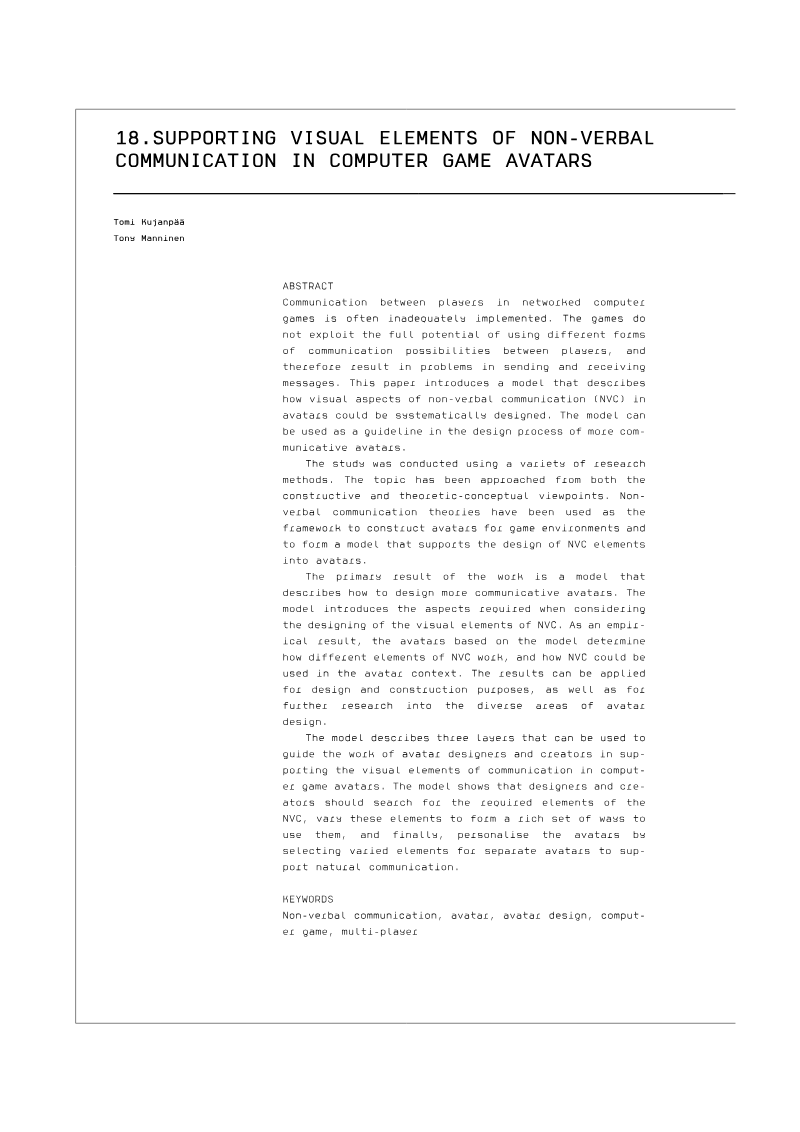
This paper presents a three-layer model for systematically designing the visual elements of non-verbal communication (NVC) in avatars for multiplayer computer games. The authors argue that networked games often fail to exploit the range of communication possibilities available to players, leading to difficulties in sending and receiving messages. Their model guides designers through selecting NVC elements, varying those elements through parameters such as movement speed and trajectory, and personalising avatars so that each has a distinguishable communicative identity. The work combines constructive research, in which avatars were built and iteratively tested in two game environments called Tuppi3D and Virtual Live Action Role-Play, with theoretical-conceptual generalisation drawn from social science literature on NVC.
The study focuses on three visual categories: physical appearance, kinesics (bodily movement and gesture), and facial expressions. Eye movement and gaze were excluded because of limitations in the experimental technology. Evaluation relied on small-scale user tests and detailed video analyses of avatars implemented with varying sets of elements. The authors report that adding NVC elements increased players' opportunities to convey and receive messages, that varying those elements enabled richer and subtler expression, and that personalisation made avatars more recognisable and prevented identical actions from appearing across different avatars. The evidence base is modest, however, consisting of prototype constructions and limited testing rather than large-sample studies.
The authors acknowledge several limitations. The model is general and does not prescribe specific technical solutions, and it does not address the particular constraints of virtual environments, such as camera distance, field of view, and the difficulty of tracking users' faces in real time. They also note that not all multiplayer games require extensive communication, and that the optimal degree of personalisation remains an open question. The paper concludes that the model is a useful design aid, while calling for further validation within real design processes and further study of NVC elements specific to virtual bodies.

DiGRA · 2023
DiGRA · 2023
DiGRA · 2023
DiGRA · 2023
DiGRA · 2023
DiGRA · 2023
DiGRA · 2023
DiGRA · 2023
DiGRA · 2023

DiGRA · 2023
DiGRA · 2023
DiGRA · 2023

PocketGamer.biz · 2026