1 free read left. Create a free account for unlimited reading + AI research.
Create free accountWhitepaper DiGRA
1 free read left. Create a free account for unlimited reading + AI research.
Create free accountWhitepaperDiGRA
The pilot examined whether eye-hand coordination relates to computer game skill and whether avid gamers have superior coordination.
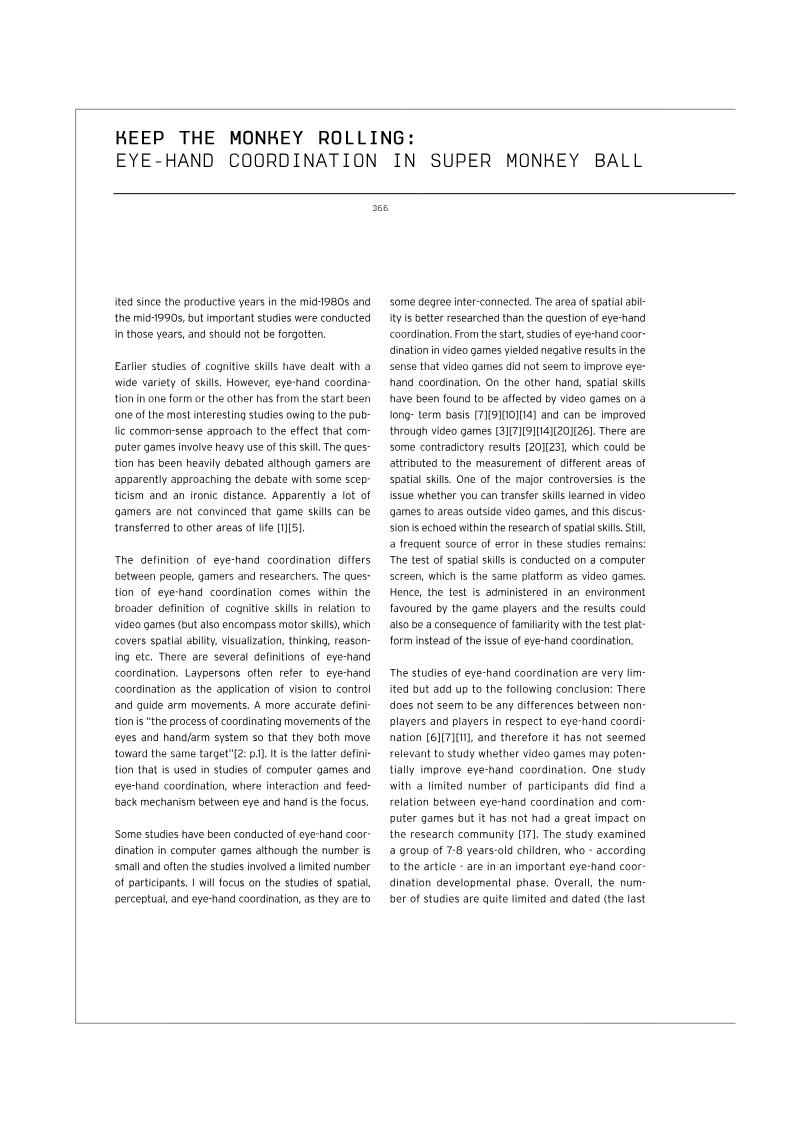
This pilot study, part of a larger joint examination of Super Monkey Ball conducted by researchers at the Center for Computer Games Research at the IT University of Copenhagen, investigates whether eye-hand coordination is linked to computer game skill and whether avid gamers possess superior eye-hand coordination. The paper is explicitly exploratory, with its main value lying in the methodological problems it surfaces rather than in conclusive findings. The game itself, released by Sega for the Nintendo GameCube in 2001, was chosen partly because its controls and party modes make it a convenient subject for observing the interplay between what players see and how they manipulate a controller.
The research combines a review of prior work with a small field study. The literature review traces decades of inconsistent results: some early studies found spatial skill gains from play, while others, including several examining eye-hand coordination directly, found no meaningful relationship. The empirical component involved seven boys aged 10 to 13 from an urban after-school centre in Copenhagen, each given the Test of Visual-Motor Skills before or after a play session. The sample was small and self-selected, and the environment was noisy and socially charged, with girls in the vicinity visibly disrupting the boys' engagement and affecting the testing conditions.
Results were too limited to support firm conclusions. Individual scores varied widely, and the one participant who played before testing and ranked lowest on the scale, along with an overall percentile mean somewhat above expectation, did not establish any reliable pattern. The author concludes that the data do not substantiate a connection between computer game skill and eye-hand coordination, though the claim cannot be dismissed outright. The paper ultimately emphasizes that rigorous future work would require controlled conditions, pre- and post-testing with control groups, and more careful attention to social and environmental influences on children's behaviour.
Each row is a game or company this document names, each column a document, oldest first. A mark means that document names it. Select a row to see those documents.

DiGRA · 2016

DiGRA · 2016

DiGRA · 2016



DiGRA · 2016



DiGRA · 2016



DiGRA · 2016



DiGRA · 2016



DiGRA · 2016



DiGRA · 2016

DiGRA · 2015



DiGRA · 2015



DiGRA · 2015