
DiGRA
The Digital Games Research Association: the international association of academics and professionals who study digital games. Its Digital Library holds the proceedings of the DiGRA conferences since 2002.
Documents
Ludologists Love Stories, Too: Notes From a Debate That Never Took Place
Gonzalo Frasca's article argues that the widely described "ludology versus narratology" debate in game studies never truly took place, because it rests on a cluster of misunderstandings about terminology, positions, and intentions.
- The 'ludology versus narratology' debate in game studies never truly took place; Frasca argues it rests on misunderstandings about terminology, positions, and intentions.
- The label 'ludology' was not coined by Espen Aarseth or by Frasca, and it was defined in ways that many later scholars wrongly took to mean a rejection of narrative.
- Few scholars actually self-identify as narrativists, making the supposed opposing camp difficult to locate.
In Search of a "Fifth Dimension"
Maaike Lauwaert's paper argues that Roger Caillois's established taxonomy of play, comprising agôn (competition), alea (chance), mimicry (simulation), and ilinx (vertigo), is insufficient for analyzing digital games.
- Maaike Lauwaert argues that Roger Caillois's four-category taxonomy of play (agôn, alea, mimicry, ilinx) is insufficient for analyzing digital games and proposes a fifth dimension, "repens," defined as sequentially embedded surprise deliberately programmed into a game's progression.
- Repens differs from chance because its surprises are intentionally placed rather than randomly generated, with examples including medical packs appearing in Tomb Raider and back-attacks in Final Fantasy.
- The paper's central thesis is that repens distinguishes digital games from non-digital games and enables them to combine multiple play dimensions at once, with No One Lives Forever and Tony Hawk's Pro Skater 3 offered as illustrative cases.
Making and Breaking Games: A Typology of Rules
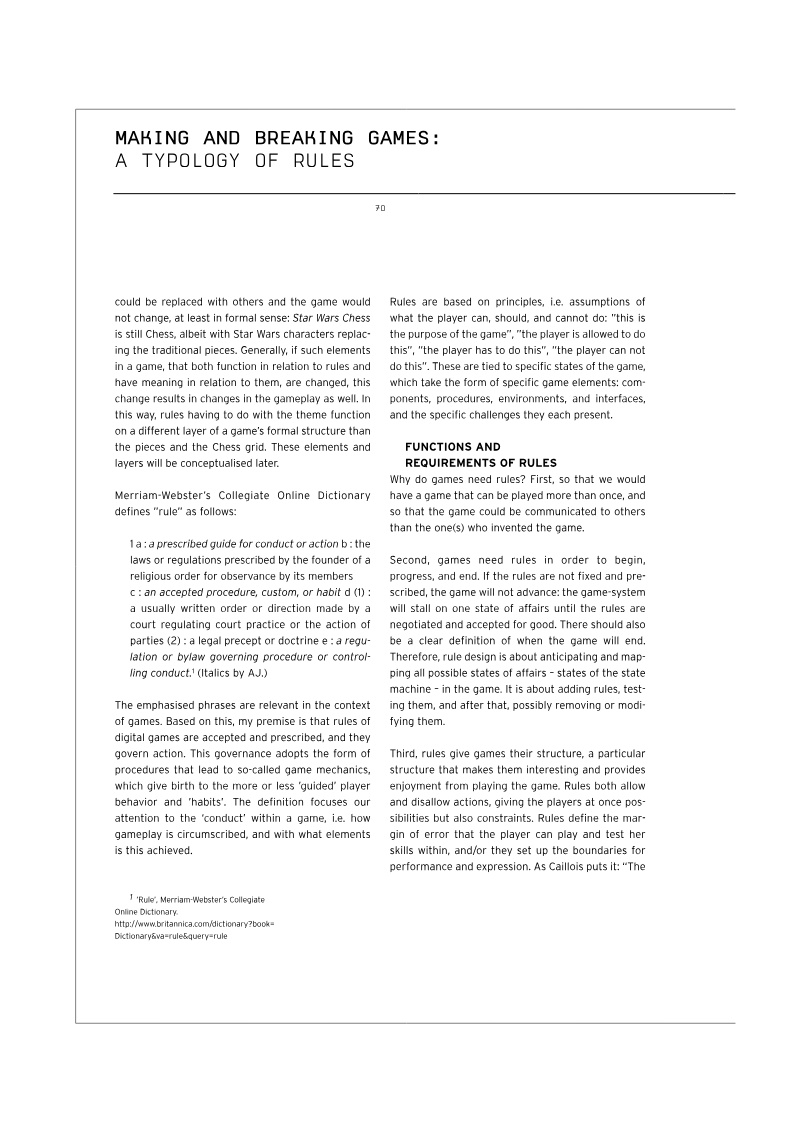
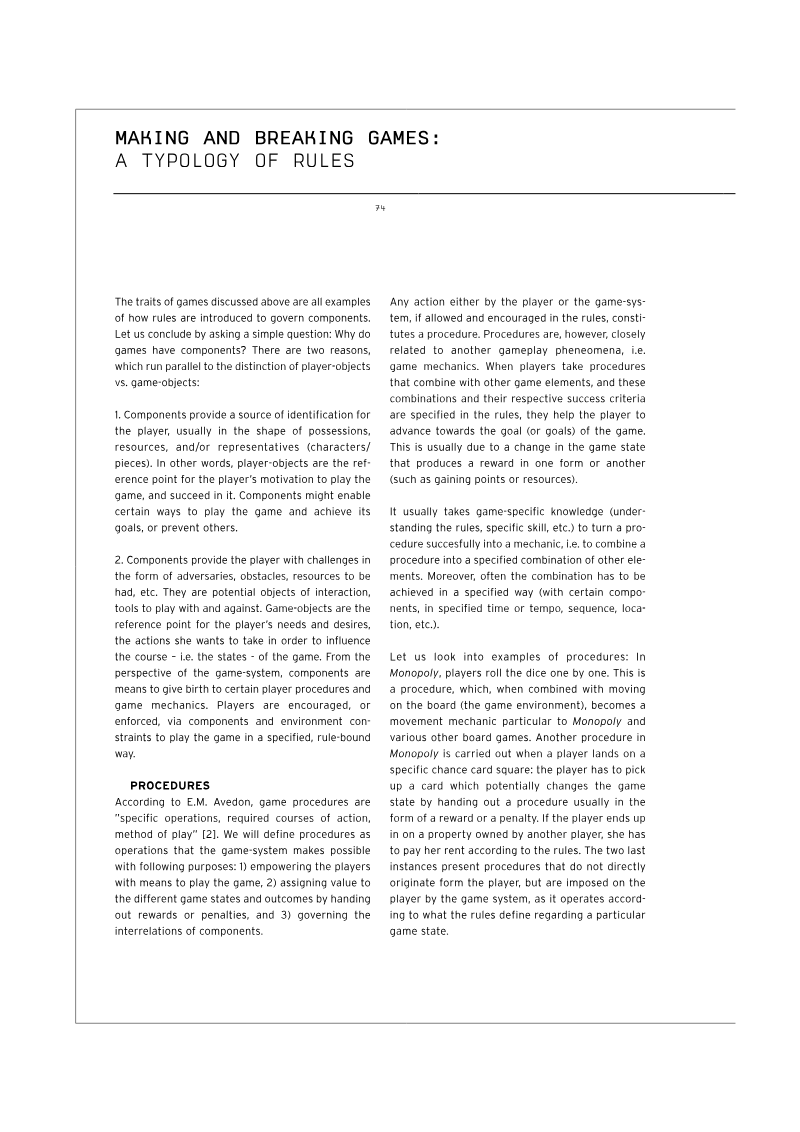
Järvinen's "Making and Breaking Games: A Typology of Rules" proposes a conceptual framework for analyzing games by treating them as state machines, in which rules define the possible states of play, the transitions between them, and the conduct permitted to players.
- Järvinen's framework treats games as state machines, where rules define the possible states of play, the transitions between them, and the conduct permitted to players, with rules rather than theme forming the fundamental structure of games.
- Rules are organized around five game elements: components, procedures, environments, themes, and interfaces, of which components and procedures are mandatory for any game while environment, theme, and interface rules are optional layers built on that core.
- The Chess-with-Star-Wars-characters example illustrates that theme sits on a separate layer from the underlying ruleset, so changing the theme does not change the game's rules.
The Gaming Landscape: A Taxonomy for Classifying Games and Simulations
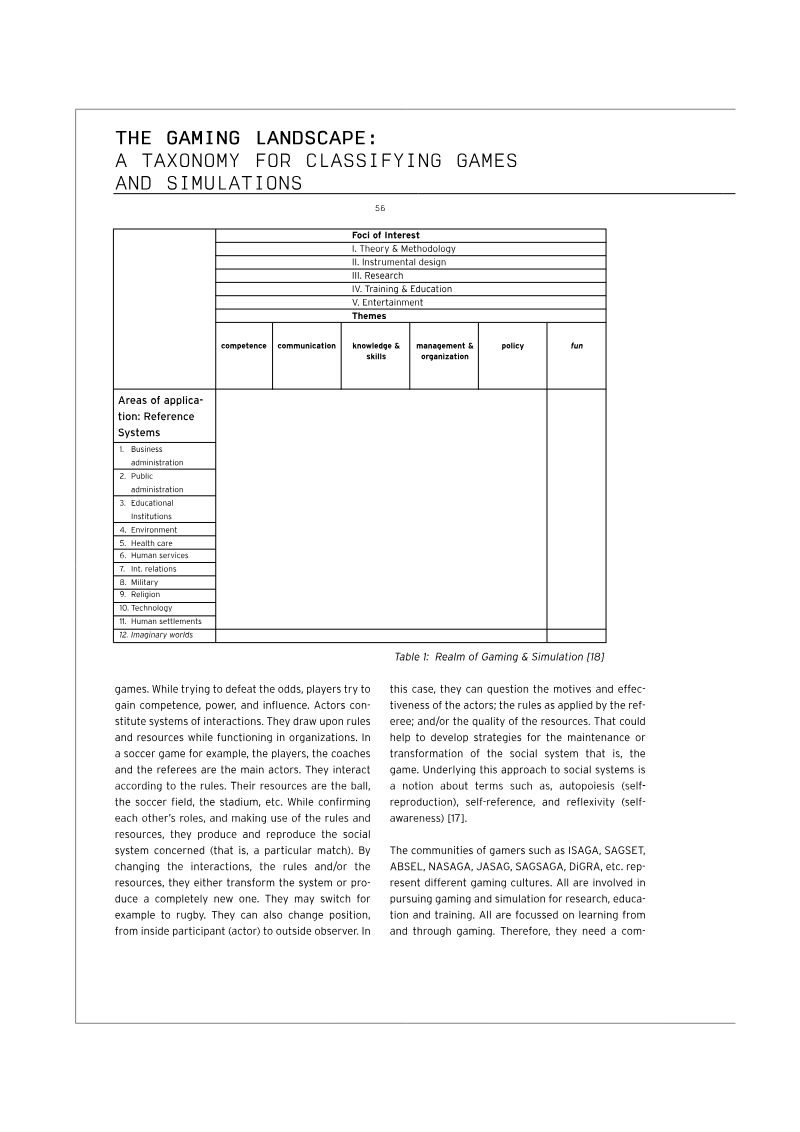
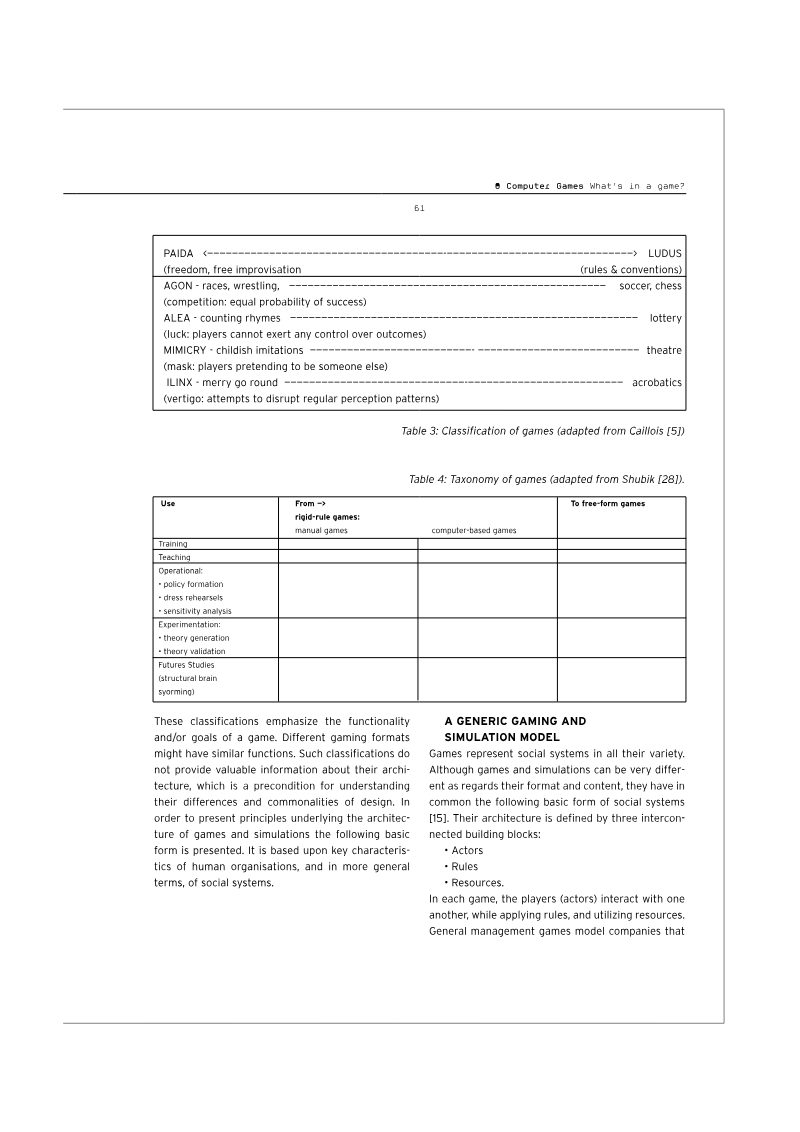
This paper develops a taxonomy for classifying games and simulations, aiming to give gaming communities a common language and a meta-disciplinary framework that reduces confusion across theory, design, research, training, and entertainment.
- The paper argues that existing game classifications, which emphasize function and format, miss the underlying architecture of games, and proposes treating games as socially constructed systems built from actors, rules, and resources.
- It contrasts an acquisition metaphor of learning (knowledge as a commodity transferred to learners) with an interaction metaphor (learning as participation within a system), grounding the latter in the paper's framing of how learning occurs through play.
- Games are proposed to be distinguished as allopoietic (steered by external control) or autopoietic (capable of reproducing and sustaining themselves), a basis the author claims is more coherent than genre- or medium-based classifications for separating gaming from simulation.
Uncle Roy All Around You: Mixing Games and Theatre on the City Streets
Uncle Roy All Around You is a research paper by Flintham, Anastasi, Benford and colleagues that describes a pervasive game mixing street performance with online play in central London during May and June 2003.
- The 2003 London production of 'Uncle Roy All Around You' ran in May and June 2003 as a pervasive game blending street performance with online play, involving 272 street players and over 200 online players.
- Street players searched the city for an elusive character named Uncle Roy using handheld computers and wireless networking, while online players tracked them through a parallel 3D model of London and could help or hinder them via text, audio and chat.
- Street participation was capped at ten simultaneous players due to technical and human resource constraints, and the production required more than ten actors and crew to support just twenty players at a time.
Textuality and Videogames: Interactivity, Narrative Space and Role Play
Textuality and Videogames is an interdisciplinary academic study that interrogates whether videogames, particularly Role Play Games, can be understood as narrative forms.
- Games incorporate narrative elements players genuinely value, but the authors argue they are not inherently narrative media, since real-time play unfolds as events rather than fixed sequences.
- Player agency disrupts the linear structures that narratological theorists such as Chatman describe, challenging the application of traditional narrative theory to games.
- Based on a two-year research project (2001–2003) at the Institute of Education, University of London, the study combines textual analysis, video recordings of players in domestic settings, and interviews with players and developers.
Together We Brand: America's Army
The document examines America's Army: Operations (AA:O), a free online military first-person shooter developed by the US Army's MOVES Institute, and argues that the game functions simultaneously as an advergame, a recruiting tool, an educational training simulation, and a branding vehicle.
- America's Army: Operations functioned simultaneously as an advergame, recruiting tool, training simulation, and branding vehicle, with the authors calling this blend "advertainment" and arguing the Army deliberately fused commercial, entertainment, and participatory online objectives into one brand experience.
- Rather than collecting explicit personal data, the game built the Army's identity through aesthetic and sensory immersion, positioning it as a central expression of the Army brand during its "Together We Stand" rebranding campaign.
- By November 2002 the free game had attracted over one million registered accounts and 32 million completed missions, and Army recruiting website traffic reportedly rose 28 percent after launch.
Enchanting Reality: A Vision of Big Experiences on Small Platforms
Martin Ericsson's paper argues that mobile gaming has so far largely cloned or ported existing console and desktop titles, leaving the distinctive capabilities of handheld devices (mobility, GPS, and communications) underused.
- The paper argues mobile gaming has largely cloned or ported console and desktop titles, leaving handheld capabilities such as mobility, GPS, and communications underused.
- Its central thesis is that compelling physical-world games create immersion through "diegetic consistency," where the fictional world aligns with the player's sensory reality.
- The authors propose "enchanted reality" games, in which real-world actions meaningfully alter the virtual world rather than merely triggering isolated events.
It's No Videogame: News Commentary and the Second Gulf War
Mia Consalvo's study examines how U.S. news media and commentators deployed "videogame" as a dismissive descriptor during coverage of the Second Gulf War, drawing on a sample of 75 stories from March and April 2003.
- Consalvo's study analysed 75 U.S. news stories from March and April 2003 to see how the term "videogame" was used in coverage of the Second Gulf War.
- The dominant usage was pejorative: critics called the war coverage fake, trivial, or unreal, arguing the conflict lacked the real human suffering that would make it serious.
- A second strand described the war as "just like a videogame" because of its hi-tech sophistication, revealing both generational unease and fascination with military technology.
Power Gamers Just Want to Have Fun?: Instrumental Play in a MMOG
T.L. Taylor's paper, "Power Gamers Just Want to Have Fun?: Instrumental Play in a MMOG," challenges the popular image of the power gamer as an isolated cheater or a joyless grinder.
- Power gaming in EverQuest is a rigorous, efficiency-driven style of play, marked by dynamic goal-setting, long sessions of repetitive grinding, treating failure as a learning opportunity, and transferring game knowledge across titles, and Taylor argues it deserves recognition as legitimate play rather than dismissal as a corruption of fun.
- Power gaming is profoundly social rather than solitary: players rely on practices like 2-boxing and 3-boxing, community tools such as ShowEQ and strategy websites, and friendship networks and "uber" guilds to access high-end content like epic items and difficult raid encounters.
- Reputation systems and collaboration shape what it means to be a power gamer, so efficiency is achieved through collective effort as much as individual skill.
The Playability of Texts vs. the Readability of Games: Towards a Holistic Theory of Fictionality
Julian Kücklich's paper argues that games and literary texts are both best understood as fictional worlds that require active, playful participation from the reader or player, and that literary theory can therefore contribute substantially to game studies beyond narratological analysis.
- Kücklich argues that games and literary texts are both fictional worlds requiring active playful participation, and that literary theory can contribute to game studies well beyond narratological analysis.
- Drawing on Wolfgang Iser's concept of the Textspiel, the paper frames fiction-making as a triadic process linking the real, the fictive, and the imaginary, with play as the mediating force.
- To give the concept rigor, Kücklich proposes a six-world model adapted from Marie-Laure Ryan's possible worlds theory, distinguishing the reader's actual and possible worlds, the narrator's actual world, and the textual actual and reference worlds.
Exploring Clan Culture: Social Enclaves and Cooperation in Online Games
Clan culture in massively multiplayer online role-playing games (MMORPGs) is shown to be a rational, adaptive response to the competitive and interdependent design of these virtual worlds.
- Clan membership in MMORPGs is a rational, adaptive response to competitive and interdependent game design, since progression and survival depend on group action.
- In a survey of 493 Lineage players, only 5.7% had never belonged to a clan, and interviews with 14 snowball-sampled participants indicated clans offer protection against fraud, bullying, and theft.
- Clans form most readily among off-line acquaintances, because existing social ties reduce the uncertainty of cooperating with strangers.