
DiGRA
The Digital Games Research Association: the international association of academics and professionals who study digital games. Its Digital Library holds the proceedings of the DiGRA conferences since 2002.
Documents
Is Electronic Community an Addictive Substance?
This paper contends that labeling online games such as EverQuest as "addictive" is a misleading framing that obscures what is often a deeper problem of social isolation and unmet need for community.
- The paper argues that labeling online games like EverQuest as "addictive" is a misleading framing that obscures deeper problems of social isolation and unmet need for community.
- The authors contend that media coverage and policy portray heavy players as helpless victims of a compulsive product, overlooking the life circumstances and social motivations driving their engagement.
- Based on six months of ethnographic fieldwork with three EverQuest players and one psychiatrist, the authors find engagement is driven mainly by guild membership, group play, social status, and a sense of accomplishment.
"You Shoot Like a Girl!": The Female Protagonist in Action-Adventure Video Games
This study examines how female protagonists are constructed in action-adventure video games, using a content analysis of three 2002 titles: Metroid Prime, Resident Evil, and Eternal Darkness.
- The study is a content analysis of three 2002 action-adventure games (Metroid Prime, Resident Evil, and Eternal Darkness) and argues that their female protagonists nominally challenge gender norms while their heroism is repeatedly qualified.
- Jill Valentine (Resident Evil) is cast as a victim, damsel, and target of abuse, while Alex (Eternal Darkness) remains largely passive until the final battle, undercutting their agency.
- Samus Aran (Metroid) is the most gender-neutral and emotionally unmarked of the three, largely avoiding the victimization and beauty conventions shaping Jill and Alex, partly because her armored suit sidesteps Western beauty ideals.
Conditions of Engagement in Game Simulation: Contexts of Gender, Culture and Age
Game design has long relied on the intuitions of "hardcore" players, who make up roughly 10 percent of the audience, a pattern that risks leaving casual players underserved.
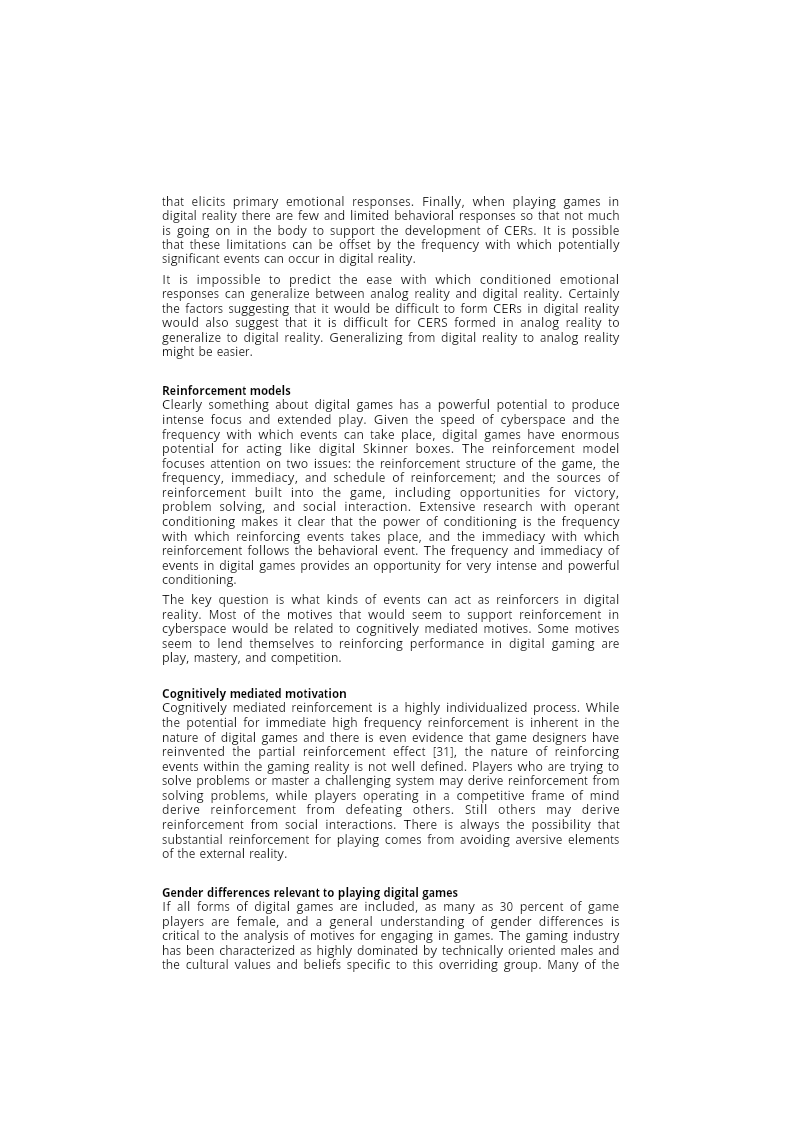
- Game design has long relied on the intuitions of 'hardcore' players, who make up roughly 10 percent of the audience, risking neglect of the casual majority.
- The authors argue casual players can be reached through systematic psychological research rather than derivative design, and that an optimal level of resemblance to reality, rather than maximal realism, may better serve broad appeal.
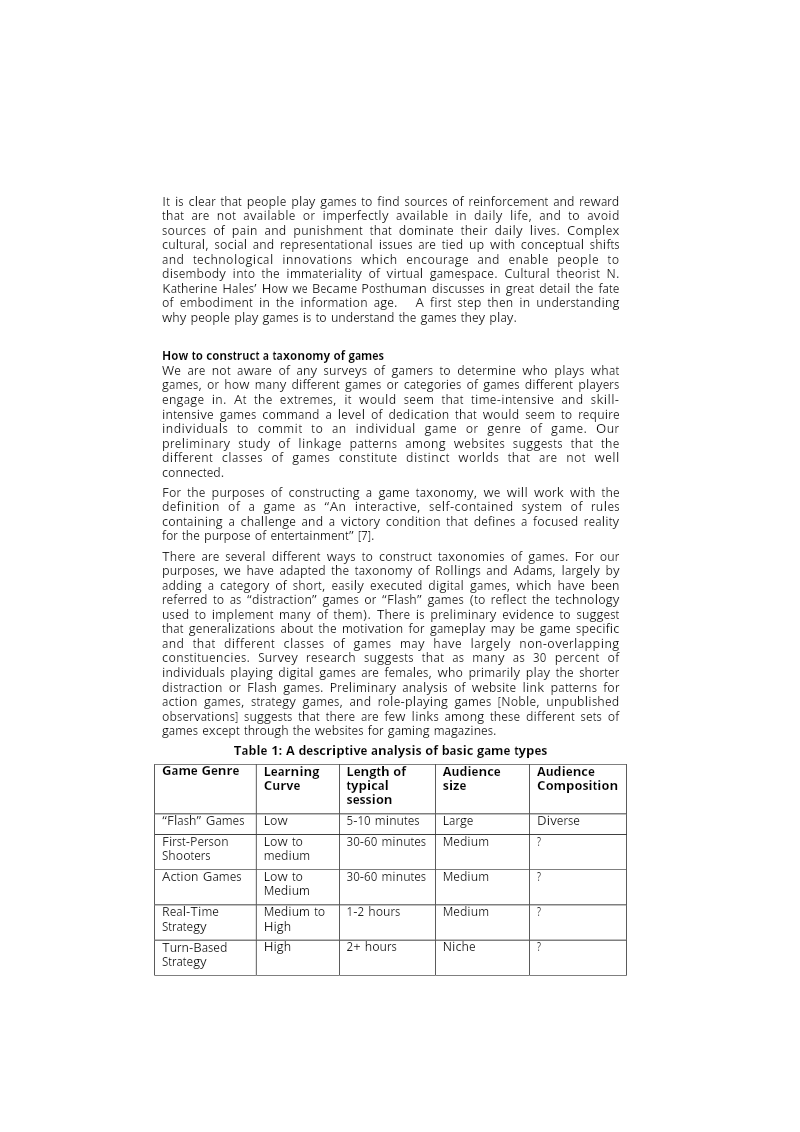
- Survey evidence suggests around 30 percent of digital game players are female, concentrated in short Flash games, though the authors acknowledge much of their game taxonomy rests on incomplete demographic data.
How Videogames Express Ideas
Matthew Weise's essay "How Videogames Express Ideas" argues that videogames are a legitimate medium of expression deserving constitutional protection, and it takes as its starting point the 2002 U.S.
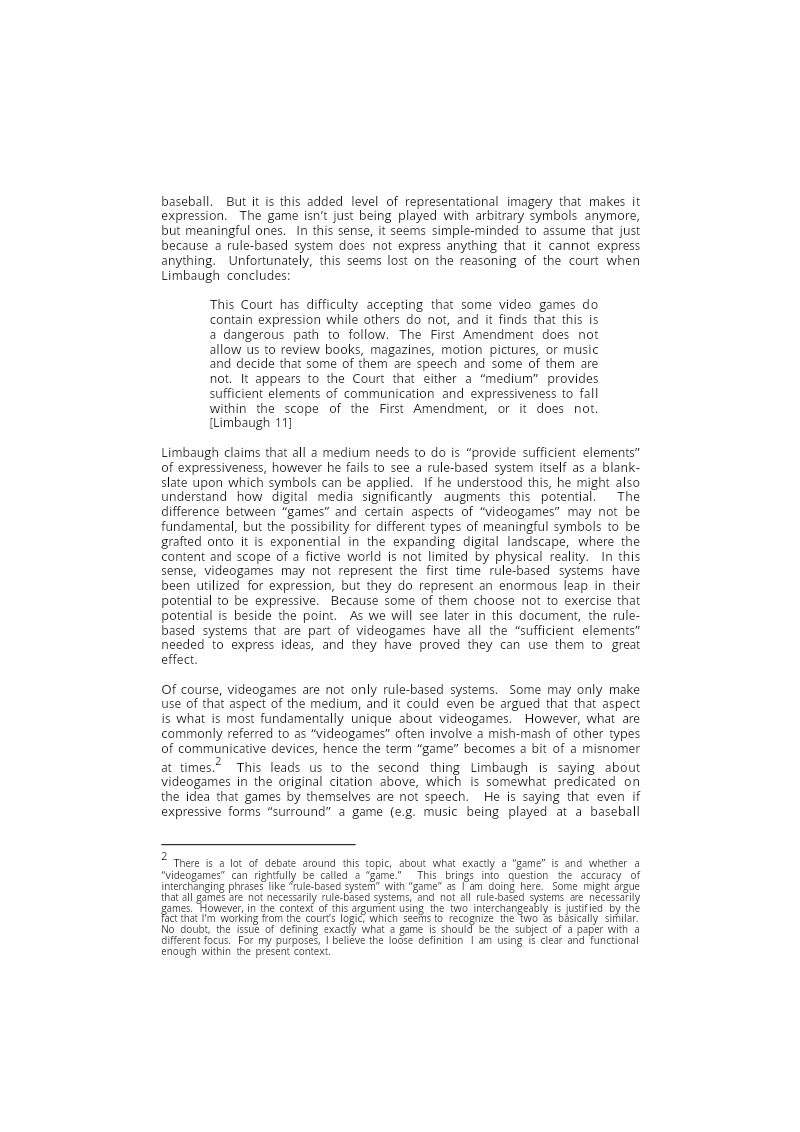
- The essay takes as its starting point the 2002 U.S. District Court ruling in the Limbaugh case, which held that videogames are not protected speech under the First Amendment, and argues that this ruling rested on two misconceptions: that rule-based gameplay cannot carry expressive meaning, and that non-playable narrative sequences are arbitrary additions.
- Weise rejects both premises by drawing an analogy to improvisational theater, arguing that rule-governed systems can communicate ideas when layered with symbolism.
- The analysis is organized around three expressive strategies: non-playable sequences, rule-based systems, and the interaction between them, with the combination considered most powerful because mechanics can reinforce narrative meaning in ways non-interactive media cannot.
The Attack of the Backstories (and Why They Won't Win)
David Myers' essay, along with the broader argument it represents, contends that backstories are not essential to computer game play.
- The core claim is that backstories are not essential to computer game play: players engage meaningfully through innate semiotic capacities without knowing a game's conventional meanings, so backstories belong to design and convention rather than to play itself.
- Backstories act as contexts of design that help role-playing games with more obscure goals that depend on contextual knowledge, while being largely inconsequential in action franchises such as Mario and Doom.
- Evidence from Ultima and Ultima Online shows players often treat narrative-linked rules as mechanics to exploit rather than story elements to honor, and in Master of Orion, gameplay balance outweighs narrative in shaping player experience.
Developing a Hybrid of MMORPG and LARP Using Usability Methods: The Case of Takkar
This paper investigates whether a Live Action Role-Playing game (LARP) and a massively multiplayer online role-playing game (MMORPG) can be fused into a single hybrid experience, using the prototype game Takkar as its test case.
- The hybrid's success depends mainly on supporting embodiment, which requires rich multimodal communication and the ability to perform actions concurrently.
- The two most serious gaps identified were the inability to walk and talk at the same time and the loss of tone of voice as an expressive channel.
- LARP should be the dominant partner in a MMORPG-LARP hybrid, with the online component adapted to LARP rules, and a minimal level of role-playing is needed to bind the two parts together.
Project Massive 1.0: Organizational Commitment, Sociability and Extraversion in Massively Multiplayer Online Games
Project Massive 1.0 is a Carnegie Mellon study examining how commitment to a guild relates to play time and sociability among massively multiplayer online game players.
- Guild commitment is closely tied to engagement: highly committed members (mean Organizational Commitment Questionnaire score of 5.3 out of 7) played 18 to 24 hours per week, versus 10 to 12 hours for uncommitted players.
- Committed members were also more likely to use email and message boards and to plan guild activities in advance, though the cross-sectional design means the direction of causality cannot be established.
- The authors argue that cultivating guild commitment could deepen players' attachment to a game and thereby support longer subscriptions and greater developer revenue.
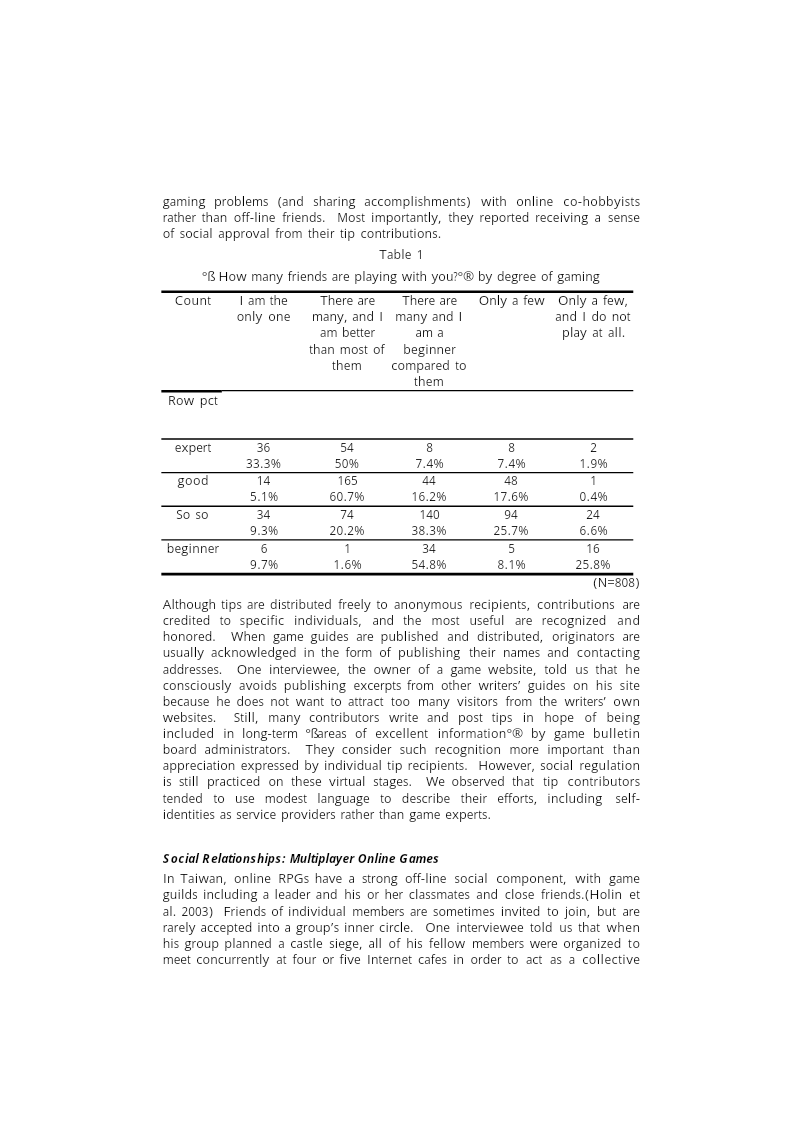
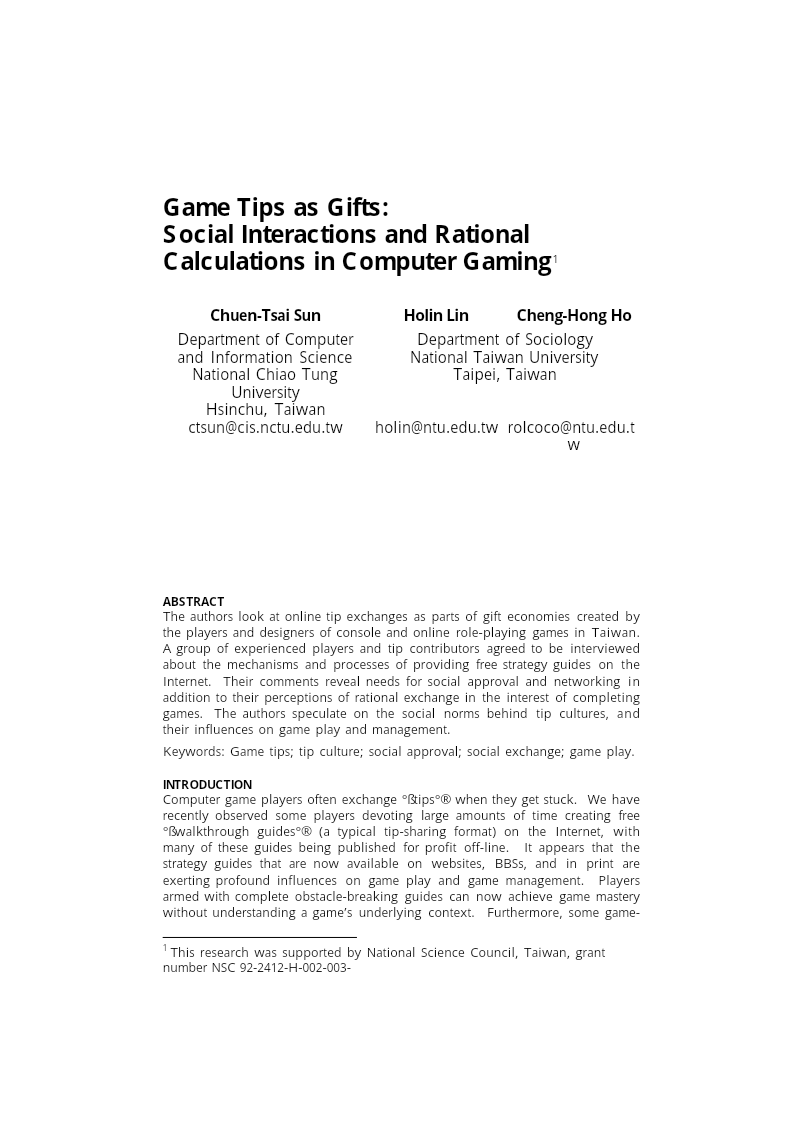
Game Tips as Gifts: Social Interactions and Rational Calculations in Computer Gaming
Game tips shared among console and online role-playing game players in Taiwan are examined here as a form of gift economy, with the study arguing that tip exchanges are driven less by pure altruism or narrow reciprocity and more by social approval, networking, and local linguistic and social contexts.
- Game tip sharing among Taiwanese console and online RPG players is better explained by social approval, networking, and local linguistic contexts than by pure altruism or narrow reciprocity, based on 15 interviews, an 861-respondent online survey, and bulletin board observation.
- Tip contributors are classified into four categories: complete walkthroughs, need-based answers, secret treasure maps, and drama-play translation guides.
- Role-playing games are the dominant genre, named as the favorite format by 67.6% of survey respondents.
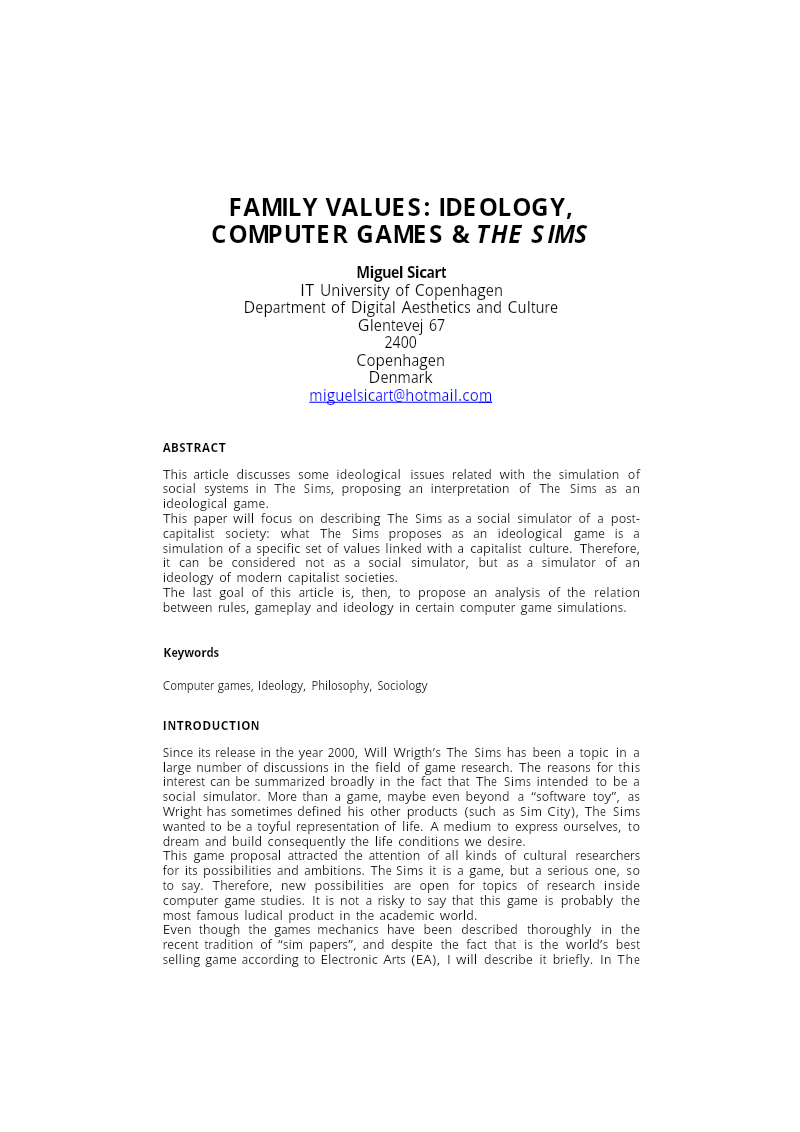
Family Values: Ideology, Computer Games & The Sims
Miguel Sicart's "Family Values: Ideology, Computer Games & The Sims" contends that The Sims, despite marketing itself as a neutral social simulator, embodies an ideology specific to modern capitalist societies.
- Sicart argues that The Sims, though marketed as a neutral social simulator, encodes an ideology specific to modern capitalist societies, embedded in its economic mechanics and social structures rather than its surface content.
- Drawing on Althusser's theory of Ideological State Apparatuses, Jameson's account of late capitalism, and Taylor's ethics of daily life, the paper frames the game's rules as encoding assumptions about what counts as a successful life and a legitimate society.
- The central conclusion is that ideology resides primarily in structural rules and gameplay, which position the player as a subject within an ideological discourse, leading Sicart to propose the category of "ideological games."
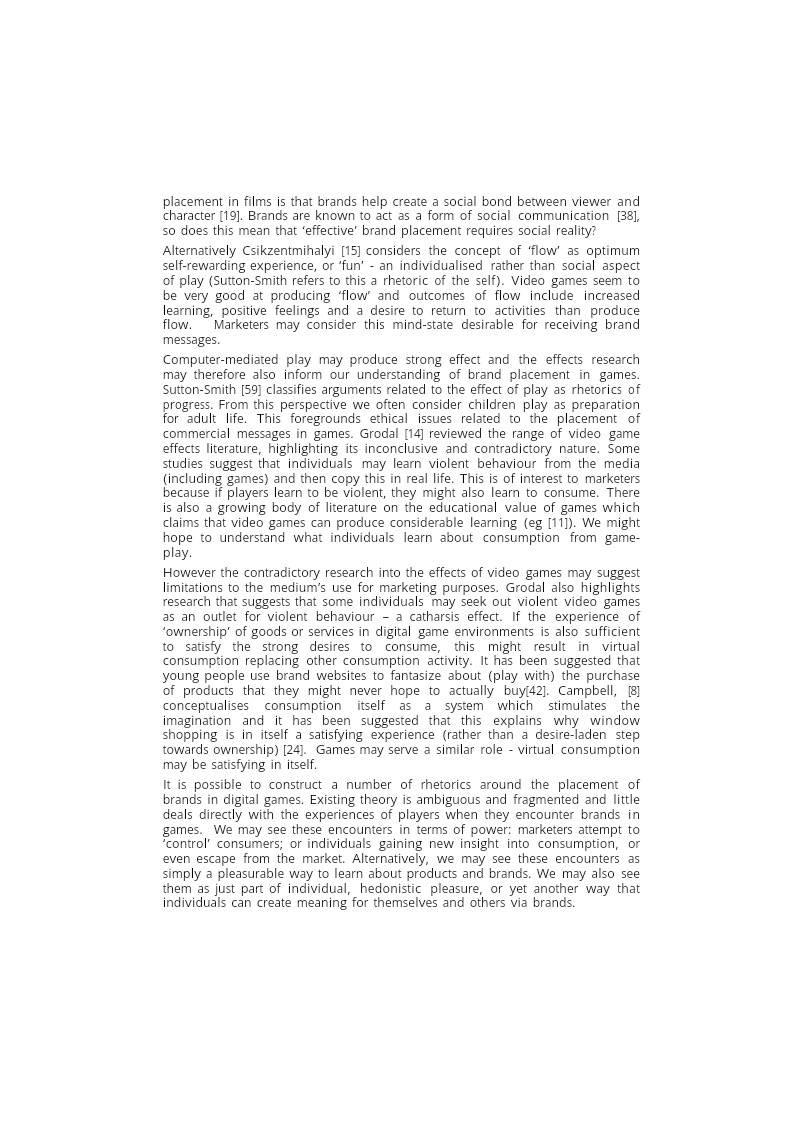
Encounters With Consumption During Computer-Mediated Play: The Development of Digital Games as Marketing Communication Media
This paper examines digital games as marketing media by considering both the consumer-culture context of play and the psychological processes that shape how players respond to in-game brands.
- Exploratory focus groups with 24 experienced video game players across four sessions found that players generally view in-game brand placement as a source of realism and as a way to fund lower-priced games.
- Players also voiced concern that brand placement can be invasive and that advertising revenue could distort game design.
- Brand placement is presented as potentially effective: it can strengthen brand recall, and players may show shifts in attitude or purchase intention.
WADs, Bots and Mods: Multiplayer FPS Games as Co-creative Media
Sue Morris's paper examines multiplayer first-person shooter (FPS) games such as Quake, Half-Life, and Counter-Strike as "co-creative media," arguing that these games are not produced solely by developers or solely by players, but through the combined input of both.
- The paper argues that multiplayer FPS games such as Quake, Half-Life and Counter-Strike are 'co-creative media,' shaped jointly by developers and players rather than by either alone, extending beyond the participatory-media framing common in fan studies.
- Wolfenstein 3-D (1992) and Doom (1993) set the foundation for the genre, and Doom's source-code release and multiplayer capabilities enabled a durable mod scene.
- Player contributions materially influenced development: early public betas and leaked alphas produced bug reports and patches, volunteer-built anti-cheat tool PunkBuster was later adopted by publishers, and mod authors behind ThreeWave CTF and Counter-Strike were hired or commercially acquired.

The Game, the Player, the World: Looking for a Heart of Gameness
Jesper Juul's "classic game model" offers the foundation for this inquiry into what games fundamentally are.
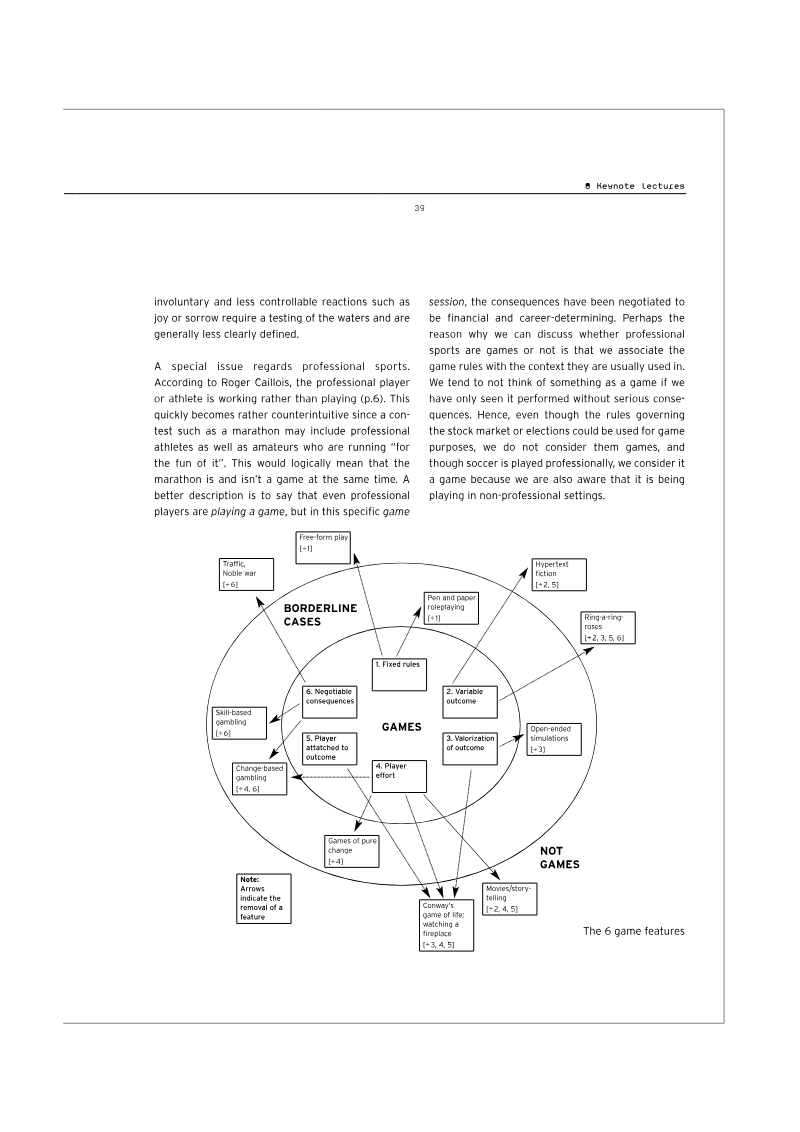
- Juul's classic game model defines a game as any activity carrying six formal features: fixed rules, variable and quantifiable outcomes, valorized outcomes, player effort, player attachment to the outcome, and negotiable real-world consequences.
- Games are best understood as a transmedial family rather than a single medium, with board games, card games, sports, and digital systems all sharing the same core features.
- The unifying element across game media is computation: rules must be upheld by some process, whether performed by humans, computers, or physical laws.