1 free read left. Create a free account for unlimited reading + AI research.
Create free accountWhitepaper DiGRA
1 free read left. Create a free account for unlimited reading + AI research.
Create free accountWhitepaperDiGRA

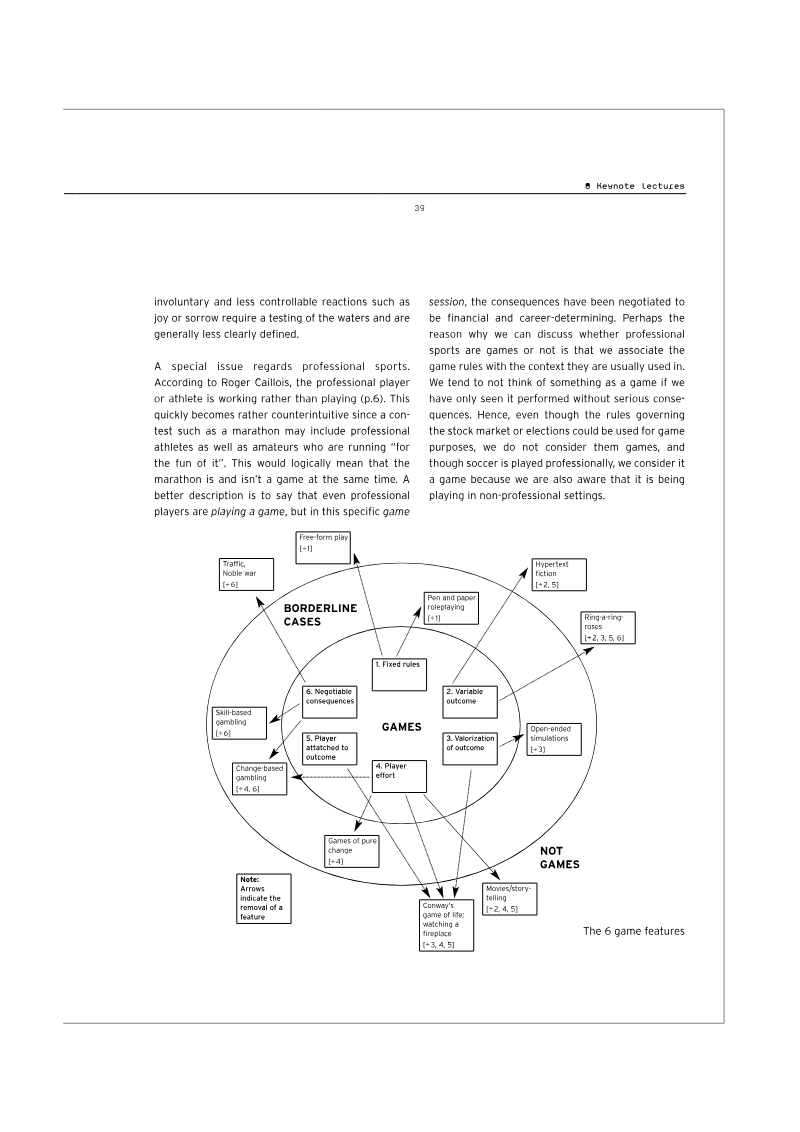

Those features are the foundation for asking what games fundamentally are.
Jesper Juul's "classic game model" offers the foundation for this inquiry into what games fundamentally are. The analysis holds that games are defined by six formal features: fixed rules, variable and quantifiable outcomes, valorized outcomes, player effort, player attachment to the outcome, and negotiable real-world consequences. A game is whatever carries all six. Rather than constituting a single medium, games form a transmedial family whose members share these features across board games, card games, sports, and digital systems. The argument rests on a review of prior scholarly definitions from figures such as Huizinga, Caillois, Suits, and Salen and Zimmerman, many of which prove reducible to shared concepts like rules, goals, and conflict.
The central claim is that games are rule-based systems that players engage with in the real world, and that the unifying element across media is computation. Rules must be upheld by some computational process, whether performed by humans, computers, or physical laws. Games therefore travel between media with varying fidelity: a card game maps almost one-to-one onto a computer, while sports adaptations involve highly selective simplification. A three-part framework of computation, game state, and interface clarifies where each element resides across media, and a comparative table shows how computer games shift rule enforcement onto the machine, broadening the design space available to designers.
The boundaries of the category receive careful attention. Borderline cases such as role-playing games, open-ended simulations, traffic, and war are assessed against the six features, while non-games like free-form play, hypertext, films, and Conway's Game of Life are shown to lack one or more of them. The analysis also emphasizes that the line between games and everyday life is fuzzy and negotiable, as illustrated by chess played by mail, gambling, and live-action role-playing.
The scope is broad, spanning millennia of game history from ancient play to contemporary digital games, and encompassing traditional, sports, and computer game media. The author's conclusion is that the affinity between computers and games arises from their shared dependence on well-defined rules that can be computationally processed, which positions digital games as the latest development in a long lineage rather than a categorical departure.

DiGRA · 2023

DiGRA · 2023

DiGRA · 2023
DiGRA · 2023
DiGRA · 2023
DiGRA · 2023
DiGRA · 2023
DiGRA · 2023
DiGRA · 2023

DiGRA · 2023
DiGRA · 2023

DiGRA · 2023












Comments