
DiGRA
The Digital Games Research Association: the international association of academics and professionals who study digital games. Its Digital Library holds the proceedings of the DiGRA conferences since 2002.
Documents

Enchanting Reality: A Vision of Big Experiences on Small Platforms
Martin Ericsson's paper argues that mobile gaming has so far largely cloned or ported existing console and desktop titles, leaving the distinctive capabilities of handheld devices (mobility, GPS, and communications) underused.
- The paper argues mobile gaming has largely cloned or ported console and desktop titles, leaving handheld capabilities such as mobility, GPS, and communications underused.
- Its central thesis is that compelling physical-world games create immersion through "diegetic consistency," where the fictional world aligns with the player's sensory reality.
- The authors propose "enchanted reality" games, in which real-world actions meaningfully alter the virtual world rather than merely triggering isolated events.

It's No Videogame: News Commentary and the Second Gulf War
Mia Consalvo's study examines how U.S. news media and commentators deployed "videogame" as a dismissive descriptor during coverage of the Second Gulf War, drawing on a sample of 75 stories from March and April 2003.
- Consalvo's study analysed 75 U.S. news stories from March and April 2003 to see how the term "videogame" was used in coverage of the Second Gulf War.
- The dominant usage was pejorative: critics called the war coverage fake, trivial, or unreal, arguing the conflict lacked the real human suffering that would make it serious.
- A second strand described the war as "just like a videogame" because of its hi-tech sophistication, revealing both generational unease and fascination with military technology.

Power Gamers Just Want to Have Fun?: Instrumental Play in a MMOG
T.L. Taylor's paper, "Power Gamers Just Want to Have Fun?: Instrumental Play in a MMOG," challenges the popular image of the power gamer as an isolated cheater or a joyless grinder.
- Power gaming in EverQuest is a rigorous, efficiency-driven style of play, marked by dynamic goal-setting, long sessions of repetitive grinding, treating failure as a learning opportunity, and transferring game knowledge across titles, and Taylor argues it deserves recognition as legitimate play rather than dismissal as a corruption of fun.
- Power gaming is profoundly social rather than solitary: players rely on practices like 2-boxing and 3-boxing, community tools such as ShowEQ and strategy websites, and friendship networks and "uber" guilds to access high-end content like epic items and difficult raid encounters.
- Reputation systems and collaboration shape what it means to be a power gamer, so efficiency is achieved through collective effort as much as individual skill.

The Playability of Texts vs. the Readability of Games: Towards a Holistic Theory of Fictionality
Julian Kücklich's paper argues that games and literary texts are both best understood as fictional worlds that require active, playful participation from the reader or player, and that literary theory can therefore contribute substantially to game studies beyond narratological analysis.
- Kücklich argues that games and literary texts are both fictional worlds requiring active playful participation, and that literary theory can contribute to game studies well beyond narratological analysis.
- Drawing on Wolfgang Iser's concept of the Textspiel, the paper frames fiction-making as a triadic process linking the real, the fictive, and the imaginary, with play as the mediating force.
- To give the concept rigor, Kücklich proposes a six-world model adapted from Marie-Laure Ryan's possible worlds theory, distinguishing the reader's actual and possible worlds, the narrator's actual world, and the textual actual and reference worlds.

Exploring Clan Culture: Social Enclaves and Cooperation in Online Games
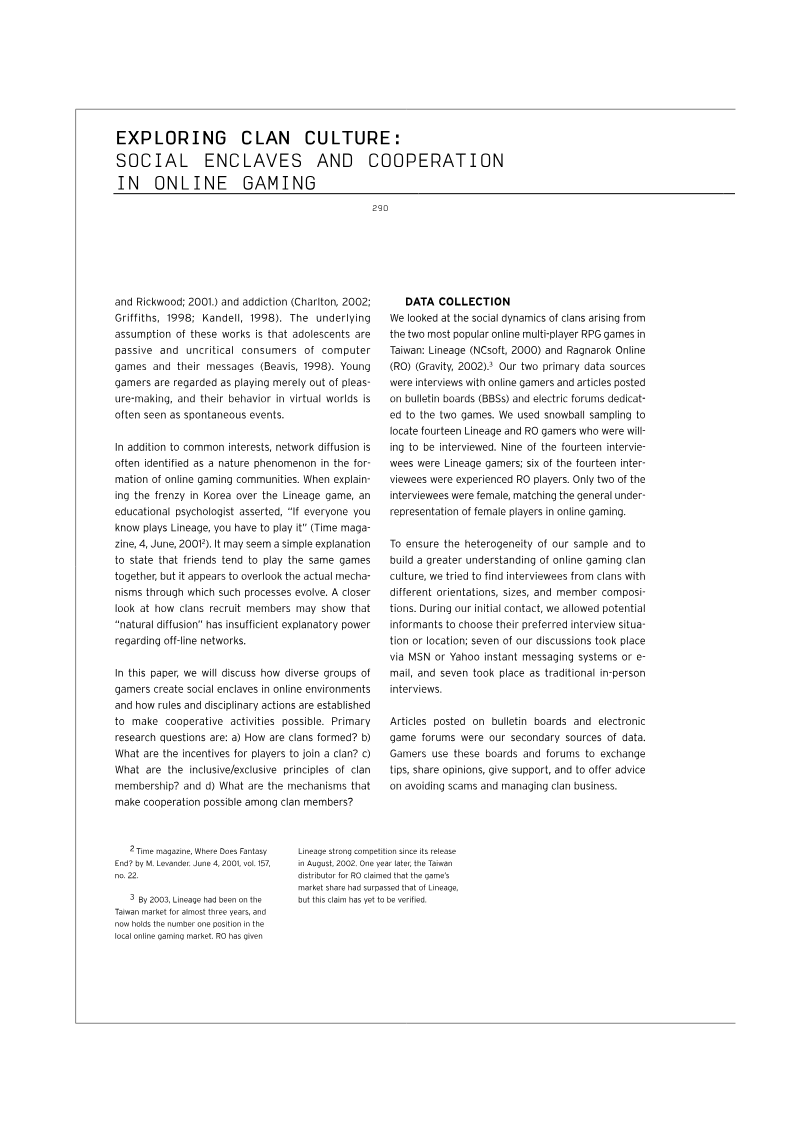
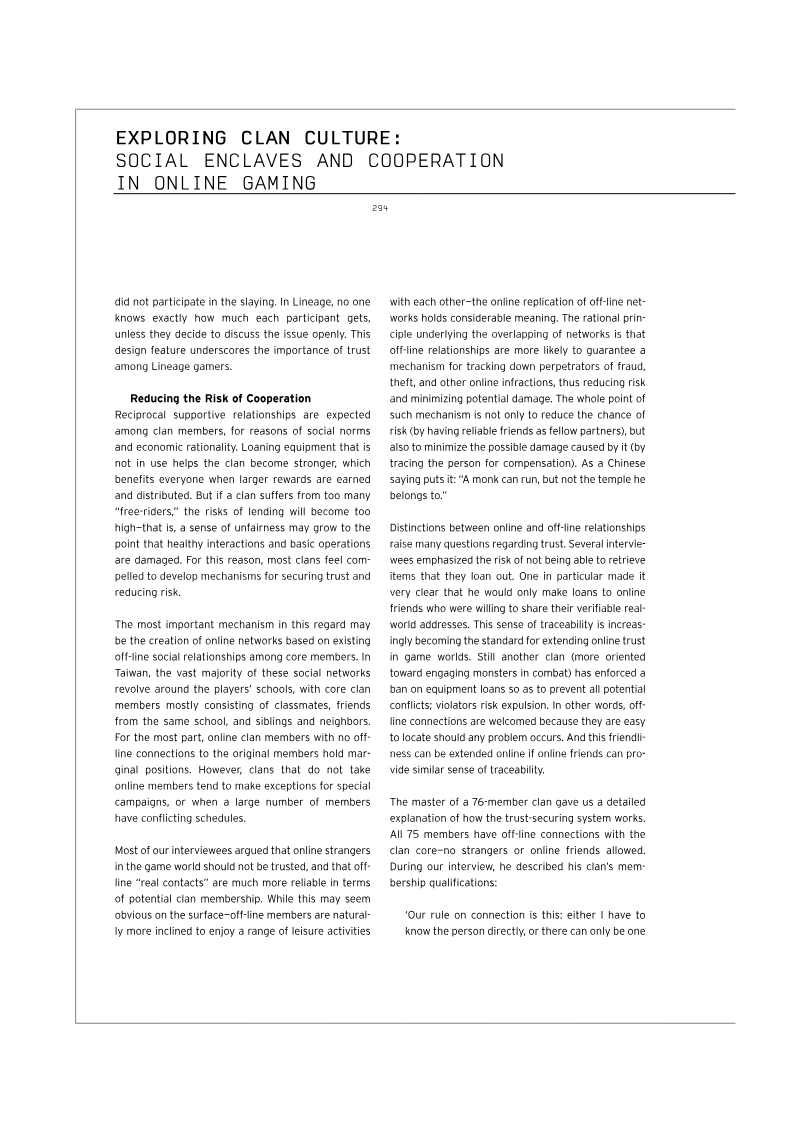
Clan culture in massively multiplayer online role-playing games (MMORPGs) is shown to be a rational, adaptive response to the competitive and interdependent design of these virtual worlds.
- Clan membership in MMORPGs is a rational, adaptive response to competitive and interdependent game design, since progression and survival depend on group action.
- In a survey of 493 Lineage players, only 5.7% had never belonged to a clan, and interviews with 14 snowball-sampled participants indicated clans offer protection against fraud, bullying, and theft.
- Clans form most readily among off-line acquaintances, because existing social ties reduce the uncertainty of cooperating with strangers.


On the Border: Pleasure of Exploration and Colonial Mastery in Civilization III Play the World
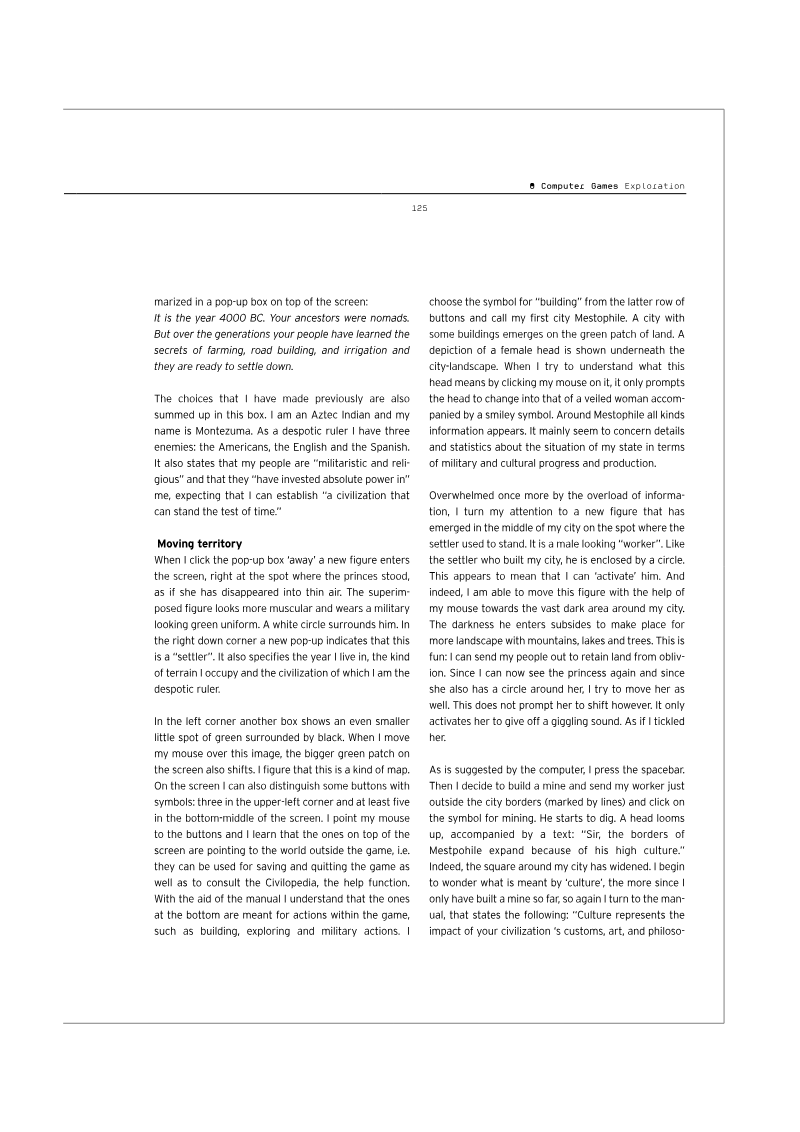
Sybille Lammes's analysis of Civilization III: Play the World argues that the game presents exploration and expansion as a colonialist progression, moving from "nature" toward a Western, white, male-centred "civilization."
- Sybille Lammes argues that Civilization III: Play the World frames exploration and expansion as a colonialist progression from "nature" toward a Western, white, male-centred "civilization," drawing on postcolonial and science studies.
- The analysis reads the game's intro cinematics (such as the Tower of Babel imagery) and setup options, including the framing of "Barbarians" as nature-bound and non-Western cultures as rivals, as naturalising links between expansionism, science, masculinity, and whiteness.
- The core claim is that the game's border expansion mirrors European colonial attitudes, with colonies serving as resource extraction zones for the homeland and "othered" peoples and territories subject to control.
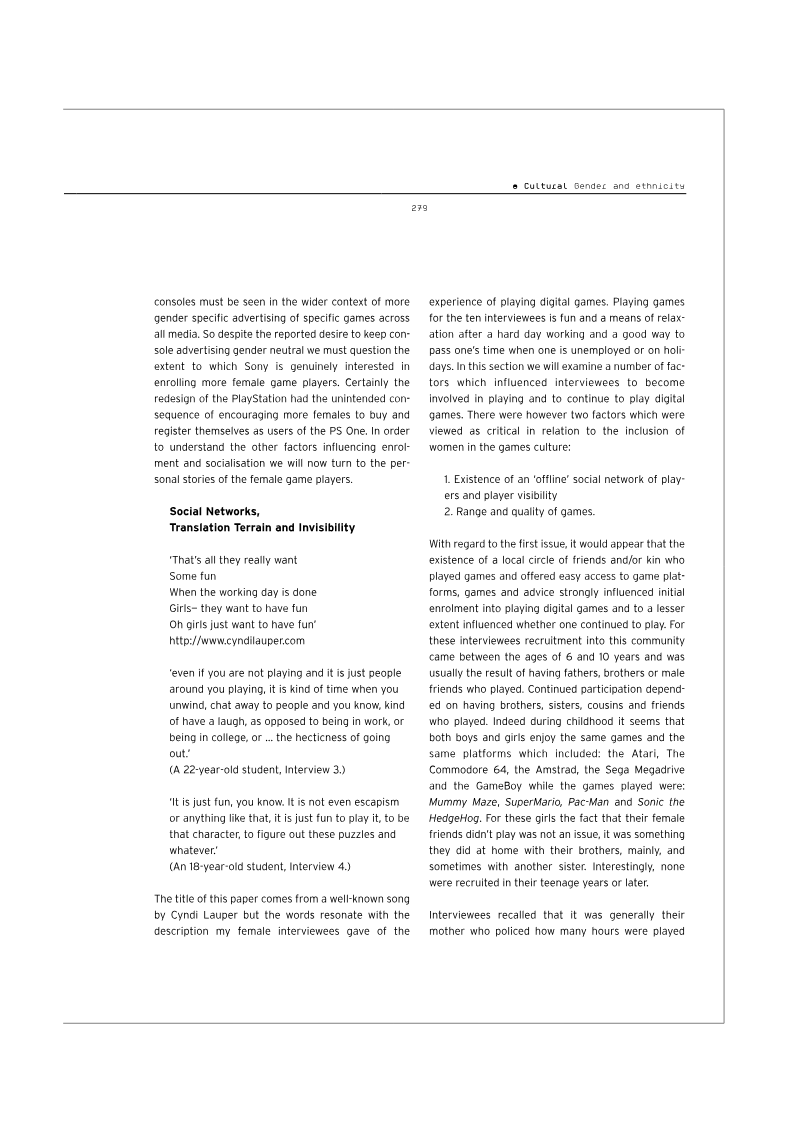

Women Just Want to Have Fun: A Study of Adult Female Players of Digital Games
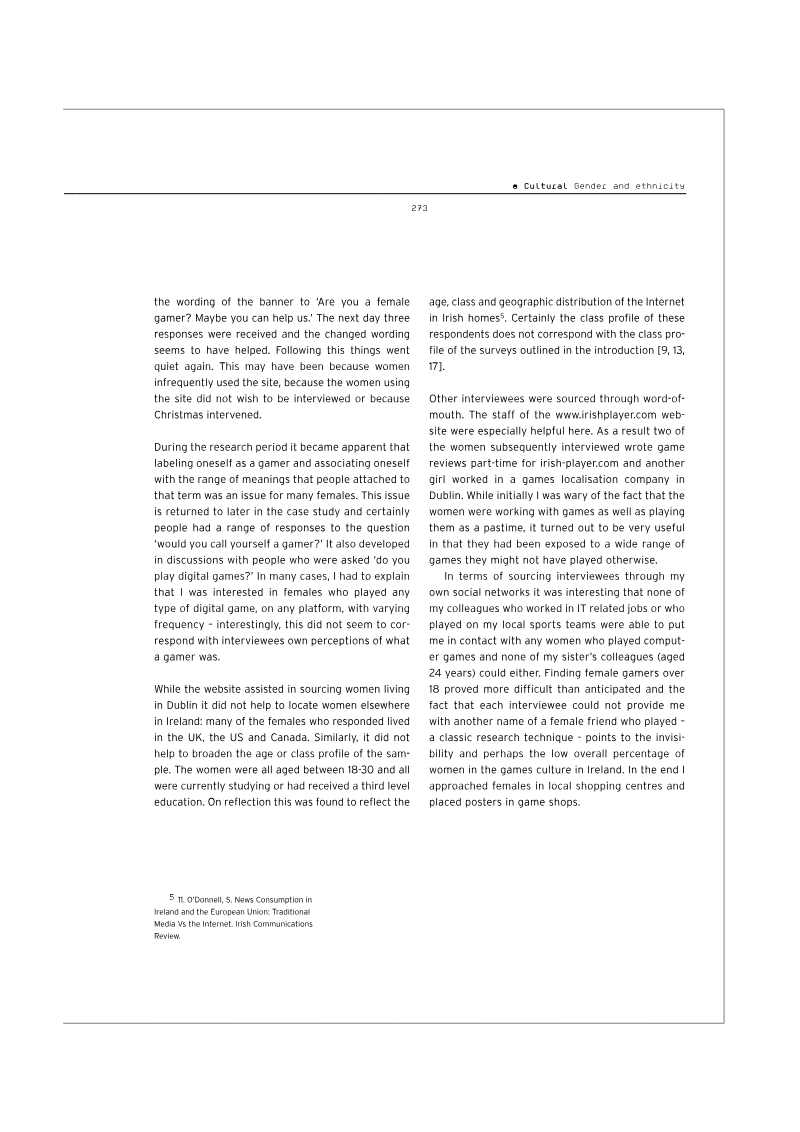
Aphra Kerr's study examines how adult women in Ireland come to play digital games and sustain that play despite a gaming culture that has long been framed as male.
- Social networks, rather than individual initiative alone, are the main force shaping how adult women first enter digital gaming and how they keep playing, with early exposure through brothers, fathers, or friends and access to shared or borrowed consoles as the principal routes in.
- Despite Sony's marketing and redesign claims of gender neutrality, female ownership of the PlayStation 2 reached only 6.7 percent of registered PAL-territory owners, compared with 11.1 percent in Japan.
- The study attributes the PlayStation 2's limited female uptake to a continued focus on hardcore male gamers, price sensitivity among women, and manufacturers' reliance on registered-user data that cannot capture people playing on borrowed hardware.
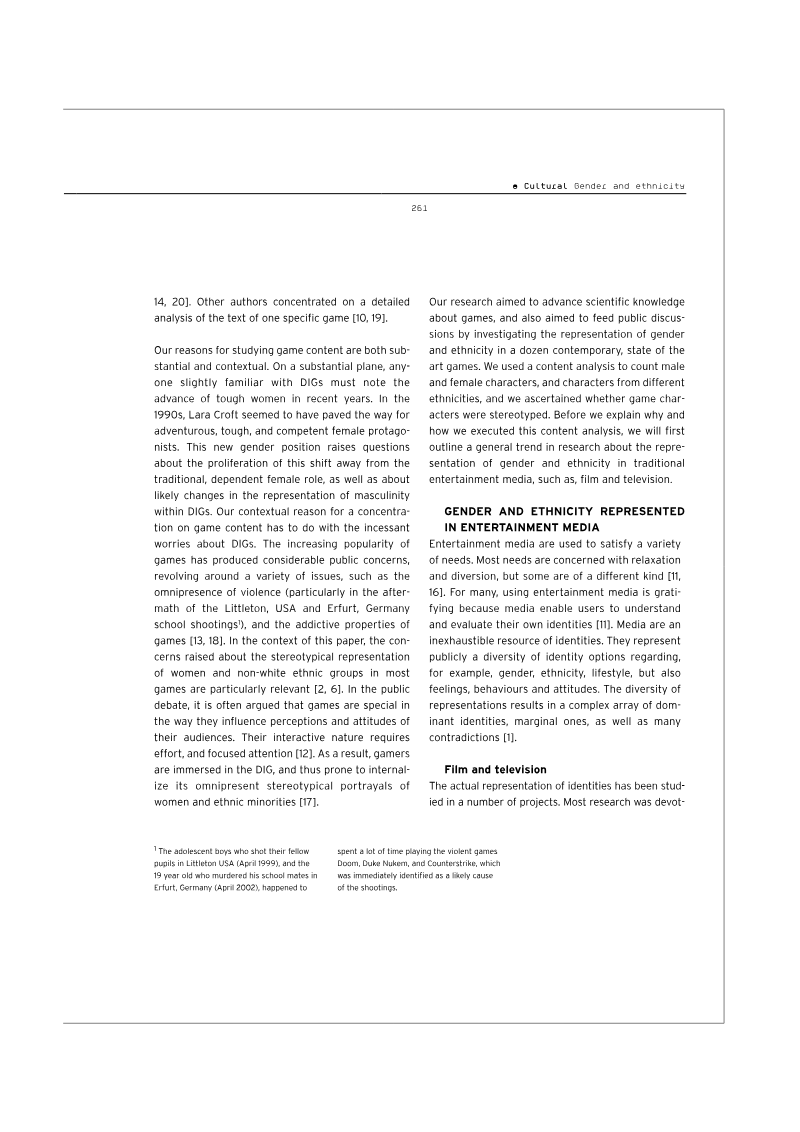

Representation of Gender and Ethnicity in Digital Interactive Games
This content analysis by Jansz and Martis examines how gender and ethnicity are portrayed in digital interactive games, an area the authors describe as understudied relative to film and television.
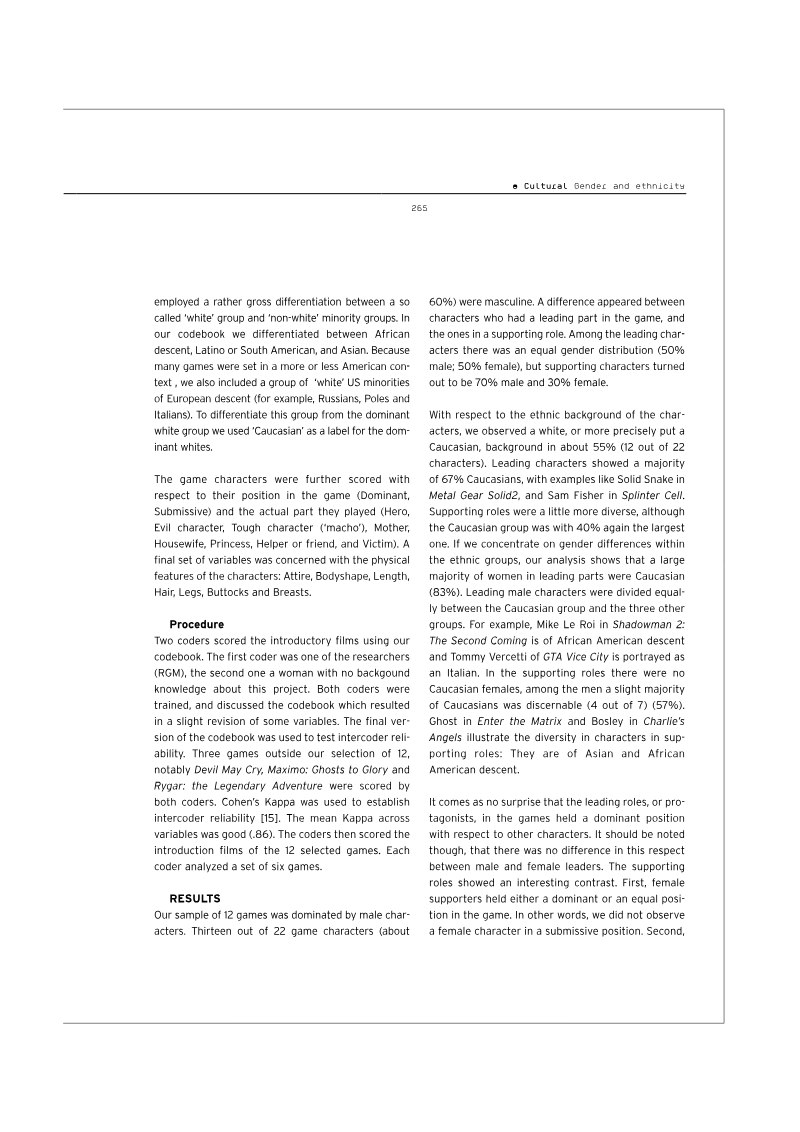
- Male characters still outnumbered females in the analyzed games, 13 of 22 characters, yet leading roles were evenly split between men and women, a shift from earlier research that found men dominating games with women in minor stereotypical roles.
- Female supporting characters were never shown in submissive positions, a notable departure from prior studies of game representation.
- Most characters were Caucasian (about 55 percent overall), and leading characters were predominantly white, indicating ethnic representation remained narrow.
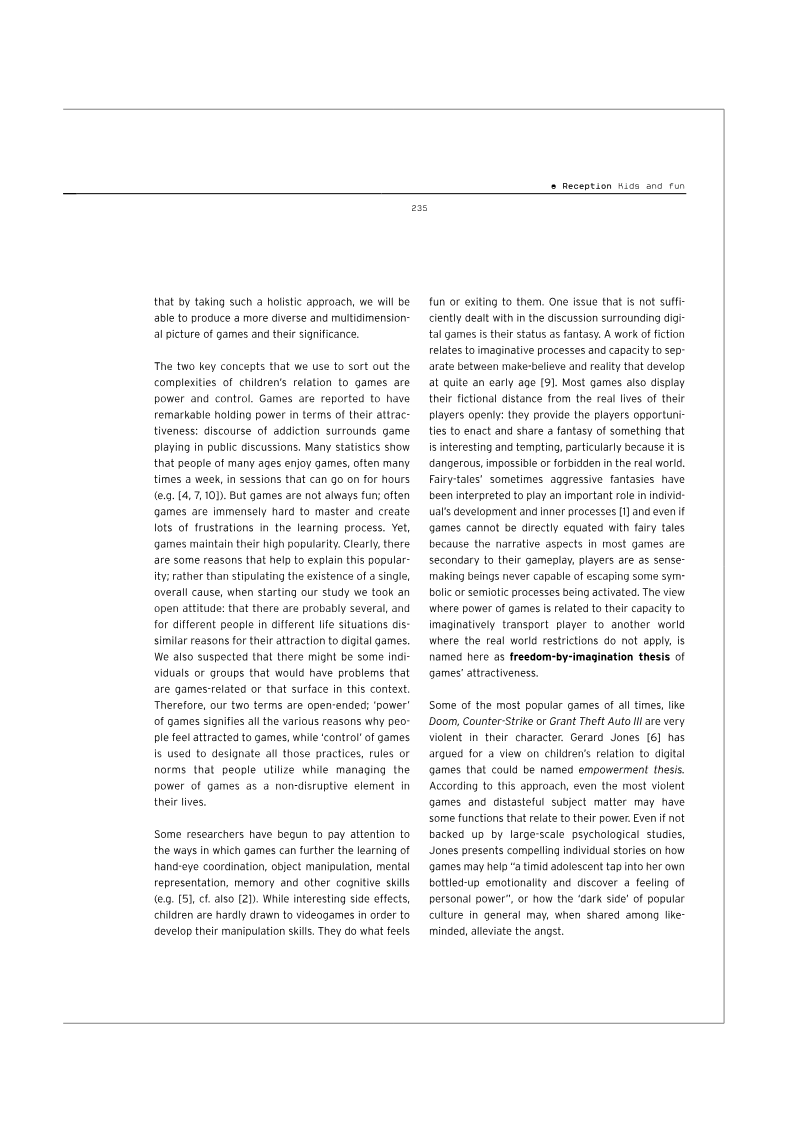

Power and Control of Games: Children as the Actors of Game Cultures
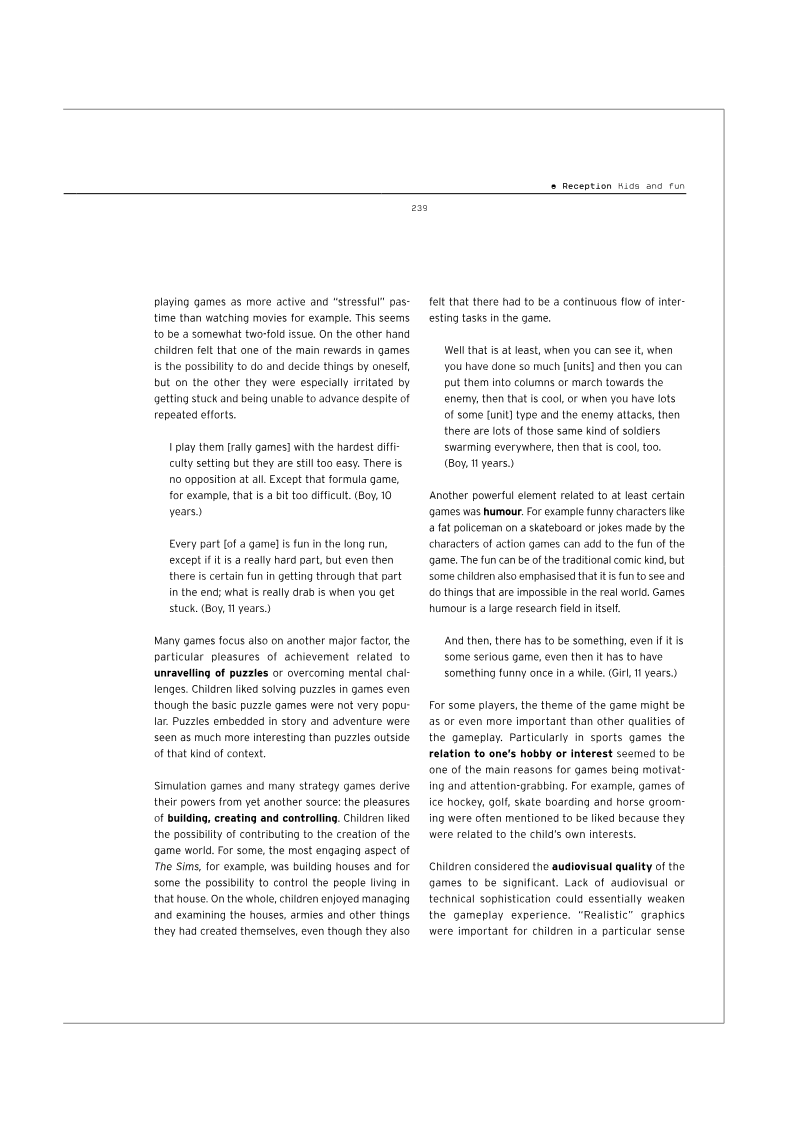
Ermi and Mäyrä's study examines the appeal and regulation of digital games among 10- to 12-year-old children in Finland, with research conducted in 2003.
- Children aged 10 to 12 in Finland are portrayed as active, articulate participants in game culture rather than passive or vulnerable consumers, according to a 2003 study drawing on a survey of 284 children and parents plus fifteen family interviews.
- Imaginary worlds are the most compelling draw of digital games because they make experiences possible that would otherwise be out of reach, with novelty, adventure, persistence, a balance of challenge, and humour as other major sources of engagement.
- Game appeal stems from several interacting qualities, including fun, puzzle-solving, achievement, building and controlling fictional worlds, and audiovisual quality, and interest often links to children's existing hobbies, showing games are woven into broader leisure and creative lives.

Supporting Visual Elements of Non-Verbal Communication in Computer Game Avatars
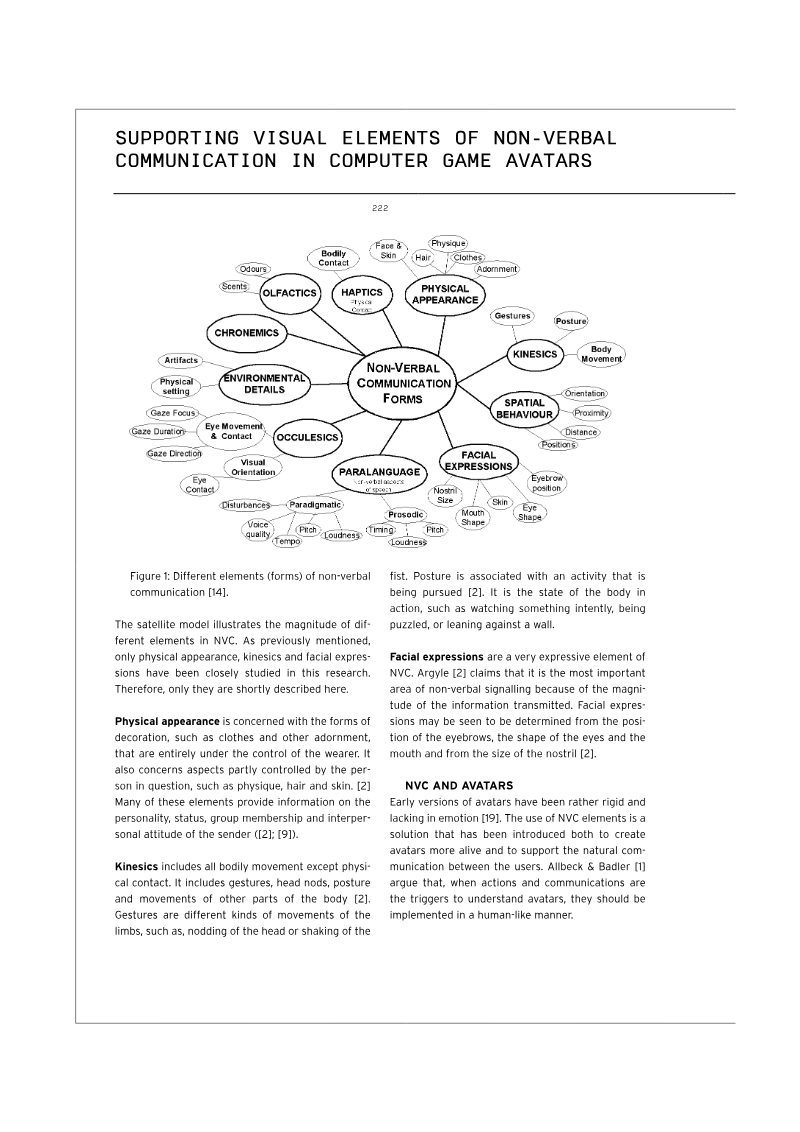
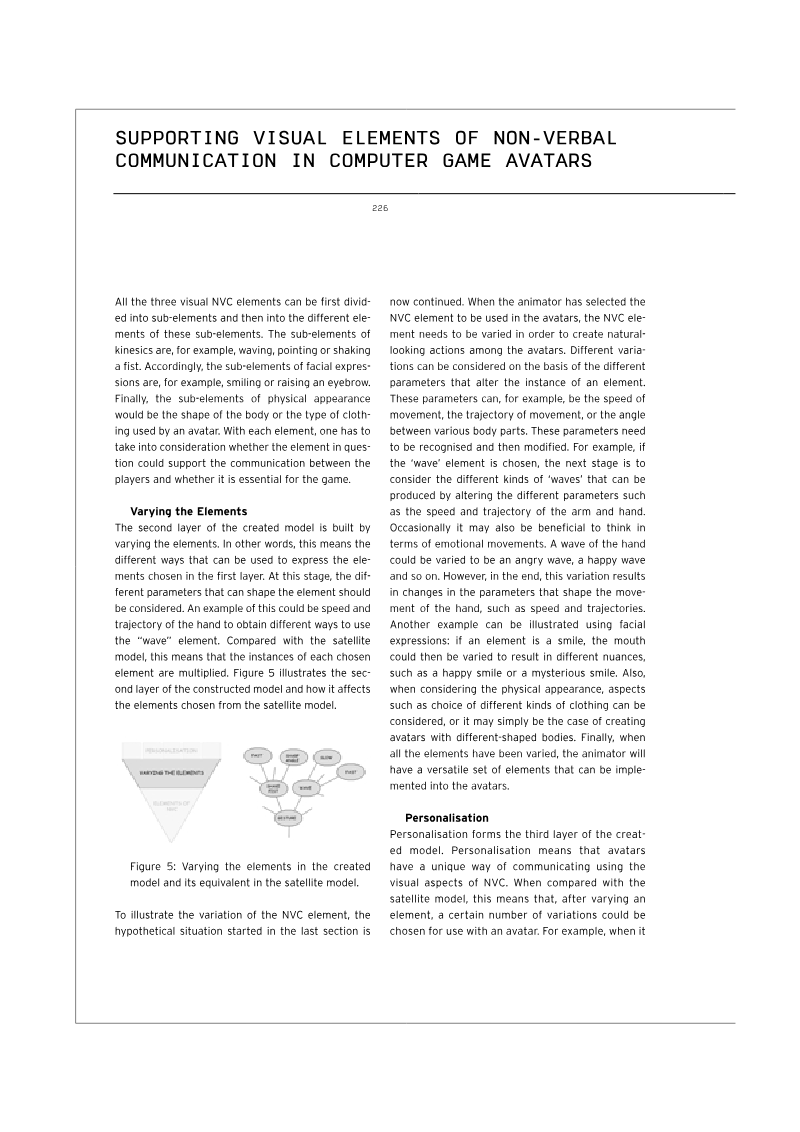
This paper presents a three-layer model for systematically designing the visual elements of non-verbal communication (NVC) in avatars for multiplayer computer games.
- The paper proposes a three-layer model for designing visual non-verbal communication in multiplayer game avatars, guiding designers to select NVC elements, vary them through parameters such as movement speed and trajectory, and personalise avatars so each has a distinguishable communicative identity.
- The study covers physical appearance, kinesics (bodily movement and gesture), and facial expressions, while eye movement and gaze were excluded due to limitations in the experimental technology.
- Adding NVC elements increased players' opportunities to convey and receive messages, varying them enabled richer and subtler expression, and personalisation made avatars more recognisable and prevented identical actions from appearing across different avatars.

Enhancing Gameplay: Challenges for Artificial Intelligence in Digital Games
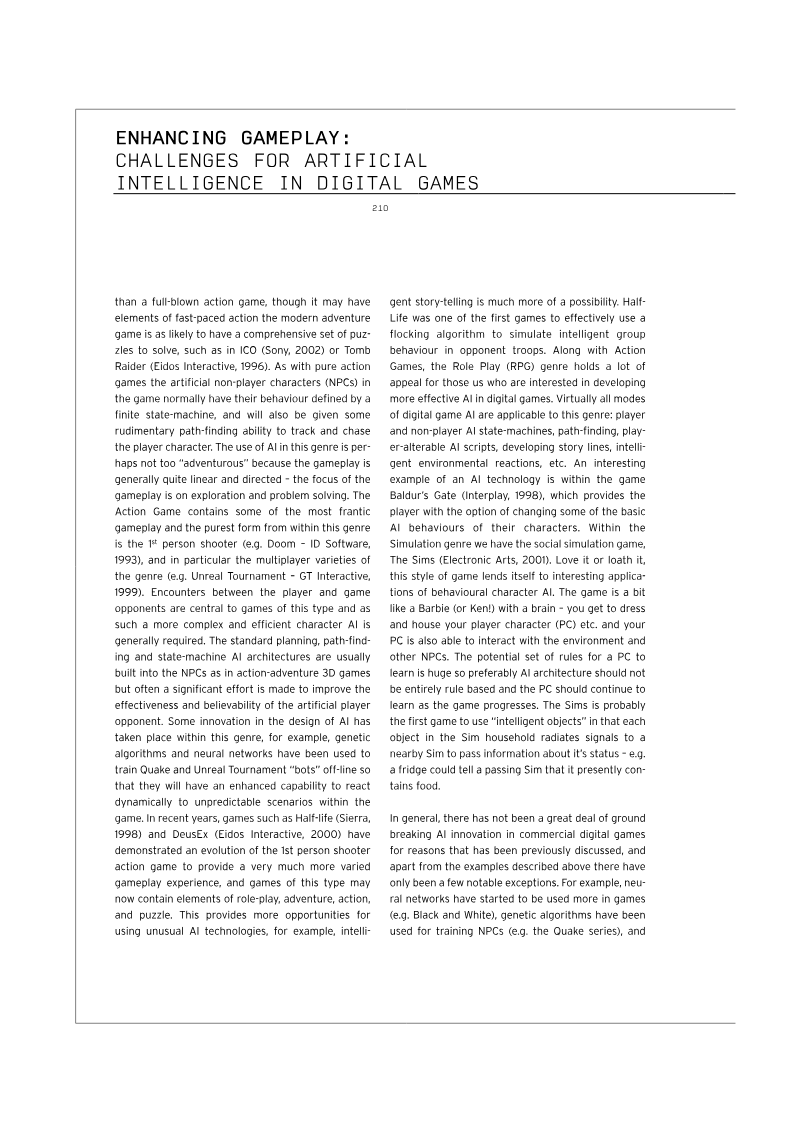
Darryl Charles's paper argues that rapid growth in computing power gives game designers a timely opportunity to pursue radical advances in artificial intelligence rather than incremental refinements.
- The paper argues that rapid growth in computing power gives game designers a timely opportunity to pursue radical AI advances rather than incremental refinements, and that AI innovation is essential to avoid industry stagnation and establish games as a serious artistic medium.
- Current titles still rely largely on established techniques such as finite-state machines, A pathfinding, and scripting, with designers prioritizing the appearance of intelligence over realistic behavioral models.
- The paper identifies three priority areas for innovation: storytelling (especially player-driven narratives in MMORPGs), dynamic online learning (illustrated by the rare example of Black & White), and emotional expression, where real-time character animation lags well behind pre-rendered film.

A Joint Study of Super Monkey Ball: Keep the Monkey Rolling: Eye-Hand Coordination in Super Monkey Ball
This pilot study, part of a larger joint examination of Super Monkey Ball conducted by researchers at the Center for Computer Games Research at the IT University of Copenhagen, investigates whether eye-hand coordination is linked to computer game skill and whether avid gamers possess superior eye-hand coordination.
- The study is an exploratory pilot from the Center for Computer Games Research at the IT University of Copenhagen, examining whether eye-hand coordination relates to computer game skill and whether avid gamers have superior coordination.
- The research found no reliable link: the data did not substantiate a connection between computer game skill and eye-hand coordination, though the author noted the claim cannot be dismissed outright.
- The empirical component was very small, involving seven boys aged 10 to 13 from an urban after-school centre in Copenhagen, tested with the Test of Visual-Motor Skills before or after a Super Monkey Ball play session.