
DiGRA
The Digital Games Research Association: the international association of academics and professionals who study digital games. Its Digital Library holds the proceedings of the DiGRA conferences since 2002.
Documents


Computer Games and Violence: Is There Really a Connection?
This study examines whether violent video games are uniquely associated with violent behaviour among adolescents, drawing on a representative sample of 9,887 Norwegian youth aged 13 to 18 surveyed in 2002 through the Young in Norway study.
- The bivariate correlation between violent video games and violent behaviour among 9,887 Norwegian youth aged 13 to 18 (r ≈ .22–.23) drops substantially once gender is added, to about .15 for first-person shooters and .18 for action games.
- In multivariate models controlling for age and gender, the association between first-person shooters and violent behaviour largely disappears, except among 8th graders, while action games remain a significant predictor across all age groups.
- All game variables together explained only about 4 to 9 percent of the variance in violent behaviour, with the largest shares found in the oldest age groups.


Wargaming and Computer Games: Fun with the Future
Patrick Crogan's essay traces the history of wargaming to argue that modern computer games carry forward a distinctive relationship to the future, one rooted in the Enlightenment project of rational prediction and control.
- Patrick Crogan argues that modern computer games extend a relationship to the future rooted in the Enlightenment project of rational prediction and control, with the core activity being modelling and simulation.
- Narrative and cultural 'texture' are treated as marginal in games because the central pleasure lies in modelling complex systems, a claim that positions the essay within the ludological tradition while challenging its positivist tendencies.
- Wargaming is traced from Helwig's 1780 squared-board game through Reisswitz's 1824 Kriegsspiel, which impressed the Prussian military and was adopted into officer training, and on through postwar American military and research simulation.


Player Character Design Facilitating Emotional Depth in MMORPGs
This work proposes that massively multiplayer online role-playing games can achieve deeper emotional immersion by giving player characters a "virtual mind," a prosthetic consciousness that moves beyond the combat statistics and generic classes that dominate the genre.
- The report argues that individually authored MMORPG characters cannot scale to thousands of players, so emotional depth must come from a generative system rather than hand-crafted content.
- It proposes a "virtual mind" for player characters, replacing conventional numerical levelling with "being-values" organized around a Mind System, Story Daemons, and a Metaphysics System, developed within the Purgatory Engine and Ouroboros project at the Interactive Institute's Zero Game Studio.
- The mind model layers a two-dimensional affect framework (emotion, mood, sentiment, personality) over a Five Factor trait structure and Maslow's being-values, modeling Ekman's eleven emotions plus "pain".

Computer Games and the Complexity of Experience
This paper by Chiel Kattenbelt and Joost Raessens argues that computer games are typically analyzed through a sensory-motor model borrowed from classical cinema, one that privileges the actuality and causality of action and an Aristotelian, action-driven dramaturgy.
- The paper argues that computer games are typically analyzed through a sensory-motor model borrowed from classical cinema, which privileges action, causality, and an Aristotelian action-driven dramaturgy, and that this framing fails to capture the full complexity of experience both represented in games and lived by players.
- Kattenbelt and Raessens draw on Peirce's categories of firstness (feeling), secondness (action and resistance), and thirdness (reflection), and on Deleuze's movement-image, time-image, and thought-image, to build a framework for analyzing the emotional, volitional, and cognitive dimensions of play.
- The authors propose three player subject positions relative to a game's represented world: the lyric (emotional and affective), the dramatic (action-oriented and sensory-motor), and the epic (reflective and contemplative).

The Appeal of Cute Monkeys
Susana Pajares Tosca's study examines why the monkey characters of Super Monkey Ball, namely MeeMee, GonGon, Baby, and AiAi, have achieved popularity despite the game offering no story.
- The monkey characters of Super Monkey Ball (MeeMee, GonGon, Baby, and AiAi) remain popular despite the game offering no story, with their appeal grounded primarily in iconic, kitsch-tinged cuteness drawn from Japanese design traditions.
- The study places the monkeys in an "iconic" category alongside Hello Kitty, arguing that such characters succeed through a combination of cuteness and caricature rather than gameplay or narrative alone.
- The monkeys' appeal depends not only on visual design but also on gameplay and on their role as a social "mask" among players, according to the study's central conclusion.



"You Can't Help Shouting and Yelling": Fun and Social Interaction in Super Monkey Ball
This paper by Lisbeth Klastrup examines how social interaction contributes to the experience of fun in multiplayer console gaming, using Super Monkey Ball as its case study.
- Console multiplayer play happens in shared living-room settings close to other players, resembling television viewing as a domestic social activity, which encourages sociability distinct from isolated PC gaming.
- Fun in the study emerges from oscillating between mastering a game's rules and staying absorbed in its world, with games acting as "affective alliances" around shared, time-limited experiences.
- A pilot study of nine participants (aged 20 to 30) in groups of experienced players, inexperienced players, and a contrasting male group found all experienced players wanted to play again and most inexperienced players did too.

Vertigo and Verticality in Super Monkey Ball
This paper by Troels Degn Johansson examines Super Monkey Ball (SMB) through the lens of its verticality, arguing that the game's distinctive vertical design, together with the frequent experience of falling and failing, gives it an allegorical and rhetorical dimension beyond its surface as a light party game.
- The paper argues that Super Monkey Ball's vertical design and frequent falling and failing give it an allegorical and rhetorical dimension beyond its surface as a light party game.
- Its cute monkey imagery, caricatured infantile behavior, and playful treatment of physical insufficiency invite a lighter mode of play that appeals to both non-gamers and hardcore players.
- The analysis rests mainly on the author's own play experience and an informal empirical study of test players, supplemented by one observation from a related study in the same collection, so the evidence base is modest.

Play in Cultural Environments
"Play in Cultural Environments" examines games that deliberately erode the "magic circle," the conceptual frame separating play from everyday life.
- The report argues that boundary-blurring games erode the "magic circle" separating play from everyday life, raising fundamental questions about games' artificiality and their relationship to lived reality.
- Games that mix freely with players' surroundings can generate forms of play more culturally relevant than those confined within traditional boundaries.
- Microsoft's web-based alternate reality game A.I.: Artificial Intelligence distributed puzzles across fan sites, used weekly episodic updates, and incorporated real-world rallies.
Approaches to Computer Game Design: Characters and Conflict
This paper examines how computer games generate action, arguing that action is the defining feature of games from the player's perspective and that it can be created and directed through well-defined characters with conflicting needs and motivations.
- Action is presented as the defining feature of games from the player's perspective, and it can be created and directed through well-defined characters with conflicting needs and motivations.
- Players perceive a game as logically coherent only when character motivations are consistent with the game's structure; the design of characters, expectations, and space must work together to guide meaningful engagement.
- Player expectations shape interpretation and behavior, including an assumed 'expectation of gaming' that a game should be interesting, challenging, and actionable, plus expectations driven by genre and intermediality.
I Have No Words & I Must Design: Toward a Critical Vocabulary for Games
Greg Costikyan's essay makes the case that game design needs a precise critical vocabulary, arguing that the term "gameplay" is too vague to guide analysis or practice.
- Game design needs a precise critical vocabulary, since the vague term "gameplay" fails to guide either analysis or practice; the essay proposes organizing discussion around interaction, decision-making, and goals.
- Interaction becomes purposeful only when organized around goals, and games are distinguished from static puzzles and non-game systems by internal meaning that arises from their own structure rather than the real world.
- Games are defined by struggle rather than competition, since obstacles can take many forms (opposing players, computer opponents, puzzles, social or environmental barriers), and a game lacking meaningful struggle becomes dull.
Introduction: All Your Base Are Belong to Us
This introduction to the Computer Games and Digital Cultures (CGDC) conference proceedings, written by Frans Mäyrä of the University of Tampere, argues that digital games have moved from marginal enclaves into a mainstream cultural form worth serious scholarly attention.
- Digital games are cited as a twenty-billion-dollar worldwide industry, a scale that the author uses to argue they have moved from marginal enclaves into a mainstream cultural form deserving serious scholarly attention.
- The author points to the spread of multiplayer networking, mobile gaming, and augmented-reality concepts as evidence of games' expanding reach, while noting that games are becoming more ambitious artistically yet retain a counter-cultural, "low culture" character.
- Game studies is presented as a young, interdisciplinary field still defining its identity, with growing university programs in games technology and research cited as a sign of its maturation.
iDTV Gamers: The Emergence of a New Community?
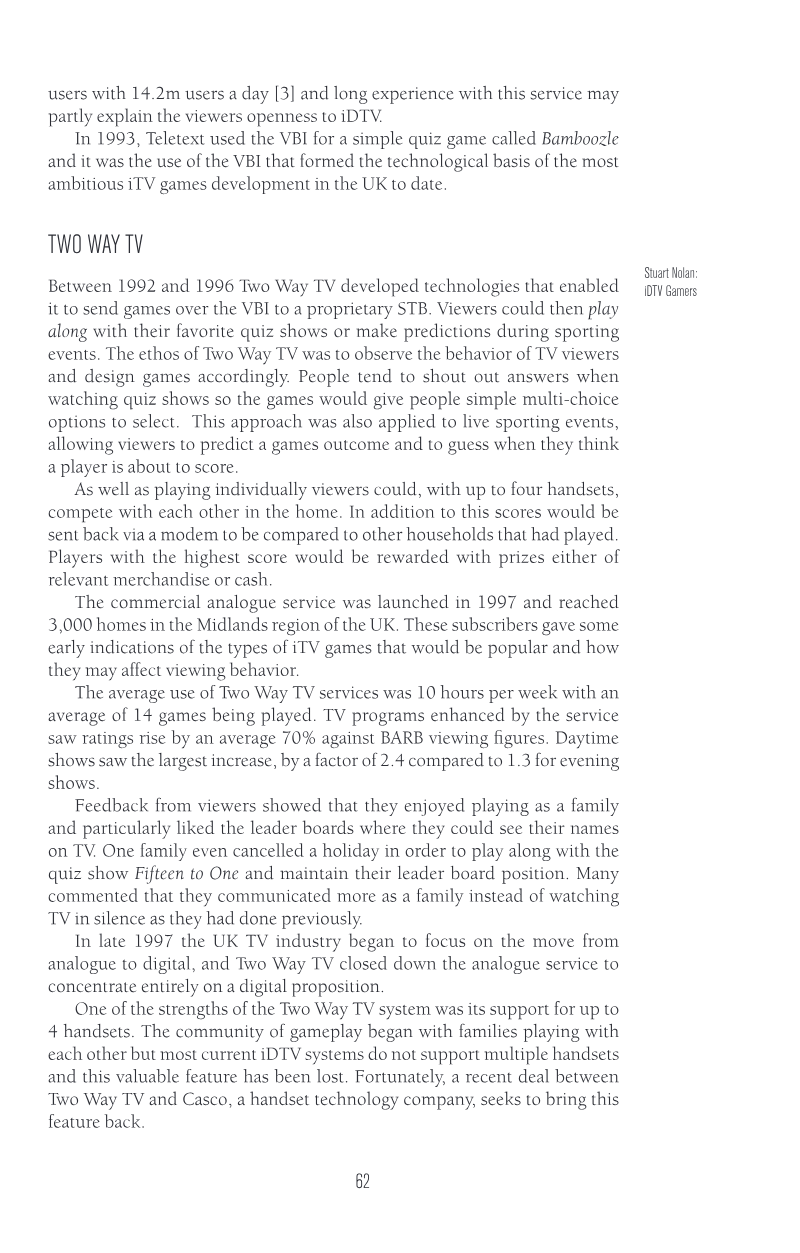
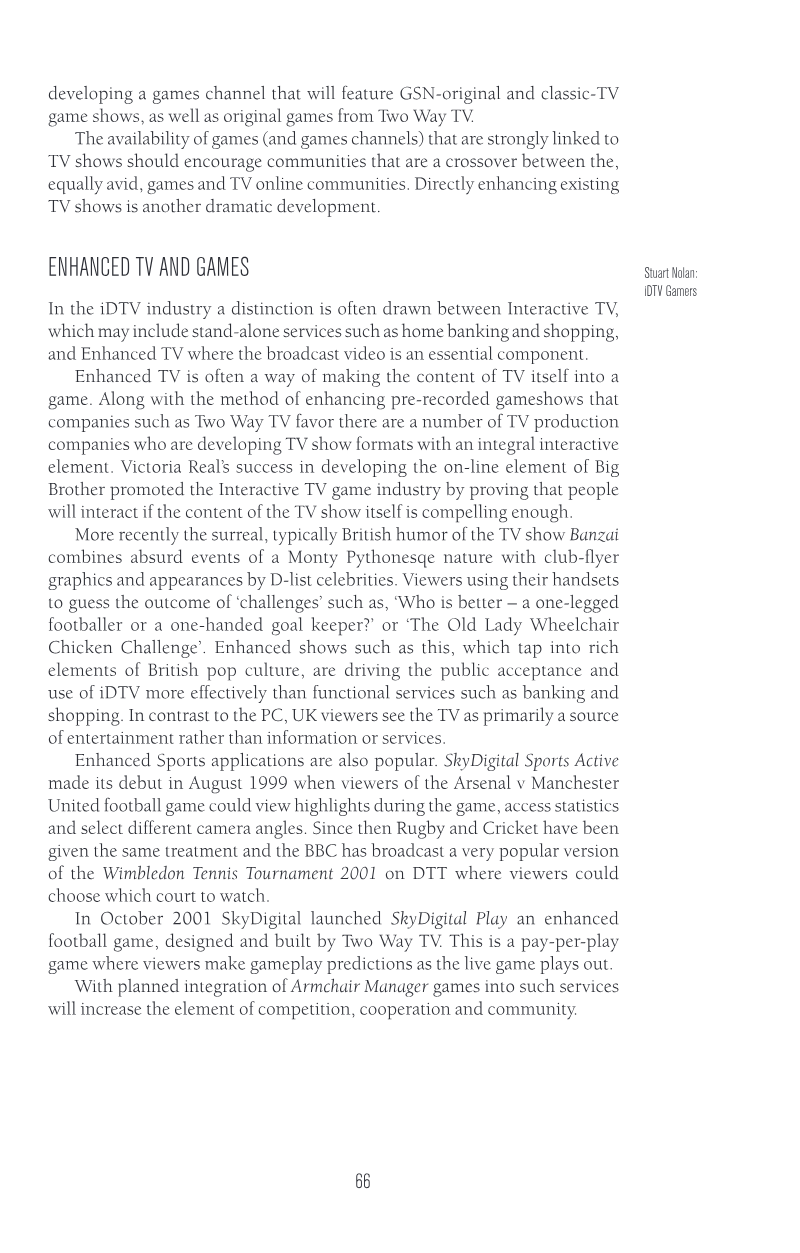
Interactive digital television (iDTV) gaming in the United Kingdom is examined as the emergence of a distinct and growing viewer community, one that departs from the traditional image of the PC or console gamer.
- Roughly 40% of UK homes now have interactive digital television (iDTV), and 44% of digital consumers play games on it, with NTL's games channel drawing older, family-oriented, and lower socio-economic audiences.
- iDTV gaming is characterised by short "dipping" sessions alongside television viewing and a preference for simple, family-friendly titles, making it an extension of household TV habits rather than a dedicated pastime.
- A Netpoll study of 50 homes identified three iDTV player types: Generation I teens, Early Clickers, and Daytime Dabblers.