1 free read left. Create a free account for unlimited reading + AI research.
Create free accountWhitepaper DiGRA
1 free read left. Create a free account for unlimited reading + AI research.
Create free accountWhitepaperDiGRA
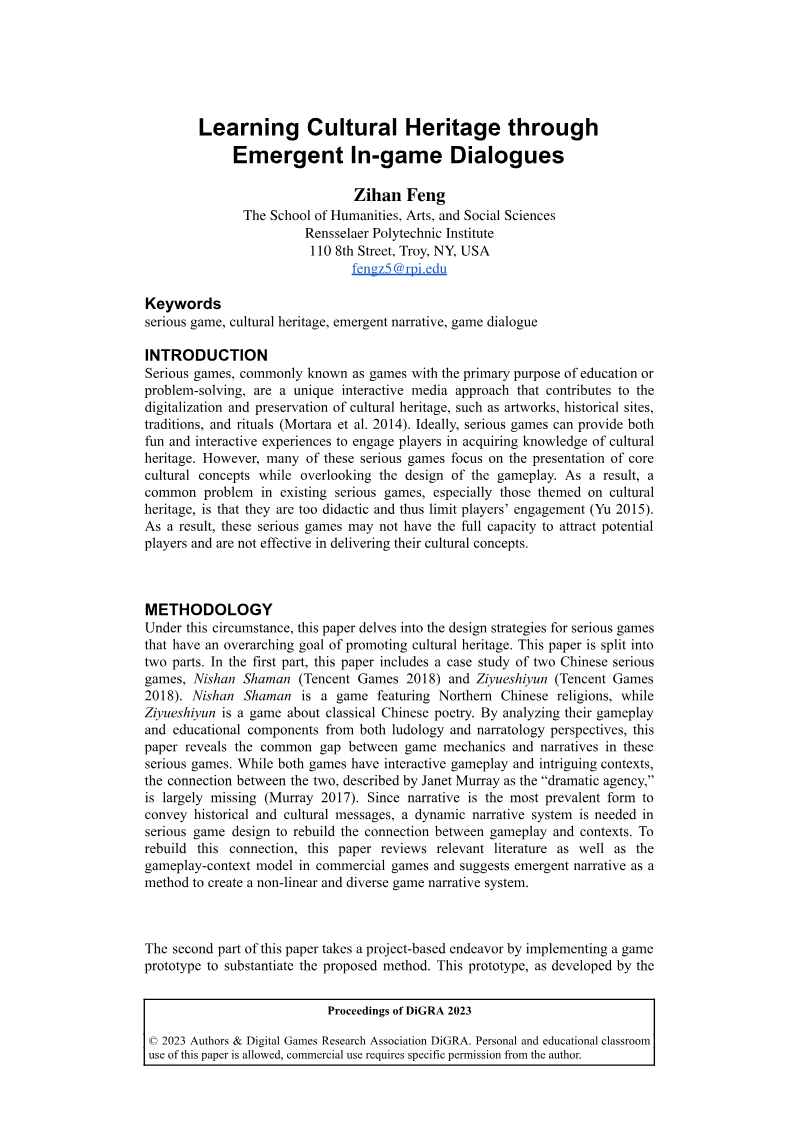
Kücklich argues that both games and literary texts require active, playful participation from the reader or player. He also argues literary theory can contribute to game studies well beyond narratological analysis.
Julian Kücklich's paper argues that games and literary texts are both best understood as fictional worlds that require active, playful participation from the reader or player, and that literary theory can therefore contribute substantially to game studies beyond narratological analysis. Drawing on Wolfgang Iser's concept of the Textspiel, Kücklich frames fiction-making as a triadic process linking the real, the fictive, and the imaginary, with play as the mediating force. He illustrates this with Half-Life, showing how its realistic setting and fictional alien intrusion exemplify the selection and imaginative construction Iser describes. The paper treats the interaction between player and game as a form of reciprocal contingency, comparable to the mutual dependence Iser identifies in reading.
To give the concept analytical rigor, Kücklich proposes a six-world model, adapted from Marie-Laure Ryan's possible worlds theory, distinguishing the reader's actual and possible worlds, the narrator's actual world, and the textual actual and reference worlds. Playing is described through three interlocking semiotic operations (intratextual, intertextual, and transtextual semiosis), which correspond to Iser's fictive, imaginary, and real. Within this framework, Kücklich outlines rules of fiction-making such as internal consistency, consistent interaction, and reliable narration, illustrated with examples from Lucky Wander Boy, ICO, and counterfactual and historiographic metafiction.
The paper is a theoretical essay rather than an empirical study, so it presents no survey data, sample, or quantitative findings. Its scope is conceptual and draws on examples from a small set of digital games and novels, with the stated aim of developing a holistic theory of fictionality applicable beyond games to film, media, and other disciplines. Kücklich acknowledges that the model is incomplete and that its rules are themselves open to revision.
Each row is a game or company this document names, each column a document, oldest first. A mark means that document names it. Select a row to see those documents.
DiGRA · 2023
DiGRA · 2023
DiGRA · 2023
DiGRA · 2023
DiGRA · 2023
DiGRA · 2023
DiGRA · 2023
DiGRA · 2023
DiGRA · 2023
DiGRA · 2023
DiGRA · 2023
DiGRA · 2023
DiGRA · 2023